Showing posts with label 15mm World War Two Figures. Show all posts

Saturday, July 18, 2026

Getting Pushy - New WW2 Land Combat Rules From 4P Press

Hello friends:

I'll start with a disclaimer that what follows attempts to be an objective review of new WW2 rules, though the rules are also written by a dear friend of mine, so take what follows with however many grains of salt you require.  

If you ever explored Wargames Vault (WV), you know that there is a vast universe of resources there - rules, scenario books, STL files, paper models, anything that can be sold and delivered via download.  I suppose that most things offered on WV are like those self-published e-books that people sell through websites like AmazonAnd I suppose that many wargamers have the itch to write their own rules because aren't we are all sometimes dissatisfied with aspects of published rules for our favourite periods and we feel that our ideas are truer to how we imagine, say, a hoplite battle unfolding.   I've never tried to write and sell my own rules, but I know people who have and I respect them.

I've read that a few people get rich selling their own e-books online, but I don't think anyone's gotten rich off WV.  However, it is a niche market and a source of revenue for some.   4P Press is one of the most prolific WV publishers that I'm aware of, and the genius behind it is Patricia Phillips, who describes herself as "an autistic history fanatic".  I know her well enough to say that this self-description is only partially tongue in cheek.   Patricia's knowledge and interests are vast and her pen (well, keyboard) is seldom still.   4P's rule offerings on WV are many - WW1 flying, early 20th century race car driving, ironclad naval combat - and she also has a goodly number of STL files done with the help of her talented friend Chris Ferree.  Patricia would be the first to say that 4P is a labor of love and not a business, but I don't think she minds whatever sales come her way.

When Patricia offered me the chance to look at Push; A Game of Ground Combat 1930-45, her new WW2 rules (though as the title says they do work for the interwar period as well), I was curious and thought it was a chance to break out my neglected collection of 15mm toys.  The rules offer an interesting take on morale (called Stance) which is as important as firepower.  As the introduction states, "The philosophy behind Push is that combat comes down to two things: the side that pushes forward and the other side's efforts to push back".   This philosophy is behind the fire mechanics, of which I'll say a bit shortly.

Push is a company level game, so an infantry company will have three stands of infantry, an HQ stand, and maybe support weapons.  Troops have the usual ratings (Elite, Veteran, Trained, Poor) but these only matter for morale tests.   The most important thing about your troops in battle is their Stance (or combat effectiveness), which ranges from Pressing (gung-ho), to Steady, to Cautious, to Pinned, to Broken.   A stand that is Steady has a better chance of working under fire, moves faster, and shoots better than a stand that is Cautious or Pinned.

I'll try to explain these and other concepts as I walk through a little game that I set up to test drive the rules.   

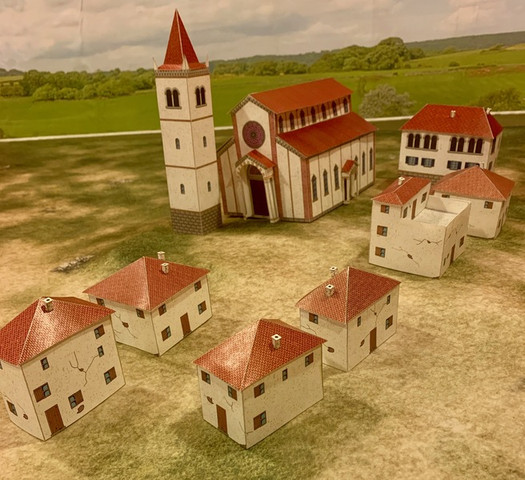
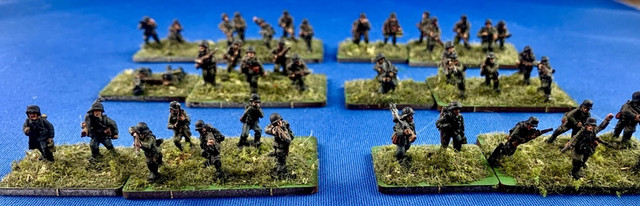
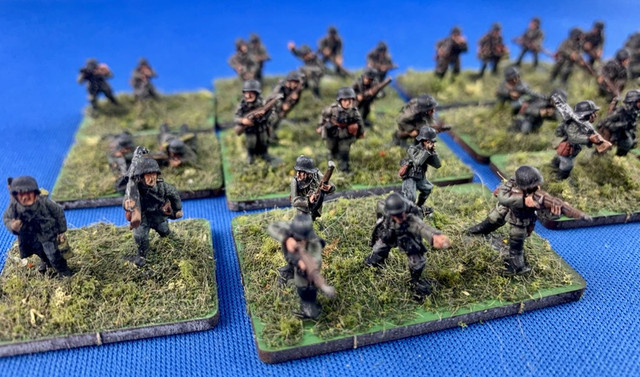
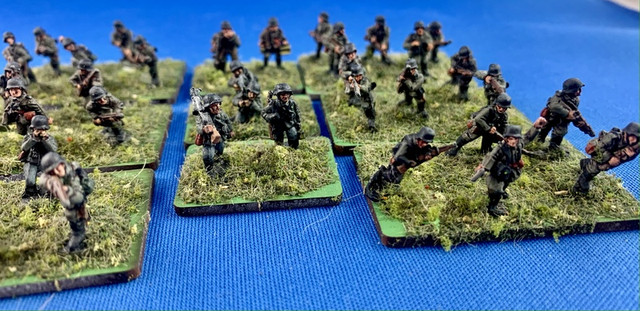
Here two Canadian companies are attacking a village at a crossroads.  Each company has an attached 2 inch mortar section, and one has an attached HMG section.  The Canadians get a divisional (medium) artillery barrage once at the start of the game.  The German company has a light mortar and an MG42 section in support.


Canadian attackers.


German defenders.

Combat in Push is an expression of what the rules call Pressure (attack) against Resistance (defence).   If the Pressure dice exceeds the Resistance score, then the target decreases its stance.  For Indirect Fire (artillery and such), as well as Reaction (basically Opportunity Fire) only the attacker gets to throw Pressure dice and see if the score for each dice is greater than the target's Resistance (determined by it's stance) modified by cover.  In this case, the medium artillery get 4 Pressure dice against each stand or base within a 4" barrage area.  The German defenders in the initial barrage are all Steady so their resistance is a four, increased by +1 if dug in or +2 if in hard cover (the ruined village buildings).   


Initial barrage results.  Dug in German squad on the left goes from Steady to Cautious.   Squad in hard cover on the right takes three hits (three sixes on the Pressure dice roll!) and groes from Steady to Broken.

The barrage does some damage.   Now on to the first turn and the first phase is the Command phase, when you can call in offboard artillery and, more importantly, use your Gumption tokens.  Gumption is an interesting and important idea in Push.  Each side gets one token per company (maybe more depending on circumstances).   A Gumption token allows you to do various things, like automatically rally a stand and improve it's stance, combine the fire of two stands, and motivate one stand to do something heroic (the game calls this stance Pressing or Carrying the Push).  More about that below.

The next phase is Movement  which is done on an IGOUGO basis, one side moving all their units, and then the other moving.   Units that move in LOS of an enemy unit can be fired on at the time of moving  (same principle as described above, Pressure dice vs Resistance rating).   My Canadians advance and take some fire, one stand going Cautious (red token).     Units that use Reaction Fire can move in their turn, but can't participate in Combat unless it's a close assault so, if you want to shoot and you're on the defence, you have to decide, do I use Reaction Fire or wait until the Combat phase when all the enemy's moves are complete?

The Combat phase combines shooting and hand to hand assaults.  If a moving unit contacts an enemy stand, then assault is immediate.  Otherwise, all shooting that has not happened as Reaction Fire happens now.  Here's an interesting thing about how Push imagines combat - it's often simultaneous.  Both units fire or melee at the same time.  Both roll their Pressure Dice vs the enemy's Resistance rating and vice versa.  Whichever side rolls more dice that equal or exceeds the other's Resistance rating than the other successfully pushes the other's Stance down one or more levels.   

Here's an example.  A Canadian stand and the German MG unit engage in combat.  The MG gets 4 pressure dice, the Canadians three because they moved half or less of their movement of 6" in the open.  The Canadians' Resistance is a 4 because their Stance is Steady and they are in the open.  The German's Resistance is 5: Steady Stance and +1 for being dug in.  The Germans roll only one dice (4) that equals or exceeds the Canadian stance, and the Canadians only roll one dice (a 5) that equals or exceeds the German stance.   The result is a tie and neither side goes down a Stance level.   Push's idea of fire combat may seem counterintuitive, as in most systems A fires at B (eg, Prep Fire in Squad Leader) and sees if it can damage B.  With Push, I imagine simultaneous exchanges of fire so in this case, the Canucks went to ground when the MG opened up and returned fire with rifles and Brens, lots of shooting, no result.   It might have gone badly for the Canucks in the open but they were lucky.


The example discussed above - a good illustration of how the Combat Phase in Push can be mutual.  The black dice are the German Pressure rolls, the red dice are the Canadian Pressure rolls.

One of the things I like about Push is that there is no casualty removal.   Everything depends on Stance and if a unit goes to Broken, it just runs away or surrenders.

Fast forward to the last few turns I had to play and a good example of the Gumption mechanic.   As my attackers get closer, I decide to use a Gumption token to give raise one stand to Pressing.   Only a Gumption token can do this and it can only be given to a Steady stand.  It gives the stand an extra pressure dice and increases its resistance to five.  Perhaps the lieutenant gave an inspiring speech or these joes just have their blood up.   

In Push there is a subset of the Movement Phase called the Initiative Phase.  This allows one stand the benefit of surprise or extreme heroism.  It can't be targetted by Reaction fire and if it engages in Combat (fire or assault) it gets its licks in first and the defender does not roll its Pressure dice in response.    A player can spend a Gumption token to give +1 to an intiative roll if the HQ of the stand that might benefit from the initiative is touching another stand of the company and within 6".  In this case, I used my second Gumption token to give the Canadians a +1 on the Initiative Roll.   Canucks win the roll, and so my Pressing stand gets the Initiative.  It runs around the corner of the stone wall and is in among the German foxholes with grenades and bayonets.  It gets an extra Pressure dice, so four dice, gets lucky rolls, and shellacks the Germans with three hits, driving them from Steady to Broken.   Kamerad!


An example of using Gumption to influence events.  The two Union Jack tokens allow the Canadian stand top centre to be Pressing and to win the intiative, thus flanking and inflicting a buttload of hurt on the German stand.  The tokens are I think from Litko.

So that was enough to give me a taste of the rules and I will definitely try them again.   One thing I haven't mentioned or yet explored is that there are also rules in Push for armour and air support, minefields, and some suggestions for solo play.    Push also comes with enough data on troops and equipment for enough nationalities to satisfy hardcore gamers.   One of Patricia's super powers is research and copious data set compilation.

Push is a first edition, so there are a few details that were unclear to me, but I got prompt answers when I asked the author.  Patricia is on Bluesky (4ppress.bsky.social) and is planning a website for questions, FAQs, and discussions on her rules.  Push offers some interesting ideas for WW2 gaming, and is currently available on WV for the princely sum of $7.70USD, which is a small amount to support an indie publisher.  Do have a look.


Tuesday, April 13, 2021

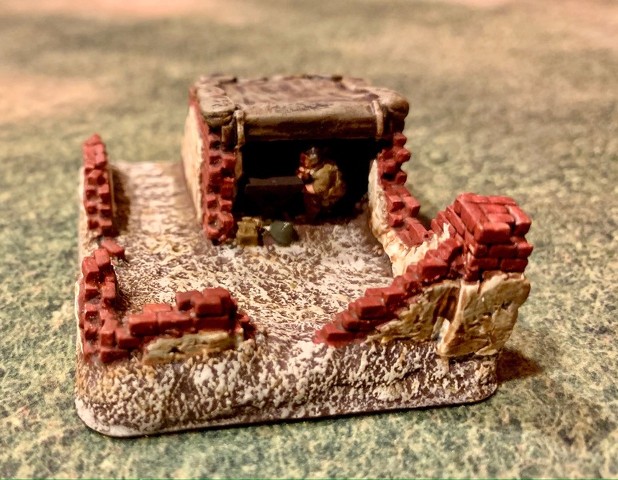
Terrain Tuesday: Battlefront 15mm Command Post

It’s always a struggle for me to allot my painting time to figures vice terrain, but as my friend Mr Hot Lead (formerly the artist known as Rabbit Man) likes to say, any time invested in making the war-games table look better is time well spent.  Thus, I’m starting a new blog feature designed to motivate me to better efforts, so every week on Tuesday I’ll post some piece of terrain that I’ve either finished or am working on, and you, dear readers, can help keep me accountable to this goal.  I hope you’re ok with this weighty responsibility I’ve dumped on your shoulders.

To start this feature, here’s a resin command post from Battlefront that was included in a British WW2 mid-war rifle company set, back when BF made metal figures.   Since the new TFL/Reisswitz Press rules O-Group place a large emphasis on command and control at the battalion level, it seemed worth moving this piece into the painting queue. 

Not much more to say, really.  It will work for any setting in Europe, but I’ve dry-brushed the ground to suggest lots of dust, making it appropriate for my Sicily 1943 project.    I’ve pained the half-profile signaller in Vallejo British Uniform since it is supposed to be a British HQ - now I need something like this for the Germans/Italians.


Speaking of terrain, I’m still shaking my head at the quality of work displayed in this video from @Joe_Wargamer, it’s stunning and clever.    I may try something like it the next time I buy some MDF buildings.

Blessings to your tabletops!

MP+


Friday, April 9, 2021

In Praise of Paper (Terrain) 2 - Basing the Buildings

Hello again friends:

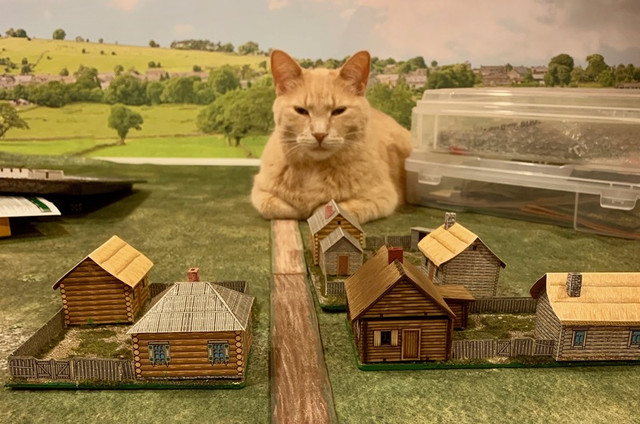
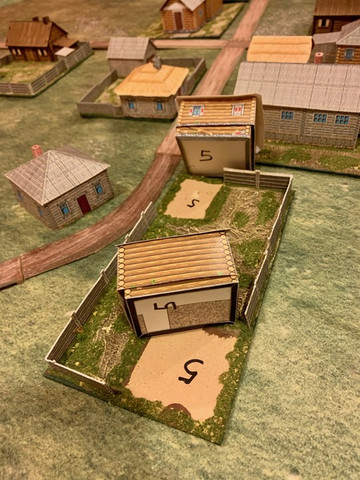
It’s me to preach the gospel of paper again, and specifically to illustrate the basing technique that I use for Paper Terrain products.   With these three 15mm Russian village buildings (including the one odd man out, the MDF building in the righ foreground) I put two paper buildings (plus a small woodshed/outspace) on a single base to represent either a farm or an entire village, depending on the scale of the game (platoon vs battalion).

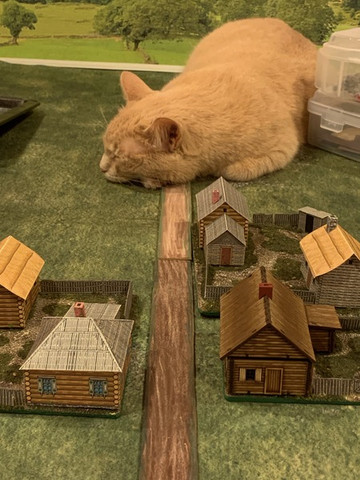
Here @MarshalLuigi, having inspected the village and found it acceptable, demonstrates correct roadblock and delaying action procedure.   The road to Moscow is secure for now.  There may be too many trees on that backdrop for the steppes!


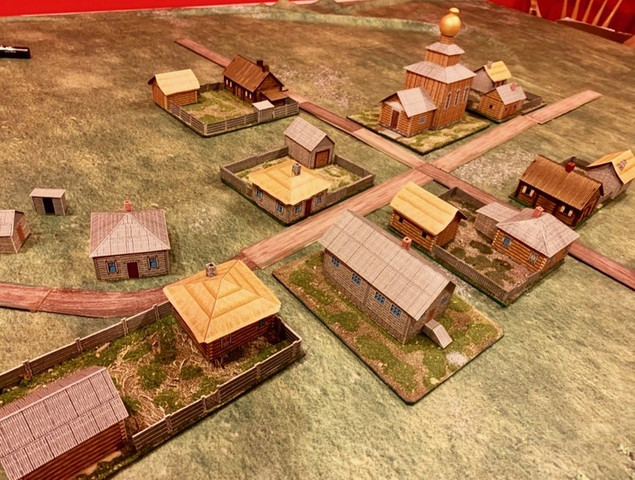
Here is the village of Paperskoye almost complete, just a few more buildings to base.


I use a numbering system to help me remember which buildings go on which bases.   I thought about gluing the ruined interior shells to the bases, but decided against it.  Having the bases in one tote and the paper buildings in another makes for safer storage and transport, I find.

Luigi, aka the Cossack Catbeast, appears to have lost interest in the project.  The road to Moscow may not be so secure now.  Wasn’t a giant cat mentioned in the Al Stewart song?

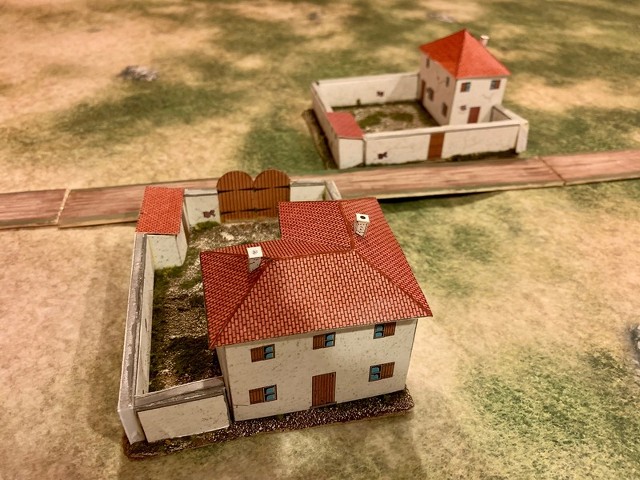
Moving to the sunny Mediterranean, we take you to a small village in Sicily.  the fist fruits of my basing efforts for my Sicily 1943 project.   These would make a nice pair of strongpoints for the defending Germans.  As with the Russian buildings, my basing technique is the same.    I handout a piece of MDF from the hardware store, texture it with a wood builder’s putty for sealing gaps, base coat it dark brown, then dry brush in two lighter colours (Yellow Ochre and then Desert Tan), and finally flock, but only in patches to suggest an arid climate, which is in keeping with this new Sicily gaming mat from Geek Villain.  I also used some brick red craft paint to go over the roof ridge lines, which were left white after the scoring and folding.  A little effort for a great improvement, I think.

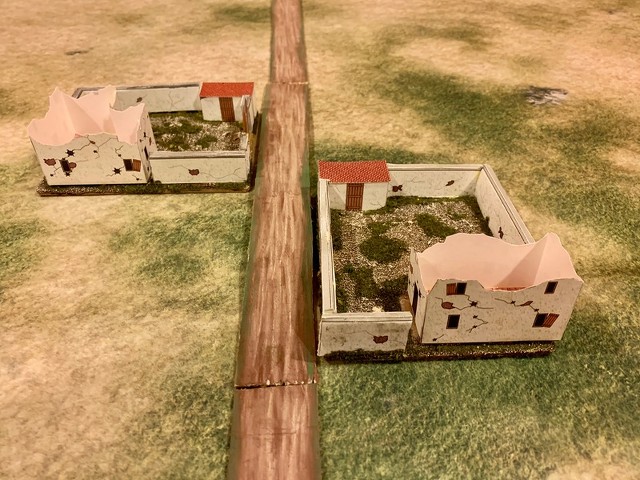
 The same buildings, having been thoroughly liberated.   

I have some British/Commonwealth troops in the queue to paint, but somehow some 6mm Napoleonics figures have used their superior mobility and stealthy size to get ahead of them.

Until next time, blessings to your basing!   MP+

Monday, April 5, 2021

In Praise of Paper (Terrain)

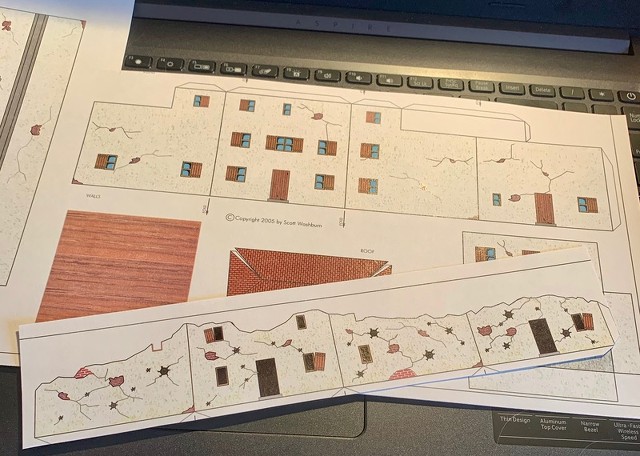
Reading the Canadian historian Mark Zuelkhe’s book on Operation Husky, the Canadians in the Sicilian Campaign of 1943, got me thinking of using some of my 15mm kit to explore that campaign, and to do so I would need some Italianate buildings, enough for a small town.   So I turned to a tried and true source, Paper Terrain, run by Scott Washburn, and ordered his Italian Village pack and his Town Expansion set.  Here’s an example of one of the sixteen buildings that came promptly in a flat manilla envelope.

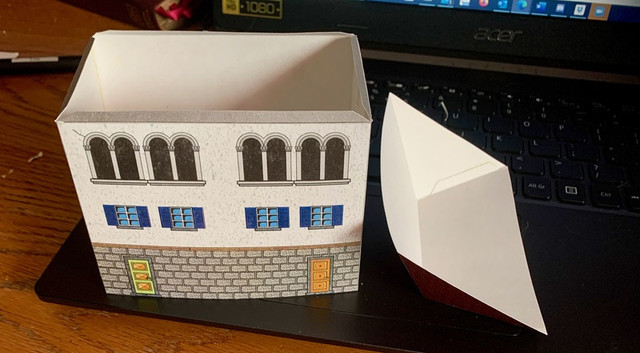
 It may look daunting, but all you need is a steady hand, some patience, a decent pair of scissors and a craft knife, and a patient partner who can put up with the myriad bits of paper that are the byproduct of the assembly process.   I used a metal ruler and craft knife to lightly score the fold lines, and while the buildings are printed on sturdy cardstock, you need to learn not to score the lines too deeply.   Once cut and scored, you fold them together carefully and glue them.  I use white carpenter’s glue.

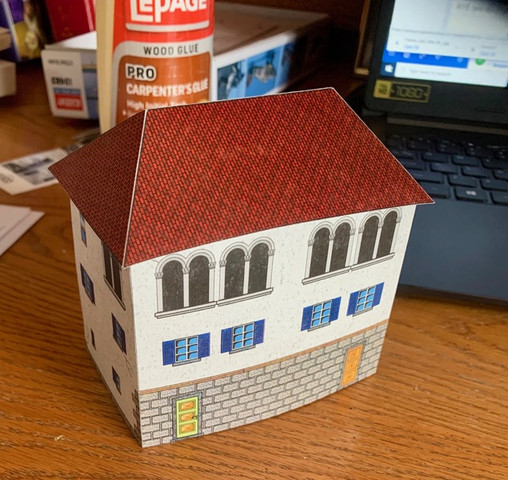
 As they say, some assembly required.   Putting the roofs on is perhaps the trickiest part but you soon get the hang of it.

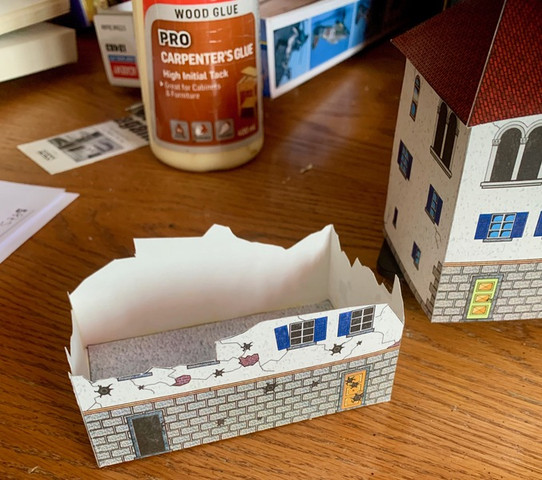
 Each building includes a ruined shell which nests in the completed building like a Russian doll set.  Very useful once the HE starts flying.  I suppose you could dress the interior with rubble, but keeping it clean makes it easier to place stands of occupying troops.


Some of the completed buildings, laid out on my Sicily fabric terrain sheet from Geek Villain, which is a nice piece of kit in its own right.  The church is stunning and large.

The buildings look good on their own, but they look even better when based.  I am working on two Italian building bases now, using the garden walls and sheds that Scott includes with his terrain sets, and I will show the finished results in another post.   

I have several sets of PT products - a Western European town set suitable for France in 1944-45, a Northern Russian village set suitable for the Ostfront or even the black powder era, and now these Italian buildings.  I’ve found Scott to be easy to deal with, and quick to answer questions about tricky points of assembly (which are rare in my experience).  In my last email exchange, he mentioned that he keeps expecting resin and 3D printed terrain to put him out of business, but demand remains strong.   For me the advantage of his product is that it’s relatively sturdy if carefully stored and handled, comes in a variety of scales, does not require painting, and provides an affordable mass of terrain in relatively little prep time.

Blessings to you scissors!

MP+r


Tuesday, March 2, 2021

Little Landsers: Getting Ready for OGroup

I suspect that like a lot of people in the Too Fat Lardies community that are excited about the release of David Brown’s O Group rules for battalion sized battles, I have gone back to the 15mm WW2 part of my lead mountain to see what I could find.  There is a LOT in my 15mm lead mountain, some of it dating back to the release of Flames of War.   I decided the first thing to do was to increase the number of my early war Germans - a useful force, as I already have a massive number of 15mm Russians for them to contest the steppes with.

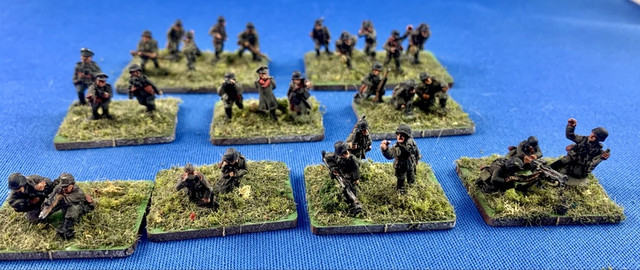
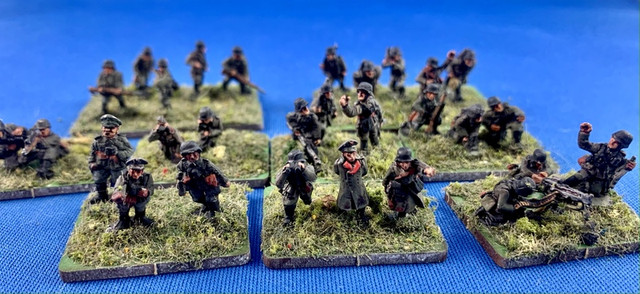
The figures are a mix of Battlefront and Old Glory that I bought in a mass order with some friends some years back.  The OG figures are, frankly, a mixed lot, some downright ugly, but they mix well enough with the BF figures.  I filled up enough painting sticks to do several platoons of generic Heer infantry with supports and command.  I put two man LMG figures on separate small bases to stretch the number of figures, so one LMG stand, with a five man infantry stand, is more or less a section.  Seems legit.

The figures were mass produced, and with a “good enough” attitude towards the final outcome.   I am not ashamed to say that I bought a can of Army Painter Field Gray spray primer to give me a base coat, and then picked out the flesh, weapons, helmets and gear.  Everything got a final wash of Windsor and Newton Nut Brown ink, a trick I saw from someone who uses it as a wash for 6mm Napoleonics, and I was happy with the end result.  The bases are coloured FOW size bases from 4Ground, covered with a blend of model railroad turfs.  I'm a slow painted, but I raced through all these figures in about five one hour sessions.

Two tripod mounted MG sections, a tank hunting team with ATR, a sniper team, a 50mm mortar, a section of combat engineers should cover most support options for smaller scale actions using TFL’s Chain of Command.

Finally, I had enough senior figures to make two command stands suitable for company or battalion level.  The fellow with the fancy overcoat has ben dubbed General Von Klinkerhoffen, in tribute to the late Hilary Minster of Allo Allo.

That should be enough for a decent sized engagement.   It’s pleasant to work in this scale again and not be too overly fussed over mistakes on a single figure.  I have a company of Battlefront Commonwealth infantry in the queue as I have become quite excited about 1st Canadian Division in Italy, but that’s another story.

Thanks for looking and blessings to your brushes!

MP+

Wednesday, August 30, 2017

Surprise Stuka

Hello all.
Another highly irregular post, just to say hello, really and to acknowledge a lovely piece of kindness.   Recently a box arrived in the post, all the way from California, and inside was this lovely painted 15mm Flames of War Stuka


It was a gift from Dai, the gamer who runs the blog The Lost, the Damned and the Stunted, which I greatly enjoy.   In one of my fitful posts here, talking about my efforts to field an early WW2 Germany army for the Eastern Front, I was lamenting how the Germans fare against the Soviet KV1.   What you need, Dai said to me, is some air support, and I just have a Stuka that is surplus to requirements. So he very kindly painted it, boxed it, and sent it all the way from California to Canada as a gift.   And it is a nice little kit, done up at least as well if not better than I could have managed.


Thank you, my friend, for your lovely and thoughtful gift.   As young Kinch has said, the Freemasonry of our hobby is a wonderful thing, and it makes me feel fortunate to have found this community.
I am hopeful too that this gift might nudge me out of a months long painting and minis gaming slump.   Some of you who follow me on Twitter (@madpadre1) know the reasons why, and I’ll leave it at that for now.  I wish I was visiting your blogs as they deserve, and I thank you of you are reading this post.
Anyway, thanks Dai, you’re a good chap, and I hope to get this fellow into the air soon to clear the road to Moscow.
Blessings,
MP+

Sunday, May 7, 2017

Panzer Reinforcements For Kampfgruppe Von Topper

Here are five new tanks for the early WW2 Wehrmacht force I am slowly assembling.  These are the excellent Plastic Soldier Company 15mm PzKpfwIV models made up as AusF models, suitable for Barbarossa.    I really like the PSC philosophy. which allows you to make different variants of the same basic tank in the same kit.  Very clever.  Likewise, their T34 kit contains two turret variants, for the 76mm and 85mm guns.   Nice.  Sadly these don’t have any stowage or decals yet.  The models don’t have much room for turret numbers.  I suppose a cross on the top of the turret might not go amiss.

I’ve dry brushed them liberally to suggest the dust of the summer/fall of 1941, though it turns the panzer grey almost green, which I’m not sure I like.   Otherwise no weathering, other than a little rust on the tracks and the track sections used as frontal armour.  I have glued them to the magnetized bases I like to use for storage in cookie tins, which keeps the models from getting bashed around.  The bases also look sharp, in my humble opinion.


These platoon had its introduction to combat the other night, when I was pushing them around the table to try and understand the mechanics of Flames of War 4.0.   Please don’t judge me harshly on this, it’s what the WW2 guys play at the club and it’s that or nothing, right now.   

I put them under the command of the household’s junior member, Leutnant von Topper, who has volunteered to command all Wehrmacht forces in future, though he wants to call them “Purrmacht”.  Here he works on digging the Soviet defenders out from cover.

                                                                                             Come out, little red mice!

As an exercise, I put the PzIVs up against four KV1s that are almost ready to roll of the Red Banner Workbench.  The Germans were rated Confident Veteran, the Soviets were rated Fearless Conscript.  I quickly learned that with KV1’s front armour of 9 and a side/rear armour of 8, there is no chance of a PZIV’s 75mm gun being able to knock out one of these monsters.  The best one can hope for is that the Soviet rolls a 1 on his armour save on a side/rear shot against the 75mm gun’s AT rating of nine, meaning that 1+8 ties the AT rating and causes a bail.  So basically the KV1 doesn’t get knocked out, it just fails a morale check.   Meanwhile the PzIV has a front armour of 5 and a side armour of 3 and while the Conscript Soviets are crap shots, it’s bad when they hit.


                                                      These comrades will ruin a tanker’s d

I think Kampfgruppe Von Topper will be asking for 88mm AT and Stuka support in its next requisition.  I think in the short term they will have to settle for some infantry support to go close assault those beasts.

Blessings to your brushes!

MP+

These figures bring my 2017 totals to:

15mm: Vehicles: 8, Foot Figures: 4, Scenic Pieces: 7

20mm: Foot figures: 18

28mm:  Foot Figures: 86;  Mounted Figures: 11; Terrain Pieces: 17


Thursday, January 19, 2017

First German Units Report for Barbarossa

So the good news is that Madame Padre is back home and doing well.   And there's also some less important hobby news to report.
Amidst my Tolkien-inspired efforts of late, I took a small sideroad to get a start on a German early WW2 force in 15mm to oppose my Soviets.


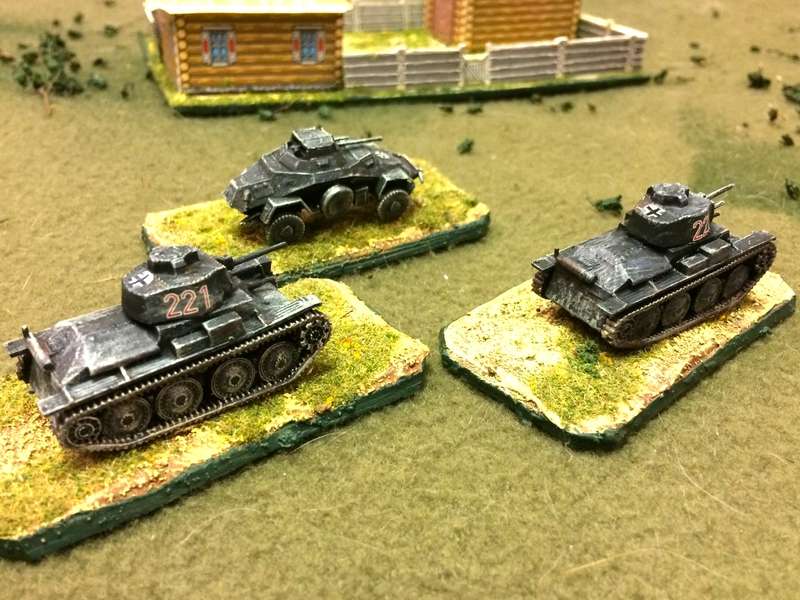
These three models are by the Russian manufacturer Zvezda, sold as part of their Art of Tactic series.  They were kindly given to me by Steve Whitesell, the proprietor of an excellent blog with a WW2 and WW3 theme.

Zevezda kits are compatible with other 15mm models, and while they are less detailed, they are easy t assemble.  For these two tanks, the track and road wheel assembly is all one part that glues onto the bottom of the hull.  Easy peasy.


These two PZ 38s and the tiny tank (sorry, the SdKfz 222) armoured car make the nucleus of a recce unit (sorry, aufsklarungsgruppe) suitable for early war.   I was pressed for time, as I wanted to get an entry into the Armor theme bonus round of the Analogue Hobbies Painting Challenge.  There were some fifty entries riffing in various directions on this theme, and it is well worth your having a look here.  If you look at nothing else there, go admire the talented Michael Awdry's wonderful Grail Knights homage to Monty Python.


My effort was paltry by comparison.  The German Gray is a base of  a Vallejo primer, brushed on as I did not have time to break out my airbrush.  When dry I hit them with Citadel Nurn Oil or whatever it is called (I far prefer Army Painter Strong Tone but am currently out) and then did some rust and chipping.  Most of the weathering got obliterated when I drybrushed on some craft store tan paint to suggest the dust of the Russian roads.  Bases are MDF, handcut, with some plastic wood texturing and then flocking.  The crosses are by Battlefront and the Pz38 turret numbers are by Dom's decals.

I have five Plastic Soldier Company early model PZIIIs assembled and painted, another pack of five PZ38s with the option to build as the Marder variant, also from PSC, so I may build a zug of three Marders for later war and give two of the 38s to this unit.


It's a start.


These figures bring my 2017 totals to:
15mm: Vehicles and AFVs: 3

28mm:  Foot Figures: 29;  Mounted Figures: 2


Friday, April 15, 2016

OP THUNDERING DICE PART TWO: Infiltrate, Exfitrate, Eliminate, Fullplate


 Picking up on my account of last weekend's war games slumber party Chez James, here are some more thrilling accounts of small scale derring do and (increasingly for the weekend) my tactical misadventures.  Again, you can read Rabbitman's take on it here, with different pictures.

During OP TD1 I got a chance to play with James' modern Afghan kit, and I certainly wanted another crack at it.  In a recent post here, I commented on how some gamers inspire me with their determination to assemble a large project, and with their perseverance to get it right over time.  James' Afghan project is an excellent example of what you can do with a vision, some determination, and some spare cash.   He also made a very interesting and, I think, wise decision to do it in 20mm, to be able to represent platoon scale actions and to take of the variety of metal, resin, and plastic kits out there.

We decided to try Black Ops from Osprey, using their rules for sneaky covert stuff in the dark.  I was quite interested in evaluating the utility of these rules for my own Weird War project, which will also involve lots of dark sneaking and frights in the dark.  We decided that we would send a small team of Canadian JTF special forces operators into a remote village to neutralize (good) or capture (better) a high value target.

Here's the view of the recce team from their mountain perch.  Just waiting for night and the insertion of the grab team.


First team makes it move in the pitch darkness.  Two more teams approach through the dry creek bed on the far side of the village.

 
Sniper team lies in overwatch.   I was very nervous about using these fellows, as missing a shot and having a wounded, loud guard on a rooftop could have been bad,  However, they did prove very useful once the op started.


Case in point.  'Hey, Achmed, you want to go get a falafel after our shift? Achmed?'  At this point I had used the sniper to take out the guard closest to Alpha Team's infiltration route and had gotten lucky.  However, a random movement roll brought the sentry's partner over to his colleague's direction.   I committed my sniper a second team and, fortunately, took down this fellow before he could give a warning.

 
Both rooftop sentries down, Alpha Team moves past a ruined wall.  In a small orchard nearby, another sentry was patrolling.  Alpha team leader snuck through the trees and came up from behind, dispatching a third sentry.

Alpha team stealthily clears rooms, killing the sleeping Talib fighters.  None of this is heard or noticed by the sentry above them, who, inexplicably, never looks down.  It must be very dark in the wilds of Afghanistan.

 
On the other side of the compound, Bravo Team is not so fortunate.  The roof sentry above them notices figures moving in the dark and challenges them with a burst from his Kalashnikov.  One round hits the Bravo leader, but his chest armour saves his life.   The rest of Bravo team, and the sniper, unleash a hail of rounds on the guard, who amazingly passes five saves before he goes down.   The blue tiles are noise markers.

 
I would have thought that the whole warband (minus the half dozen killed in their beds) would have poured out of their huts, but that wasn't how the rules seemed to work.  Instead, the leader came out to see what was going on.   Alpha Team, hiding behind a Hilux pickup, watched through their NVG incredulously as Mr. High Value Target stauntered out in front of them..   Two operators dashed forward and bested HVT in a quick struggle.

 
Mr. HVT is bundled into the second truck, which has luckily was left with the keys in the ignition.  Alpha Team throws HVT in the back, none too gently, and  drives off into the night, singing BTO's Taking Care of Business loudly.  Bravo and Charlie (Charlie never fired a shot, was never needed) melt back into the dry creek, where Alpha abandons the truck, rigging it with a block of C4 just because.    A good night's work, and another Black Ops story that will never appear in the Globe and Mail.
 
 
In the afternoon we shifted to a game of Chain of Command in 15mm, pitting my Soviets against James' Jerries.   A can of beer seemed the perfect accompaniment to a Too Fat Lardies game.


A randomly determined scenario had me on the attack, using a somewhat compressed games table. My objective, the village of Turnipograd. With 12 support points, I bought an elite squad of scouts, a 5-man Maxim MG team, and an opening barrage to hinder James' opening deployment. With our jump off points quite close to one another, I thought I might have a chance early on to grab at least one of his.

 
Turn one and my elite scouts grab part of the town and hope to press on. Thanks to my opening barrage, James doesn't get to put a lot fo troops down for Turn One, but diastrously for me, he rolls two sixes, meaning that he gets two turns in a row.

 
Turn one and my elite scouts grab part of the town and hope to press on.  Thanks to my opening barrage, James doesn't get to put a lot fo troops down for Turn One, but diastrously for me, he rolls two sixes, meaning that he gets two turns in a row.  Because James took two green squads with his support points, he gets two eztra LMG teams, and he has a lot of firepower and bodies to put in the way.  I get held up on the right.

 
And on the left, my poor scouts are hammered by the Germans, waiting for them with an LMG in the cottage and the rifle team on the far side of the farmyard.

 
A third German squad deploys by its jump off point and while it can't move, it can shoot.  They shred the squad supporting my scouts.   I discovered that in a game of CoC where the Junp Off points are close to one another, the battle becomes a knife fight where you can be cut up quickly and fatally. 

 
My Maxim team opens up and punishes James, landers in return, but on the right, my rifle squad is getting bashed about by its jump off point.   Just before this shot was taken, my Maxim team got ten hits on ten dice, an amazing throw.

 
And in their second turn of firing, the Maxim team rolls ten misses on ten dice, and is now suffering from incoming fire.  Meanwhile, James uses his infantry advantage to swing wide, taking my first JO point and threatening my second.  My Force Morale is plumetting.   The only good thing about my effort is how nice my Jump Off points look.  They are painted resin objective markers from a ompany called Army Group North miniatures.
 
 
My scout squad has been wiped out, and I an now down to one intact squad.   Time to call it a day.
 
 
After filling me full of lead, James filled me full of excellent Indian takeway.   It seemed a fair compensation.
 
 
It was good to playChain of Command again but sobering to realize how unforgiving it is to poor tactics.  My plan was very poorly thought out.   I led with my best asset and had no way to support them.   I put two JOs on the right axis of my attack but committed almost all of my attacking elements to the left axis of attack, leaving these JOs to be tempting prizes just asking to be grabbed, which they were.   While it was unlucky for me when James got two turns in a row, these things happen and a plan which depends on luck is not much of a plan.
 
Black Ops was a lot of fun to play, probably more fun for me than for James, who bore his sentries' incompetence with good humour.   I like the mechanisms in Black Ops, especially those for covert actions, and think it would be quite easy to modify them to my own Weird War Two project, which has lots of sneaking and skulking and frights in the dark.
 
Op Thundering Dice concluded with us playing the Lord of the Rings boardgame I have described here previously.   It took us a good four hours, but I watched in increasing frustration as Sauron while the nasty hobits got into Mordor and kind of ambled their way to Mount Doom.  Actually it was tense.  I had several good chances to stop them but several supporting characters (Gandalf the Grey, Boromir and Legolas) all sacrificed themselves willingly and allowed the Ringbearer to achieve his mission.   It was terrific fun, particularly as we imagined the Nazgul advisors leaving the council meeting where Sauron declared war, shaking their heads.  'Now my irrigation project for Nurn will never go forward.  Always war, war, war.'  'Yeah, and my Mordor Tourism Board budget is getting totally slashed now.  I had this great idea for aerial tours of Mt. Doom by Fell Beast.'  'Always war, never trade.  My free trade agreement with Gondor was almost ready to sign.  Years of work wasted.'  Such is the sad lot of an evil counsellor.
 
Blessings to your die rolls and may all your games be as much fun!  MP+


Blog Archive

Followers