Showing posts with label Ancients. Show all posts

Sunday, September 27, 2026

A Battle In Germania Using Three Ages Of Rome Rules

 Some time ago I finished painting another batch of 8 Foundry Early Imperial Romans, seen here.


With these new recruits to the legions mustered in to a collection that's either Foundry or Victrix, I decided that I had enough figures to try a battle revisiting Philip Garton's Three Ages of Rome (3AR) rules published by Helion.


These are fairly simple rules, mostly quite clear and self-explanatory, with army lists for the republican, early imperial and late imperial eras of Roman history.   The rules are written with 15mm figures in mind, but can be adapted easily for 28s by increasing movement and missile ranges by 50%.  There are simple command rules, loss of cohesion instead of removing figures as casualties, and no buckets of dice to throw.

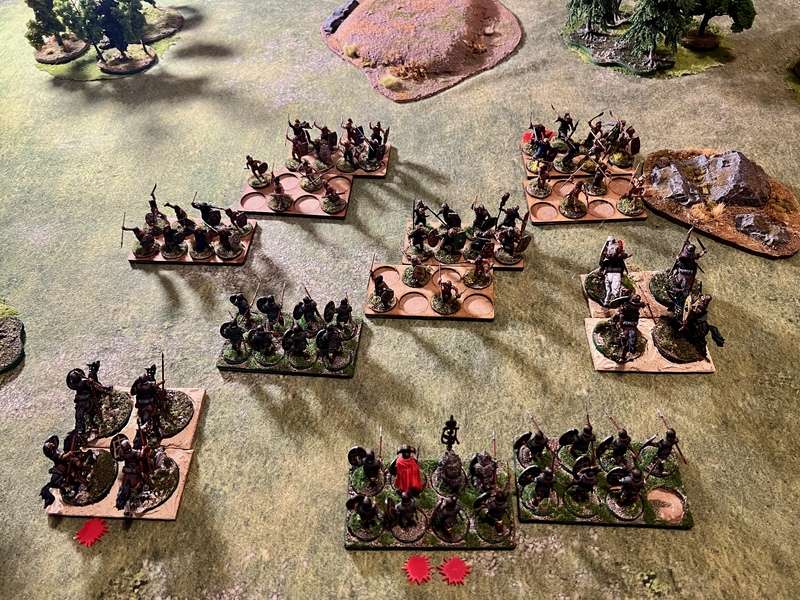
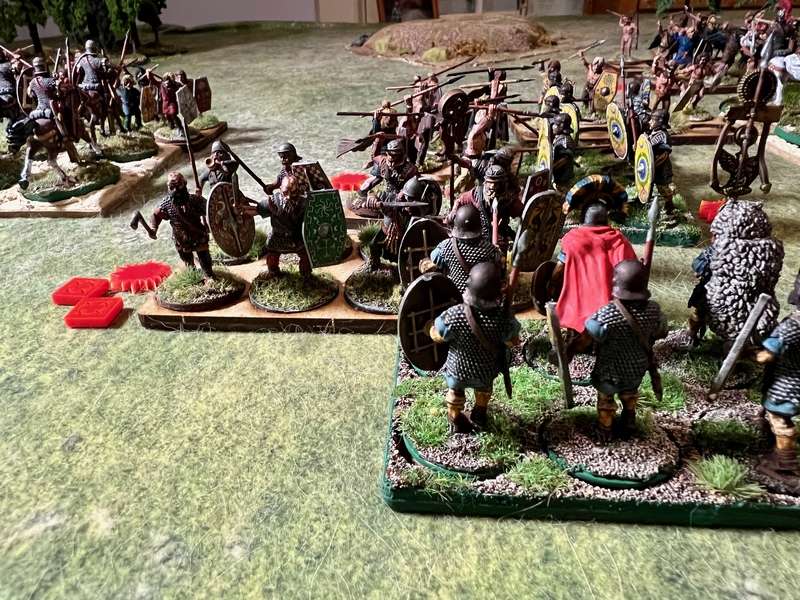
Wulf Stinkig had rallied the men of the Fritzi tribe and their allies, and after raiding and much annoying behaviour, had drawn out a substantial Roman force.  Wulf's force includes two veteran units of massed infantry, two trained mass infantry and one trained unit of skirmishers, a raw unit of mass infantry and a raw unit of javelin armed skirmishers.  His co-commander is his brother in law, Grull the Bald (the little axe markers are to remind me which are the veteran units).


Opposing Wulf is the veteran general Bulbus Nasus, who has spent the last five years in Germania after an unfortunate dalliance with Caesar's niece Vuluptua.   He is assisted by Crismus Bonus, a hard headed centurion. Bulbus has four veteran units of massed infantry legonaires, a unit of trained skirmishers with slings, and a unit of hastily raised auxiliary archers, rated raw.  He also has a unit of trained massed cavalry tucked away behind some woods, Maximus style, and commanded by a young and eager tribune,  Caius Insalubrius.


Wulf Stinkig gives a long oration, which can be summed up as variations on "Slit Their Gizzards".  3AR has a pre-battle rule for oracles and orations, which can help or hinder each side, but in my haste to get started I forgot about it until too late.  I guess there were no priests or soothsayers available.


The Romans take a cautious stance, opting for Hold orders.  Wulf and his warriors rush forward.  Movement in 3AR is generous, 20cm for massed troops in the open, and it recommends adding 50% to the movement rates for 28mm figures.   This brought the Germans almost to charge distance.  They take a round of sling stones and arrows, and the greenhorn archers do some damage to the one raw unit of warriors.  In the Roman move (order of movement depends on chit or card draw to activate various commanders and their troops), the missile troops pull back and two units of legionaires under Bulbus rush forward.


Both sides are locked in combat, but Grull the Bald's veterans are coming up to support their comrades, while Wulf sends his skirmishers through the woods.  They flank a unit of Roman auxiliaries, which hold their own, just barely, personally led by Crismus, while the raw archers come through again, keeping a unit of German javelin throwing maniacs at bay.


As Grull leads his men forward, the young firebrand Insalubrius leads his cavalry forward, making some speech about how if you find yourself in Elysium, then you've failed your saving throw.


Crunch!  They crash into the flank of some German veterans, who are pushed back in Disorder.  In 3AR being flanked or even attacked in the rear isn't necessarily fatal.   In either case, the defending unit takes a -1 on its saving throws if any hits are scored.  In the case of the auxiliaries above, they survived several rounds of combat with the skirmishers on their flank.  What 3AR does well, I think, is that once your units get into the fight, it's hard for them to recover their cohesion.  Adverse results can cause Disorder, which is bad, Disruption, which is worse, and Rout, which is worser.   Routing units can provoke Impetuous Pursuit in the victor.   While there is a rally phase, it's harder to recover cohesion, especially with enemy units nearby.


Wulf Stinkig has seen enough.  Most of his units have lost some level of cohesion, and he hasn't really scratched the Romans.  He orders a general withdrawal, so his brave Fritzii can live and fight another day.   The Germans stream off the field.


One German unit is caught front and rear and is destroyed, the only loss of the game.  3AR might seem a little bloodless to some, I found that most combats end with, at most, one level of cohesion lost (Sound to Disordered, Disordered to Disrupted).  However, as noted above, it gets progressively harder to rally troops in the thick of it, and so you can sense when a battle is lost or won fairly quickly.


So Bulbus Nasus is happy because he can claim a victory and he has some captives to sell to the slavers.   Caius Insalubrius will be mentioned in dispatches, burnishing his career.  Wulf and Grull will retire and try their luck another day.

All in all, I like 3AR, it's a fairly simple set of mechanics with army lists that cover a large swath of ancient history.   It doesn't require throwing buckets of dice, which I like.  Most melees are decided with each side throwing one or two d6 to hit, and then throwing saves, with a 4 on 1d6 always being the magic number after modifiers.  The rules for command and control are simple, with three basic postures for each wing or command of an army:  Hold, Attack, Withdraw.  Commanders have radii where they can influence their units, and any commander designated Heroic can add a +1 modifer to a unit in combat on the first round, with some risk of being killed or captured.   So no mechanics that couldn't be taught to someone in twenty minutes, and a conclusion within two or three hours, makes these rules suitable for club play.

I'm a sucker for rules and I admire how Helion supports the hobby with a line of rules for various periods, though they are probably eclipsed somewhat by the Osprey blue series of rule books.   Philip Garton knows his onions, this is one of three sets of rules for ancients that he's written and published with Helion, which I respect.  3AR would be a good way to introduce folks to ancients gaming, though I suspect that if I wanted to find opponents, I'd be better off putting more time into learning Midgard, which seems to be as well suited to ancients as it is to fantasy.  Of course, there are also the TFL Infamy, Infamy! rules for the early imperial period, and my copy just arrived, so stay tuned for more struggles in Germania!

Blessings to your die rolls!

MP+


Tuesday, March 24, 2026

Quick Thoughts on MMP's Storm Over Jerusalem


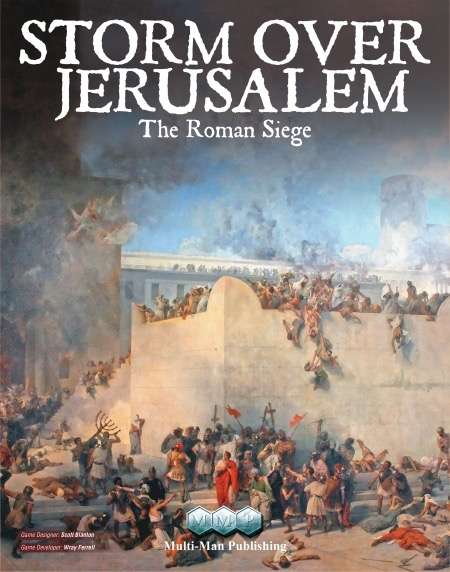
I've now finished two solo plays of Storm Over Jerusalem, MMP's game of Titus' siege of Jerusalem in AD 70.  It's a winner.   It has fairly simple mechanics (a very slim and well written rulebook) that are reminiscent of those old area movement games of the past, most famously Avalon Hill's Storm Over Arnhem.  

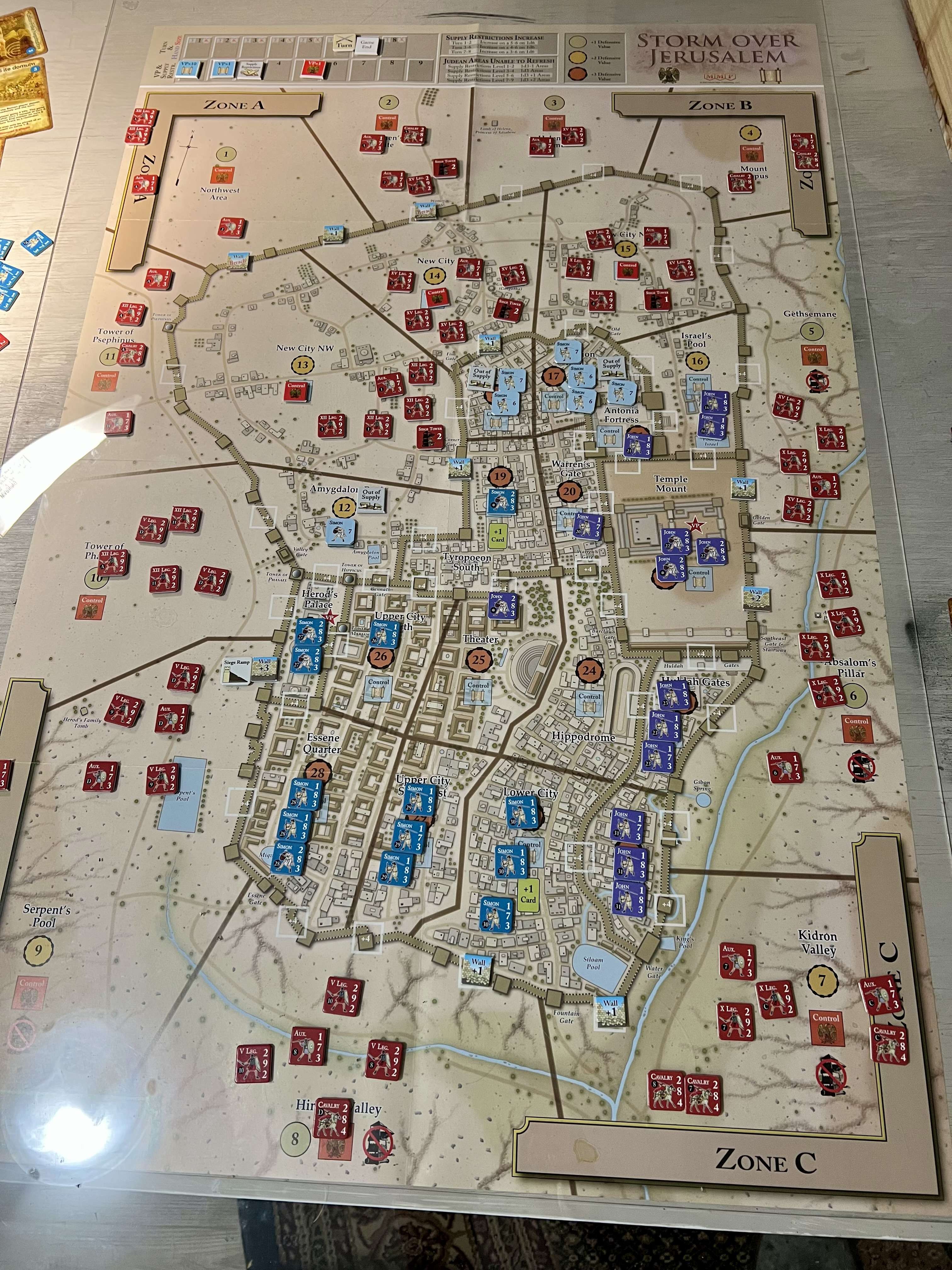
It's a fairly short game (eight turns) in which the Romans have a daunting task of getting over the walls of Jerusalem (so many walls!).  There are two vital areas, the Second Temple and Herod's Palace, and if the Romans can take both in the same turn they win automatically, but that's easier said than done.

The new town (top of the map) is easier to take because the defensive bonuses are slightly less than they are in the old town and the terrain around the new town areas is conducive to siege engines and siege towers which can partially negate the wall defensive bonuses.   So the Romans can make initial headway taking these areas but they aren't vital to the Jewish defenders and they can chew up valuable time.

The Romans have a lot of troops but they don't all start on the map oat once and can only be brought on from four specific reinforcement zones.  The Roman stacking limit is five units per zone, so the Roman player has to develop attacks carefully and plan to reinforce them.

The game is card driven, in that each player gets a hand of cards with fresh draws per turn and the cards convey certain bonuses and allow strategems, such as gradually cutting off Jewish supplies, upgrading Jewish units with captured Roman weapons, onager and ballista attacks, siege ramps, and such.   Some cards can negate others, so if the Roman plays the battering ram card and if the Jewish player has the flaming brand card, it cancels the battering rams.    If you like the flavour that cards bring, you'll like this game.

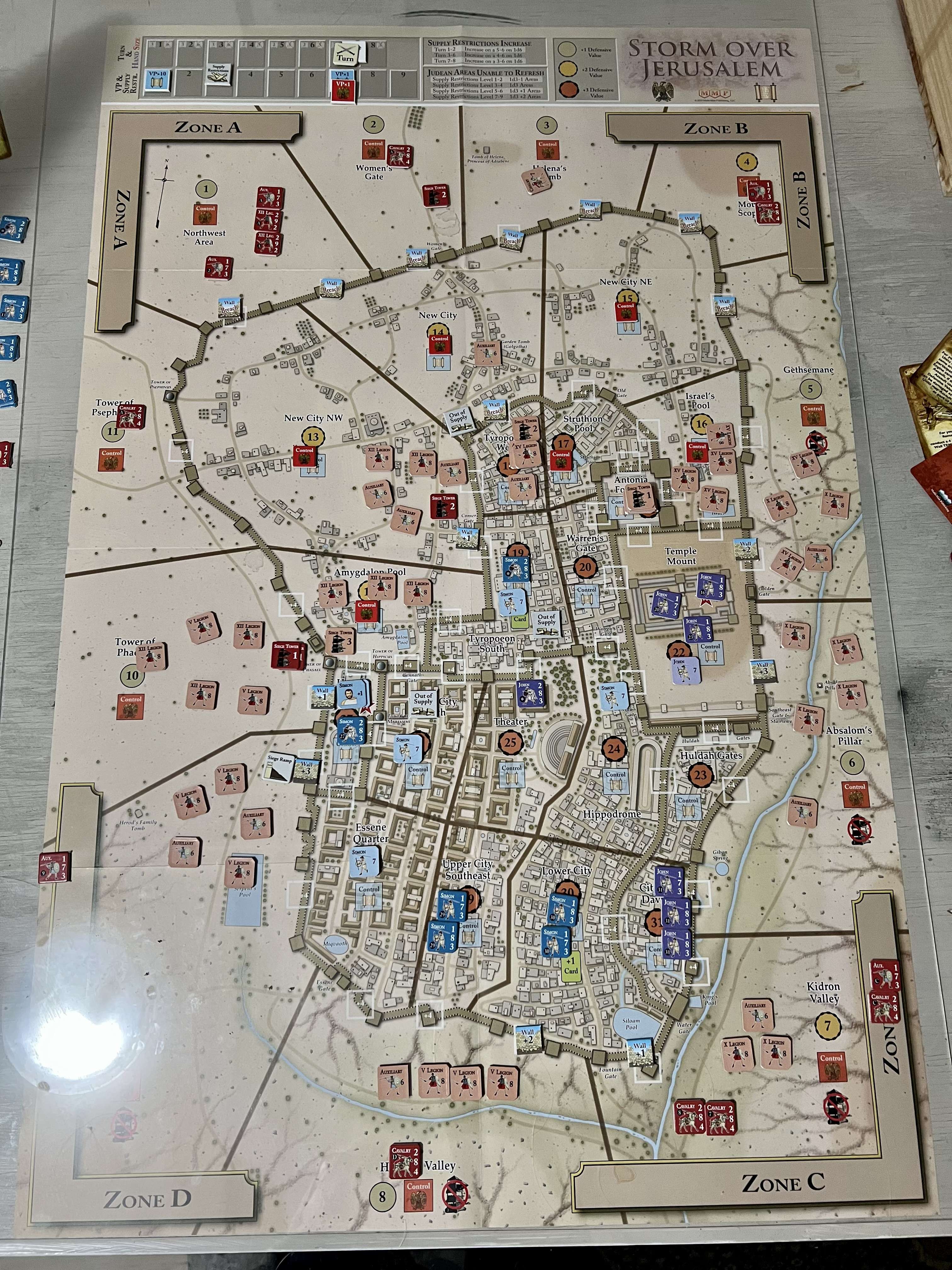
Here's the situation at the end of the second of two play throughs.    The Romans have thrown their full might at Herod's Palace (left) and the Temple (right) and in both case the Jewish defenders hung on grimly.  The game ended a turn early because of card play, and it was a tie simply because the Romans inflicted massive casualties on the Jewish garrison.


Siege games have a lot appeal for me.  For the attacker they can be interesting problems to solve, and for the defenders while there may not be lots of maneuvre choices, the tension of hanging on is always fun.   And the advantage of a paper game like this one is that I don't have to build a model of Jerusalem and to paint both armies, the game's all in the box.   

Physically the counters are oversize, colourful and well printed.  While mounted mapboards seem to be a thing of the past, it's a lovely and educational map and the cards are well done.  Full marks for the game's components.

This is a game I would definitely play again.

Cheers and blessings to your die rolls,

MP+


Sunday, March 15, 2026

Foundry 28mm Imperial Roman Legionaires

 And this post is pretty much what it says in the header.

Catching up on this blog after all the WW1 naval business which has dominated this blog in the past year  to show some recently completed work now that I'm fully moved into the new house and the painting desk is up and running.   The Ides of March seems like a good time to show off another eight metal 28mm Foundry Romans.


The shields are handpainted, matching a previous design from some figures I did a year (!) ago.  At this rate I might have a century if I live to be a century.  I like the resting pose of these figures, suggesting that they are being held in reserve or just waiting for the Germanii to come charging out of the treeline.

They are based individually but I have an abundant supply of eight figure rectangular movement trays for ease of handling.


Thank you for looking and blessings to your brushes!
MP+


Tuesday, March 25, 2025

Foundry Roman Legionairies

Marching off the painting table and mustering to the eagles this week are eight 28mm Roman legionaries from Foundry.  They are sculpted wearing mail shirts, so they don't have that classic segmenta lorica look of Romans in the films, but I think they look well enough, and from what I understand, there would be a variety of armour types in the same legion.

As I noted in a previous post, there shields are hand painted.  Sometimes seeing another painter's work, in this case a far better painter than I, provides inspiration to say "I could try that" and I'm glad I did rather than try to find shield transfers that would be the same size as the Foundry shield blanks.   The results are a bit uneven, but I have another 24 in the painting queue to practice my skills on!


Another decision that I made while painting was to give them simple linen shirts, unlike the film Romans who always seem to wear the brightest red fabric even though they're grunts.   I like the "warriors for the working day" look.  I did make a concession to the movies by giving them red neckerchiefs.


These are the first proper legionaries that I've added to my Roman force, all the other figures thus far are auxiliaries.    It will be interesting to see how some rules, like Hail Caesar or Three Ages of Rome, rate the difference.   In a build your own army points system, like Midgard, I think you'd rate them as Heavy Infantry, but not sure they would have any better armour rating than auxiliaries.   Bears thinking on.

Thanks for looking and blessings to your brushes!
MP+


Tuesday, February 25, 2025

Freehand Roman Shields, or, Scutum Selfies

 Ave, amici!

Currently I'm working on a test batch of Foundry 28mm metal early imperial Romans, which come with separate shields, or scuta (neuter plural if I recall my college Latin).  I was vaguely considering ordering some shield transfers, but then I came across some work on the Bluesky social media site by the supremely talented @moiterei.bsky.social who still maintains an excellent war-games blog here.  

His Roman legionaries are stunning and their shields were all painted freehand, as you can see (nota bene - the image below is his work, not mine).  

His work gave me the courage to try my own freehand work, and I totally cribbed his design.   The result isn't nearly as good but to me it's good enough.


As they say, imitation is the sincerest form of flattery.

Blessings to your brushes,  MP+


Tuesday, February 18, 2025

A Hail Caesar Test Drive: Much Bonking and Hacking


This weekend in the old Rectory games room I had a few hours to put all my painted ancients figures on the table and try the Hail Caesar rules from Warlord for the first time.   I used the early German and imperial Roman army lists and had enough figures to field the following:
Roman: 1 18 regular sized and 1 8 small sized unit of Heavy Infantry Auxiliary Infantry w Spears, 1 small unit of slingers, 1 small unit of Auxiliary archers, and 1 regular sized unit of Medium Auxiliary cavalry.
German: 2 32 figure warbands, both Eager Fighters, 1 small unit of 8 javelin skirmishers, 1 small unit of 8 archers, and 1 small unit of skirmish javelin cavalry.

Most of the figures on the table are Victrix plastics, though there are a few Foundry metal figures and some fantasy castings from Thistle and Rose filling out the German ranks.

Here are the forces arrayed at the start of the battle.  I didn't put any terrain down as I simply wanted to learn the core mechanics.   I quickly realized that with infantry movement at 6", cavalry movement at 9", and maximum bow range at 18", you don't want to put the two forces too far apart.  My limited collection meant that I played with one division aside, though HC allows for three divisions per side.


Romans won the initiative, which as I understand HC means that they keep it all through the game.   The command/activiation rules mean that units might get 1, 2, or 3 moves, or none at all, depending on how far they are away from their division commander, so the side that moves second might have a better turn depending on how the activations go. 

In their first turn, all the Roman units got to move, but in subsequent moves things got a bit herky jerky for both sides, so if you don't like activation rolls, this probably isn't the game for you.  The war band on the German right held back, and the Roman cavalry were reluctant to move.   I quickly learned how missile fire worked, and between them the Roman slingers and archers made short work of the German bows.  The German skirmishers and Roman horse exchanged volleys of javelins.  It seems to me that most units in HC have some kind of missile capability, but the real game is decided in hand to hand combat.
Below, a small unit of German skirmish horse is trying to annoy the Roman left, but as they are skirmishers and the Romans are formed, there didn't seem much that they could do, and the Roman archers kept them well at bay.


Proconsul Luigi briefly visited the battlefield and watched as everyone in the centre collided.  He seemed to be planning his next triumph, with my dogs in chains behind his chariot.  I don't have a lot of experience with ancients gaming but it seems that the big scrum in the centre is how most fights are decided.


Giving the Roman archers some love.  They did well in their first fight.  My sabot bases from Warbases take eight figures, and as far as I can tell from HC, eight figures is a small unit, and sixteen would be a regular sized unit, so that's convenient.


So on to the big final scrum.   There are a lot of photos just because it amused me to see all my figures on the table, locked in combat.   One thing about Ancients, the big battles just look darn cool.

The two war bands had an initial advantage.   For their first melee they throw seven D6, hitting on 4-6, but as Eager fighters they get to re-roll misses.   The Roman auxiliary infantry elected to Close Ranks, meaning that they get a plus on on their save rolls, saving on a 4-6, but hitting on a -1.  That seemed a fair trade, and thus the Romans survived the first round with only two hits.  


However, in subsequent rounds, the tide began to shift.   In their subsequent attacks, the war bands only attack with 6 d6, whereas the Romans fight every round with 7d6.  Hits on the Germans began to accumulate faster than they could cause them.  In the third round, the Roman cavalry finally passed an activation roll and joined the battle.  Likewise, the small unit of Roman infantry joined, though how they achieved that was funny.  I rolled a 12 on 2d6 for them to join the fight, which in HC is a blunder, but the blunder table result was an uncontrolled advance into the enemy, which allowed them close the distance and contribute to the final round.

At close of play, the German war band on the left broke thanks to the intervention of the cavalry and was removed from play, while the one on the right was very close to breaking.   The larger of the auxiliary infantry had been forced to retreat in disorder, but the result was still a Roman victory.


It's always interesting to try a set of rules for the first time.  The mechanics were fairly simple to grasp and there was a clear result within six turns, but there were some dynamics that I would like to explore further, particularly how skirmish, open order, and close order units interact.   There was a moment where the Roman slingers fired annoyingly, and then in the next turn the auxiliary infantry advanced through them to seek a resolution, so I felt I was doing that part right, but there feels like more to explore.   
The two sides felt different - the German power lies in their unwieldy war bands, which felt both powerful and fragile, whereas the Romans felt more resilient. Perhaps it would have been a tougher fight if the Romans had been outnumbered.
One thing I felt I might have missed was the influence of commanders on the game.  As far as I could tell, they simply exist as a measuring point to units being given orders - if they are beyond 12" from the commander, it's harder to get them to react.  They didn't seem to have any other rule that I could see. There were rules for commanders becoming casualties, but in my first play through I couldn't see how that worked, but you always miss details the first few times.
As for the activation rules, you either like them or you hate them.   I recall the same sort of activation principle when I once tried Warlord's Black Powder, and they are not unlike Lardie rules in that respect.  

Having all these figures on the table looks grand, but in 28mm, if you use the unit sizes that HC requires, you need a LOT of figures.  Two war bands at 32 figures each exhausted my available figures, so I had to add in some fantasy barbarian figures from Thistle and Rose.  If you look closely you can see them in the back ranks of the war bands.   My friend James suggests just using smaller units, or another set or rules, such as Midgard.  Not bad ideas; Midgard certainly has some interesting roles for commanders and their influence on battles.  Another way to maximize a smaller collection such as mine would be to try playing skirmish games using a set of rules such as TFL's Infamy, Infamy, or Clash of Spears.   Those are both options to explore.  Otherwise one is looking at painting a LOT of figures, which may be what a company that makes minis and rules wants!

So, congratulations to me for trying a new set of rules and getting all my ancients figures on the table.  I'll give Hail Caesar another try down the road.  Next up, the same armies using the Midgard rules from TFL/Reisswitz.

Thanks for reading and blessings to your die rolls!  
MP+


Monday, February 17, 2025

Stinky, Hairy, and Violent Foundry Germanic Warriors

 Here are six recently completed 28mm Foundry Germanic warriors from their Ancients range.  I have a large batch of Foundry Germans in the lead pile, but wanted to see how they took paint and their irregular quality makes a pleasant break from painting a large uniformed regiment.  The shields are hand painted and you probably guessed that they aren't transfers.  :)


Young men doing what they do best, shout, posture, and look for a fight.   The fellow in the centre seems quite comfy wearing his pajama bottoms.


The fellow on the left earned his grey beard the hard way, he was probably a young shirtless buck braying in the front of the war band but he's gotten smarter over the years.  He looks like a tribal leader.


"This envoy bored me and now he's broken.  Send another!"


One thing I've noticed playing a test battle of Hail Caesar yesterday (more on that in the next post) is that if you want to field multiple war bands, you need a lot of figures.   If you use the prescribed figure count in the rules, a war band is 32 figures, and I had two on the table, which meant augmenting my Germanic figures with some fantasy barbarians.  By that point, the quality of the painting needs to bend a bit if one wants to put a lot of figures on the table.    Perhaps I should look at a skirmish game like Infamy, Infamy if I want a smaller figure count?

Thanks for looking and blessings to your brushes!
MP+


Friday, February 14, 2025

Finished: Some Victrix Roman Auxiliary Archers

A dozen Roman auxiliary archers have stepped off from the Basing Depot and will be mustered into the Emperor's service.   They'll be marching off to the forests of Germania shortly.

I continue to like the Victrix figures, they look good, are well proportioned, and take paint well.   The assembly was a bit of a chore, and while they do come in a pleasing variety of poses, there were one or two where I felt, "that doesn't look quite right".   However, they'll do.   I painted them fairly quickly, I'm not sure it qualifies as "slapchop", whatever the kids mean by that, but they are I guess what one would call "wargame standard".   I painted them with the same light blue tunics that I gave to my existing auxiliary infantry, to suggest the same legion or affiliation.


They're based individually but the washers I can use can fit into my Warbases sabots, and can be stored in a box lined with magnetic paper.

The Victrix early imperial archers set comes with 12 figures from the western empire and 12 in the distinctive dress of the eastern empire.  I'll save the eastern figures for a Middle Earth project, and while it would be nice to have another 12 of these painted, I am not sure how reliant the Roman armies were on archers - I suspect they were a fairly small and specialized arm, but not sure.  Probably for now a dozen for a small tabletop army are sufficient.

Speaking of Middle Earth, it also occurs to me that these figures could be used as Gondorian militia archers, as opposed to the Games Workshop Gondorian archers in their full armour, but that's another thought.


I noticed that quite a few of the heads are sculpted wearing moustaches.   It reminded me that in Rosemary Sutcliffe's The Legion of the Ninth, the hero commands some auxiliary archers and they are described as being from Gaul, and one thinks of ancient Gauls as being hairy fellows.   Or maybe a coincidence?    Pray speak up in the comments.
Next up, some definitely hairy ancient Germans.

Thanks for looking, blessings to your brushes.
MP+


Wednesday, February 5, 2025

Work In Progress: Foundry Ancient Germans


From the Foundry Ancients range, 28mm Germanic warriors finished and in the basing queue.   Shocking fellows, terrible manners.


Friday, November 8, 2024

Three Victrix Imperial Roman Generals

I continue to be pleased with the quality of Victrix figures and by how well they take paint.  Here are three 28mm Early Imperial big cheeses to lead my numerically tiny Roman forces.  I like the fellow on the left because he's old and cranky and it probably hurts to climb on his horse in the morning.    I feel a certain kinship with him.


Mostly I used Foundry tri-tone paints, especially on the horses, which I think turned out quite well.


The iconic red cloaks that you see in all the films.  For these I used Foundry British Redcoat, which looked fine to me.


Thanks for looking.  Ave, vale, salve!
MP+

Tuesday, August 27, 2024

Battle of the Brothers: The Baetis Campaign by C3i


Getting a lot of gameplay since it arrived earlier this summer is a boardgame designed by Dan Fournie and the centrepiece of the Nr 37 edition of C3i magazine from RBM Studios.    There is some debate about whether magazine games are really that great, but I've never been disappointed by the quality of the games published by C3i.

Dan Fournie has a number of ancients games to his credit, and this design focuses on a decisive battle of the Punic Wars in Spain, when Rome's Scipio brothers faced off against the Hasdrubal brothers of Carthage.   What I know about the Punic Wars is fairly limited, so I enjoyed the lengthy article that came with the magazine.  Essentially Upper Baetis was a double battle, as both sides, four armies under four brothers, were unable to concentrate their forces.  Historically the battle was a Roman defeat, but in this game anything can happen.

This photo below shows the game as it is set up.  On the left, the Romans under Publius Scipio in light brown face the army of Hasdrubal Gisgo in light green, while on the right, the Romans of Gnaeus Scipio in red and their Iberian allies face the Carthaginians of Hasdrubal Barca in blue.  The Romans have two camps to defend, and the Carthaginians have two towns to defend.  Victory points are awarded for towns/camps captured and sacked, and for units and commanders eliminated.  The battle is fought over two and a half days, each day divided into two turns.  Before the game begins, the Carthaginian player can determine how much silver to spend on bribes to try and persuade Rome's Celtiberian allies - spending a little with a reduced c chance of defections gives Carthage a VP, spend a lot with an increased chance of defections gives Rome a VP.   Whatever the strategy, some of the Celtiberian units will disappear on each night turn, so the Roman player has to use these units before he loses them.

The game system is surprisingly fluid and elegant, very reminiscent to the one that Mark Herman uses for the GMT game, Rebel Yell.    In both systems, players take turns moving units and can move them as often as they want until one player passes, at which point the other player gets a variable number of moves before the movement phase ends and they go to combat.  Units cease moving when the enter the Zone of Control of an enemy unit and are locked in combat.  The combat phase has a similar process, so a smart and lucky player can put pressure on a flank or an isolated unit, advance, and continue the pressure and even roll up the enemy.  It took me a bit to figure out the nuances of this system, but once I did I really admired it.

In this photo below, the round markers indicate the Commander's Intent.   Each commander has a 4 hex radius within which his units can maneuver and attack.  Each marker is placed at the beginning of each movement phase.  Once the movement phase is complete, the Intent markers are replaced with a marker indicating where the commander commits himself in battle, giving units a bonus in combat but with the chance that the commander might be killed in an adverse result, as the Scipio brothers were in the actual battle.


I've played Baetis several times solo, with both sides winning, sometimes Rome prevails on one side of the map and Carthage on the other.   When my friend James came over and gamely agreed to try it (hex and counter games are not really his thing), he took to the system quite quickly and won a decisive Roman victory.

In this last photo, a Roman victory is unfolding.  James has sacked one of my towns and Barca is dead, replaced by a middling subordinate.    

 One measure of a good game is that victory can go either way.  In Baetis, both sides are evenly matched.  The Romans have an initial advantage in numbers until night falls and their Celtiberian allies slink away, while the Carthaginians have a few superior units like the elusive Numidian cavalry.   While both sides have key positions to defend, maneuver and aggressive play is the only way to win, as James grasped quickly.  I think I have to call him "Hispania" from now on.

I am sure that Baetis would make an interesting miniatures battle if one had the figures, though it might need to be played on two separate tables.   C3i 37 includes counters for   a Beatis scenario in GMT's SPQR game.  However you fight it, it's a tense and interesting battle to play out.

Blessings to your die rolls!
MP+


Sunday, August 25, 2024

Mustered Into Service: 28mm Foundry Balearic Slingers

Among a batch of recently completed figures are these eight Balearic slingers, part of a recent first-time purchase from Foundry's Ancients range.   I am very fond of Foundry for many of their other ranges, but these Ancients did not disappoint - solid figures, lots of detail, and very little flash to clean up.


My early Imperial Roman force is currently quiet small, a handful of Auxiliaries and some Auxiliary cavalry, so these figures give my little army a missile and skirmishing capability, very useful against the Germanic hordes and their many javelin throwers.

The skin tones are painted using Foundry's trim-tone system, and the clothing is done using FolkArt craft paints and some Army Painter shaders.

I confess that I have no idea if light troops such as these would have been part of the Roman armies in Germania in the first and second centuries AD, but they were easy to paint and look very business like, so I hope they will get some use on the tabletop as I take another look at Three Ages of Rome (Helion) and maybe try Hail Caesar when I get some more figures panted.

Next up in the Ancients painting queue are some Victrix mounted Roman officers and some more Foundry Germanic barbarians, big fellows with severed heads and shocking manners.

Strength and honour to your paint brushes!
MP+


Friday, May 17, 2024

A Battle In Germania: Playing Three Ages of Rome


 Three Ages of Rome (3AoR) is written by UK wargamer Philip Garton for the Helion Books war-games series (published 2022).  Garton has a number of ancient and early modern rules to his credit.   Even though it is written with massed armies in 6mm and 15mm in mind, I found 3AoR an easy and quick way to play an Ancients battle using my 28mm figures, using the recommended adjust of +50% to movement and ranges for 28mms.

Troop types are quite simple and familiar to old school gamers, with infantry  being either Massed, Skirmish, Adaptable (can change formation from Massed to Skirmish, eg Roman auxilia).  Cavalry can be Massed or Skirmish. There are also unit types for Pike Blocks for Hellenic themed armies, artillery, archers, and rabble.   Different troop types can be armoured or unarmored, shielded or unshielded, etc, which matters in missile and melee combat.   Troop quality can be either Raw, Trained, or Veteran, and commanders can likewise range from Political to Normal, to Veteran.   There are rules for setup (which can depend on how many units in an army confer a scouting advantage) as well as discerning omens before a battle!  Once the troops are fielded, every turn players each choose one of three possible orders:  Attack, Hold, or Withdraw.


My existing collection allowed me to field three units of Roman auxilia (2 trained, 1 veteran) and two units of cavalry (1 trained, 1 veteran).   The Germanii had a veteran unit of armoured infantry with their chief, four units of unarmored massed infantry with shields (2 raw, 2 trained) and three units of javelin armed skirmishers (all trained).   I used bases I'd bought years ago for GW's War of the Ring and they worked fine, as 3AoR is basing agnostic, though it has recommended base sizes for those that want them.

Turn order can be determined randomly by cards or dice.  I gave the Germanii a slight advantage because their commander was Veteran.   In the first turn the Romans were roughly handed and pushed back on the wrong foot.   The red shock markers indicate morale states.  In 3AoR units have four morale states:  Sound, Disordered, Disrupted and Routed.   Units can rally and improve their morale at the end of the turn under certain conditions, but the more threatened they are and the worse their morale, it gets harder.   Units with decreasing morale are more likely to be destroyed in melee.  Thus the rules have a nice feel for that Ancients tipping point when armies begin to disintegrate.


The above photo shows how the battle can become chaotic as units swirl and the battle line breaks up.   The longer units fight, the more fragile they become as disruptions and worse become sticky.  In the above photo, the German bodyguard and the centurion's unit, both Veteran, clash while the Germans move a unit in to prevent another Roman unit from intervening in the decisive battle.

Combat in 3AoR is very simply resolved, always using 1d6.   Units shooting or melting get 1 or 2 dice, and regardless of the type of roll required (shooting, melee, saves, morale) a 4 or better on a d6 always succeeds, though there are some basic modifiers (eg, for unarmored, disrupted, etc).   The basic mechanism is thus easily learned and quite simple.  There are some other clever touches, such as testing to see if units move into close proximity to enemy massed units (depends on the troop rating of the attacker/defender).


The game ended when the Roman veterans threw better than the Germanii veterans, who, having no path for a rout, were destroyed and the Germanii chief captured.  A very close game.

 3AoR divides Roman history into Ages of Expansion, Empire, and Decline, and includes army lists for each of these periods.   It includes a few sample scenarios based on famous battles, and allows players to build armies using a simple points system.  

I liked these rules a lot, they are accessible, give a clear result, and while I am not an experienced Ancients gamer, they felt right to me.    I would recommend them to others, and look forward to trying them again when I get a few more units ready for the table.

Thanks for reading, cheers and blessings to your dice!
MP+


Blog Archive

Followers