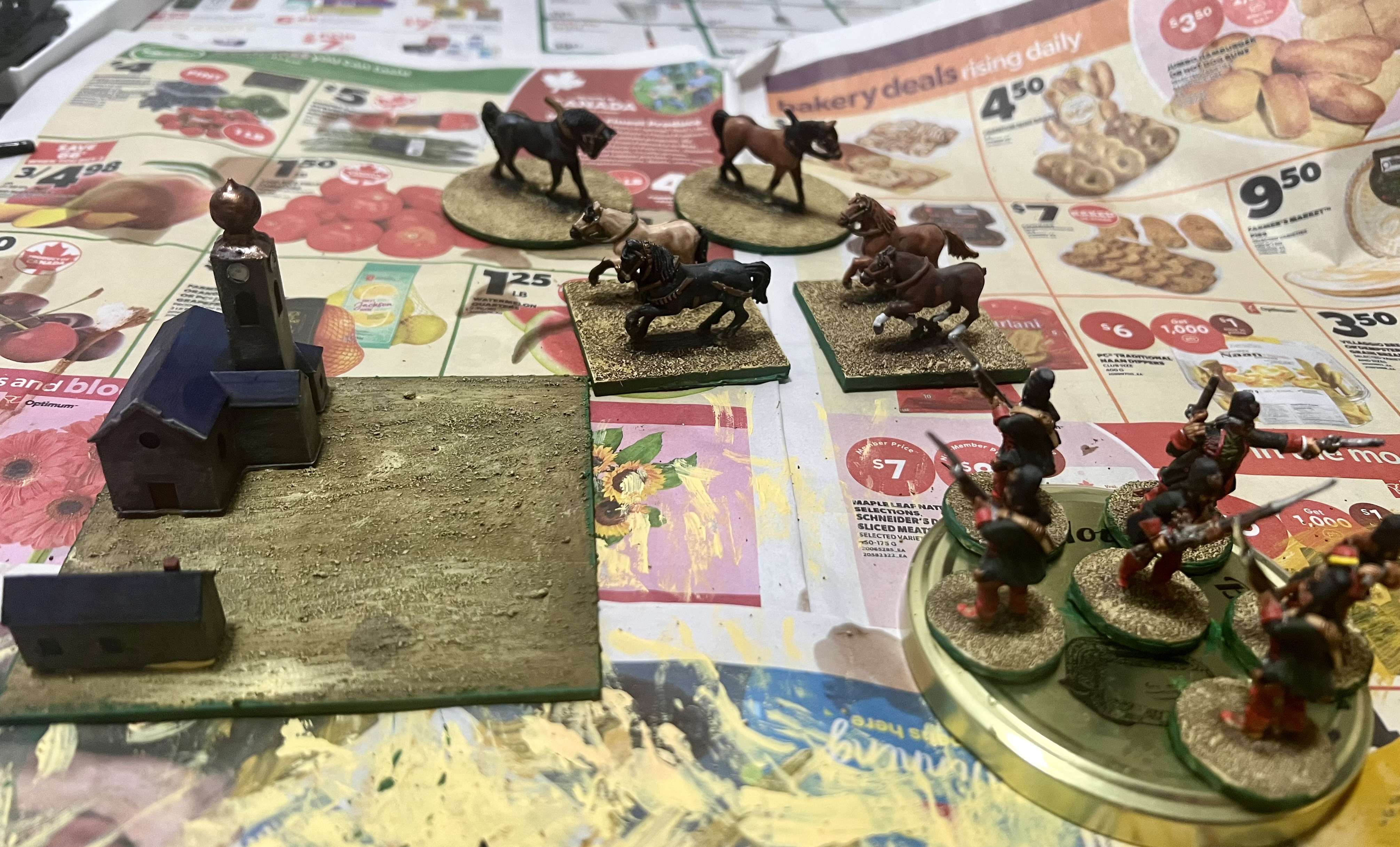
I've been making a determined effort to go through the half-finished projects started before my move last winter, and am making good progress. Here's a 6mm church for my wee Napoleonics figures.


Thanks for looking and blessings to your brushes!
MP+
I've been making a determined effort to go through the half-finished projects started before my move last winter, and am making good progress. Here's a 6mm church for my wee Napoleonics figures.
Back in March I had the opportunity, thanks to my mate James, to pick up a pile of 18th century figures from Foundry at a reasonable price. They are slowly making their way off the painting desk and being mustered into service.
I was pleased that the sale included these 12 Pandours to give my Russian army some scouting and skirmishing potential. Here they are complete with their cute little boots. With two musicians, they probably won't be able to sneak up on their foes, but at least they'll be entertained.


Hello friends:
I've been dusting off my 6mm Napoleonics collection, which is predominantly French and Austrians, and decided to revist Sam Mustafa's Blucher rules.


This is Sam's Scharnhorst map of a generic slice of Southern Germany, which has cunningly been renamed as the Electorate of Golpen und Burpen. The Elector, Hans Joachim von Smolhausen, has somehow managed to stay neutral until 180X, when the Austrians cast covetous eyes on it and it's thriving burlap sacking industry. General Konrad von Smettana and his Army of the Moldau are tasked with capturing the Electorate. Warned of these intentions, Marshal Ferdinand le Gros, dubbed by Napoleon "the grossest of the gross", is alerted to assemble his Army of the Southwest Elbe.
In Blucher terms, both armies are in the 200 point range. One is slightly larger than the other. Before the game begins, both sides secretly choose how many of their cavalry brigades they will commit to reconaissance. The side with the most brigades doing recon gets to go first and gets to choose which edge of the map they will enter from. The side with the lower number of committed brigades goes second, and must enter from the opposite map edge.
The Austrians choose to commit more of their cavalry brigades than the French and so choose to enter from the north side of the map, in four columns. Each column can have one to eight brigades, and the opposing player may not learn how many or which type until one of his columns is adjacent, in which case a player can scout or can declare a battle.
At the end of turn 1, the Austrians have entered the map from the north. On turn 1 both columns have a movement allowance of three MPs, so there won't be any contact. The Austrians seize the town of Niederheim and the village of Wunsberg. Seeing their advance, Marshal le Gros takes the unusual step to bring his force, in three columns, all onto the SE corner of the map. Looks like he might be hoping to concentrate all of his force against part of the Austrian force!

Nice counters, aren't they? They're plastic chits from Litko, very sharp.
In another day or so I should hear back from both players as to the second turn moves and we may have a battle! Stay tuned.
Cheers and blessings to your die rolls,
MP+
MP+
Hello friends:
Not much hobbying to report. Mrs P went into hospital on Friday for a shoulder replacement (she is a poster child for arthritis and had an injury thanks to two adorable but demonic Border Terriers) so after many months of pain and immobility it was finally her turn to go under the knife. It seems a sign of our age that she was besieged with advice by friends who have had joint replacements - take this supplement! don't skimp the physio! do this exercise! The surgery was successful, she came home on Saturday with a sizeable (but not huge) incision, a sling for her arm (at least six weeks of not using her wing) and a cool machine that pumps ice water through a sleeve that fits over the shoulder. I'm managing to get the minimal requisite of parish work done, while getting the odd half hour of paintbench therapy in and keeping an eye on post season baseball (I'm rooting for the Papal White Sox). Mrs P is plucky and deterimed to put her new shoulder to use, so the extra effort as caregiver is worth it.
Well enough about me. Some time ago when this blog was more of a thing, I decided on a feature called Terrain Tuesday. So here's what I've been working on, and pretty much ready to call it done.

This is a print from one of the 28mm sets of STL files from 3D Print Terrain. It's the parsonage that is part of the Aspern Essling church. It printed in several sections, and there wasn't a clean fit between the roof and walls, so I had to use some caulking to fill in the gaps, which are still somewhat noticeable here.

However that's just a small grumble. All of the files I've seen from this designer are top notch - I bought their 6mm Napoleonic line of buildings and now that I'm moving into a larger scale for black powder I wanted some buildings that would work for 18th and early 19th century Europe. I'm sure it's immaculate on the inside, thanks to a brisk no-nonsense housekeeper who looks after the absent minded pastor. I lived in a parsonage for a while, but the squirrels drove me out.

Now that the parsonage is finished, I can turn my attention to the church!

Thanks for looking! I see that my last post on lead figures got a lot of comment, so I need to go through and answer your comments. Hope all's well with you all.
Cheers and blessings to your brushes,
MP+
Recently the historical gaming community (including the author) were shocked and a little dismayed to learn that the people behind Gripping Beast were retiring and would soon be closing the business. Fair enough, I'm thinking about (and sometimes longing to) retire myself. Their announcement expressed the hope that someone would come along and buy GP and the various lines it's taken under its wing. In the meantime, they encouraged gamers to get in their orders soon and that they would be announcing a cut off date in the near future when "we will have to turn sales off so that we can finish everything outstanding and get the last parcels out the door befor we turn off the lights".
I have no idea if it would be profitable or even wise to take over such a business. The price of metal alloy continues to increase, postage rates, heating, and power costs increase constantly, tarrifs and regulations make shipping more complicated, moulds wear out, and there are so many more options for gamers now in 3D printing or from all plastic outfits like Victrix. God bless Foundry and the Perry Brothers, among those still committed to making metal figures, but I do wonder how long they'll be around.
I'm enough of a curmudgeon that I still have a soft spot for metal. The very first Napoleonic figures I painted (badly) were old metal Minifigs from the mid 1970s. I love the feel of them. My collections include metal and plastic units (which would drive some folks nuts) but I always prefer the metal guys. One of the reasons why the GP annoucement saddened me was that I'm especially fond of Front Rank, and wanted to ad some of their 28mm Napoleonic range to my collection while it's still available, so a purchase has been made.

Here are two figures from the FR Naps line. They have a pleasing amount of detail, but are on the small side for 28s and perhaps they show their age a bit.

And then there is the attractiveness of 6mm for mass gaming. I know Baccus is still going strong and I have a pile of their metal figures, but I'm just finishing the basing on these 3D print figures and it didn't take me long to get a brigade (or division depending on the scale of the game on the table.


Finally, next to the big lad are these wee voltiguers, also 6mm MC Miniatures, done on my Bambu filament printer, and surprisingly detailed.
So what do you think? Are metal figures an endangered species? Are they a relic of a bygone time, like rotary phones? Would you miss them? What do you see happening in the hobby?
Cheers and blessings to your brushes,
MP+
I

Cheers and blessings to your brushes,
MP+
Some time ago I finished painting another batch of 8 Foundry Early Imperial Romans, seen here.


With these new recruits to the legions mustered in to a collection that's either Foundry or Victrix, I decided that I had enough figures to try a battle revisiting Philip Garton's Three Ages of Rome (3AR) rules published by Helion.

Wulf Stinkig had rallied the men of the Fritzi tribe and their allies, and after raiding and much annoying behaviour, had drawn out a substantial Roman force. Wulf's force includes two veteran units of massed infantry, two trained mass infantry and one trained unit of skirmishers, a raw unit of mass infantry and a raw unit of javelin armed skirmishers. His co-commander is his brother in law, Grull the Bald (the little axe markers are to remind me which are the veteran units).


All in all, I like 3AR, it's a fairly simple set of mechanics with army lists that cover a large swath of ancient history. It doesn't require throwing buckets of dice, which I like. Most melees are decided with each side throwing one or two d6 to hit, and then throwing saves, with a 4 on 1d6 always being the magic number after modifiers. The rules for command and control are simple, with three basic postures for each wing or command of an army: Hold, Attack, Withdraw. Commanders have radii where they can influence their units, and any commander designated Heroic can add a +1 modifer to a unit in combat on the first round, with some risk of being killed or captured. So no mechanics that couldn't be taught to someone in twenty minutes, and a conclusion within two or three hours, makes these rules suitable for club play.
I'm a sucker for rules and I admire how Helion supports the hobby with a line of rules for various periods, though they are probably eclipsed somewhat by the Osprey blue series of rule books. Philip Garton knows his onions, this is one of three sets of rules for ancients that he's written and published with Helion, which I respect. 3AR would be a good way to introduce folks to ancients gaming, though I suspect that if I wanted to find opponents, I'd be better off putting more time into learning Midgard, which seems to be as well suited to ancients as it is to fantasy. Of course, there are also the TFL Infamy, Infamy! rules for the early imperial period, and my copy just arrived, so stay tuned for more struggles in Germania!
Blessings to your die rolls!
MP+
Hello friends:
I've been terribly neglecful reading your blogs and updating my own. September has flown by in a blur as work resumed. The church is like school, it all kicks off in September and while I'm enjoying my work and the people I serve, this year I'm painfully aware that I no longer have youthful energy reserves to draw on. Perhaps some of that has bled into my hobby time, though I have been working hard on some projects in my spare time. I think often of retirement, it sounds more and more attractive.
I had a long conversation with my son this summer abour his experience with ADHD and how he's managed it successfully as a young adult. He startled me when he looked at me and said "Dad, where do you think I got it from?" I've never been diagnosed, but I now realize that I've had something akin to ADHD all my life. My attention span can be short, I get distracted easily, and while I can be good at what I do (I have a few post graduate diplomas and a CV to prove it), to be successful I have to concentrate hard on one task and when it's done I'm exhausted. Not to bore you with my personal life, but in hobby terms I find that I can overload myself with projects, ping ponging (SQUIRREL!) from one period and scale to another. I've learned some coping skills - put one project in a box and keep it in one place, and don't let my workbench become chaotic. Plan a unit and paint it. Decide on one rules set that I want to learn and play. It doesn't always work, but it helps.
So this September I decided to take a break from my SYW and WW2 naval projects and return to Napoleonics. Because I've enjoyed Sharp Practice, I wanted a small force that I could play with, and because my mate James has a lot of Bavarians and kaiserlicks, I thought that I couldn't go wrong with French. I started with a set of Victrix 28mm French infantry. Not my first time with Victrix, but I won't lie, these fellows are tricky and you have to concentrate on getting the right arms with the right bodies. Had to hunt for instructions online. Not great. Then I decided that I would paint a test batch with white undercoat, which is a change from my normal practice of using black. After all, the base of an official French uniform is white, n'est ce pas?


y.
Hello friends:
There's been more activity in the shipyards and recently two more 1/300 scale ships have sailed to join my collection for gaming with the Torpedoes and Tides rules.
I ordered two of the freighter models from Skytrex from their Cruel Seas line and now have one painted. Nice kits, a resin hull with metal superstructure, funnel, lifeboats, and other bits. I used green painter's tape to mark off the upper white section of the hull and gave it the usual weathering treatment. The funnel marking is of my own design. I haven't given my commercial ships any flags because they are equal opportunity targets.


As mentioned, the pandours should never have been left that far forward. They inflict a little shock on the advancing Prussians and their stinky leader, but the Prussians stop, present, and unleash a first volley that kills two pandours and sends the rest reeling back with lots of shock. So a lesson learned.


At this point I stopped taking photos so I'll briefly describe the outcome. The pandours fell back and were out of the fight. The Russian Lvl 3 Big Man was lightly wounded trying to rally them. Meanwhile the Russian line infantry pushed up to the wall, firing at the evading jaegers and killing two of them. Their advance carried two of the three groups in the formation over the wall but the third group was now separated from their comrades by the right angle of the wall, so I ruled that they were broken off from their formation. Leutnant Stinky, having disposed of the pandours, broke off one of his two groups and along with the cannon they made life miserable for the exposed group of Russian musketeers, which lost three men and took a lot of shock.
The depleted Russian hussars thought they might sneak around the barn and catch their nemesis in the rear, but the cards went against them, the hunters became the hunter, and in a second melee the Russians lost two more men without doing any damage. The survivors were out of the fight. The Prussian hussars had nothing between them and the Russian deployment point, so they galloped up, captured the cart of fodder and vodka, and with the Russian morale rapidly collapsing, I called it a day.
Things I learned:
1) I was reminded how good SP is for solo play. As long as I can play a complete turn, I can leave it and come back to it when time permits without forgetting a unit that hasn't moved.
2) I use chits but I really need to make some playing cards, the chit pull is awkward and the way I've painted the MDF chits, they tend to stick together. Also, I allowed myself to put the Tiffin chit back in the cup if it came up too quickly and only apply it the second time.
3) Light infantry and skirmishers are fun to use but the caveats described above apply. They are too vulnerable to be left in the open.
4) Cannon are fun but don't expect too much of them. Rolling ten dice is a pleasant experience, and it will cause some damage, but with two actions to reload and one to lay the gun to get the extra dice, it means that a cannon will at best fire every second turn.
5) Formations, formations, formations. Two, or better yet, three groups of lined infantry in formation, ideally with a subordinate leader to help reduce shock, are terrifying to face if handled properly, and their first fire is a veritable Death Star. However, they are easily disrupted by bad terrain.
6) Don't forget that a Big Man needs to spend a Command Action to activate a group or formation he's with. It's not automatic. It was one of those details I'd forgotten from previous games.
7) A little terrain goes a long way. I think the table I set up had a good mix of terrain to troops.
One final thing, I mentioned that I was using Sharp Practice army lists for the SYW and yes, I have lists for the Russians and Prussians but I'm blessed if I know where they came from. If you'd like them, let me know in the comments and I'll send them to you.
Cheers and blessings to your die rolls! MP+
I have a little ritual when I finish painting a horse and musket era unit. I like to "muster it in" to the army I'm currently working on, and so, having shown you the Prussian grenadiers finished in my previous post, I wanted to stage a little parade with their compatriots from IR3 Anhalt Dessau. Together they will represent the 3/6 Von Kleist Converged Grenadier battalion, which is drawn up for inspection here by Der Alte Fritz.


