Showing posts with label SPI. Show all posts

Monday, February 12, 2024

First Look At A Bulge Monster Game: Wacht Am Rhein by Decision Games

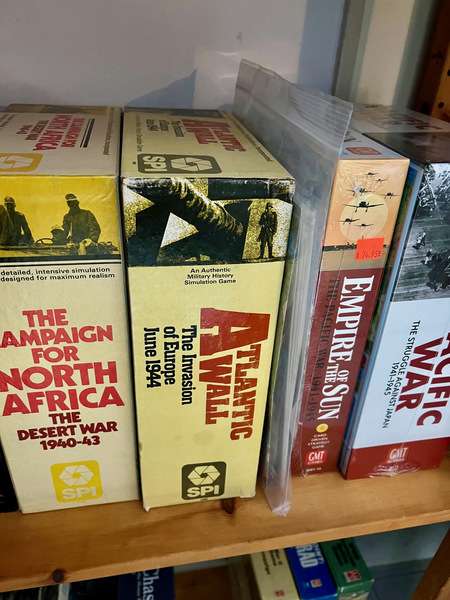
 I think anyone who remembers the heyday of paper, hex and counter wargames from the 1970s and 80s has a fondness for the monster games, multi-map, thousand plus piece mammoths that took up all available space, chewed up thousands of hours, and often never got finished.     The most well-known were published by SPI in so-called "soap box" format because they resembled those old laundry detergent boxes.


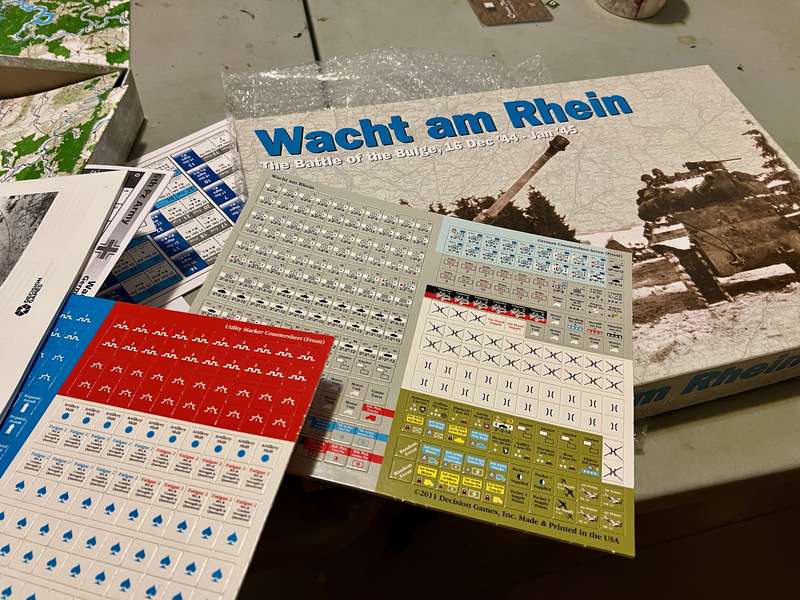
Last December I remembered that I had a Bulge monster game in my stash and I thought it was a good time of year to give it a try.   Wacht Am Rhein is a Joe Youst design, published by Decision Games in 2005, and traces its lineage back to an SPI game of the same title designed by Joe Balkoski and Jim Dunnigan and published in 1977.  There's a lot in the box.


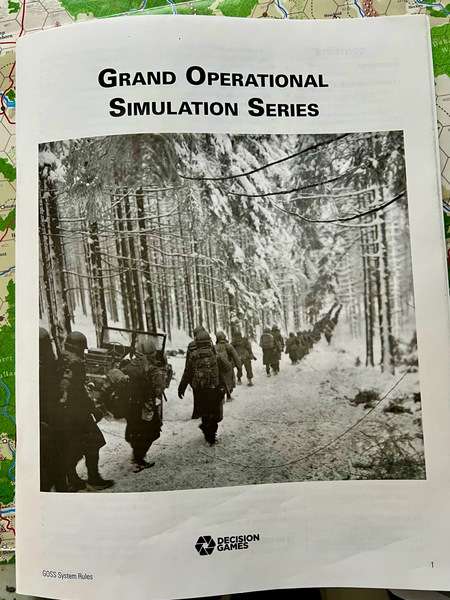
It comes with a big rule book.   The Grand Operational Simulation Series (GOSS) is highly detailed, and is grand-operational in scale, which is one of my gaming sweet spots.  Units are mostly battalion sized, and have three steps; most BNs can break down into company level which is useful when attaching armour to an infantry attack, or distributing AT units among a defensive line.  The system reminded me of SPI's Atlantic Wall which I played a lot of long ago.


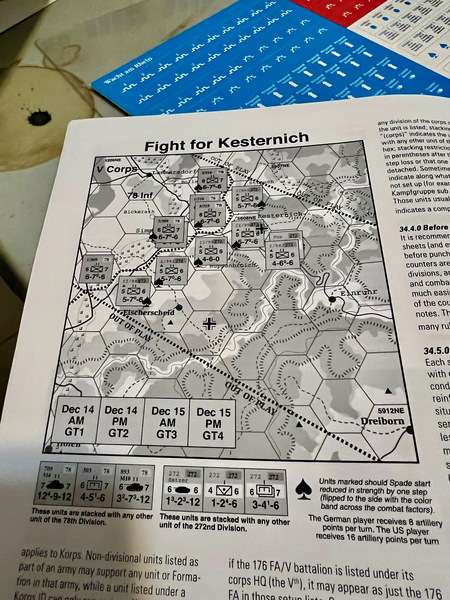
I chose a very simple learning scenario, a four turn (two day) battle called Fight For Kesternich, in which the US 78th Infantry Division tries to capture a ridge on the German/Belgian border guarding the Roer Dam.  Defending the ridge was most of the 272nd Volksgrenadier Regiment.  Historically this American offensive kicked off just days before the Ardennes offensive and forced the Germans to change the northern pivot point of their operation. 


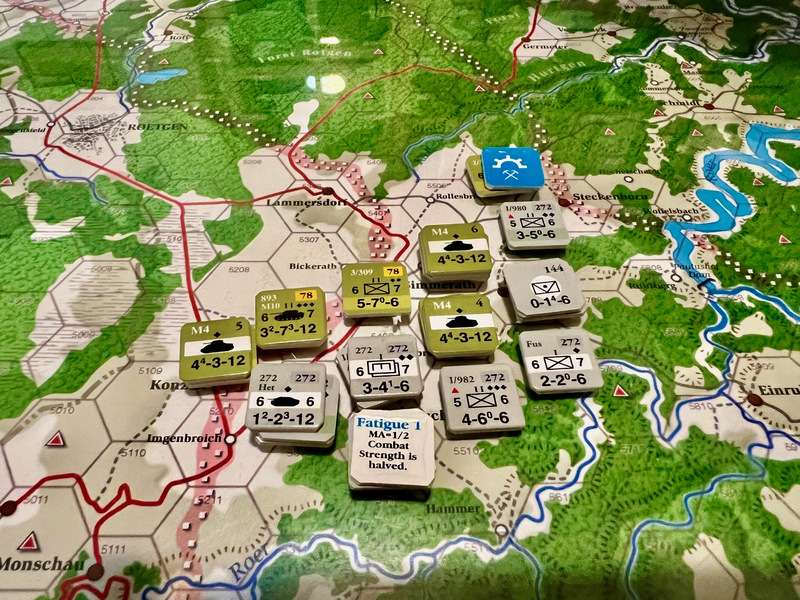
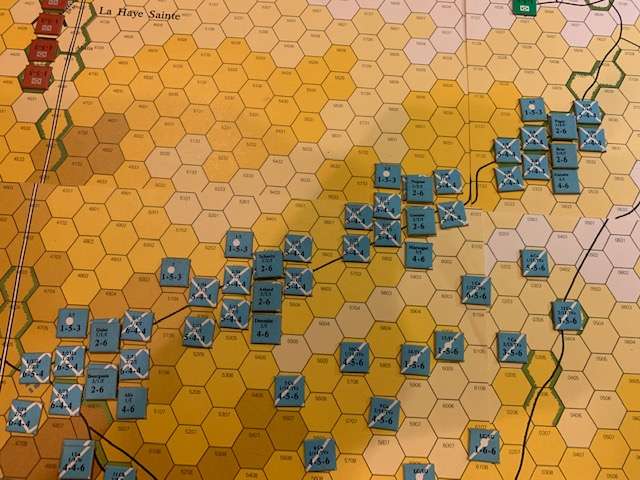
In the scenario, the Americans have two days/four turns to capture two hexes, one being the village of Kesternich (shown below towards the left of the photo, occupied by a stack topped by the German (grey) AT company0, as well as hex 5510 towards the bottom of the photo.  I've broken the US tank battalion down into three companies to support the infantry.    The Germans begin the game entrenched, so are hard to dig out, and there are some hexes occupied by the Germans at start which are rough and restrict the number of units that can attack each turn.  The shot below is taken just after the first US turn, with a little progress made on the attack but the Germans pretty much holding fast.

This learning scenario abstracts artillery, has no weather or night rules, and imposes strict boundaries on the hexes in play.


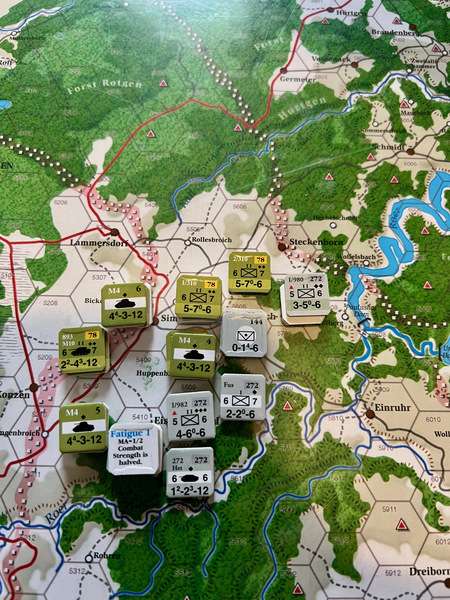
And the state of play at the final turn, No American progress to report, and at the bottom of the photo, the US attackers have actually been pushed back.   Both sides have suffered casualties, and it would be unlikely that the 78th could manage another day on the offensive and still be effective, while the Germans have clung on by their fingernails.

One of the things I like about GOSS is the combat system is quite complex at first, but as you get the hang of it, you see its wisdom.    Terrain determines the starting odds, which are then adjusted for or against the attacker depending on whether the attack is prepared, whether engineers are in support, whether the artillery barrage has been effective, and for the defender depending on entrenchments and, crucially, adjacent enemy units that are not themselves being attacked.   Such shifts simulate supporting and enfilading fire that can be brought to bear on an attack from supporting, adjacent defending units, and they can break an attack.     

Once the odds are calculated, there are a variety of bonuses that can be added to the D100 die roll depending on armour superiority, regimental integrity if more than one BN of the same Regt is attacking, and so forth.  Both defender and attacker roll separately, meaning that an attack can have a NE fail while the defenders' fire is murderous, or vice versa.  Combat results are a tradeoff between step losses, fatigue, or retreats, depending on how badly you want to hold a hex.  A few days sustained combat can easily wreck a division.

So my first attempt at WAR was successful and I learned a lot about the basic system.  The bigger systems have rules for strategic movement, transport, logistics, weather, air support, leaders, etc that I have yet to crack.

It was great fun to make it a little ways up the mountain of this monster game, and I hope to return soon.  The next scenario features the 101st AB defending Bastogne and looks like great fun.

Blessings to your counter clipping!

MP+


Monday, October 16, 2023

Games From My Past

I admit that I was a weird kid.  In senior high school I was poor, had no car, and was thus severely handicapped in the dating game.  What I had was a love of military history, a small income from summer jobs, and an older friend, David, son of my parents’ friends, who introduced me to paper war-games.    Thus I had a subscription to SPI’s house organ, Strategy and Tactics, and an opponent who was happy to beat up on me on evenings when I should have been learning calculus (I never did).   To this day, old hex and counter war-games, especially SPI titles and their distinct, slightly musty smell, are a Proustian gateway to the late 1970s.

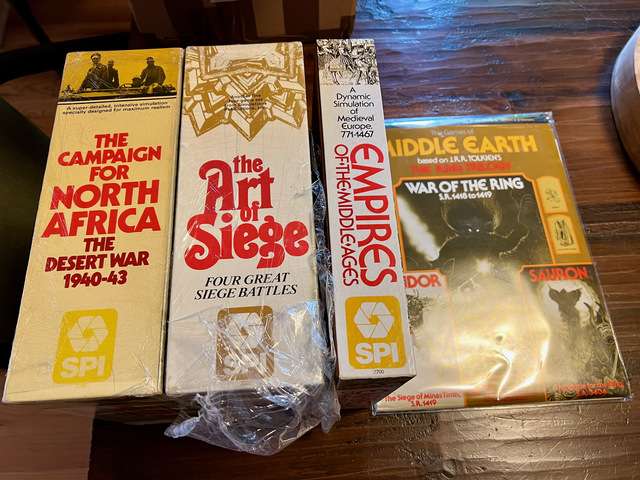
Thus it was with great happiness that I discovered via Twitter a fellow who was selling off a considerable stock of old paper war-games.   I took a bit of a risk in sending him money (I won’t disclose the sum but, while considerable, it was very fair) and then waited while the promised games were boxed.  Once I got a legit tracking number, I figured he was a decent chap, and sure enough a box arrived last week, a sort of time capsule of SPI at the height of its powers in the late 1970s.

Two of these games are well known to me.  I played Empires of the Middle Ages a lot in undergraduate days, and it probably cemented my desire to do graduate work in medieval studies.   SPI’s Middle Earth trilogy was likewise something that I played, a LOT, though sadly I sold both titles during a period of youthful poverty.

The other two titles are ones I’ve wanted for a long time.  Art of Siege features four famous sieges from Alexander’s siege to Tyre to Lille and Sevastapol in the gunpowder era.   Never played, long wanted.  Likewise, Campaign for North Africa is the Mount Everest of paper monster games.    It has a legendary aura, as a ludicrously complex, unplayable white elephant, but as someone who once played Avalon Hill’s Africa Corps, it represents the extreme other end of the complexity scale from that legendary AH game.  Will I play CNA?  Maybe.   Maybe I’ll die with it on the shelf. But I had to have it.

Did I say that these four games were unpunched?

Blessings to your die rolls.

MP+

Thursday, July 8, 2021

#ThursdayNapoleonics: SPI'S Wellington's Victory, the Battle of Waterloo at 12:45pm.

Hello friends:

It’s Thursday and time for the weekly Napoleonic update.   

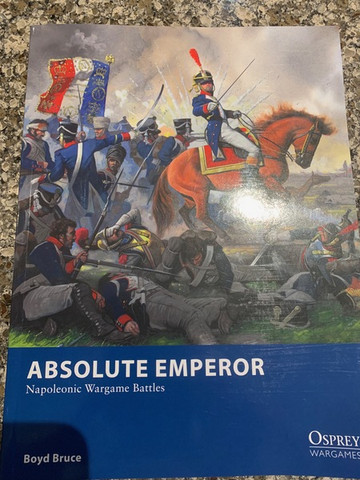
I took a chance on these new Osprey rules, hoping they’d be to Naps gaming what Dragon Rampant has proved for quick and easy (an earlier generation of grognards would have said beer and pretzels) gaming.

Boyd Bruce, the author, promises in his forward that these rules will indeed be simple and fast playing.   It is agnostic to scales and bases, and while the game’s smallest unit is called a division, grouped as corps, the rules still allow for tactical formations (square, column, line) which seems odd to me.   I’ve had to wade through with a highlighter to understand the mechanics, as there is no index or any QR charts, but I think I grasp the mechanics and hope to try it with some 6mm units soon.  More to follow.

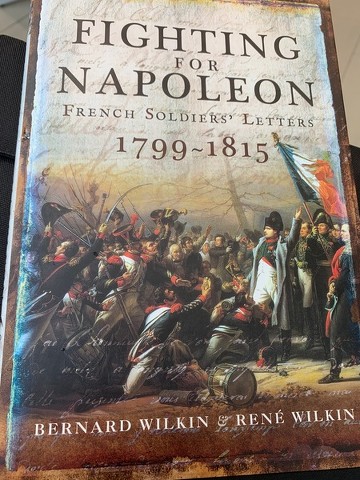
Currently in my bedside reading is this book, obtained from a recent Hellion Press sale.

The authors have done a brilliant job of combing the archives and pulling together letters from a wide variety of soldiers - rankers and the odd junior officer - and  they are generally grim reading.    A typical letter might read:  “Dear Mother and Father, I am tired of war.  Please send me money as I lost my equipment and need to buy more.  I am hungry, cold, have no shoes.  I send my love.”   Many of the letters focus on conscription, trying to obtain release from the army or exemption for younger brothers, and most are very simple, as the letter writers were not all that literate.  Sometimes men from the same village or town would pull together and have someone write a letter  for them, in all their voices.   There are notes for each letter explaining what is known of the soldier writing it, and sadly, many never came home.   Grim reading that inspires respect for the hardships these men endured.

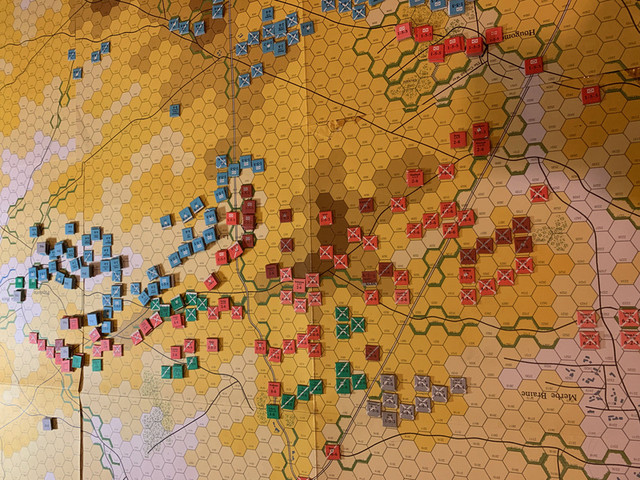
Now, down to the basement and the gaming room, which thus far has remained cat proof.   Here is the Battle of Waterloo having just finished the 12:30pm turn.


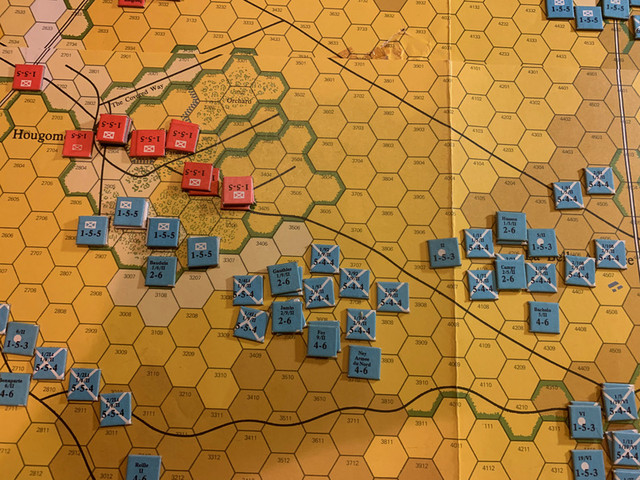
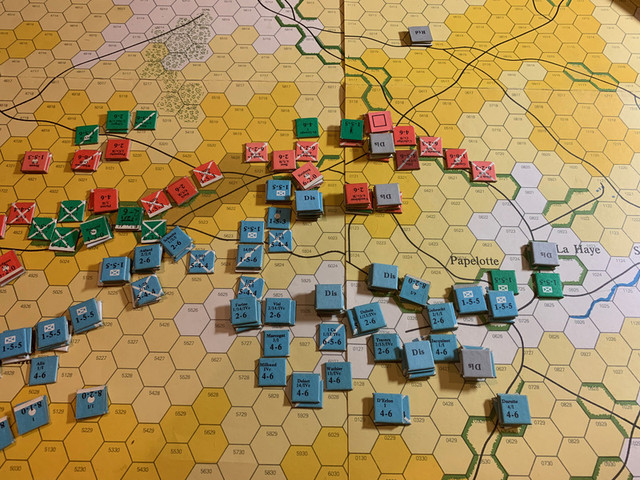
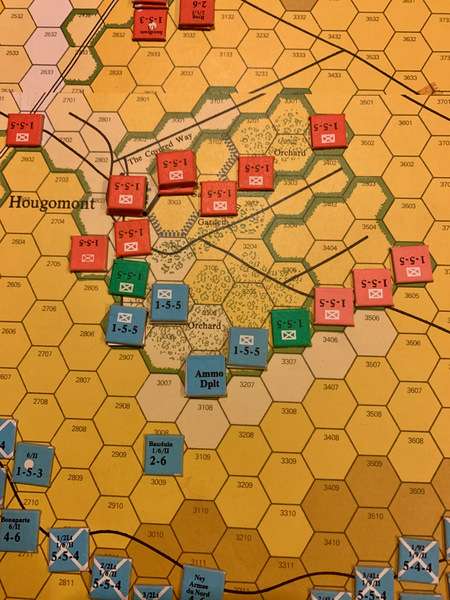
On the right, a token force of French light infantry has forced their way into the orchard of Hougoumont, but show no signs of going any further.  Foy’s and Bachelu’s divisions of II Corps are now committed and appear to be moving towards La Haye Sainte??

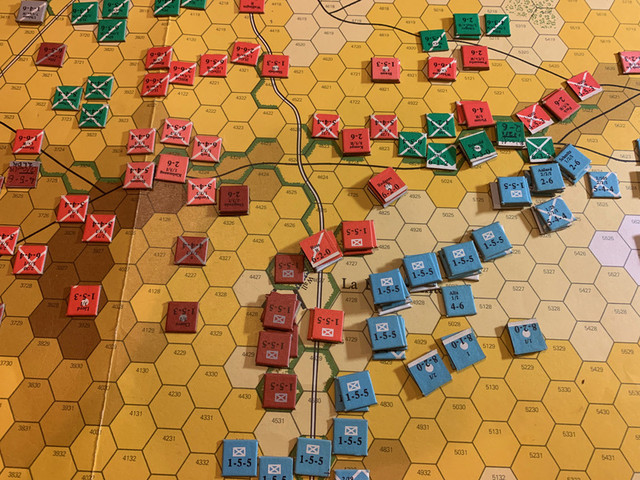
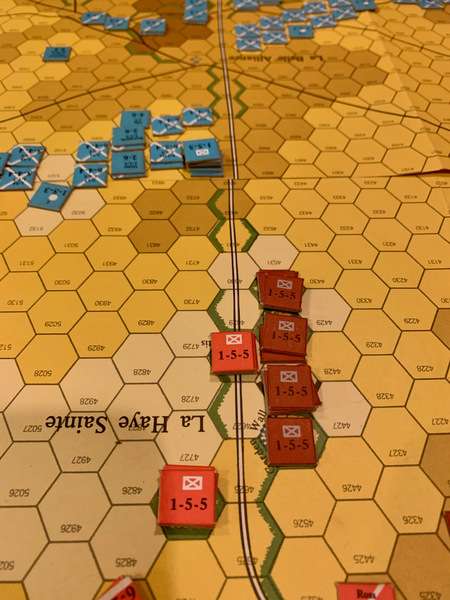
Pressure building on La Haye Sainte and on the Allied centre.  Galling fire from French skirmishers has caused some 300 casualties to the KGL and Rifles holding the farm this last turn.  Allied musketry in response was unlucky.  French I Corps artillery is now unlimbered and ready to fire at long range.

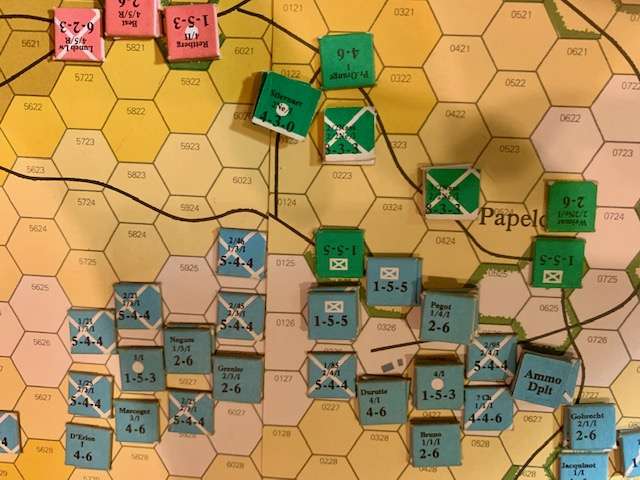
Fighting has been fiercest on the French right.  D’Erlon’s I Corps has been pushing hard, but a company of Dutch/Belgian skirmishers amazingly still hold Papelotte and have already seen off an attack by ten times their number.    Some of the Dutch battalions have broken but the Hanoverians are holding steady and Pack’s redcoats are in line behind the ridge waiting for their moment.   There have been charges and countercharges - Vivian and Vandaleur’s brigades have pushed back Jacqunot’s chasseurs, with losses on both sides.  Of the commanders, Perponcher and Vivian on the Allied side are hors de combat, and Bruno likewise.  Shock combat has proven deadly to chaps in lace coats.

French infantry attacks are proving fragile, as seems right, but the pressure on Wellington’s left is growing and it is a long time before the first Prussian columns appear on the map.

Any advice for Wellington or Napoleon?

Blessings to your die rolls!

MP+

Thursday, July 1, 2021

Thursday Napoleonics: SPI's BIG Waterloo Game, Wellington's Victory, to 12:15pm

For my June project, I am revisiting a game I first played in high school, against a much older and patient opponent, who methodically dismembered me, though if you’re reading this, Dave, you got some key rules wrong!

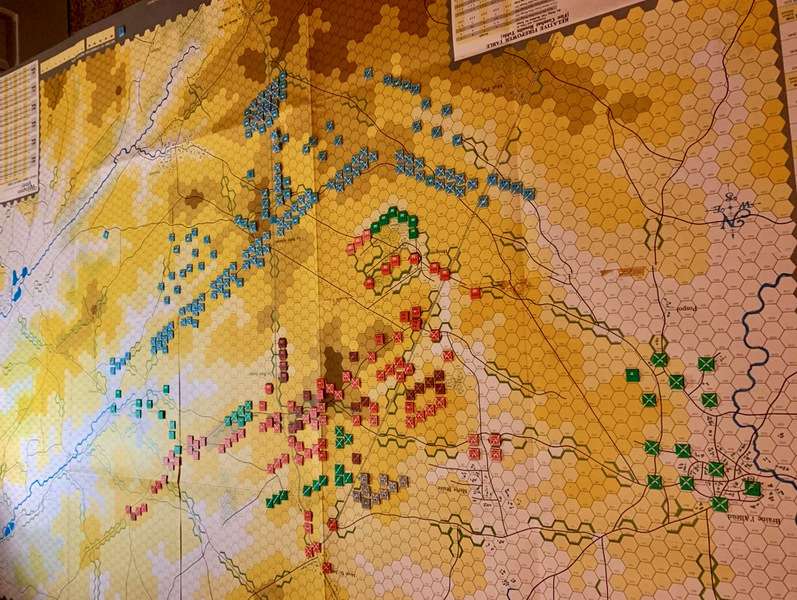
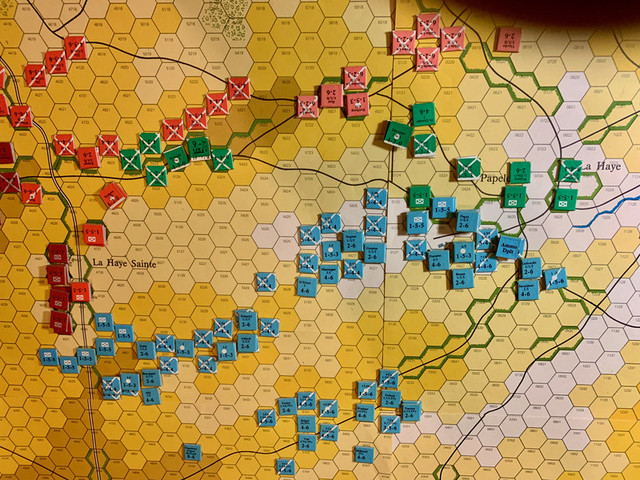
This is Wellington’s Victory, one of SPI’s monster games of the 1970s, and in my opinion there is no lovelier paper, hex and counter game, though the colour choices for the elevations seem quite arid for the rain-soaked spring landscape of Belgium.   Certainly the national colours for the various units are lovely.   Here is the complete setup for the complete Battle of Waterloo, which commences at 11:45 on the turn track.

Any Waterloo game has to assume that Napoleon knows that Grouchy will not come, otherwise it doesn’t make much sense.   So, in this solo game, my object as the French is to throw as much of my weight as possible against the Anglo-Dutch, though the drain of committed brigades on the Army Morale total (let it drop to zero and bad things happen) mean that I have to decide carefully how much of my force to commit at the outset.

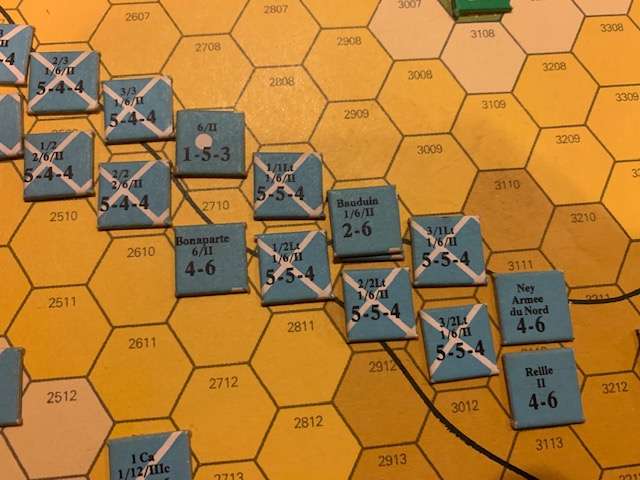
Opening Moves:  French commit Bauduin’s brigade of Jerome Bonaparte’s 6/II Div.  These light infantry battalions will deploy as skirmishers and move against the Hougoumont orchard to keep the British honest.

On the right, me/Napoleon commits all 8 brigades of D’Erlon’s I Corps, as well as the Corps light cavalry division of Jacquinot.  The French plan is to threaten Wellington’s left without getting sucked into the Hougoumont trap while punching hard  against the Anglo-Dutch left.


British throw the 1/95th Rifles and a battalion of KGL lights as skirmishers into La Haye Sainte to reinforce the position.  Meanwhile a regiment of British Guards deploys as skirmishers and moves to reinforce Hougoumont, but no more reinforcements there for now.


D’Erlon’s Corps begins its advance.

French light infantry skirmishers begin to press into Hougoumont’s orchard at bayonet point, both sides taking some casualties.  I begin to feel the magnetic pull of  chateau.  Must Resist!

Close up of the action as the French press against the Belgians and Dutch holding Papelotte.  

Just after this photo was taken in the Allied fire phase, the French columns started coming under cannon fire and three battalions were disordered with casualties.  Meanwhile, Milhaud’s 3rd HvyCav Div is committed and moving up.  Allies responded by committing Vivian and Vanderleur’s two cavalry brigades on the A-D left flank.

More to follow as I play it!   Who knows if I’ll finish the game this calendar year!

Blessings to your die rolls, 

MP+

Sunday, January 24, 2021

Revisiting a Hex and Counter Classic: Napoleon's Last Battles

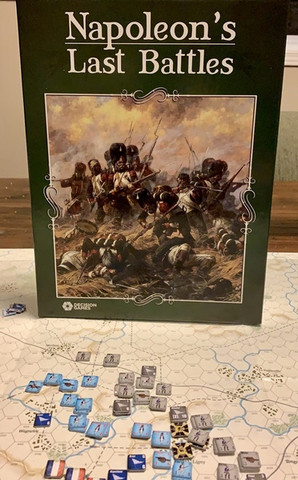
Back in 1976, in the heyday of disco, detente, high inflation, and my vain attempts to get Madeleine Bennett to notice me in Grade 6, Simulations Publications Inc.  published Napoleon’s Last Battles, one of the classic war-games systems.  It was designed by Kevin Zucker, one of the galaxy of talent that SPI’s Jim Dunnigan gathered around him like Napoleon and his marshals.    Kevin went on to found his own company, OSG, and is widely considered one of the authorities on Napoleonic board gaming today.

There is a great review of NLB, including photos of the original counter set, and a thoughtful appreciation of its impact on many subsequent titles, on the sadly inactive Map and Counters blog . on I bought the re-edition of NAB published by Decision Games, which picked up most of the old SPI titles after TSR acquired them.   NLB now comes in a shiny box with new artwork, and the original counters have been updated.  


The scale of NLB is operational, with individual counters representing brigades with combat and movement factors.   Optional rules allow for basic command and control; for example, Napoleon can only give orders to three divisional commanders in a turn if they are within his command range of five hexes, and the divisional commanders can only fully employ their units if they are within three hexes.  Combat is hex to hex, though artillery can add their combat factors if two hexes away.  Combat is a simple ratio worked out on a Results Table that only gets bloody if the odds are 4-1 or above, or 1-3 or below.   Otherwise units will safely retreat unless all possible retreat hexes are within the Zone of Control of an enemy unit.  Hex and counter gamers of a certain age will remember what being ZOCed is and why it is fatal.

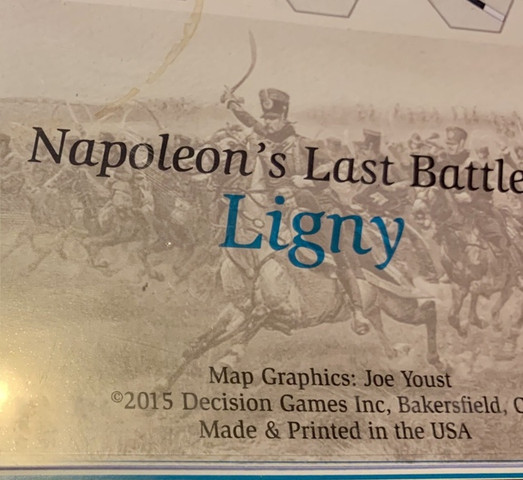
NLB comes with four games (it was the original SPI Quadrigame) of the Hundred Days: Ligny, Quatre Bras, Wavre and La Belle Alliance.  There are of course rules to play all four games as a campaign game.  

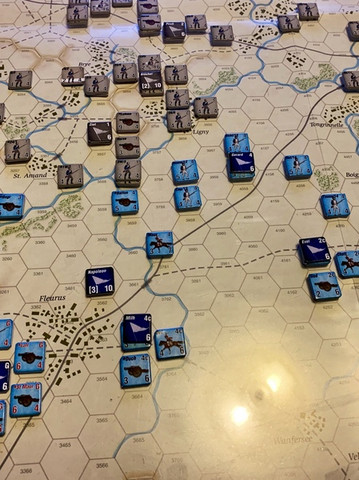
As time only permitted me to play one game, I chose Ligny. 

As in the battle, the French player only has six hours of daylight to inflict serious harm on Blucher’s three scattered corps.   The Prussian must hold with Zeiten’s and Pirch’s corps while bringing von Thielmann’s III corps to the rescue.

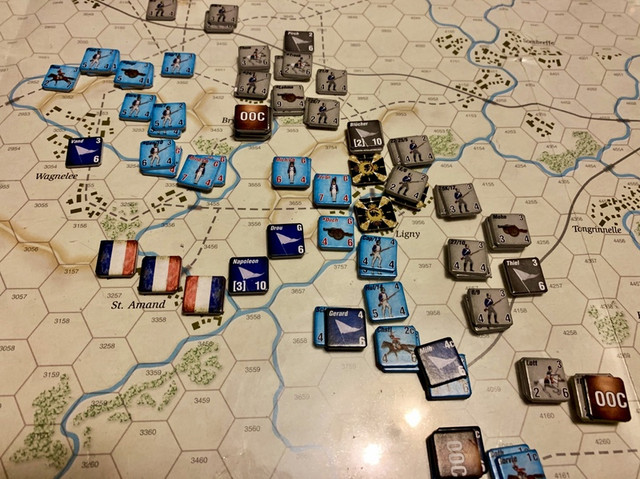
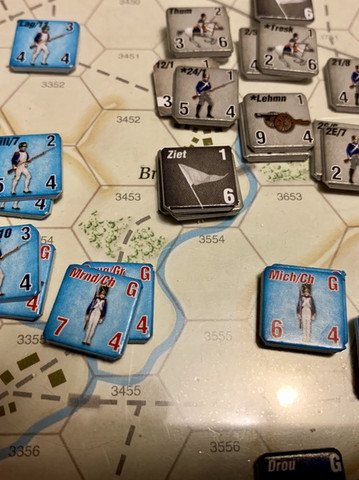
Alas for France, my first run-through did not go so well, as it took me too long to remember how to use ZOCs to my advantage.  At game’s end, Gerard’s Fourth Corps had suffered a mauling at the hands of Von Thielmann’s troops, while the Guard and Vandamme’s III Corps had taken Fleurus easily but were being forced out of Ligny proper.

Hero of the game:  Zieten, who held off Napoleon’s last big attack before twilight and who sent the Imperial Guard packing.  Prussian victory!

NLB is one of those simple game systems that remains fresh and interesting after fifty years, despite it’s new coat of paint in the Decision Games re-issue.  While it might seem dull because its woefully lacking in the chrome that we have since become accustomed to (although SPI’s monster Waterloo Game, Wellington’s Victory, also published in 1976, has all the complexity one could wish for), NAB does the job.  It presents an operational problem in sufficient detail to challenge the player, and delivers a clean result in a few hours, and works well enough as a solo game.  I would be delighted to play it against you on Vassal, if you care to.

 I’m very pleased to have it in my library and look forward to revisiting it again.

Blessings to your die rolls!

MP+

Tuesday, May 5, 2015

Tuesday Night Boardgame: Berlin '85 Update, CCN Napoleonics Wertingen, And A New ACW Game

Hello all!

It’s Tuesday and that means, in my fitful, irregular sort of way, a board game update.   First, an update on the SPI Berlin ’85 game I mentioned here a month ago.  Sorry to those who were awaiting more updates.  That game ended on Day 3 of World War Three as a NATO marginal victory.   Most of the US and British units had been eliminated and the survivors, along with a handful of remaining WG police and militia, were pushed back to the city centre.  The British suffered badly when the American flank collapsed and the East German division got behind them, cutting off their retreat routes.  The lavish amounts of Soviet artillery in the south make it very hard the for Yanks to hold their ground, but they did it long enough for a tiny US battery to shell the key rail line at the south end of the map.  As long as that unit is protected by NATO Zones of Control, it can rack up an impressive score of victory points by interdicting the Soviet supply line to the main front, so it did its job beautifully until finally hunted down and eliminated.  The Soviets never committed their Airborne division, since that comes with a steep cost in VPs.   Berlin ’85 has some interesting optional rules, including the use of Soviet chemical weapons, which would make it much harder for NATO.  The design notes admit that this is a pretty dire advantage for the Soviets, but speculates that the USSR would likely not use chemical weapons in an urban context, given the terrible toll on civilians and resulting propaganda costs.  Fortunately this was never tested.  I’ll put Berlin 85 back on the shelf,as it was one of the better games to appear in Strategy and Tactics in the late 1970s (and there were some bad ones - remember Armada?), and it would be fun to use the unknown strength counter sides of the units in a two player game.

 Last week I had Command and Colors Napoleonics set up on the games table.  I chose the first official scenario from the Austrian Army expansion,  Wertingen.  This battle (8 Oct 1805) came in the opening phase of the Ulm campaign, and saw Murat’s cavalry and Oudinot’s grenadiers crush an isolated Austrian force.  I played it solo and the French won it easily, 5-2.   

Starting positions (sorry for those of you bored by photos of blocks.  Not very sexy, I know).  The Austrians outnumber the French, but the French have 2.5 times as many cavalry units, and a big chunk of the Austrian army is sitting on the right wing, whereas the French are massed against the weaker Austrian left.  

While the Austrians did well early, knocking off a heavy French cavalry unit and killing its leader (sorry, Murat fans), the  French cavalry ground away at the Austrian left, while a timely Flank March card allowed the French to get the grenadiers forward early on.   While bloody for both sides, the end was not long in doubt.  Here’s the view at the end.  The Austrian Left has been entirely eliminated.

I want to go through the Austrian scenarios and see which ones lend themselves to interesting miniatures games.   I have enough 6mm figures to do Wertingen, but I’m not convinced it would be an interesting battle.   The consensus on CCNaps.net is that this is almost an impossible scenario for the Austrians to win.

I can say though that the Austrian army in CCNaps is interesting.  The big 5 block Austrian line infantry units can put out some fearsome firepower, and the Battalion Mass rule allows Austrian line to go into Square without giving up a card, which seems very handy.   I’m looking forward to dipping into more of the scenarios in this Expansion.  Speaking of CCN Expansions, is anyone else excited about #5, Generals, Marshals and Tactics?  

In a future Tuesday Boardgame, I’ll talk about a game that just arrived in the mail, Huzzah!: Grand Tactical Battles of the American Civil War, from One Small Step.

 The designer, Richard A. Dengel, has done at least one other ACW game, Rebel Yell, which I don’t know.  However, the fact that the four battles depicted in this game (Belmot, Newbern, Iuka and Stephenson’s Depot) are fairly obscure, and the small tactical focus of this game, promised to scratch a number of my itches.  There’s a review by Paul Comben here, and a spirited response from Dengel.

Here some quick impressions from my unboxing.  My heart sank as I picked up the shrink wrapped box and heard individual pieces of cardboard rattling around inside.   That didn’t inspire confidence.   Here’s the reason why I was hearing that sound.  Almost half of the counters had detached from the two counter sheets and were rattling around.  Some had infiltrated the folded maps, others had made their way into the rules and scenario booklets.  I tried to be careful not to lose any, but I think sorting the counters out is going to be a bit of a chore.

Speaking of counters, it would have been nice of the publisher, OSS, to have at least included a handful of ziplock plastic bags to store the counters once punched and sorted.  GMT does that, and while it’s a small thing, I think it goes some way to making up for the lost golden days of plastic counter trays that SPI and Avalon Hill once routinely included in their boxed games.

Huzzah! comes with four separate, quite small maps.  Here’s the map for Belmont, which I’m going to try first.  Belmont was US Grant’s first battle, and not his best by a long shot.    The map seems a little dark but it is rich on geographical features and has a pleasing number of charts printed on it, which may make up for the absence of a graphic player aid card (the one reference chart in the box is all text based).

So watch for news of the Battle of Belmont in a future Tuesday Boardgame report.

Before I sign off, I note that today is the anniversary of  the Wilderness, another US Grant battle, and a much bigger one.   I recently read Gordon C. Rhea’s book, The Battle of the Wilderness: May 5-6, 1864.   I know SPI did this battle years ago, perhaps in one of their quad packs, but I’m not aware of anyone who has done a board game treatment since.  It’s a battle that would lend itself well to partial treatment on the tabletop, and I’ve given that some thought, but I’d need a lot of trees.  Lots and lots of trees.  I don’t think one could do the whole battle unless it was in 6mm, as it was a huge, sprawling, confused engagement.  Whatever one thinks of Grant as a commander, and he didn’t exactly shine at the Wilderness, at the end of May 6 he turned his army south, and that was the beginning of the end for Lee and his army.  Not every general would have made that commitment after two days of bruising and mauling battle.  Good fellow, Grant.

Well chaps, it’s past my bedtime, so that’s all for now.  Blessings to your die rolls!

MP+

Wednesday, April 1, 2015

Tuesday Night Boardgame on Wednesday: Still Taking Berlin

Picking up from last week, here’s the board on the dawn of the second day of WW3 and the Soviet assault on West Berlin.   In the bottom left, the East Germans have overrun Wansee and the Americans are falling back slowly.  In the south, 14th Guards have taken wicked casualties in exchanges with US and West German police and have had their teeth pulled.   In the North the French have stabilized their sector but the main weight of the Soviet attack now appears to be falling on the British.

 Here’s a thorn in the Soviet side.  That little green unit between the T and B in West Berlin is a single US battery, but it’s done nothing for the first three NATO turns except execute fire missions on the vital railroad line (see the flame marker at the bottom of the photo) feeding reinforcements and supplies to the main front.  Each fire mission is worth 5VPs to NATO, more than offsetting losses in casualties and objective hexes thus far.  It is totally untouchable for now, the Russians don’t have the troops to touch it.  Most of the red units towards the bottom of the photo are 34GDs Army artillery, not assault units.


Here’s another cool NATO move.  That little brown unit is B Squadron of the Royal Scots Dragoon Guards, the most mobile unit in the NATO garrison.  It’s exploiting some gaps in the line to try and get onto one of those rail hexes.  If it can do it, that will be 10VPs per turn it stays there and will divert some Pact combat units to find it and kill it.

 The butcher's bill so far.   Combat in this game is quite bloody.  

Much as the Pact commander will hate to do it, he may have to ask for release of the airborne division to make the headway he needs.

Tuesday, March 24, 2015

First We Take Berlin (Tuesday Night Wargame)


As mentioned a while ago here, I’ve had a hankering to play an old SPI game, Berlin ’85, a Jim Dunnigan design that appeared in Strategy and Tactics Magazine in 1980.
 
Here you can see the initial setup, from the first of three scenarios, Operation Unity, which assumes a USSR attack on an unreinforced West Berlin garrison with minimal warning.  
 
 
The USSR has three Russian and one Easy German divisions massed to attack, plus the 103rd Guards Airborne Division is ready and may make a play for the city centre.   How long can NATO hold?  We’ll see.

Wednesday, February 4, 2015

Reading Roundup: Wars Past and Future

Not a lot of gaming or painting getting done of late.  I have my head down trying to generate the first draft of my MA thesis in time to meet an April defence date and a return to the uniform and whatever military posting awaits me.  In between thinking and writing about religious pluralism in the Canadian Armed Forces, I do however pick up the odd book or read something non-thesis related just to give my mind a rest.  Here are some reports and recommendations from that front.
 I never blogged anything about the Brad Pitt film Fury when I saw it last fall.  I went with my brother The Mad Colonel, a retired infantry and staff officer, and he was somewhat non-committal about it.  For my part I thought it excelled at catching the feel of tank warfare in World War Two, and the interaction between the characters rang true to what I know of soldiers.  Mind you,  I had some issues with the final scene, where a happy, intact SS battalion was marching around Germany in the last days of the war, singing lustily but had somehow forgotten its antiarmor drills, but I digress.


Recently I stumbled across this interview with Steven Zaloga, an American defence analyst and historian, who thought that given “the limits of what you can do in Hollywood … I thought it was very authentic”.  That made me feel a little more kindly towards the film, and even want to give it a second look.

I was also interested in some of Zaloga’s criticisms of some of the accepted truisms on tank warfare in NW Europe, specifically that the Sherman was a deathtrap (Zaloga says the “Ronson” image is “nonsense”), or that the Allies paid five Shermans lost to take out one German tank (Zaloga attributes this to cliche to an over reliance on British authors and their experiences of Normandy, not true of US-German kill rates at all).  Anyway the article is quite interesting and worth a read.  I found this bit especially interesting, given how war gamers and modellers love the big German tanks and often over-represent them on the table.

“To give you a general sense, in April of 1945 the Germans have about 90 tanks on all of the Western Front.  All tanks, everything, Panthers, Panzer IV, Tigers.  They had a handful of Tigers.  They had about 400 other armoured vehicles, assault guns, Stug III and things like that.  So they had just short of 500 armoured vehicles on the entire Western Front, from the North Sea all the way down to Bavaria and Southern Germany.  At that point in time the United States had 11,000 tank and tank destroyers, to give you some sense of the disparity in forces."

Zaloga's forthcoming book Armored Champion is on my wish list - coming out from Stackpole this May.   Zaloga also recommends a book from his colleague Robert Forcyzk, Shwerpunkt: Tank Warfare on the Eastern Front, 1941-42.  Forcyzk knows German and Russian and uses sources largely unused by popular military historians.

The other day I posted on an oddity from the Cold War.

If future war is your thing, you might want to look at five short pieces imagining what the first shots of the next world conflict might look like.  A US think tank called The Atlantic Council and the War On the Rocks website recently sponsored a contest for creative writing submissions that imagined how such a conflict might spin up, and the five winners are posted here.  Hopefully it’s not a spoiler to let you know that drones and the internet figure prominently in these submissions, as does China and the kind of undeclared, deniable proxy wars currently being perfected by the Russians.   If you’re a resident of a Pacific country, these scenarios might be disturbing.  The conflicts imagined here pose an interesting challenge for wargames designers, in that a generation ago, all you had to do was imagine the Red Army and the Warsaw Pact rolling across the West German border and you’re away to the races.  These submissions suggest that the next war will be a lot more chaotic and fluid than that - see Sydney Freedberg’s Talinin is Burning for an example.

Speaking of World War Three, I used to be quite a fan of WW3-themed wargames back when they were plentiful in the 1980s. They were so plentiful that I recall an interview with Jim Dunnigan in which he said that they kept SPI afloat until ’89, when the Cold War ended and the bottom fell out of that market.  I always wanted SPI’s monster game The Next War, and if you have a copy you want to sell, let’s talk. I did recall a game I  haven’t played in ages, Anyway, I dug out my copy of this classic, and am hoping to play it at some point if I can get another thesis chapter done this week, and if I can get my Longstreet game finished.


The only problem I have is that there isn’t a kitten-proof surface in the house.

Finally, returning to books, our friend Edwin King, wearing his bookseller hat, has started carrying reprints from the History of Wargaming project.  I’ve treated myself to a reprint of the Peter Young classic, Charge! (Ross Mac says it’s an essential read, and who am I to argue with Ross?) as well as Paddy Griffith’s book on Napoleonic Wargaming.  Check out Edwin’s blog and send some business his way.
Blessings to your books,  MP+

Thursday, April 25, 2013

On The Shoulders Of Giants 2: Jim Dunnigan On SPI And Wargaming


A few months back I posted here on an interview with Don Greenwood, formerly of Avalon Hill, as run by David Dockter on his excellent Guns Dice And Butter blog. While on David's site I noticed that he had also recorded an interviewwith wargaming legend Jim Dunnigan, the founder of Simulations Publications, Inc (SPI), and resolved to go back and listen to that interview when time permitted. I've now done so, and the interview unleashed a horde of gaming memories and thoughts which I'd like to share with you. Hopefully I'll say something interesting.
A small(ish) preamble is necessary here. When I was a kid in a small town in Western Canada in the mid 1970s, my older brother Alex introduced me to a copy of The Courier, a small mimeographed newsletter in a construction paper cover that introduced me to the world of toy soldiers. God alone knows how The Courier found its way to our little town in the Rockies. I saw photos of grown men playing battles with stiff toy soldiers of Scruby/early Minifigs vintage on tables adorned with wooden hills and model trees, and I wanted so much to do that. But I was a kid and my allowance and paper route money wouldn't go allow for armies of toy soldiers, so that dream got deferred for the day when I would one day be a grown up.
That kid grew up and now owns more toy soldiers than he could possibly imagine back then, so the story ends happily, but it wasn't so sad in the middle, either, because that little kid discovered paper wargames thanks to two people: David Lewis and Jim Dunnigan. David Lewis was the son of friends of my parents, and he was living at home while pursuing a summer job. David became my hero. He had just finished a degree in history down island at the University of Victoria. He was worldly and listened to Boz Scaggs and Fleetwood Mac, which opened my ears to adult music, and he introduced me to paper wargames, starting with a great SPI Waterloo monster game called Wellington's Victory, a Frank Davis design that had just been published (1976). With the abundant patience of a surrogate big brother, David introduced me to the world of adult wargaming that Jim Dunnigan had opened up to us with SPI. I still have a treasured copy of this game that David gave me as a gift.
That year, 1977, I persuaded my parents to get me a copy of the SPI house magazine, Strategy and Tactics, which came with a game in every issue, and a lot of the S&T games I got were Dunnigan titles - Berlin '85 was a special favourite of mine because it was scary cool at the time to think about World War Three and it had some innovative mechanics, including unknown unit strengths, so that when you moved a unit into contact you flipped it to the revealed strength side to find out how good it was. That same mechanic featued in a bonus game that came with my S&T subscription, Panzergruppe Guderiananother Dunnigan title.
While the artwork in the SPI maps and counters of that era was primitive compared to those published today by the likes of GMT and Victory Point, there was a cool modernist vibe about SPI that appealed to me. The sleek plastic boxes with their build in counter trays had a space age aesthetic that the Avalon Hill bookcase games didn't have (almost everything about AH was stodgy and slightly dull), while the SPI cover art and counters were minimalist but appealing.
When I was a high school senior I lost touch with David but remained connected to SPI. My proudest possession in those years was their monster game Atlantic Wall, a divisional level treatment of Normandy where the smallest unit was the company(!). Through most of Grade 12 I had all five maps spread out on my bedroom floor and tiptoed around them to and from bed. My parents were bemused. I had the sense that I was somehow touching history in a real sense, and even if I didn't really understand all the nuances of the Normandy campaign I felt I was doing something very important and grown up.
When I went to college in 1980 I fell in with role players who mostly played Dungeons and Dragons, and there never seemed to be the room or time to spread out a big game for any period of time. In the mid 80s came graduate school and a turn to miniatures gaming, so that decade wasn't very kind to my boardgaming, and in the 90s I alternated between computer games and miniatures. One of the computer games that consumed a lot of my time was an early MUD, a multiplayer online game, Hundred Years War, hosted on the GEnie network (anyone remember GEnie?) that was a Dunnigan design. Little did I realize then that the evolution of my gaming life in the 70s, 80s and 90s pretty much matched the rise and fall of SPI and paper gaming.
In the GDB interview, Dunnigan doesn't talk a lot about his own designs, but he does describe with broad strokes how SPI came on the scene in the 70s and took wargaming in a direction that the more conservative Avalon Hill wouldn't go in. You get a sense of how clever this guy was in seeing opportunities, such as the appetite for contemporary/Cold War games, particularly from US military gamers, that led to titles such as Red Star/White Star. My own personal favourite was Dunnigan's World War Three (1975), a grand strategic game based on his WW2 engine, where players had a limited number of nukes which could obliterate whole hexes and all the fleets and armies therein, but each time at the risk of triggering a global nuclear exchange which ended the game. My younger brother and I blew up the world quite a few times playing that game. An interesting moment in the GDB interview is hearing JD describe how interest in contemporary gaming declined precipitously ("it fell of a cliff" is JD's phrase) after the Cold War ended.
Another takeway from the interview is what a tech-savvy businessman JD was. SPI was brilliant at capturing user feedback and figuring out what gamers wanted. In a pre-Kickstarter era, each issue of S&T would float several design ideas and make production decisions accordingly. I remember poring over the stats and rankings at the back of each issue of S&T, numbers that Dunnigan himself crunched using the programmable computers of the day. The interview also shows that JD had a pretty shrewd idea of what games would sell, and of how SPI's SF and fantasy titles would merit larger print runs (maybe 10 to 12 thousand) than the historical titles did. Several non-Dunnigan titles of that era, War of the Ring (1977) and their thinly-disguised Star Wars ripoff, Freedom in the Galaxy (1979) were friends of mine in high school, as was their terrific little Creature That Ate Sheboygan a homage to the old Godzilla-type movies of the 1950s and 60s. I regret that I have parted with these titles over the years. I suspect that every kid like me who bought Freedom in the Galaxy subsidized SPI's clunky monster games like their legendary Campaign For North Africa.
The trajectory which led to SPI's demise in 1982 pretty much describes the evolution of my own gaming life in those years, which wandered away from paper wargames into roleplaying, computer gaming, and miniatures. AS JD describes it, paper wargaming flourished in the 1960s and 70s because a well educated generation came up that was ripe for the kind of mental and imaginative challenges that wargaming offered. The first crop of AH games offered the appeal of chess, two players locked in an intellectual battle, but SPI exploited the idea that any conflict or historical period in time could be presented as a simulation, which added an extra dimension to the basic appeal of the game. By the late 70s, however, a number of factors, including the rise of TSR and D&D, and the coming microcomputer revolution, spelled the doom of big wargaming companies that were built on the publishing business model. SPI lost customers like me because we had more hobby options in the 1980s.
In the middle part of the interview JD makes a few interesting comments about how miniatures gaming survived and grew as a hobby despite the decline of the paper wargame. He rightly notes that miniatures gaming was always a niche in the hobby, with a high cost of entry in terms of time and money to paint the "figurines" (sic) and to master what he calls the "arcane" rules, but the people who got into the hobby (as I wanted to do when I was a kid lookng at those Courier magazines) were always loyal and enthusiastic. In JD's opinion the limitation of miniatures gaming is that it only allows for tactical games, rather than the grand strategic games that make up so many of his 100+ published designs. While this comment may be true of many club and convention games, a quick survey of wargaming blogs shows many examples of tabletop games that are driven by rich and complex strategic designs.
Another advantage of tabletop gaming that JD doesn't necessarily realize is that his own comments in the interview about how good designs should allow for players tweaking and customizing games (variant and what if scenarios, for example) is eminently true of miniatures gaming. The only limits to how we as gamers can modify history, explore what-ifs, etc are our imaginations and the number and type of figures/models available to us.
At the end of the interview, JD makes some comments on the barriers to entry to wargaming that apply to all parts of our hobby. The idea that wargames are difficult to learn and play, the "I'm not smart enough to do that", certainly applied to an SPI monster game in its day, and applies equally to many tabletop games, though we've come a long way from the scary, brain-busting rules books of the WRG era. JD is a great believer in turnkey solutions, giving the new player everything he or she needs to get started and making entry to the hobby as painless as possible. Those of us who mock companies like Battlefront or Games Workshop might do well to remember that they understand how to get new people/customers into the hobby. The strategic alliances developing between Warlord Games and Osprey, or the Battlegroup rules affiliated with PSC, or moves that JD would approve of.
Hearing David and JD talk for almost ninety minutes is a great treat. Love him or hate him, Dunnigan was a key player in our hobby. He had a great, even modernist, belief that with enough data and a spreadsheet you could model pretty much anything. His best games had a few brilliant mechanics, and his strategic level games often included clever political and economic subsystems. Empires of the Middle Ages (1980), another SPI game I have sadly let go of over the years, is a brilliant example. Dunnigan also had a belief technology should be explored and exploited, and he knew that much of what the monster paper game tried to do could eventually be done better by a computer. Today companies like Matrix Games show his foresight. For miniatures gamers who still keep a foot in the paper gaming tradition (or are returning to it, as I am), he's someone we all owe much to. If you want a trip down memory lane, or want to see an annotated list of Dunnigan's 100+ designs, Dockter has one here.
Now, where's my copy of PG Guderian?
Blog Archive

Followers