Showing posts with label 20mm World War Two Figures. Show all posts

Monday, September 30, 2019

A Tale of Two Typhoons

Hello friends.

Breaking silence from a fairly busy final year of work in a new job.   By final year, I mean retirement from the Canadian Forces in June 2020. , which I quite look forward to.  By new job, well, I like it and it keeps my busy, so all good.

Not a lot of hobby time of late, but I have been on a bit of a model airplane kit.  Not sure why.  I built quite a few plastic kids as a kid, and it’s enjoyable to revisit that part of my past.

At least a decade ago, I bought an Airfix 1/72nd scale Typhoon for WW2 gaming.   It was typical of the old Airfix kits, a few parts, poorly moulded, and not very interesting.  I made a start on it, lost interest, and forgot about it.  Found it last year, realized I had lost the clear plastic canopy, and took a chance on emailing Airfix customer service to see if I could get a replacement.  Lo and behold they sent one in the post, free of charge, and that inspired me to finish the job.   

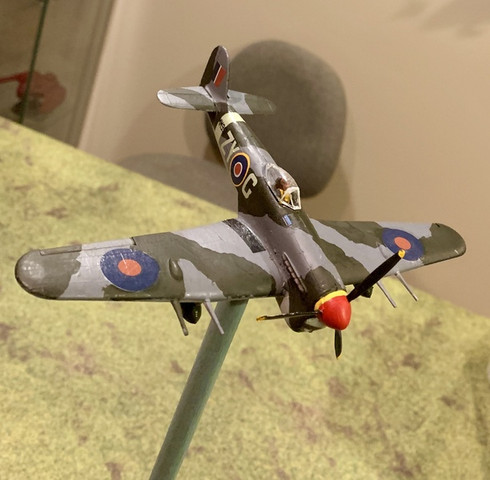
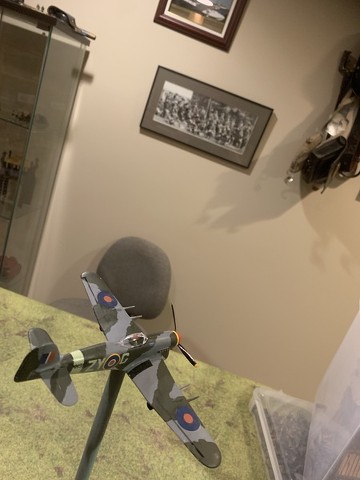
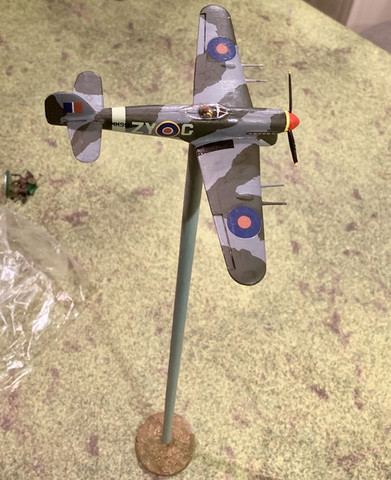
A fairly simple paint job, and here it is, ready to make a brief appearance in a 20mm war-game as the scourge of some poor panzer.

Zoom zoom.

Typhoon on a stick.  The stand is a fairly thick piece of dowel with a nail at the top, which inserts into the bottom of he fuselage.   The bottom of the dowel is glued onto a base which is heavily weighted by a large metal washer.   Works fairly well.

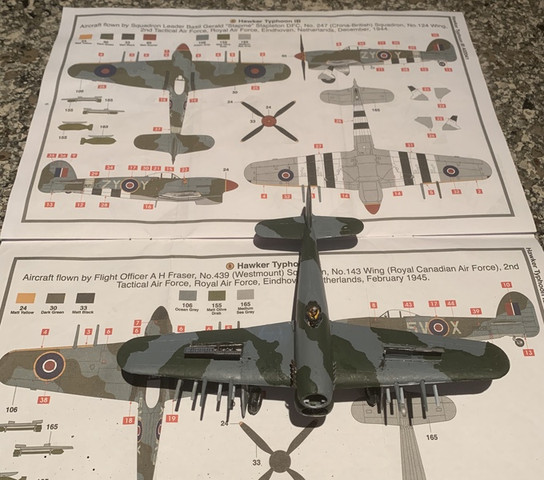
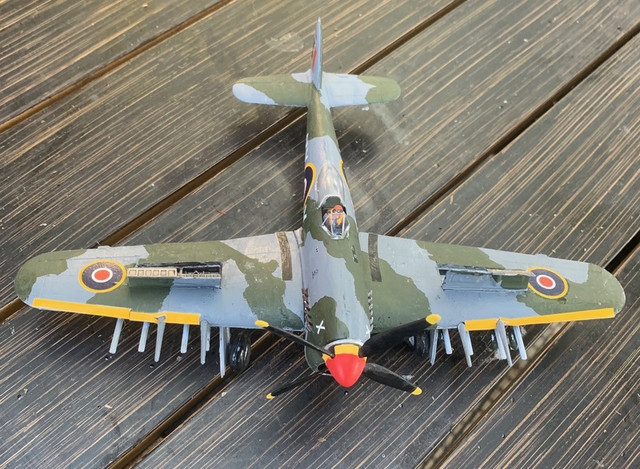
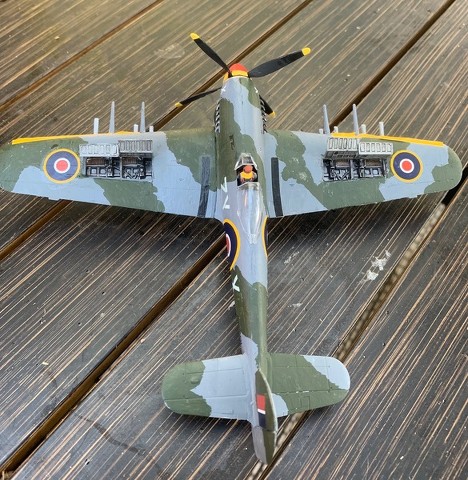
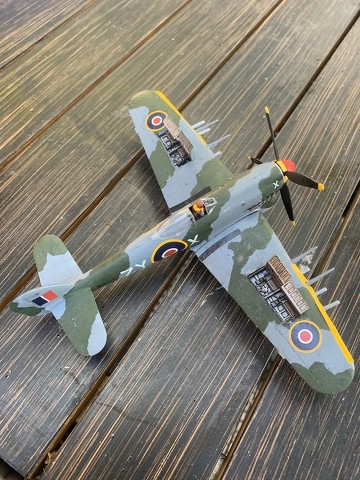
I enjoyed making this so much that I went out and bought another one, a fairly new release, and I was pleasantly surprised to see how much quality Airfix has put into their products.  The quality of the parts, the complexity of the model, the detail of the instructions and the options for assembly were all vastly improved over my old Typhoon kit.

Here’s the finished product in the decals and paint scheme of a Typhoon in a Canadian squadron in early 1945.  I chose to make it with the landing gear down, which is always a tricky business for me, as the parts can be fiddly in the smaller scales and the strut assemblies sometimes lack strength to support the model.   Here it worked fairly well.

The kit includes the possibility of opening the gun compartments, which appealed to me, even though it required some delicate surgery with a craft knife.   That and the open canopy suggest that the pilot if waiting for the final check by his ground crew.

What does this have to do with wargaming?   Nothing, really, but he will sit on a shelf behind my desk at work, and it gives me ridiculous amounts of pleasure to glance at it from time to time.


What have you made, not for gaming, but just for the pleasure of making it?

Sunday, September 18, 2016

Italieri Country House Finished

While I had my light box out recently, I thought I would grab some shots of some work completed earlier this year but never shown here during the blogging doldrums.

This is the ever-popular 1/72nd scale Italieri Country House (Product # 6074), a mainstay of many wargames tables.  Made of sturdy plastic, with an easily removed roof and second floor, it’s a gamer’s delight, and easy to assemble, though I confess that I bungled the upper floor on this model by putting two of the supports in the wrong places and not noticing until the glue was dry.  Not that you can tell, from this view, and the floor still works, but it is the annoying sort of mistake that comes from being overconfident.

I am not sure if this model is still in production, as it doesn’t show on the Italieri website.


I painted it more or less to match its cousin, the Italieri Country House with Porch, which I assembled and showed here in 2014.  I think this one came out a little better than the first.  The vines on the walls are a laser cut painted paper product from a model railroad store, supposed to be Virginia Creeper, I believe.   I thought it halped the rustic vibe.  As with the first model, the walls were copiously washed with Army Painter Light Tone from a tin, then sprayed with Dullcote to get rid of the shine that product leaves.


 I have seen photos on the inter webs of some of these models lovingly and effectively based, but I think for now it just goes in the box with the 20mm scenery items.   It may be useful in 28mm games as well if you don’t look too closely.


My Italieri village thus far.  That’s Luigi, the Fell Catbeast of Mordor, in the background.  

Italieri also makes a church in this scale, which like the country house models could pass for anywhere in Southern Europe.  Would be nice to have, and I see today there is also a ruined house and a stone house model in their range, so maybe one day.   As I finished this model I sometimes wondered why I do WW2 in this scale when I do it in 15mm and 28mm.   That seems like a rationalization to kick down the road for another day.

Thanks for looking and blessings to your buildings!

These figures bring my 2016 totals to:

28mm:  Foot Figures: 56; Mounted Figures: 8; Buildings: 2; Terrain Features: 4

20mm:  Buildings: 1

6mm:  Mounted figures:  36;  Buildings:  2

Thursday, September 24, 2015

Reworked Russkies

Back in the 1990s I started building a Soviet army in 1/72nd / 20mm.  Some were ESCI figures, of which I still have this box to paint.

 I had a copy of the Osprey book on the Red Army in the Great Patriotic War, but not a lot of painting smarts, so I tended to paint them all in Tamiya Flat Earth brown, so they looked like this.  The basing was pretty minimal - cereal box cardboard with green paint and some simple green flocking.  I’ve taken these chaps off a base so I can repaint them in dribs or drabs, as the spirit moves me while at the painting bench.


I’m fairly happy with way I’ve been able to clean these figures up.   A fairly simple process.  Following a speed painting tutorial I saw once on The Guild website, I did the helmets in Vallejo Russian green, the tunics in Vallejo Dunkelgelb primer, and the trousers in Vallejo Russian Uniform.  I left the red leather belts from the original paint job untouched, but added some fresh black to the books, some Army Painter gunmetal silver to the SMGs, and some Citadel Bestigor Flesh to touch up the faces.  I then hit them all with Army Painter Strong Tone wash.  Basing done to my usual spec for 20mm WW2 fire teams, a piece of MDF cut with a circular saw and my normal SOP for terrain and flocking.

I like the running figures, they have that rugged, determined quality of Soviet Realist artwork.  Onwards, comrades!

Hopefully they’ll last for another two decades of gaming.

Blessings to your brushes!

MP+

These figures bring my 2015 totals to:

28mm:  Foot Figures: 35; Mounted Figures: 10, Artillery: 2, Vehicles: 2, Scenic Pieces: 2

20mm:  Vehicles: 1; Artillery: 1, Foot Figures: 6

15mm: Armour/Vehicles: 5; 15mm Scenic Pieces: 5

6mm:  Scenic pieces:  7


Tuesday, September 15, 2015

I Take The Chain of Command Challenge

If you live on Planet Lard, you’ll know about the Chain of Command Challenge.  Following  a very erudite and thoughtful post by the Aussie blogger Trailape, on the merits of Too Fat Lardies’ WW2 skirmish rules versus the leading brand, Big Rich of TFL has invited other war gamers to try Chain of Command and post their thoughts on it.

I’ve been a Lardite for some years now, and before CoC came out I was a devotee of their previous skirmish rules, Troops, Weapons and Tactics, which suffered from an unfortunate acronym.   I quite enjoyed these rules, but have played CoC enough times to find it a superior set of rules.   The card-driven sequence of TW&T and the mechanism of initiatives that can be claimed by other player as they draw their leader cards (very similar to the system in TFL’s Sharpe Practice rules) was clever, but the use of dice to generate initiatives in CoC is much easier and, I think, far more subtle.  CoC is a better system than its predecessor, I think.

So I’m not sure, being a servant of the Lard, that I really qualified to take the Lard Challenge, but I decided to reset the table that I had created last week for a OHW scenario, with a little more scenery to reflect a more nuanced tactical game.   Same idea, there is a stream with two crossings (bridge and ford) and victory to the side that is able to control both crossings.  Here’s the table after the end of the patrol phase.   Both sides have Jump Off Points within 18” of the stream.

I tried to do my bit for technology and tweeted the game while I was playing it during my spare time in the last week.  You can follow me on Twitter (@madpadre1) or by using the hashtag #spreadthelard if you’re so inclined.  This report will be a little less detailed.

Germans get two rifle squads up to the stream.  First squad in the lower picture pushes its rifle team across and into the woods, hoping to dominate the open ground that the Russians must cross.

Russian support choice rolls onto the table - a KV1, headed for the bridge.  That’s an old ESCI model.

Russian LMG team on a hill peppers the rifle team in the woods and does a surprising amount of damage over several turns, killing one landser and spreading shock.

While another Russian squad exploits its jump off point on the road to rush forward and catch the German second squad as it slowly fords the stream.   They will also do damage, and force the Germans, now flanked, to abandon their questionable decision to hold the far bank of the stream.

It takes a while, but the KV1 lumbers forward and onto the bridge, which is covered by the German third squad in the woods.   I decided on a low (5%) chance that the bridge would not support this heavy tank, but the bridge holds. KV1 now begins happily shelling the Germans in the wood.

Sometimes a game hinges on one or two key plays.  In this case, I had deduced to randomize the German support choices, and got a flamethrower team, which was attached to third squad.  Since the Germans have a second turn (two sixes in their Command dice roll) they rush the flame-thrower team into the open, planning to hose the tank with flaming death in their next phase.  At the same time, the German panzershcreck team which is part of platoon HQ also rushes forward. If the flamethrower doesn’t cook the tank, maybe they will.  Sadly, the Soviets have a Chain of Command dice, and use it to interrupt the Germans.  The KV1 opens up with coax and wipes out the flamethrower team.

However, the panzershcreck team is untouched and takes its shot. It’s about 20 inches range, and that stone bridge partially obscures the KV1.  But, incredibly, the AT team rolls an “11” on 2d6, enough to hit!

A satisfying handful of dice get chucked.  Thirteen German strike dice (white) hitting on 4-6 for the flank shot, vs the KV1’s 8 five.  Sadly not enough for the tank.

Hurrah!  Feldwebel, get those men some Iron Crosses and an extra bratwurst, they’ve deserved it.

That was about it.  I realized, quite late in the game, that I had handicapped the Germans by not giving them their 8 dice for their belt-fed MG42s, instead giving them the same 6 dice that the Russian LMGs got.  Once I sorted that out, and with three intact LMG teams, the Germans were able to keep the Russians at bay when they got up to the stream, and it ended in a German victory.  What a nail biter!   The German landsers had taken a real beating in their hasty and bloody retreat back across the stream, and if the AT guys had missed the tank …  a very satisfying and suspenseful game.

Last night, I took my 20mm kit to what has become my new games club, an eclectic bunch that plays boardgames and miniatures just as happily.    I set up a busy looking table somewhere in Normandy, using my German and British figures.   Sadly, I was too involved in helping run the game to get many pictures, and while we didn’t get a complete game in, we had fun.


Tommies (Valiant and Revell figures from my collection) line a hedge and prepare to open up on the oncoming Germans.   Of the three other fellows, two had played CoC before and quite liked it, finding it more realistic than Bolt Action.   The third had played Disposable Heroes and Flames of War, but had never played CoC before, and he had very complimentary things to say about CoC after his first game.


Two games in a week was a real luxury for me, and confirmed my fondness for these rules.   Even though I’ve played CoC about a dozen times, I still find myself getting things wrong.  In last night’s game, I gave a -1 to a German panzerschreck team when they deployed onto the table and took a shot on a Cromwell.  I had ruled that deploying onto the table counted as a move, and I was wrong.  Rule 4.3.1 clearly states that troops deploying onto the table cannot move in the same turn as they deploy, but they can shoot to full effect.   

I suppose the second game, which allowed a war gamer to try CoC for the first time, allows me to qualify for the Challenge after all.  :)  If reading this post or my tweets has you curious, you can get yourself over to the TFL shop and save 20% on CoC purchases for the rest of September!

Blessings to your die rolls!
Tuesday, September 8, 2015

Two Cheers for One Hour Wargames

I’ve had my second chance to take Neil Thomas' One Hour Wargames out for a test drive.  The executive summary of my thoughts as processed through my many biases:  great scenarios, but only ok games.   

I tried an early scenario (#4, I think) where both Red and Blue start off the board, with a river in the middle.  Red and Blue both get six units, determined randomly.  The objective at the end of fifteen turns is for one side to control both the bridge and the ford.  Here’s my appropriately simple table.   Besides the river with the two crossing points, the only terrain items Neil calls for are a hill SW and a forest NE.  I added some fields because the poor old table looked so naked.

For this battle I decided that my 20mm WW2 kit would make a nice change from the medieval battle I tried last time with OHW.  Red (of course) are the Soviets.  For them I rolled 1 tank 1 AT gun, and four infantry.   Blue (German) get 1 tank, 1 mortary,  and four infantry.   Because I was using a bigger table than the 3’ by 3’ that OHW calls for, I doubled the movement and range distances.    Here the Russian tank has reached the ford, while the AT gun approaches the bridge.   Three Russian infantry groups in the open, and one in the woods top right.  Germans brace to meet them.

Russian AT gun moves up to the stream, while infantry rush across the bridge.   Notice my brave Naval Infantry leading the way.  That gun looks suspiciously like it belongs in the Fall of Berlin, not out by this lovely stream.

Russians taking fire.  15 hits on a unit eliminates it.  Combat in OHW is brutally simple.  Each shooting unit rolls a dice and adds or subtracts modifiers, thus generating the number of hits.  For example, infantry vs tank roll 1d6 -2.  Tank vs tank roll 1d6 +2.  The Soviet infantry are also getting hammered by the German mortars, 1d6+2 vs infantry, while the T34 is getting roughed up by the PZIV and the supporting infantry.

But the Jerry tank is KOed by the T34 and AT gun, while Soviets rush over the bridge.  That tank, by the way, is a Britannia resin model I splashed out on a few years back, and very nice it is.

Casualties mount as the infantry duke it out.   The naval infantry did their job as bullet magnets and allowed the supporting squad to cross the stream.

With two hits remaining to it, the T34 (an Armourfast model) charges the hill occupied by the mortars (represented by the command figure) only to be KOed by a lucky shot from the infantry in the background.

Game ended on Turn 9 with all German infantry wiped out, and two surviving Russian infantry racing for the hill to take out the mortars.   I decided it was a Russian victory.

So an enjoyable game, and easily played in a hour.  It would be churlish to say anything bad about a rules set that aims to deliver a complete game in 2-3 pages.   So, if one wants a game with:

1) No leadership rules

2) No morale rules - you fight to the last man

3) No troop quality rules - everyone fights the same

4) No range effects - units shoot the same at long range and short range

5) No casualty effetcs - units fight as well with all 15 hit points or with only 1 remaining

… then this game is for you.    I also have to say that I didn’t find the WW2 game that different from the medieval game I played.  Both felt slightly generic.

However, as I said, I am being churlish.   The book delivers short, playable games that would be good introductions to the hobby to newcomers and young people, and I suspect have some tactical complexity that I have not yet begun to appreciate.  I could even see a niche subset of tournament games using these rules.   More importantly, OHW delivers an excellent supply of scenarios, and as I’ve said here before, I really really suck at designing good scenarios.  

Having set up this board, I decided to use it and the control the river crossings to revisit my favourite tactical level WW2 rules, Chain of Command. This is to do my bit in Too Fat Lardies’ Chain of Command Challenge for September.  I kept it as Soviets vs Germans, but made the table a little sexier to reflect a more tactical environment.   If you wish, you can follow my progress on Twitter, as I will be tweeting updates as time permits.  Follow me at @madpadre1 or by hashtag #spreadthelard.  I’ll do a complete report here when the dust settles.

Blessings to your die rolls!

MP

Sunday, June 28, 2015

Revell Krupp Protze and a Basing Blitz

I had a great game last night with Rabbit Man and the gang.  I’ll write it up anon but you can read James’ account of how the Fascist hordes were stalled on the road to Moscow.

I haven’t made a plastic kit in a while.  I found this in a local hobby store some months ago and thought I’d use it to keep my hand in.  It’s the Revell Krupp Protze truck with 3.7 cm anti-tank gun. It will be useful for Chain of Command games, which make sense for my 20mm collection.

I don’t think it quite dawned on me that this was a 1/76 scale kit.   All the other Revell kits I’ve made are 1/72.  Some research on the inter webs revealed that this was originally a Matchbox kit.

Painted with Vallejo 73.603 German Panzer Grey Surface Primer.  Drybrushed with Americana Yellow Ochre hobby paint.  I see in the photo below I forgot to dry rush the bit above the drop gate, which looks far too clean.

Nice to have a 3.7cm AT gun.  I think I’ll base it separately.  I can use the crew figures from the Matchbox Opel Blitz and 7.5cm PAK kit.

For the past two weeks I’ve been on a basing blitz.   I’ve made up MDF bases for all my 20mm German vehicles.  Each one is magnetized on the bottom, to fit into the ubiquitous cookie tins to get ready for the coming move and for better storage.   Here are the German A and B echelons.  It’s interesting to look at the various paint schemes I’ve used over the years, including the three Hanomags, a grey and rust pattern which I think I originally took from a Matchbox paint guide in my youthful naiveté.  There are two Pz MkIIs and a Pz 38 in that paint scheme which I haven’t based yet.


These figures bring my 2015 totals to:

28mm:  Foot Figures: 19; Mounted Figures: 10

20mm:  Vehicles: 1; Artillery: 1 

15mm: Armour/Vehicles: 5

6mm:  Scenic pieces:  7

Kilometres Run: 252

Thursday, July 17, 2014

More 20mm Soviets: Command Group and Vehicles

It’s hard to say what I’m going to use these figures and vehicle for, but I like them and I enjoyed finishing off another project as I move some old figures through the painting queue and hopefully on to the gaming table.

This group is a 20mm Soviet command group from Britannia, as well as a Brtannia GAZ radio truck.   The command group comes with six figures and two pieces of furniture, and I painted up a random Soviet soldier from the bits box to act as a sentry.

The 39th Guards Shock Army’s G3 explains how they will smash through the enemy defences and strike into the lair of the Fascist beast.    Note the absence of Powerpoint in this briefing.


General Gutskoff listens while wondering if his nemesis General Badinov will make it across the Elbe before he does, despite promises to Comrade Stalin that the Fighting 39th will lead the way and be the first to plant the glorious Sovet banner on the far bank.  I have to say that I really like the figure in the leather trench coat standing behind the general with the cup in his hand.  He rather reminds me of Alec Guinness’ character in Dr. Zhivago.


I had started painting this vehicle last year but had to redo much of it after I discovered that the pigment I had used for weathering reacted poorly to Dullcote.   Again, not sure what I’ll use it for except as eye candy for the table or perhaps an objective marker for larger scale games.


Some of that white stuff around the grill and the rolled tarp on the front fender are residue from the great pigment disaster.


The other project I finished at this time is this Armourfast T34-85 quick build tank.  A very simple kit, with a modest amount of weathering.   It could use some stowage.

Putting vehicles on bases is a new thing for me, a bit of an experiment.   I think I like the look of it.


These figures bring my 2014 totals to:

28mm Mounted: 13

28mm Foot: 22

28mm Artillery: 1

20mm Foot:  33

20mm Artillery: 2

20mm Vehicles:  2

20mm Terrain Pieces: 1

15mm Foot: 26

15mm Terrain Pieces: 3

6mm Terrain Pieces: 2

Kilometres Run: 681

Blessings to your brushes and die rolls!  MP+

Sunday, June 8, 2014

Still More Soviets: Tankodesantniki! 20mm Britannia Tank Riders

Last year I posted here about two Italieri ISU-122s that I’d completed for the 2013 Analogue Hobbies Challenge.   Shortly after painting them, I learned the hard way that Dullcote does not interact well with pigment.  While the models weren’t ruined, exactly, most of the pigment turned a wintry white and I had to redo them.   A little heartsick, I put them in a “To Do Later” box and sort of forgot about them.   Then I dug them out while working through a pile of Britannia 20mm Soviet infantry, including a half a dozen tank riders.   Finishing them off gave me the motivation to pull out the ISU-122s and get them back into shape.

I like these Britannia figures, and their combination of uniform items - greatcoats, fur heats, etc - matches the Italieri AT gunners I showed here previously, making them perfect for a winter/spring 1945 assault force on the Reich’s cities.

With only six figures, total, that doesn’t allow me a whole mob of tank riders, but it does suggest men who have been detailed to ride with the assault guns and protect them from snipers, Hitler Youth with panzerfauts, etc.  I figured the easiest course was to glue them to the tank models, since otherwise they would only fall off when in use and rattle around in boxes when not in use.  For game purposes we can decide whether the figures are in play or not in play.


I won’t count the two tanks towards my 2014 totals, since really they were finished and blogger last year, but I will count these six tank riders.


These figures bring my 2014 totals to:

28mm Mounted: 13

28mm Foot:  22

28mm Artillery: 1

20mm Foot:  26

20mm Artillery: 2

20mm Terrain Pieces:  1

15mm Foot: 26

15mm Terrain Pieces: 3

6mm Buildings: 2

Kilometres RunL 621  

Blessings to your brushes!  MP+


Blog Archive

Followers