Showing posts with label Reviews. Show all posts

Saturday, December 26, 2020

Review of White Dog Games' The Mission

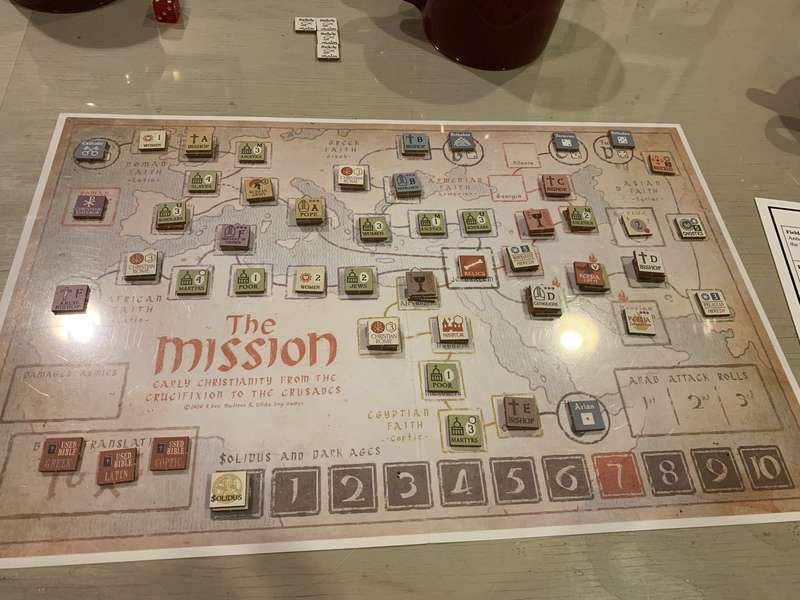
The Mission by White Dog Games is one of those rare games where you genuinely feel like you are learning as you play.   Designed by the highly prolific Ben Madison, The Mission is a solitaire game covering the whole of Christian history from the death of Jesus to the beginning of the First Crusades.   During that time your job is to spread the Christian gospel throughout the known world, establish the church, and then defend it from enemies within and without.   At games’ end, in the 12th century, your score will determine whether Christianity survives as a world religion or as a small cult practiced in some backwards region.

The Mission is a 4X game with emphasis on the first three Xs: Explore, Expand, Exploit.  The fourth X, Exterminate, is something you try to avoid.   At first things seem easy, as the original apostles move out from Jerusalem with the gospel of Jesus.   Soon they will die and their bones will become relics, which may help you financially later in the game, but before they pass away they have, hopefully, won a foothold in each of the six geographic tracks of the game board. 

In the first phase of the game, you move further out on each of these tracks, attempting to convert regions which in turn give you revenue to fund missionaries and bishops, build key infrastructure (hospitals, monasteries, and universities), and translate the bible into regional languages (Latin, Greek, Armenian, Coptic, and Syriac).  Before Constantine, the Roman Empire can hinder or tolerate you, depending on the policies of various Caesars.   After the Empire becomes Christian, you make hay while the sun shines, because it gets tougher later on when the Empire collapses.   

In the Dark Ages stage of the game, you now try to defend the five tracks against various hordes of people pushing towards the centre over 28 turns, each covering a varying number of decades.   After the fall of Rome, some of these encroaching peoples can be converted if you work at it (always convert the Saxons if you can), and others have to be resisted as best you can.  Good luck with North Africa, you’ll need it.    Later on, when you’ve hopefully got the hordes under control, the rise of Islam means that various jihads emanate from Jerusalem in the centre and try to conquer their way outwards. so you’re always fighting fires and trying to keep regions from being conquered and slipping into apostasy.   Translating the bible helps, as do various great theologians, but at the same time you’ll face challenges from local despots, schisms where various regions choose their own popes and stop talking to you or sending you money, and that perpetual annoyance, heretics.    As regions fall into heresy, you can either sweet talk them back into the orthodox faith or ruthlessly suppress them, though cruelty can work against you in the long run.

I’ve taught church history in my profession as a vicar so I thrive on this sort of thing, and don’t think there’s been a game on this subject so good since Jim Dunnigan’s venerable SPI title Empires of the Middle Ages, though the two games are only roughly comparable.  If your worldview is secular but you’re interested in the ancient or medieval histories, this game does a good job of showing you the transition from the first to the second.  

White Dog Games uses a print on demand business model.  The components are attractively designed and presented, and the counters are on thick laser cut cardboard.   You’ll need four mugs or containers to hold various sets of random chits, and the game board gets more crowded as the centuries proceed.  My first game went fairly well.  The rules and player aid charts are well laid out and the rules explain themselves as you go along.

I did reasonably well for Christianity in my first game, and look forward to trying it again.  Highly recommended.  The Mission gets the Mad Padre blessing.

MP+


At f

Wednesday, January 23, 2019

First Look at GMT's Pendragon, The Fall of Roman Britain


Last fall as part of GMT Games' annual sale, I couldn't resist ordering their 2017 title Pendragon: The Fall of Roman Britain.   Designed by Mark Gouyon-Rety, it is one of the latest instalments in their series of COIN games, and is developed by Volko Ruhnke, the Prince of COIN.

GMT's COIN games are multiplayer simulations of political and military struggles other than traditional warfare.   Since they don't use the traditional war-games hex and counter format with historical orders of battle, and have a Eurogames look to them with their many multi-coloured blocks, they aren't for some grognards.   I confess I like them because of their complex and clever modelling of the historical processes - influence, population movement, and shifting allegiances - that mark many conflicts.  Some years ago I made some comments here about their Afghanistan COIN game, A Distant Plain.


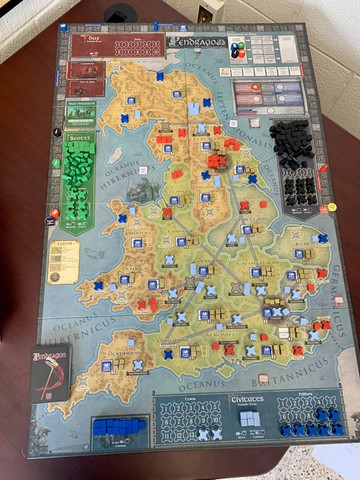
So here we are in the last days of Roman Britain.  The red counters are Dux, the Roman Army in the late 4th century. They have a lot of good troops and forts, and are at the start politically linked with the Civitates, the Romanized Britains (blue) who hold the towns and a variety of strongholds throughout the countryside.   On the left, the green counters are the Scoti, Celtic Irish and Scottish tribes, while the black counters are the Saxons.   Obviously the Scoti and Saxons want to carve up Britain between them.


As the photo shows, Pendragon is a beautiful game to look at, and is typical of GMT's high production values.  A quick  play by play of the first few moves follow to give you a sense of the game mechanics.

The turn sequence is card driven, as in other COIN games.   Each card shows the four factions' icons in different sequences.   Two factions can act on each card, starting from left to right.  The card on the left is in play, and the next card is placed face up on the deck, so players often face choices on whether to act on one card or pass and wait for the next, more optimal card.


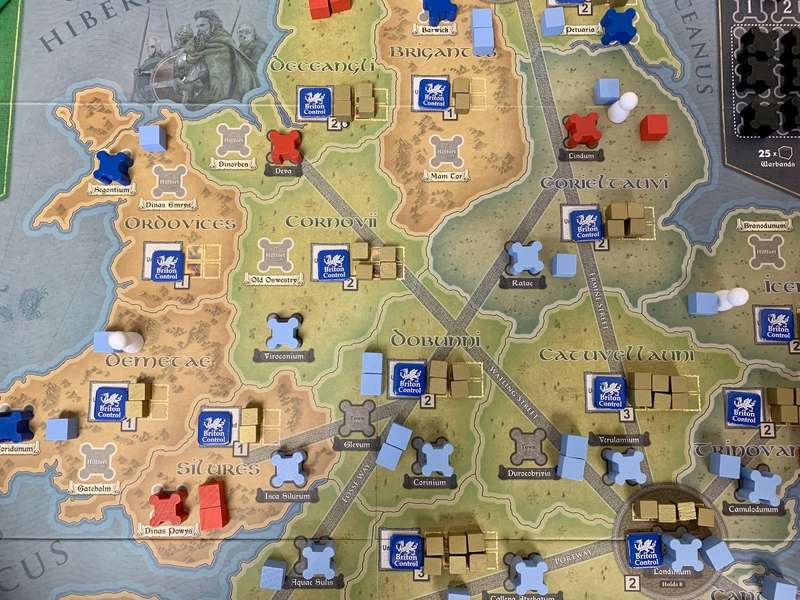
The first faction allowed to move is the Civitates.   Since, while wearing my Civitates toga,  I know the barbarians are coming, I decide to use the Muster Command to pay resources to place an extra militia cube (the light blue cubes) in each of the provinces marked with a white pawn.  I also spend additional Resources to stockpile Wealth, which can be used for unit upgrades and the like.   Might as well get ready.   

Next up on the St. Germanus card is the Dux faction, and since they are maxed out, with all their troops and forts already in play, they pass and accrue some Resource points for biding their time and harvesting their strength.   Because the Dux passed, the Scoti can act, bu since the Civitates have gone first, the Scoti only have a Limited Action, meaning they can only operate in one area.  They could play the shaded part of the St. Germanus event card, Papal Oversight, which would rob the Civitates of resources, but their game is all about raiding, and I want to see how the Raid mechanics work.

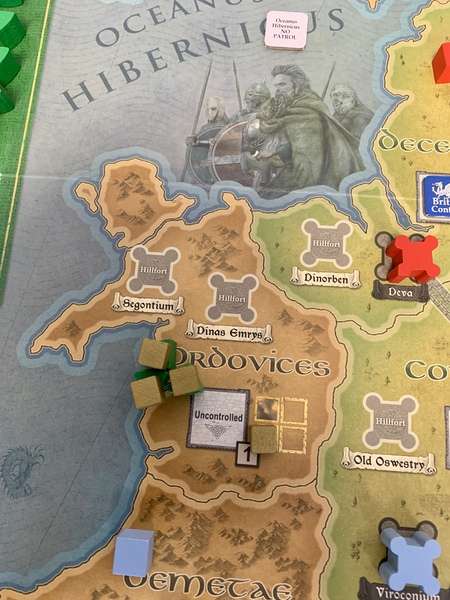
Each raid generates a random number of raider units, which are not as strong in battle as regular units, but are quite pesky.  The Scoti get to roll 1d4 for free, but chose to spend a Renown point (Renown points measure the success/failure of the two barbarian factions) to roll an extra dice.  Scoti rolls a 7, so seven raider parties descend on the region of Ordovices.   The Hibernian Sea is currently unpatroled, so the raiders are cross successfully.


Wealth in Pendragon is measured by gold Prosperity/Plunder cubes.  Ordovices has two, and the raiders can take a number equal to the population rating (Orodovices has pop 1) so the Scoti get a Plunder cube to try and take home - if successful they convert the Plunder to a Renown point, which the barbarian factions need to win.  The only Civitates militia cube in the region has wisely retreated into the hill fort at Segontium, but the Scoti can afford to throw all those raiders at the hill fort.  A multi-stage process (Escalade, painful for the attackers, then Storm, a straight exchange) follows.  At the end, the Scoti lose four raiders, but eliminate the hill fort and the militia, and acquire two more Plunder for a sacked stronghold.  They have three raider units left, so can carry all three Plunder.  Hopefully in the next Scoti turn, the raiders can return home and convert that Plunder into three Renown points.

Since two factions have moved, the St. Germanus card is finished and the Annona card is now in play.   Dux and the Saxons are the first eligible factions to move on this card.  The next card, now face up on the deck, is Groaning of the Britains.   Again, a faction can either chose the event on the card in play, (top version) good for them or (shaded version) bad for the others, or instead of an Event they can chose an Action, so there is always a choice on each card.
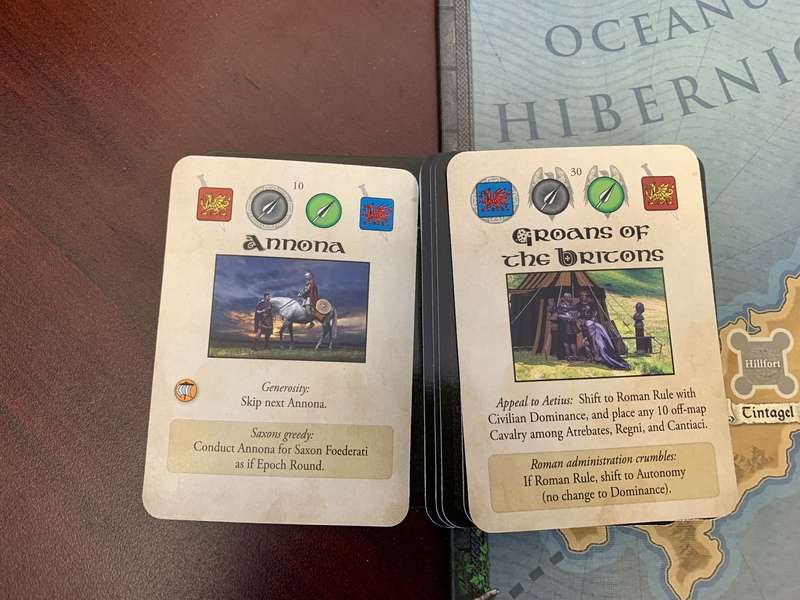

Situation at the beginning of the next card - Dux can go first.  The "Annona" event isn't relevant since there are no Feoderati (barbarian bands hired by the Dux/Civitates) in play yet that need to be paid for.   Dux therefore focuses on actions and could choose the Train option to reinforce,  but since all its allowable forces are already on the board, there is no sense in that.   Dux has two red cavalry units in neighbouring Deceangli which could use a Move action to reach Ordovices, but since the British have lost control of that region, the Dux cavalry could not bring the Scoti raiders to battle.  They could do this on an Intercept move, but only if the region was under Briton control (before Fragmentation, Dux and Civitates are both treated as Britons).  Getting Ordovices back under Briton control is a long-term project that Dux is willing to leave to the civilians, and besides, those two cavalry units in prosperous Deceangli are needed in case of further raids.  Dux passes and collects 3 Resource points.
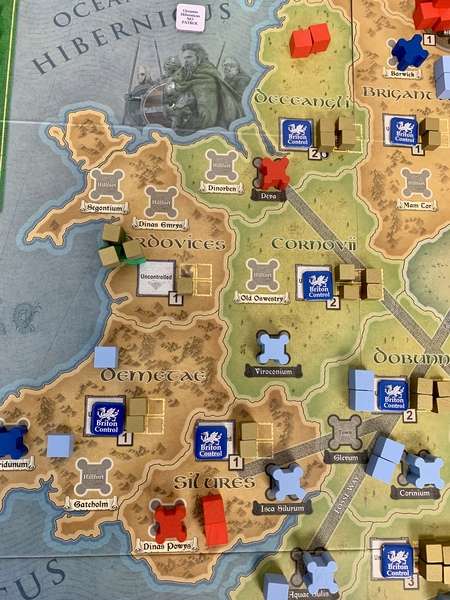


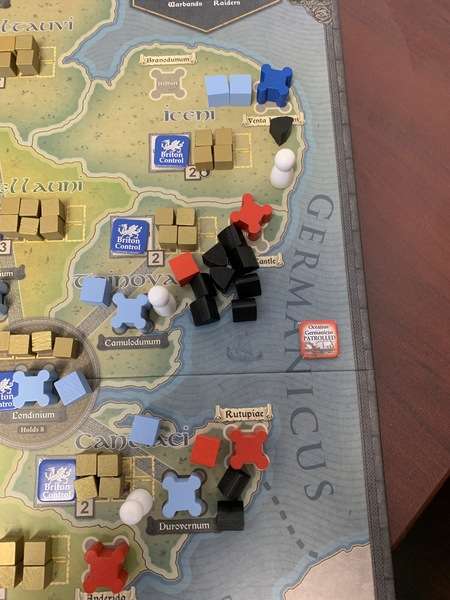
Saxons are next according to the Annona card and with my Saxon cap on, I decide to Raid in a big way.    The Saxons can Raid up to three regions or cities bordering the Oceanus Britannicus or Oceanus Germanicus.  They choose, from N to S, the three regions of Iceni, Trinovantes, and Cantiaci, spending 1 Renown each for Iceni and Cantiaci to roll 1d4 of Raiders and 2 Renown for Trinovanes to roll 3d4 of raiders.  The result looks grim for the people of Trinovantes, with 8 raiders descending on them!


Because the Oceanus Germanuicus is partrolled and is bordered by three red Dux forts, the residue of the Roman Navy does its job and three raiders are removed from each group, which means that the Britons only have to worry about Trinovantes.   The Saxons now grab Plunder equal to the population, so two Plunder cubes.


 The united Britons decide to stand and give Battle, and we go through the preBattle sequence, where the Saxons elect to try and Ambush (need a 5 or 6 on 1d6) but fail their die roll.  The hard hitting Dux cavalry charge first, killing two raiders, then in a  simultaneous round the raiders inflict 1 and 1/2 hits, killing both Briton units, while the Militia do 1/2 hits, enough to kill 1 raider.  That leaves two Saxon raiders loaded with loot, and that seems like a good if bloody day's work.  Trinovantes remains Britain but is now devoid of its garrison and the Saxons, like the Scoti before them, will try to take their loot home.   A dark pattern for Roman Britain is emerging.

So there are lots of things I am probably getting wrong, but that is the game so far, and I am enjoying it and the many decisions it forces on each faction.   As I continue, I may try and use the "bots", the decision trees for the non-player factions, if only to learn what the optimal strategies are for them, but for now the best COA for the barbarians seems to be raid, raid, and raid some more, until the Britons are weak enough that the remaining raiders can start to take up a permanent foothold.

Blessings to you gaming!
MP
Tuesday, September 19, 2017

"Zulus, Mr. Rico! Zillions of 'em!" : A Quick Review of Zulus on the Ramparts by Victory Point Games


“Men of Harlech, stand you …  AAARRRRGGGGHHHHHH!” 

Don’t let this happen to you.

If I’m a little bleary eyed this morning, it’s because I was up past my bedtime playing Zulus on the Ramparts, a solitaire game about the Battle of Rorke’s Drift from Victory Point Games’ States of Siege series, designed by veteran grognard Joe Miranda.  In the few times I had played it already I had gotten a quick and unpleasant result, as the Zulu imps almost effortlessly overran my defences and the rifles fell silent.    This game was a different result.  Miraculously the Zulus held off until the defences were reinforced, giving me time to get all my heroes, Bromhead, Chard, Colour Sgt. Bourne, Hook, Hitch, and Ammunition Smith the Padre among others all on the firing line.  When they came on, we let them have it, and while they got close to our final redoubt, it was Steady Lads Steady and Men of Harlech and we dropped them as they came.   All through the night we held, and then the last impi came on like a black thundercloud,  and we were down to our last cartridges, but we held, by God.  It was a Martini Henry miracle with a bayonet and some guts behind it.

Well, as you can see, I enjoy this simple game.  If you’ve played other VPG solitaire games, like Dawn of the Zeds, you’ll recognize the basic idea.   The bad guys (four Zulus impis of various strengths) each start on their own track and their progress is chit driven.  If any one reaches the centre of the board, you lose.   You can help your cause by building two sets of barricades, if you have time, to buy yourself some more space and time to defend. As the Zulus advance, you are drawing cards which allow you to bring various heroes and personalities into play (like Dick, the Surgeon’s dog) and Pvt. Hook, or any of the various volley cards which allows you to engage the Zulus from various ranges.    Each turn you have to chose an action - do you fire a volley, work on extra barricades, pass out more ammo, or get one of your personalities into the battle to use their various abilities?  You have a lot of heroes (all those VCs, after all) which help, but never enough time.

There is a day phase, and a night phase, which is worse because it’s harder to hit the Zulus at night unless buildings catch fire, which they can do.  There are also some random event cards, and some what ifs, like Company G actually showing up and helping the garrison.  If you want pics and more comments, you can find the ZotR page here on BGG.  At $40 it’s at a midrange price for a boardgame, and the components have the usual VPG high quality of treatment - a hard mounted board, professional cards, and thick MDF laser cut playing pieces, so to my mind that’s a good game at a fair price.  While this is a solitaire game, it would be fun to take to the pub/club and play a few times.  A quick defeat can take twenty minutes, but an epic stand might take an hour.  My record so far is one out of three wins, so it’s a challenging game.

 I have this week off, so I’ll probably watch Zulu for more inspiration.

Blessings to your die rolls!

MP+


Wednesday, July 12, 2017

Tuesday Night Boardgame (On Wednesday): GMT'S Fields of Despair


I couldn’t resist this title by GMT games - any World War One game generally goes to the head of my purchasing queue, and this one was no exception.    Fields of Despair (FOD) is a strategic scale block game designed by Kurt Lewis Keckley - you can find his blog here and follow him on Twitter at @PhotoAvalanche .  It comes with an attractive hardback folding map, several hundred counters and blocks which need to be stickered (thankfully, for Command and Colours fans, only on one side).  

I’ve only played FoD solo which is a pity because that is rather like driving a Ferrari in stop and go traffic and never getting out of second gear.  This is a game designed for two players, and the one-sided blocks mean that you never know exactly what is waiting for you when you launch an attack.   I can’t wait to try this game head to head because the suspense would be epic.   The blocks themselves are the heart of the game, reminiscent of the four-sided blocks used in well-known Columbia games such as Quebec 1759 and Waterloo.   Blocks range from 1 to 4 up to 17 - 20 Strength Points, with 20SP blocks representing a multi-corps army.   Most blocks represent infantry, with a few cavalry units given to each side.

In addition, players can commit artillery to key battles (representing strategic artillery assets) and can also commit aerial units in the hopes of forcing the other player to reveal some or all of his blocks before battle.   Aerial reconnaissance is not a sure thing, however, because the defending (or passive) player can throw in his/her air units as well to try and keep the observer planes from carrying out their missions.   Besides his/her own blocks, the defender can try to hold the line with a few key fortresses, such as Verdun, which are very hard nuts to crack.

Here is a shot of the game board in the early stages of the three-turn introductory scenario, set in 1914.  Infantry units move two hexes a turn, and cavalry three, but units have to stop when they enter an enemy controlled hex.  Unless all defending units are removed from a hex, it is considered contested and remains in the defender’s control, so the ownership counters seen here are quite important for deterring victory.

And the same game at the end.  The Germans have taken heavy losses, but have done worse damage to the French, and have come within an ace of capturing Paris before the end of the game, which the Germans won 9-7 based on hexes control.  The British (tan counters) are slowly building up strength, but were separated from their French allies by the German advance.

In retrospect this game might have gone better for the French if played H2H, since playing it solo it was impossible as the stronger German side to hit the French where they were weakest.   There is a slightly intimidating solitaire system for one of the late war scenarios, which I hope to try at some point.  

WW1 fans will appreciate the fact that the game is highly attritional.  While breakthroughs are possible and  can be exploited, they are difficult to achieve and hard to exploit.  Manpower is a very finite quantity in the game.  The Germans have an initial advantage, and their army grows considerably in 1914, but like the other countries the manpower streams dry up later in the war, so every SP lost early in the game is one you won’t have later when you may need it.

There are several economics and technology R&D tracks, where players can put resources into developing new weapons (poison gas, gas masks, better aircraft, tanks, etc) and also put resources into maintaining the Allied blockade vs the German submarine campaign, ether of which can hurt the other side’s resources.    The German player must also think about the second front with Russia, which is represented in a very abstract but effective way.  Don’t put enough resources into the Russian front and you as the German can lose the game.   

While the game does not use a card system like Ted Raicer’s WW1 classic Paths of Glory, it does have a series of technology thresholds that introduces events like aerial combat, the start of trench warfare, as well as political events like the US entry to the war.  

FoD is a simple and highly playable game with enough chrome to give it a good feel for the strategic choices faced by the combatants in the Great War on the Western Front.   Fans of WW1 should check this out.  While it would be huge fun with an opponent, the solitaire mechanism looks promising and there is also Vassal.

Speaking of Vassal, here is some bonus WW1 content.  This is a screen shot of a game that Jonathan Freitag and I are playing online - it is from the introductory scenario of GMT’s 1914: Offensive a outrance, from their operational monster game about the first months of WW1 in the West.  My French divisions begin the war by hurling themselves on the Boche to erase the infamy of 1870 and to recapture France’s provinces.   Latest communiques from French HQ confirm that all is going well.  

The cool thing about this game is that it is a 100% digital version of the real game, and while the going is slow, Jon and I are learning a lot about Vassal in the process.

Good luck to your die rolls, virtual or otherwise.

MP


Blog Archive

Followers