Tuesday, April 13, 2021

Terrain Tuesday: Battlefront 15mm Command Post

It’s always a struggle for me to allot my painting time to figures vice terrain, but as my friend Mr Hot Lead (formerly the artist known as Rabbit Man) likes to say, any time invested in making the war-games table look better is time well spent.  Thus, I’m starting a new blog feature designed to motivate me to better efforts, so every week on Tuesday I’ll post some piece of terrain that I’ve either finished or am working on, and you, dear readers, can help keep me accountable to this goal.  I hope you’re ok with this weighty responsibility I’ve dumped on your shoulders.

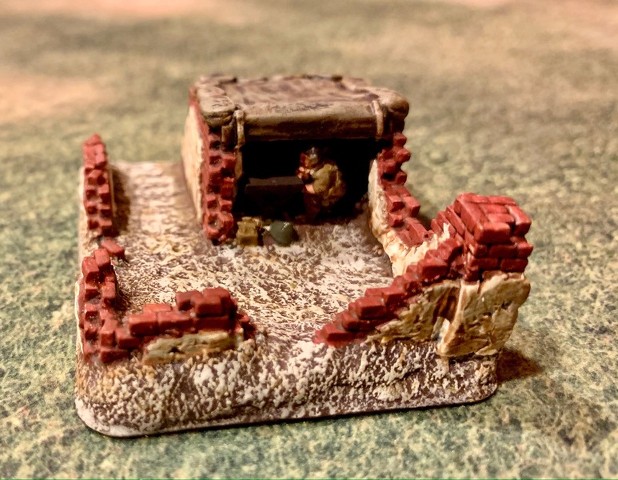
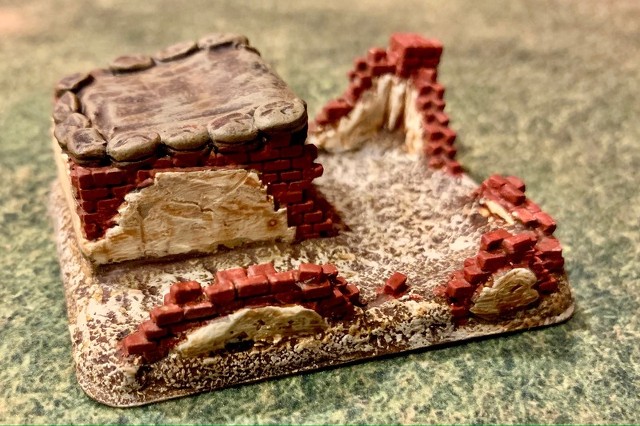
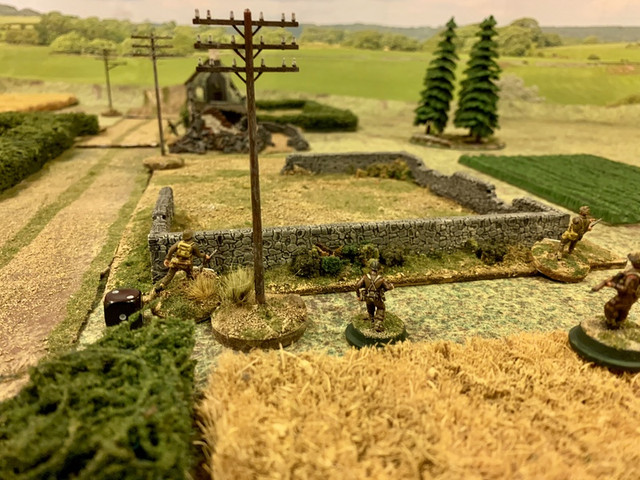
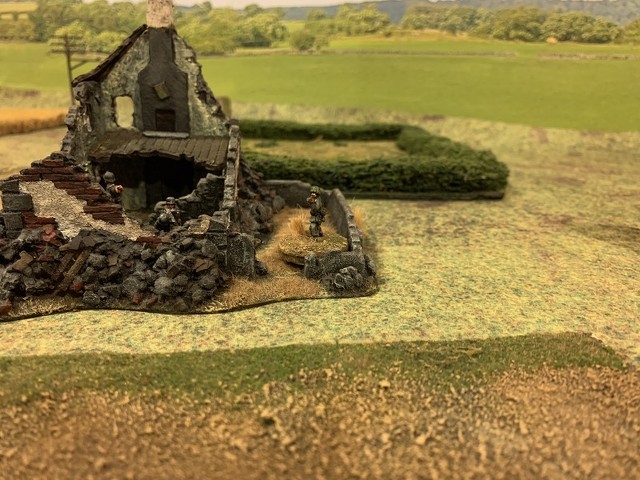
To start this feature, here’s a resin command post from Battlefront that was included in a British WW2 mid-war rifle company set, back when BF made metal figures.   Since the new TFL/Reisswitz Press rules O-Group place a large emphasis on command and control at the battalion level, it seemed worth moving this piece into the painting queue. 

Not much more to say, really.  It will work for any setting in Europe, but I’ve dry-brushed the ground to suggest lots of dust, making it appropriate for my Sicily 1943 project.    I’ve pained the half-profile signaller in Vallejo British Uniform since it is supposed to be a British HQ - now I need something like this for the Germans/Italians.


Speaking of terrain, I’m still shaking my head at the quality of work displayed in this video from @Joe_Wargamer, it’s stunning and clever.    I may try something like it the next time I buy some MDF buildings.

Blessings to your tabletops!

MP+


Monday, April 12, 2021

Revisiting 6mm With General D'Armee

There was a while back around 2012 when this blog was buzzing with excitement about my foray into 6mm Napoleonics.  I had purchased a large collection of painted Austrian and French figures, bought some new figures from Baccus, and was learning to paint them.   I had picked up Sam Mustafa’s Blucher rules and had played a few games with them, and was generally happy with my progress.   Then a move, my wife getting sick and dying, a new duty assignment, retirement from the military, remarrying and starting a new life.   A lot of things got in the way, and I think the resurgence of my interest in this period and scale has to do with being in the happiest place I’ve ever been in my life.   Funny how it all works.

This Easter seemed like a good time for a wargaming vicar to live out the resurrection by raising my 6mm collection out of their boxes and taking Dave C. Brown’s General d’Armee rules for a spin.  I had previously played Dave’s ACW rules Pickett’s Charge (PC) and liked them, and found the mechanics similar enough that GdA was fairly easy to pick up.

I decided the the best way to learn the mechanics was to take two identical forces, thus, a French division of three infantry brigades, four batteries, and a light and heavy cavalry brigade faces its Austrian mirror image.   All units were rated as Line for simplicity’s sake.   This force selection seemed to promise enough complexity to get a sense of rules that claim to be scaled from Divisional to Corps level. 
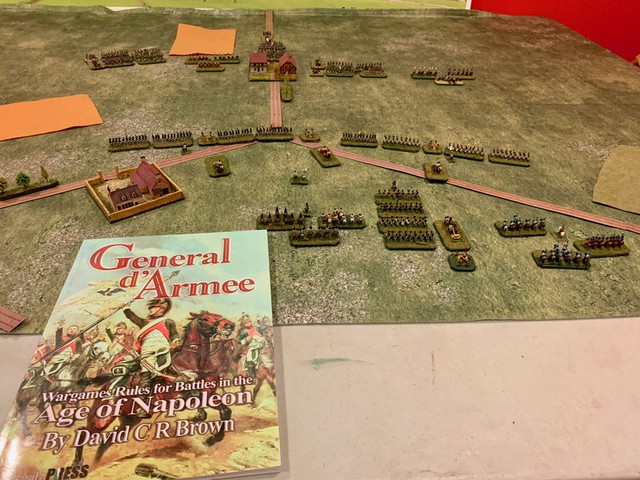
 The Austrian force of General Albert Kurvi-Tasch (dubbed by Archduke Franz Joseph “More moustache than brain”) defends the key crossroads south of the village of Schlumpen and watches as the French of General Theodore d'Ordure, dubbed by Napoleon as “the Grossest of the Gross”, comes into view.   The backdrop is not 6mm, sorry about that.
 The battle began with the light brigades of cavalry scrimmaging on the Austrian right.    Dave’s charge procedure rules were basically familiar to me from PC and are fairly simple to administer in horse on horse actions, where there is no defensive volleying to complicate things.  At first things went fairly evenly, with the two brigades somewhat battered and retiring to reorganize.   When the went at it again, however, the Charge dice went disastrously for the French: their “2” vs the Austrian “12” on 2d^ (it’s all d6 based) saw the French light horse simply dissolve.  Charges can be exciting and tempting because you never quite know how they’ll go.
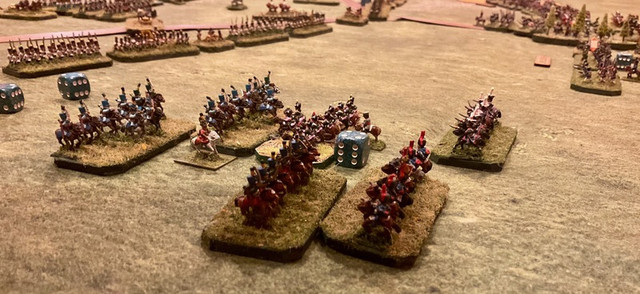
 The French reserve advances through Schlumpen in a brigade column, hoping to punch a hole through the Austrian centre with the support of the heavy cavalry to their left and the two flanking infantry brigades.   As you have noticed by now, I am using small dice to keep track of casualties, though am not happy with the look.  Perhaps I need micro-dice?   I’m now wishing my unit stands had little slots for casualty dice like the cool kids have.
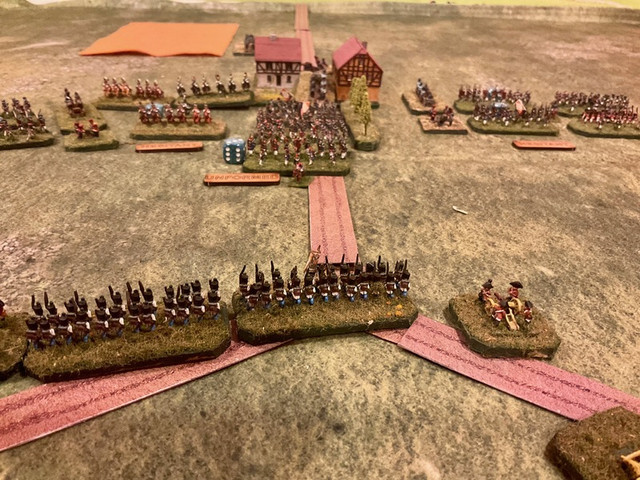
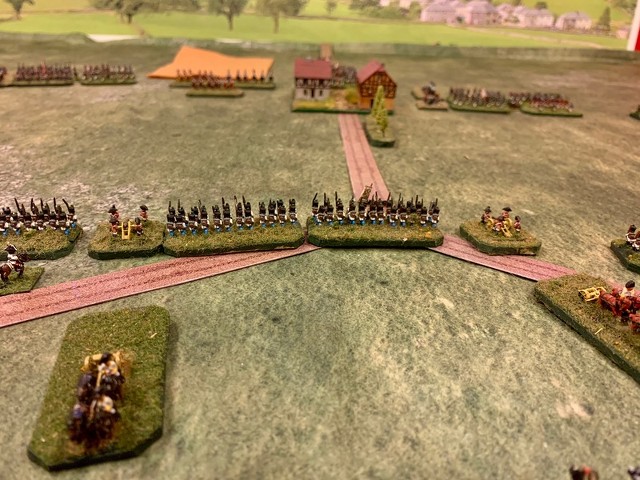
 Artillery can be deadly in these rules.   The two Austrian batteries in the centre have savaged the lead unit in the assaulting brigade, and checked its advance.   Ordure moves his heavy cavalry forward to open the way, and the Austrians respond.  It’s still anyone’s battle. 
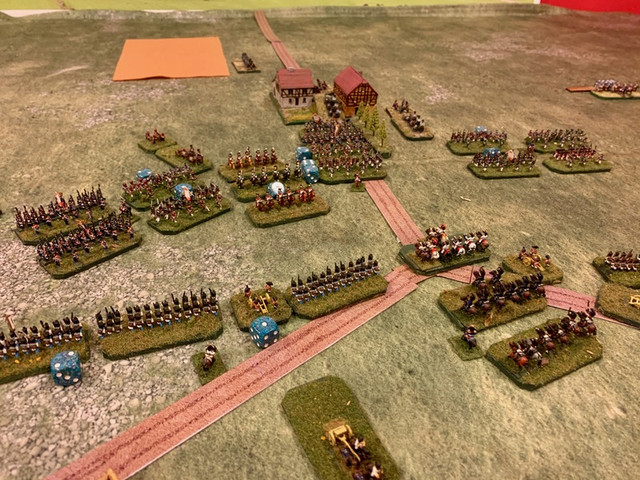
 

 Austrian cuirassier and French dragoon trade blows, largely ineffectually, and the two brigades basically repel one another like bumper cars at a fairground.  For me this is where 6mm really shines as a visual scale with the clash of massed units.  I would never paint enough larger figures in my remaining lifetime to achieve the same effect.

Speaking of visual appeal, I’m quite happy with the table.  The game is being fought on a Geek Villain 6 by 4 fleece Grasslands mat, the roads are from Paper Terrain (glued to cardboard and then cut out) and the buildings are by Timecast which I really like.
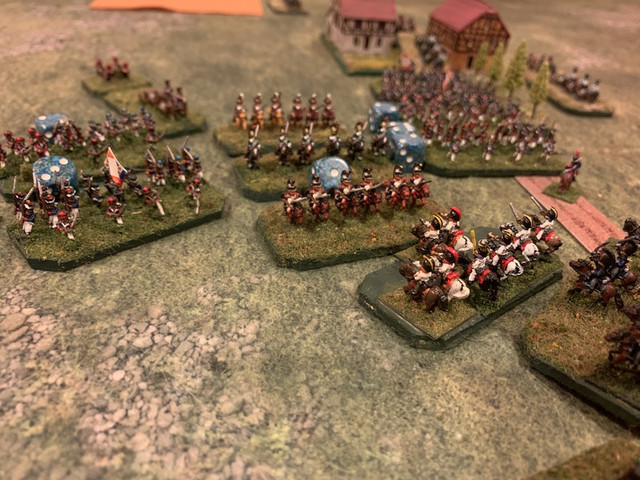
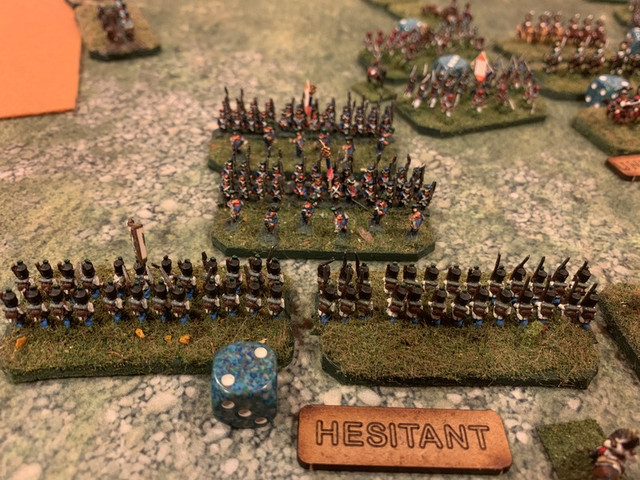
 In the final clash of the game, the French columns advance on the Austrian lines.  I’m very happy to say that the two French infantry units in the centre are the first 6mm figures I ever painted, almost a decade ago now, and I’m very happy with the way they look.   At this point you may be wondering how I portray formations.  Good question.

All my units are based the same, in lines, though with French units I usually put some skirmishers in front.   However, because in my world a single base represents a single unit, I don’t have any way to represent the formation changes that GdA and other rules call for.  My core assumption then for this game is that each unit is currently in the formation that makes sense fir the situation and for its army doctrine.  Thus, here the French are in column and the Austrians are in line.   Infantry, if charged by cavalry, would go into square if they made the appropriate test.   Cavalry are generally in column.  I have enough limbers (another benefit of 6mm) to portray artillery either limbered or unlimbered.  It seems to work so far.
\\

 With the repulse of the French infantry (as in Dave’s ACW rules, defensive fire from an intact foe is pretty deadly), and with the destruction of the French light horse, the game seemed to be done and an Austrian victory.   

One of the features of Dave’s rules that I especially like is command and control.  As in PC, GdA uses a varied number of Aides de Camp each turn to help ensure that your brigades do what you want them to do, and reduce the chance that they might go Hesitant and spend a turn dithering in uncertainty.    ADCs can help you salvage wavering brigades, can direct artillery in intensive bombardments useful to prepare for a charge, etc.   In this game the French could have 5 ADCs a turn to the Austrian 4, but you then have to roll for their availability each turn, so you seldom have enough, which adds some uncertainty and friction - no wonder Richard Clarke and TFL rep Dave’s rules, they are a natural fit with the TFL philosophy.  

I look forward to revisiting GdA soon, preferably using an historical battle as the template.   I just finished using CCN to fight Wertingen, the Austrian defeat at the start of the 1805 Ulm campaign, and that seems a manageable sized battle to fight.    

Thanks for reading.  Blessings to you tiny soldiers!

MP+


Friday, April 9, 2021

In Praise of Paper (Terrain) 2 - Basing the Buildings

Hello again friends:

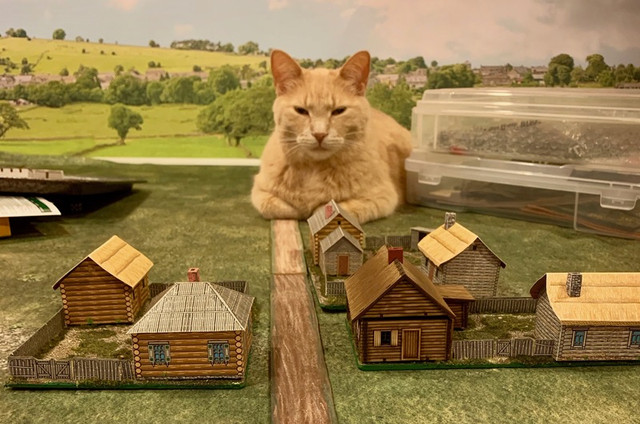
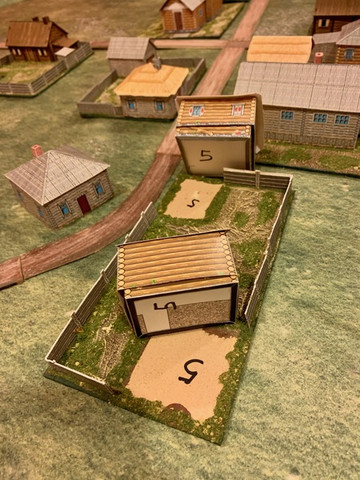
It’s me to preach the gospel of paper again, and specifically to illustrate the basing technique that I use for Paper Terrain products.   With these three 15mm Russian village buildings (including the one odd man out, the MDF building in the righ foreground) I put two paper buildings (plus a small woodshed/outspace) on a single base to represent either a farm or an entire village, depending on the scale of the game (platoon vs battalion).

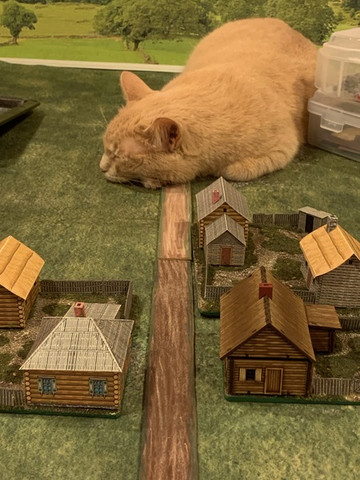
Here @MarshalLuigi, having inspected the village and found it acceptable, demonstrates correct roadblock and delaying action procedure.   The road to Moscow is secure for now.  There may be too many trees on that backdrop for the steppes!


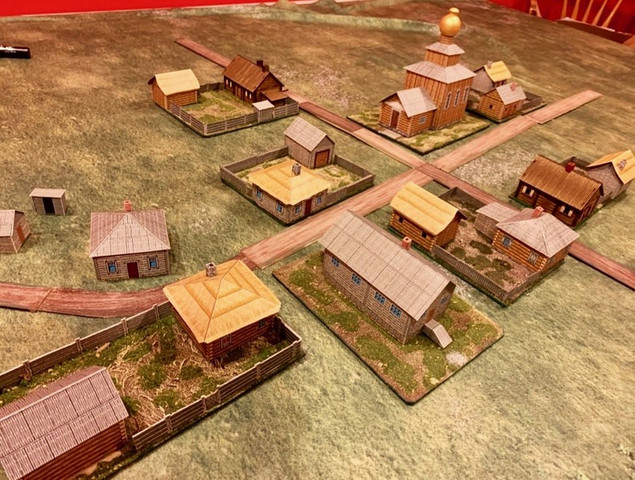
Here is the village of Paperskoye almost complete, just a few more buildings to base.


I use a numbering system to help me remember which buildings go on which bases.   I thought about gluing the ruined interior shells to the bases, but decided against it.  Having the bases in one tote and the paper buildings in another makes for safer storage and transport, I find.

Luigi, aka the Cossack Catbeast, appears to have lost interest in the project.  The road to Moscow may not be so secure now.  Wasn’t a giant cat mentioned in the Al Stewart song?

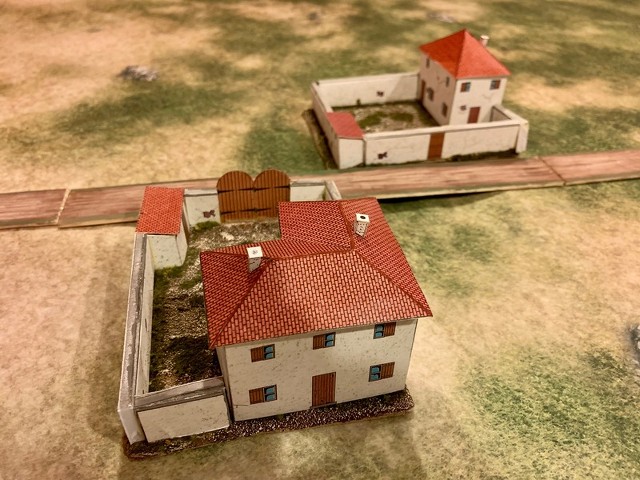
Moving to the sunny Mediterranean, we take you to a small village in Sicily.  the fist fruits of my basing efforts for my Sicily 1943 project.   These would make a nice pair of strongpoints for the defending Germans.  As with the Russian buildings, my basing technique is the same.    I handout a piece of MDF from the hardware store, texture it with a wood builder’s putty for sealing gaps, base coat it dark brown, then dry brush in two lighter colours (Yellow Ochre and then Desert Tan), and finally flock, but only in patches to suggest an arid climate, which is in keeping with this new Sicily gaming mat from Geek Villain.  I also used some brick red craft paint to go over the roof ridge lines, which were left white after the scoring and folding.  A little effort for a great improvement, I think.

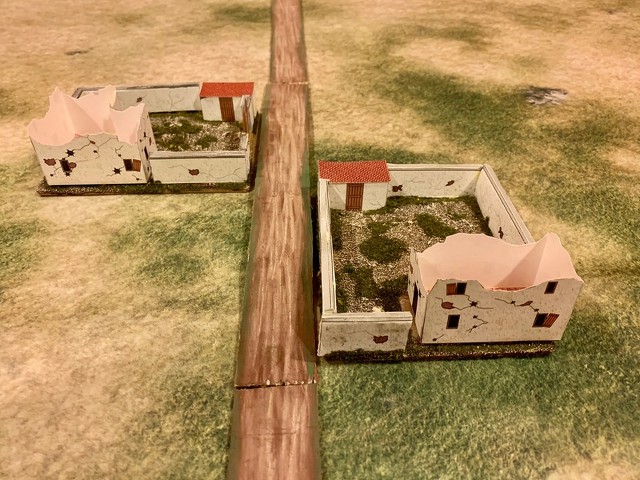
 The same buildings, having been thoroughly liberated.   

I have some British/Commonwealth troops in the queue to paint, but somehow some 6mm Napoleonics figures have used their superior mobility and stealthy size to get ahead of them.

Until next time, blessings to your basing!   MP+

Monday, April 5, 2021

In Praise of Paper (Terrain)

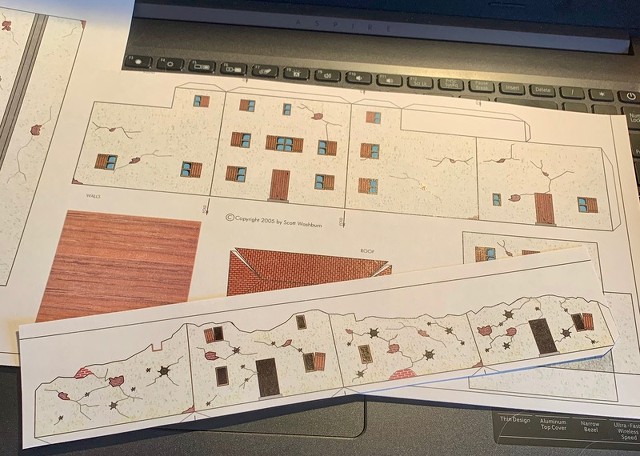
Reading the Canadian historian Mark Zuelkhe’s book on Operation Husky, the Canadians in the Sicilian Campaign of 1943, got me thinking of using some of my 15mm kit to explore that campaign, and to do so I would need some Italianate buildings, enough for a small town.   So I turned to a tried and true source, Paper Terrain, run by Scott Washburn, and ordered his Italian Village pack and his Town Expansion set.  Here’s an example of one of the sixteen buildings that came promptly in a flat manilla envelope.

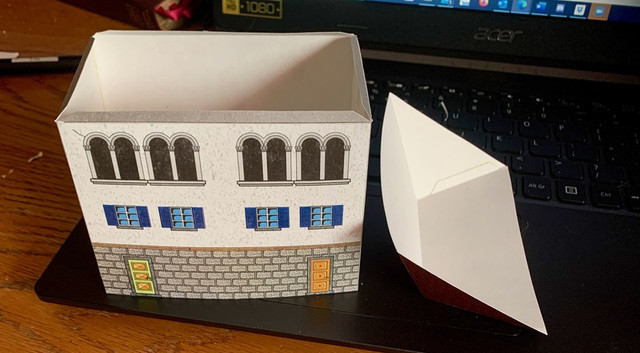
 It may look daunting, but all you need is a steady hand, some patience, a decent pair of scissors and a craft knife, and a patient partner who can put up with the myriad bits of paper that are the byproduct of the assembly process.   I used a metal ruler and craft knife to lightly score the fold lines, and while the buildings are printed on sturdy cardstock, you need to learn not to score the lines too deeply.   Once cut and scored, you fold them together carefully and glue them.  I use white carpenter’s glue.

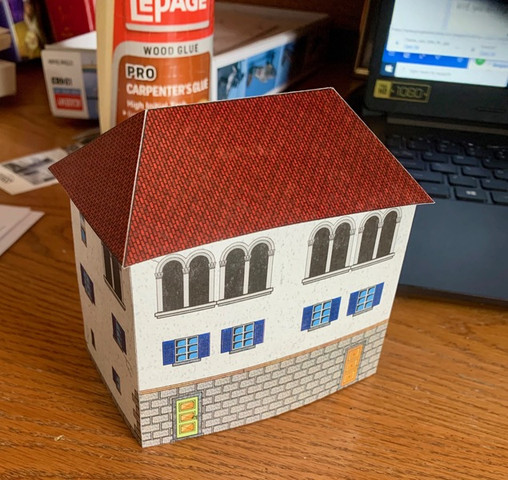
 As they say, some assembly required.   Putting the roofs on is perhaps the trickiest part but you soon get the hang of it.

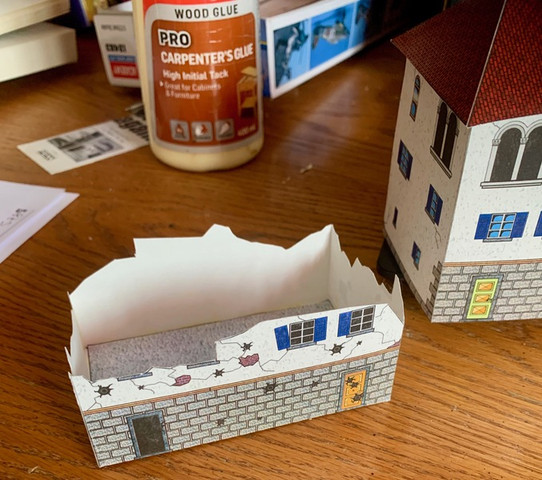
 Each building includes a ruined shell which nests in the completed building like a Russian doll set.  Very useful once the HE starts flying.  I suppose you could dress the interior with rubble, but keeping it clean makes it easier to place stands of occupying troops.


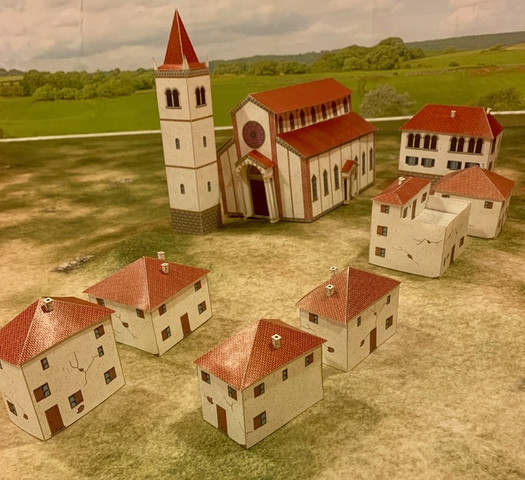
Some of the completed buildings, laid out on my Sicily fabric terrain sheet from Geek Villain, which is a nice piece of kit in its own right.  The church is stunning and large.

The buildings look good on their own, but they look even better when based.  I am working on two Italian building bases now, using the garden walls and sheds that Scott includes with his terrain sets, and I will show the finished results in another post.   

I have several sets of PT products - a Western European town set suitable for France in 1944-45, a Northern Russian village set suitable for the Ostfront or even the black powder era, and now these Italian buildings.  I’ve found Scott to be easy to deal with, and quick to answer questions about tricky points of assembly (which are rare in my experience).  In my last email exchange, he mentioned that he keeps expecting resin and 3D printed terrain to put him out of business, but demand remains strong.   For me the advantage of his product is that it’s relatively sturdy if carefully stored and handled, comes in a variety of scales, does not require painting, and provides an affordable mass of terrain in relatively little prep time.

Blessings to you scissors!

MP+r


Monday, March 29, 2021

Meanwhile in Rohan 9: The Muster of the Shieldwomen

Good evening friends:

As readers of this blog will know, the world of JRR Tolkien is an abiding gaming interest of mine, and the Rohirrim are by far my favourite army of that mythology.   Some years back I purchased several sets of Dark Ages women warriors from Bad Squiddo Games, thinking they would do nicely to augment my Rohan figures (who are, not surprisingly, all male).  It makes sense that in the existential threat that a raid on a village or fortress would pose, there would be women who would take up arms and even know how to use them (the subplot with Eowyn in LOTR and the novelty of her bearing arms betrays Tolkien as being a product of his generation, I think).

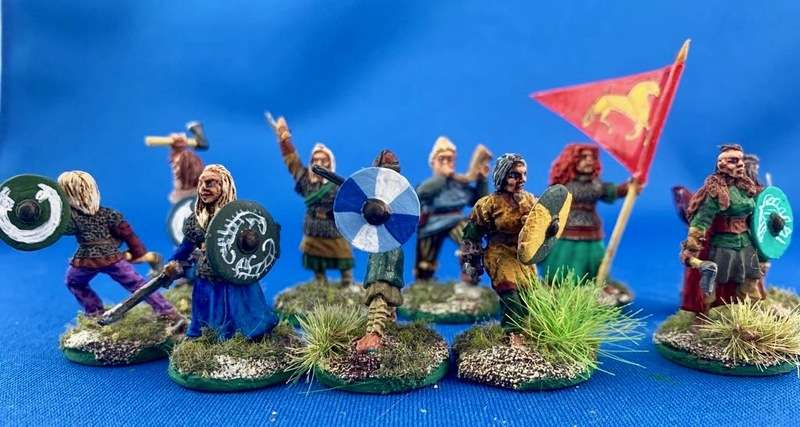
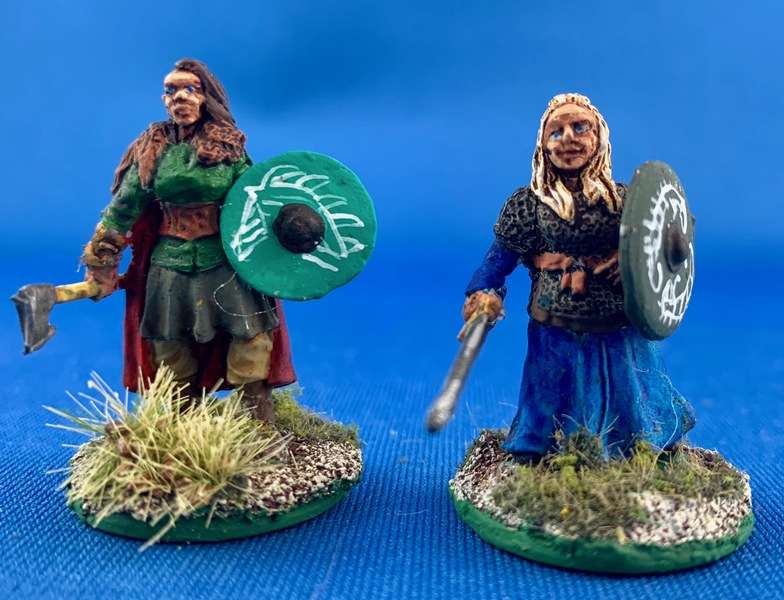
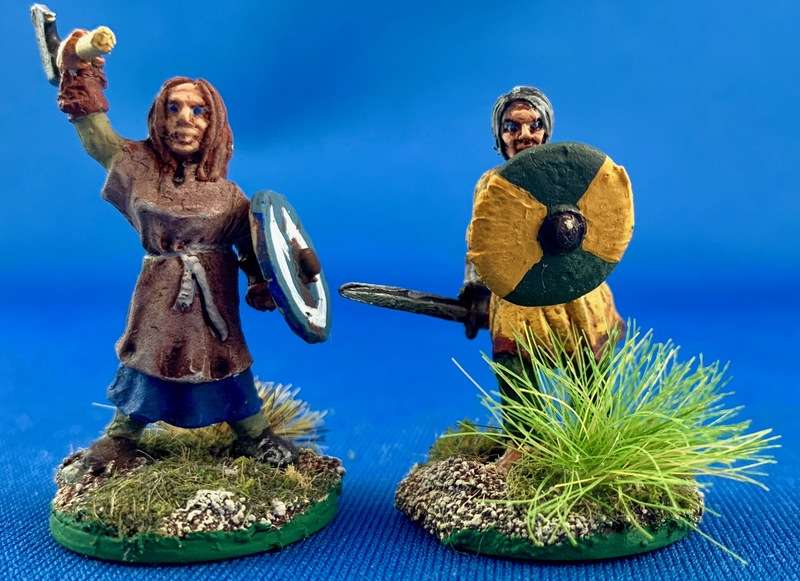
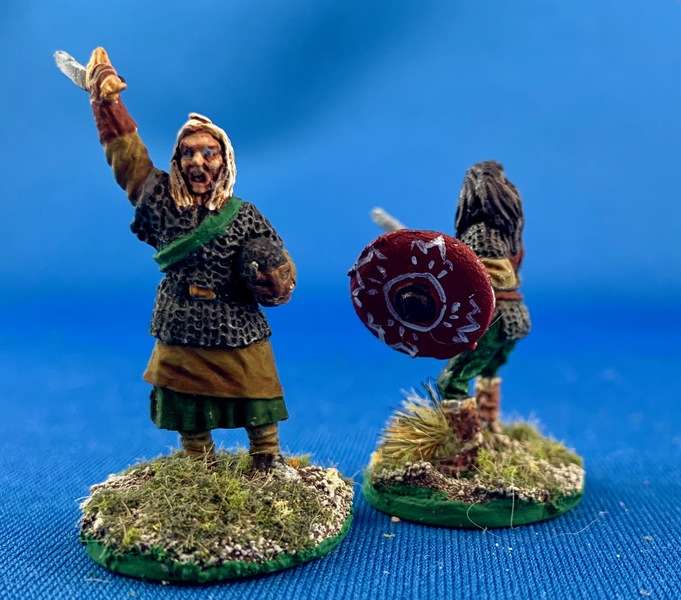
Anyway, Annie at Bad Squiddo does a nice range of female warriors that seemed suitable and I am using this pandemic time to finish old lots of figures from the lead mountain, so here are the ten I purchased some years back.


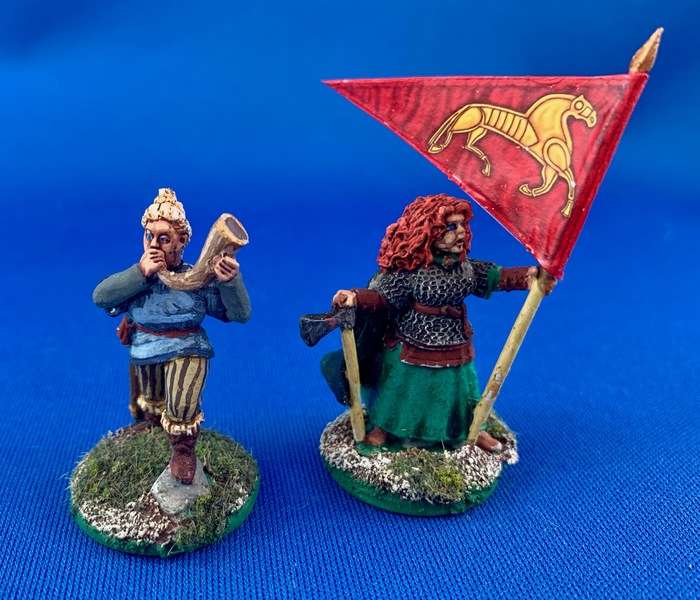
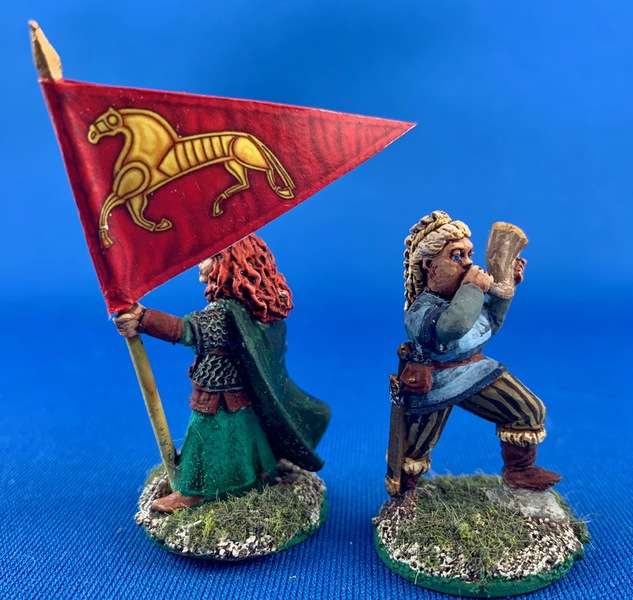
These two figures are lovely sculpts from Alan Marsh.  The banner is from a set of Saxon flags from Little Big Men Studios.


The remainder of these figures no longer appear on the Bad Squiddo website.  They are sculpts by Phil Hynes, who doesn’t appear to work for Annie any more - at least, his name doesn’t appear on her site.  The shields are done freehand, a lot of inspiration from my friend James, and I’m happy with these two in particular, even if the eyes on the one on the right are lopsided!

Anyway they are good sculpts, some better than others in terms of quality.   I enjoyed the fact that they aren’t all young supple warriors - these two are grannies that are just not having any Uruk-Hai crap, and as I creep towards my sixties, I’m ok with that.


There are tons of new Dark Ages sculpts in Annie’s shop that would be suitable for Rohirrim (including riders!) since my last visit there, as well as lots of interesting scatter terrain, so I am sure I shall be a returning customer.

Thanks for looking, and blessings to your brushes!

MP+

Thursday, March 25, 2021

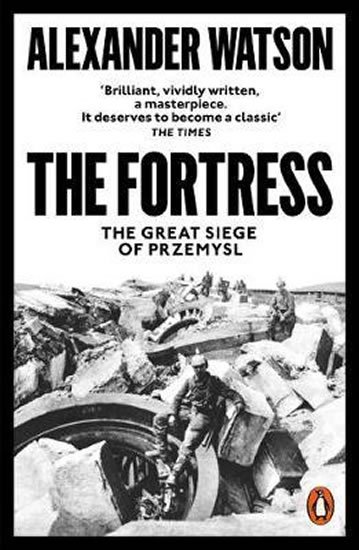
Book Review: Nicholas Watson's Fortress: The Great War Siege of Przemysl


The Fortress: The Great Siege of Przemysl, by Alexander Watson, New York: Basic Books, 2020.  

This is not as long a book review as my last one, more of an appreciation, really, but I can’t remember the last time a book of military history made such an impact on me as Watson’s book on this obscure battle of the Great War in the East.

For those of us in the Anglo-Saxon world, unless we are particularly well-read, our knowledge of the Great War on land is most likely centred on the campaigns in France and Belgium,  with side trips to the Dardanelles and perhaps the fighting in the Alps between Italy and Austria.   The Tannenberg campaign is probably the latest singular exception to this rule, but the frontier battles that raged in Galicia and the Carpathians in 1914-15, and which devoured hundreds of thousands of lives, were a mystery to me until several folks online said that this was a must-read for students of the Great War.

Alexander Watson is a relatively young professor at the University of London, who has already published one book on this subject, Ring of Steel: Germany and Austria-Hungary at War, 1914-18.   Fortress by contrast focuses on the Austro-Hungarian defence of Przemysl, a town on the edge of the Carpathians in what is now Poland, which was surrounded by a ring of mostly obsolete fortresses.   There was no vital reason to defend it, but after the collapse of the Austro-Hungarian offensive in Galicia in 1914, the decision was made for reasons of prestige to hold it with a scratch force of reserve troops from the town and from the far reaches of the Empire.   The city held out until the spring of 1915, when starvation forced its surrender to Russia.

I won’t try to duplicate the many glowing reviews out there, such as this one in the Guardian.   I found the book absolutely gripping, and could quickly see why it’s such an acclaimed and awarded title in military history circles.  I will also say that I found the book unbearably tragic.  Like all sieges, it has the same narrative arc of gallant defiance and comradeship giving way to dull despair as food and hope runs out.   Watson is drawn to the city’s unlikely defenders, mostly older reservists with obsolete weapons, but he is also clear-eyed as to the Austro-Hungarian Empire’s long record of massacres of the local population of Ruthenes (speakers of various Ukrainian dialects) as suspected Russian sympathizers (there are some dark photos out there).  On the other hand, the Russian regime’s treatment of the Jewish population could be just as grim, and as Watson notes, the First World War in Eastern Europe is a prelude to the ethnic cleansing and genocide of the Second World War.    Przemysl, a multi-ethnic city before the Great War, was greatly and sadly changed by the war, and its fate, like that of Sarajevo in the 1990s, reminds us of how fragile multi-ethnic societies can be when forces of hatred are unleashed.

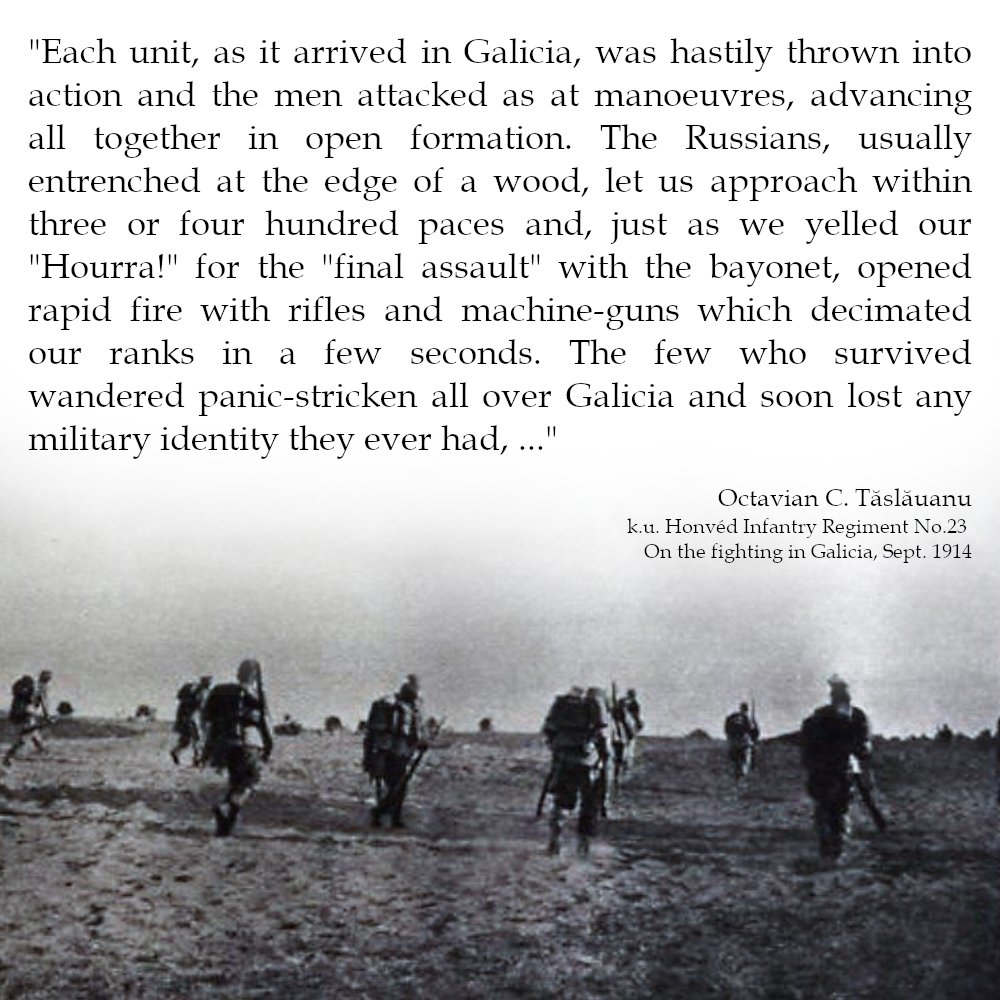
The other thing I found particularly tragic about the book was the stupidity and callousness of the Austro-Hungarian army and its commander, Conrad von Hotzendorf.  It’s hard to imagine a more malignantly irresponsible figure in all of military history.  Whereas the Russian armies fielded against Przemysl appeared to be relatively competent, the  Austro-Hungarian command threw the lives of their troops away - there’s no other way to describe it.  This quote isn’t from the book but is from the must-read Twitter account of @PikeGrey1418 captures it well.  

  Watson’s book is full of this sort of account, and they still haunt me a month later.

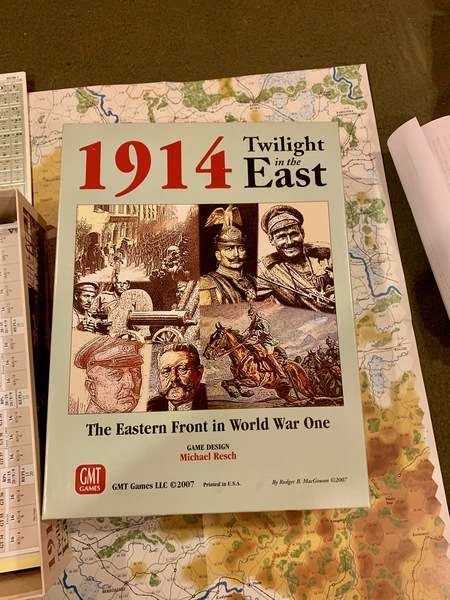
Sitting on my games shelf is this mini-monster game from GMT Games, designed by Michael Resch.  

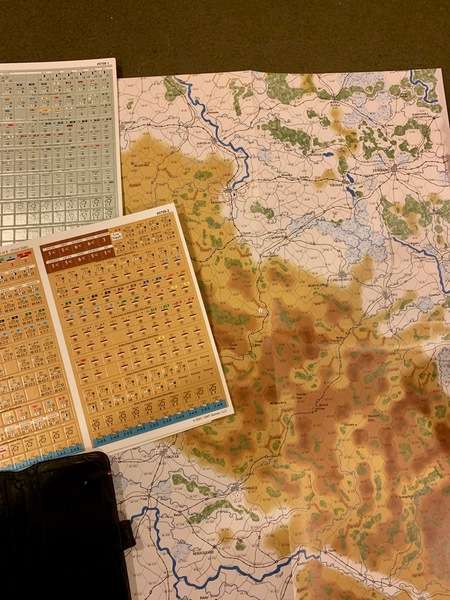
I confess I’ve had it for a few years, unpunched and still in the shrink-wrap, but after reading Watson I had to open it up and have a look.  Here’s the Galicia map, with just some of the counters.


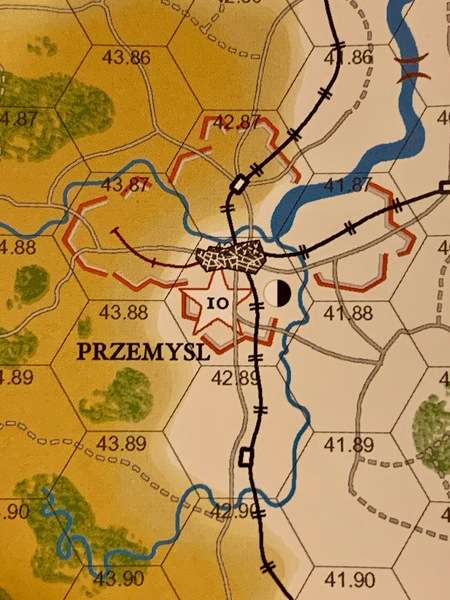
And there’s Przemysl, with its ring of fortresses.

 I may not get to this anytime soon, as I currently have a large Franco-Prussian hex and counter game on the go, but I am very curious to give this a go, as I’ve played Resch’s sister-game on the Western Front, and learned a lot about the difficulty of commanding large armies in that game.  

Even if you never want to add this subject to your gaming repertoire, I can’t recommend Watson’s Fortress enough to you as a superb treatment of an obscure campaign.   Just be prepared to be a little haunted by it.

Blessings to your books,

MP+


Thursday, March 11, 2021

Quick Look at Five Men in Normandy, Nordic Weasel's WW2 Skirmish Rules

Hello friends:

Just putting a few words of praise here for Five Men In Normandy, 30 Cal Edition, a cheap and cheerful set of skirmish rules by Nordic Weasl for very low (squad/section) level infantry actions in WW2.   I’ve been following @weasalnordic on Twitter for a while, he runs a solo game design business and is quite prolific.  I was originally interested in his SF rules but 5 Men was cheap and looked like just the thing for a simple game that was easy on the brain.

Here five Canadians are tasked with securing a ruined building to use as an OP post.  They have one sniper rifle, one Bren, one rifleman with an SMLE, a corporal with a Sten, and an officer with a pistol.   The ruined building is held by four Germans, a two man LMG team, a rifleman, and an NCO with an SMG.  All weapons randomly assigned.

The German defenders. 

 The Canadians got a map as a random asset, so they were able to sneak into initial positions.  From there, it was fairly straightforward real world tactics, with the sniper and the Bren keeping heads down while the thee others moved into grenade range.  The Germans took two casualties and the survivors elected to slip away.

You can find these rules in Nordic Weasal’s section of Wargames Vault to purchase as a PDF download.   As I said, these are very simple, D6 driven rules, ideal for very small actions with a cinematic feel.   No armour or offboard infantry, just a few guys running around with infantry weapons. You could teach them to someone in less than five minutes, and I could see my grandkids giving them a go as they get a few years older.  If you want complexity, then look to a system like TFL’s Chain of Command.  

It was also fun to get out my 20mm toys after a year in their boxes and to try out some photos against my new model railroad backdrop, which probably needs its own post.

Blessings to your die rolls!

MP+

Blog Archive

Followers