Monday, March 29, 2021

Meanwhile in Rohan 9: The Muster of the Shieldwomen

Good evening friends:

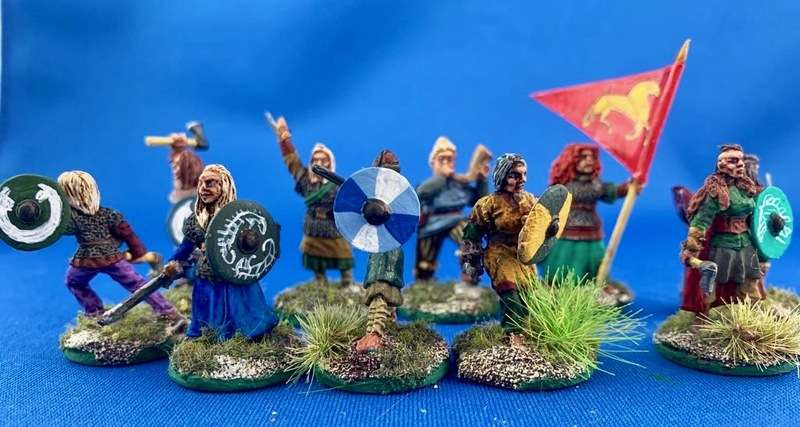
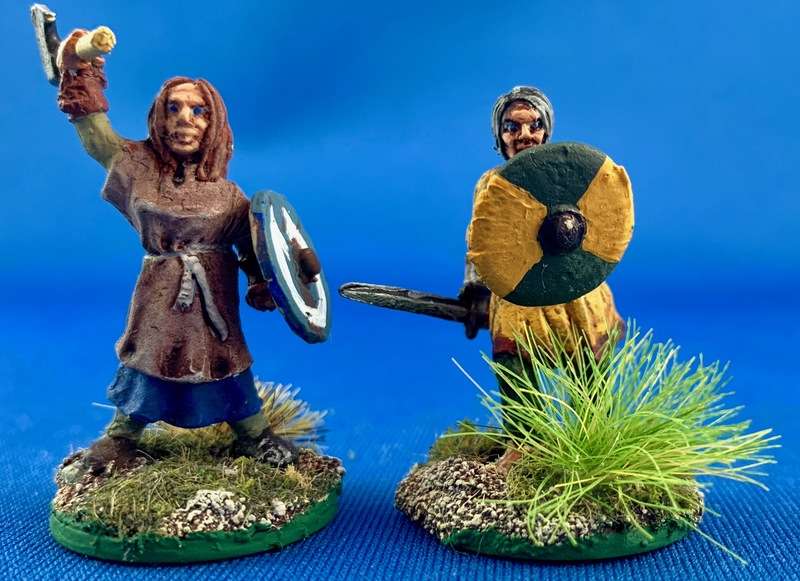
As readers of this blog will know, the world of JRR Tolkien is an abiding gaming interest of mine, and the Rohirrim are by far my favourite army of that mythology.   Some years back I purchased several sets of Dark Ages women warriors from Bad Squiddo Games, thinking they would do nicely to augment my Rohan figures (who are, not surprisingly, all male).  It makes sense that in the existential threat that a raid on a village or fortress would pose, there would be women who would take up arms and even know how to use them (the subplot with Eowyn in LOTR and the novelty of her bearing arms betrays Tolkien as being a product of his generation, I think).

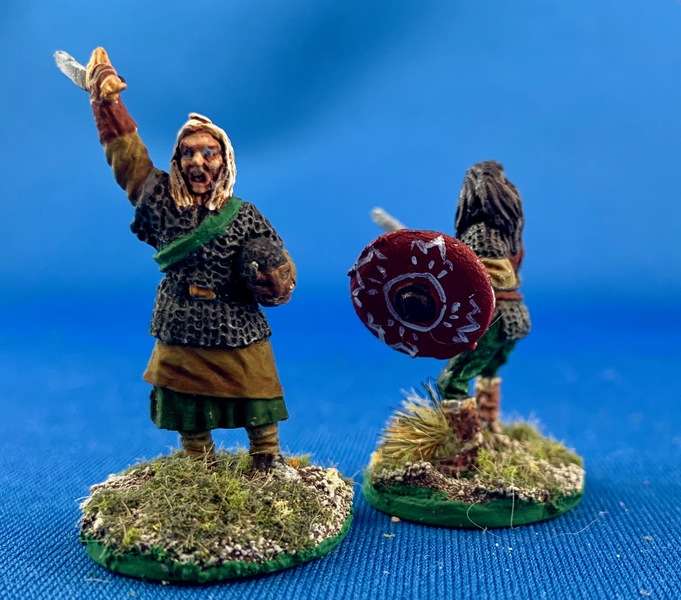
Anyway, Annie at Bad Squiddo does a nice range of female warriors that seemed suitable and I am using this pandemic time to finish old lots of figures from the lead mountain, so here are the ten I purchased some years back.


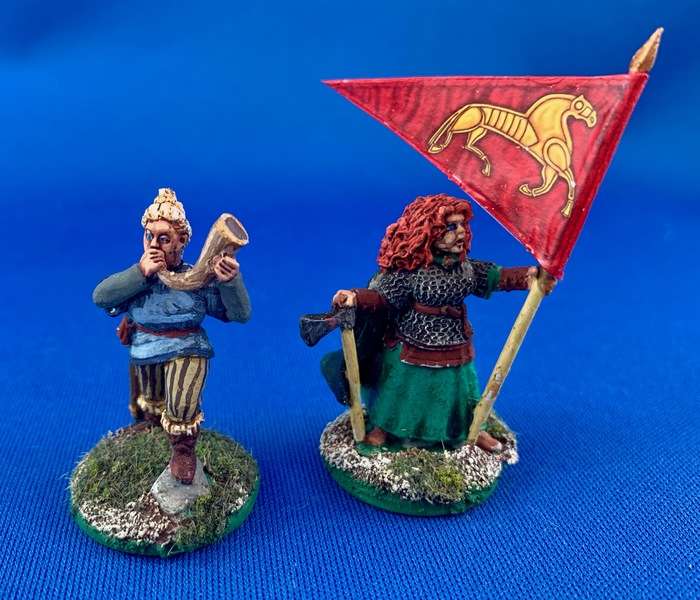
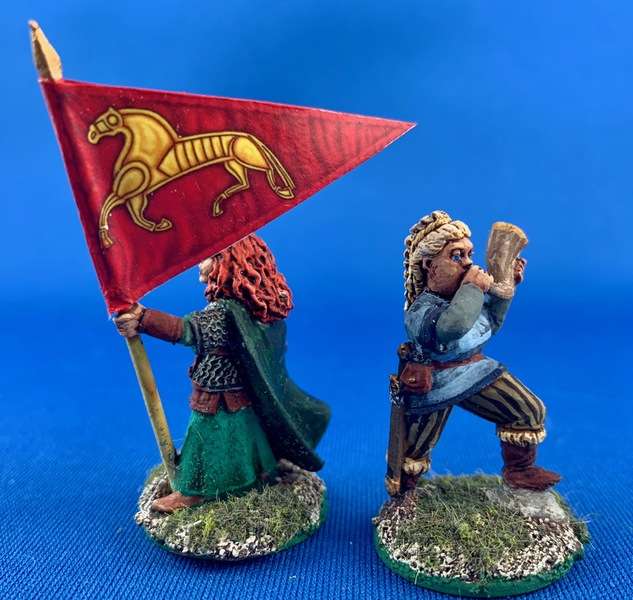
These two figures are lovely sculpts from Alan Marsh.  The banner is from a set of Saxon flags from Little Big Men Studios.


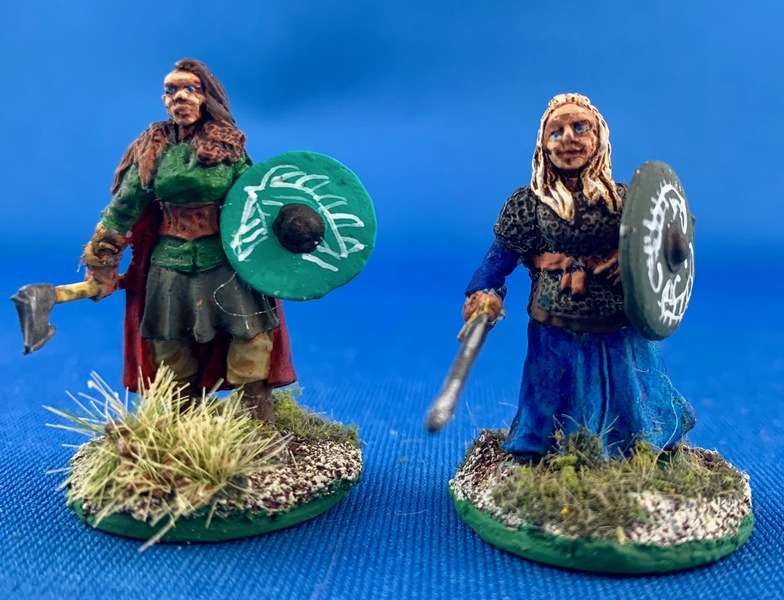
The remainder of these figures no longer appear on the Bad Squiddo website.  They are sculpts by Phil Hynes, who doesn’t appear to work for Annie any more - at least, his name doesn’t appear on her site.  The shields are done freehand, a lot of inspiration from my friend James, and I’m happy with these two in particular, even if the eyes on the one on the right are lopsided!

Anyway they are good sculpts, some better than others in terms of quality.   I enjoyed the fact that they aren’t all young supple warriors - these two are grannies that are just not having any Uruk-Hai crap, and as I creep towards my sixties, I’m ok with that.


There are tons of new Dark Ages sculpts in Annie’s shop that would be suitable for Rohirrim (including riders!) since my last visit there, as well as lots of interesting scatter terrain, so I am sure I shall be a returning customer.

Thanks for looking, and blessings to your brushes!

MP+

Thursday, March 25, 2021

Book Review: Nicholas Watson's Fortress: The Great War Siege of Przemysl


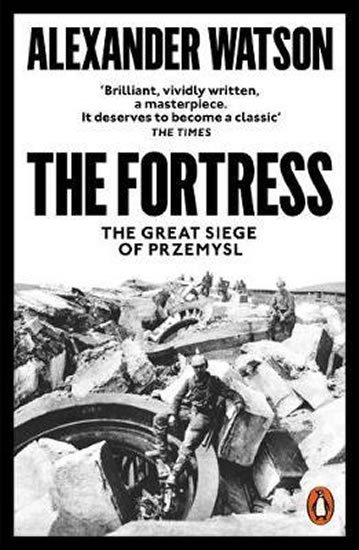
The Fortress: The Great Siege of Przemysl, by Alexander Watson, New York: Basic Books, 2020.  

This is not as long a book review as my last one, more of an appreciation, really, but I can’t remember the last time a book of military history made such an impact on me as Watson’s book on this obscure battle of the Great War in the East.

For those of us in the Anglo-Saxon world, unless we are particularly well-read, our knowledge of the Great War on land is most likely centred on the campaigns in France and Belgium,  with side trips to the Dardanelles and perhaps the fighting in the Alps between Italy and Austria.   The Tannenberg campaign is probably the latest singular exception to this rule, but the frontier battles that raged in Galicia and the Carpathians in 1914-15, and which devoured hundreds of thousands of lives, were a mystery to me until several folks online said that this was a must-read for students of the Great War.

Alexander Watson is a relatively young professor at the University of London, who has already published one book on this subject, Ring of Steel: Germany and Austria-Hungary at War, 1914-18.   Fortress by contrast focuses on the Austro-Hungarian defence of Przemysl, a town on the edge of the Carpathians in what is now Poland, which was surrounded by a ring of mostly obsolete fortresses.   There was no vital reason to defend it, but after the collapse of the Austro-Hungarian offensive in Galicia in 1914, the decision was made for reasons of prestige to hold it with a scratch force of reserve troops from the town and from the far reaches of the Empire.   The city held out until the spring of 1915, when starvation forced its surrender to Russia.

I won’t try to duplicate the many glowing reviews out there, such as this one in the Guardian.   I found the book absolutely gripping, and could quickly see why it’s such an acclaimed and awarded title in military history circles.  I will also say that I found the book unbearably tragic.  Like all sieges, it has the same narrative arc of gallant defiance and comradeship giving way to dull despair as food and hope runs out.   Watson is drawn to the city’s unlikely defenders, mostly older reservists with obsolete weapons, but he is also clear-eyed as to the Austro-Hungarian Empire’s long record of massacres of the local population of Ruthenes (speakers of various Ukrainian dialects) as suspected Russian sympathizers (there are some dark photos out there).  On the other hand, the Russian regime’s treatment of the Jewish population could be just as grim, and as Watson notes, the First World War in Eastern Europe is a prelude to the ethnic cleansing and genocide of the Second World War.    Przemysl, a multi-ethnic city before the Great War, was greatly and sadly changed by the war, and its fate, like that of Sarajevo in the 1990s, reminds us of how fragile multi-ethnic societies can be when forces of hatred are unleashed.

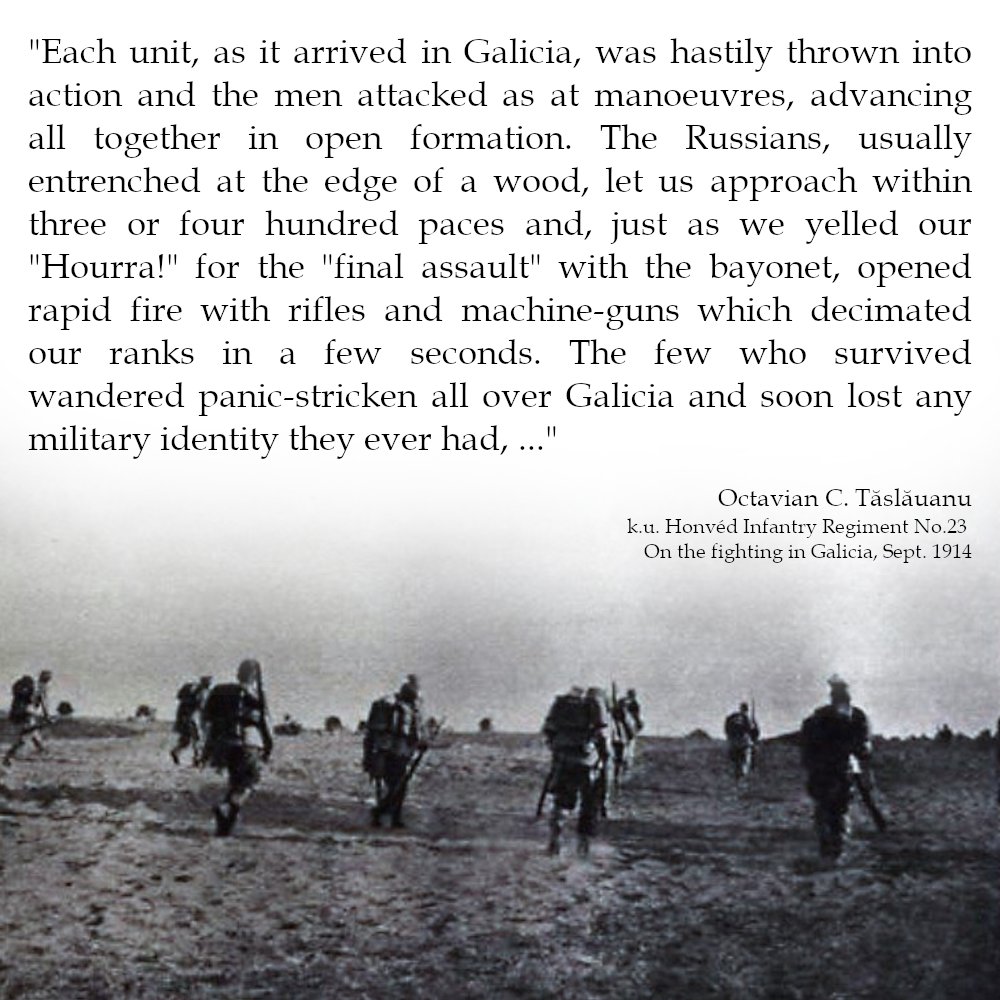
The other thing I found particularly tragic about the book was the stupidity and callousness of the Austro-Hungarian army and its commander, Conrad von Hotzendorf.  It’s hard to imagine a more malignantly irresponsible figure in all of military history.  Whereas the Russian armies fielded against Przemysl appeared to be relatively competent, the  Austro-Hungarian command threw the lives of their troops away - there’s no other way to describe it.  This quote isn’t from the book but is from the must-read Twitter account of @PikeGrey1418 captures it well.  

  Watson’s book is full of this sort of account, and they still haunt me a month later.

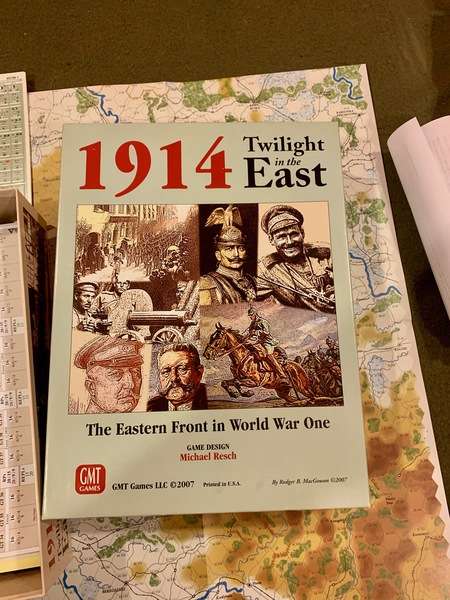
Sitting on my games shelf is this mini-monster game from GMT Games, designed by Michael Resch.  

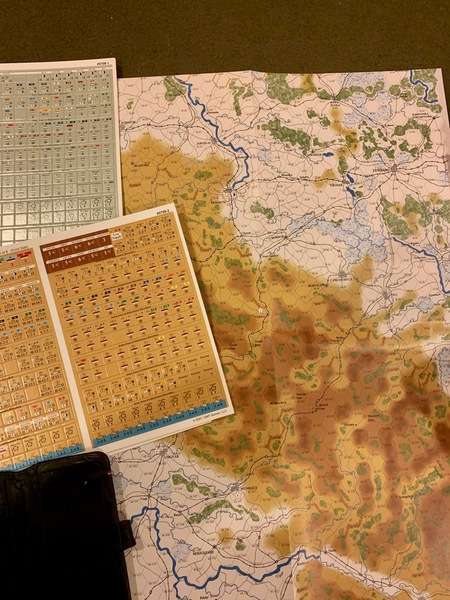
I confess I’ve had it for a few years, unpunched and still in the shrink-wrap, but after reading Watson I had to open it up and have a look.  Here’s the Galicia map, with just some of the counters.


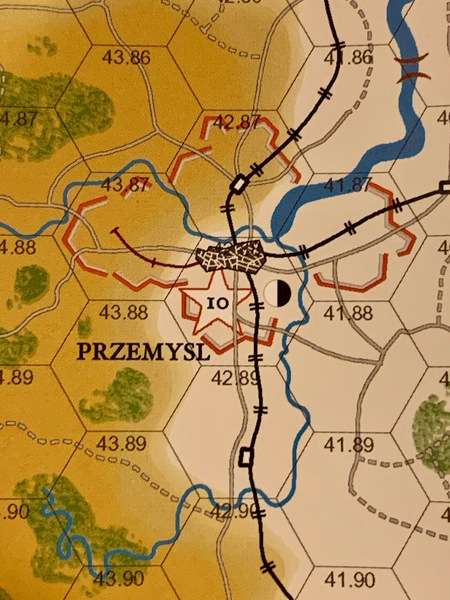
And there’s Przemysl, with its ring of fortresses.

 I may not get to this anytime soon, as I currently have a large Franco-Prussian hex and counter game on the go, but I am very curious to give this a go, as I’ve played Resch’s sister-game on the Western Front, and learned a lot about the difficulty of commanding large armies in that game.  

Even if you never want to add this subject to your gaming repertoire, I can’t recommend Watson’s Fortress enough to you as a superb treatment of an obscure campaign.   Just be prepared to be a little haunted by it.

Blessings to your books,

MP+


Thursday, March 11, 2021

Quick Look at Five Men in Normandy, Nordic Weasel's WW2 Skirmish Rules

Hello friends:

Just putting a few words of praise here for Five Men In Normandy, 30 Cal Edition, a cheap and cheerful set of skirmish rules by Nordic Weasl for very low (squad/section) level infantry actions in WW2.   I’ve been following @weasalnordic on Twitter for a while, he runs a solo game design business and is quite prolific.  I was originally interested in his SF rules but 5 Men was cheap and looked like just the thing for a simple game that was easy on the brain.

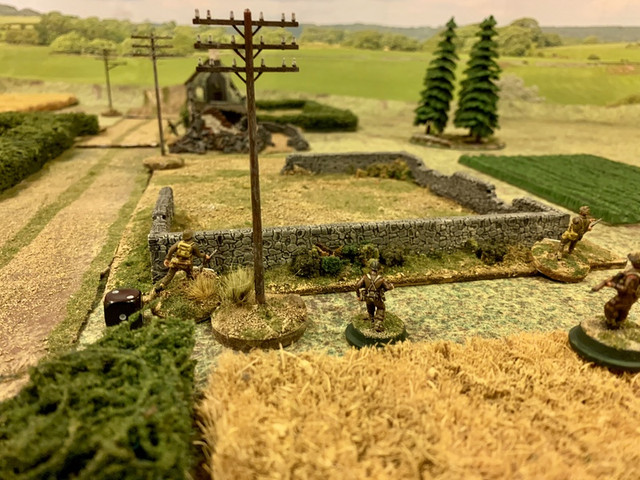
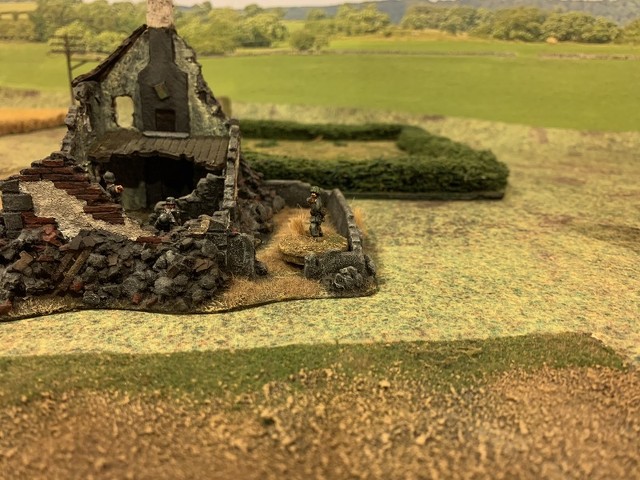
Here five Canadians are tasked with securing a ruined building to use as an OP post.  They have one sniper rifle, one Bren, one rifleman with an SMLE, a corporal with a Sten, and an officer with a pistol.   The ruined building is held by four Germans, a two man LMG team, a rifleman, and an NCO with an SMG.  All weapons randomly assigned.

The German defenders. 

 The Canadians got a map as a random asset, so they were able to sneak into initial positions.  From there, it was fairly straightforward real world tactics, with the sniper and the Bren keeping heads down while the thee others moved into grenade range.  The Germans took two casualties and the survivors elected to slip away.

You can find these rules in Nordic Weasal’s section of Wargames Vault to purchase as a PDF download.   As I said, these are very simple, D6 driven rules, ideal for very small actions with a cinematic feel.   No armour or offboard infantry, just a few guys running around with infantry weapons. You could teach them to someone in less than five minutes, and I could see my grandkids giving them a go as they get a few years older.  If you want complexity, then look to a system like TFL’s Chain of Command.  

It was also fun to get out my 20mm toys after a year in their boxes and to try out some photos against my new model railroad backdrop, which probably needs its own post.

Blessings to your die rolls!

MP+

Saturday, March 6, 2021

On To Paris! By Compass Games Turns 1 and 2

Currently on the Mad Padre’s hex and counter table I have open On To Paris (OTP), an operational/strategic treatment of the Franco-Prussian war, designed by Milan Becvar for Compass Games.  I understand the game system is ported over from an American Civil War publication from Victory Games, which I’ve never played.   I gather OTP has had a complicated production history, and there are some noted graphics issues which others have noted - in brief, I find the board and the charts hard to read because of strange font and colour choices, but I’ll leave that for now.

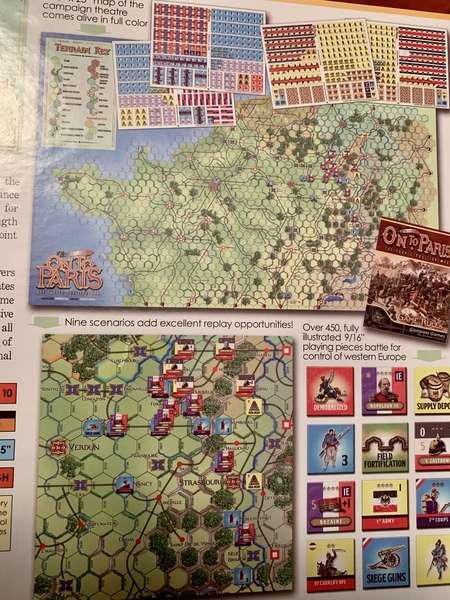
Here’s the back of the box to give you a sense of the game’s look.

OTP is a bit of a head-scratcher for a bear of little brain like myself, but I’m slowly working it out.  The building blocks of each side are infantry and cavalry strength points.   Infantry can be left as SPs for duties like garrisoning fortress, but are best organized into corps which can be attached to armies for maximum flexibility.  Cavalry are organized into divisions which can likewise be attached to armies.   

The turn sequence is a series of random impulses in which each side uses dice-driven random allocations of Command and Initiative Points to organize and reinforce, maneuver, and fight.   Amies have some reactive capability so the non-phasing player can sometimes move to counter the phasing player’s operations, depending on things like commander abilities, which gives it a fairly fluid feel.

Prussian armies are somewhat better at command and control than the French and so are more maneuverable.   There is some historical chrome:  French artillery problems at the beginning of the war mean that French combat strength is reduced in the early battles, though Prussian massed infantry tactics at the stat of the war mean that they take higher casualties.  Both sides have chances to improve their processes over time.

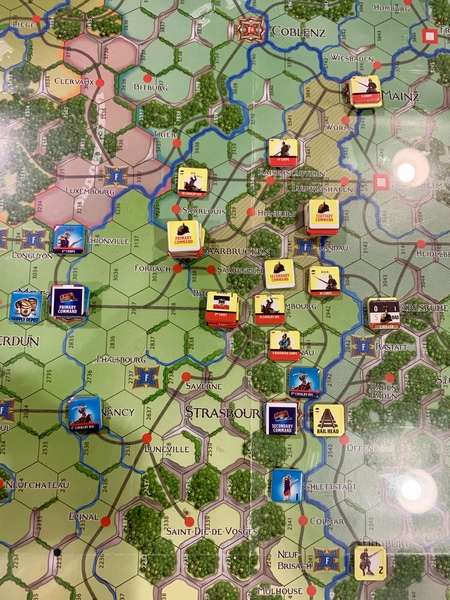
I’m playing a long scenario starting in July 1870.  Here two Prussian amies are massing near Saarbrucken, while a third menaces French forces gathering around Strasbourg.  One Prussian army has crossed the border and is besieging a French corps in the fortress of Bitche (cue puns here).


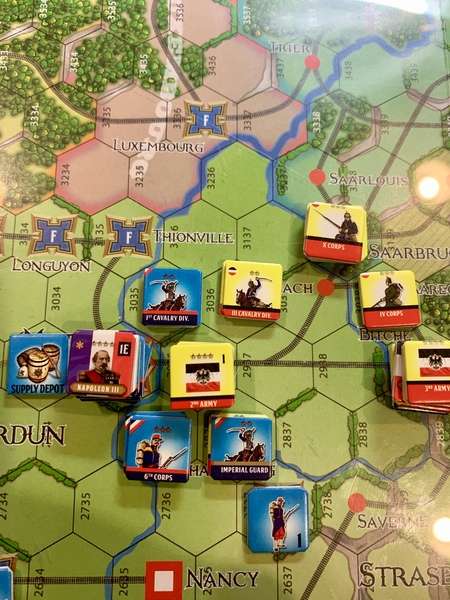
Turn 2 - with the largest Prussian army, the Second, with four corps, bearing down on Metz, the French command sees an opportunity to encircle and defeat it before reserves can come up.  A risky strategy as it would be better to entrench behind the river and rely on Metz’s defence, but (Gallic shrug) en avant! is the cry, as the French sally forth under the gaze of Napoleon III.  If the French get lucky and win the next initiative, they might have a chance of encircling and even destroying Second Army.  Battle has been joined as I slowly work out the combat mechanics.   More to follow.


Tuesday, March 2, 2021

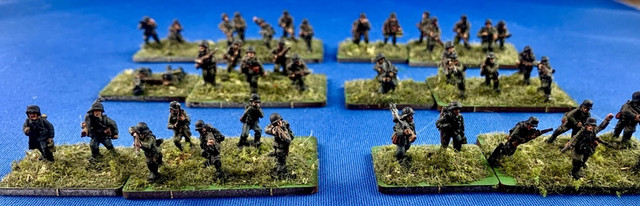
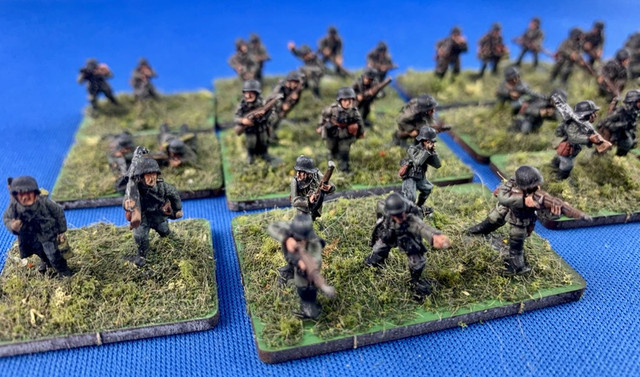
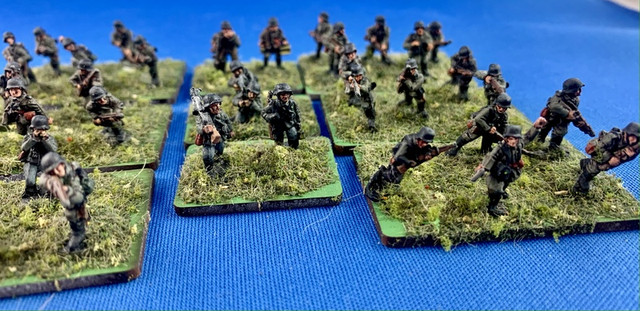
Little Landsers: Getting Ready for OGroup

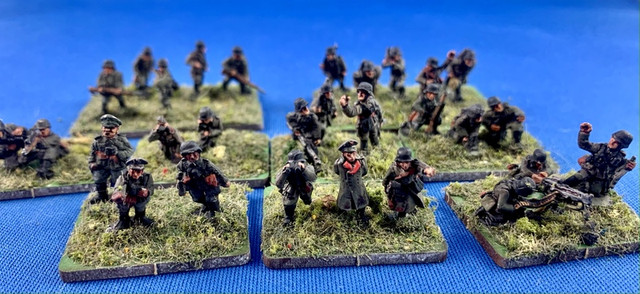
I suspect that like a lot of people in the Too Fat Lardies community that are excited about the release of David Brown’s O Group rules for battalion sized battles, I have gone back to the 15mm WW2 part of my lead mountain to see what I could find.  There is a LOT in my 15mm lead mountain, some of it dating back to the release of Flames of War.   I decided the first thing to do was to increase the number of my early war Germans - a useful force, as I already have a massive number of 15mm Russians for them to contest the steppes with.

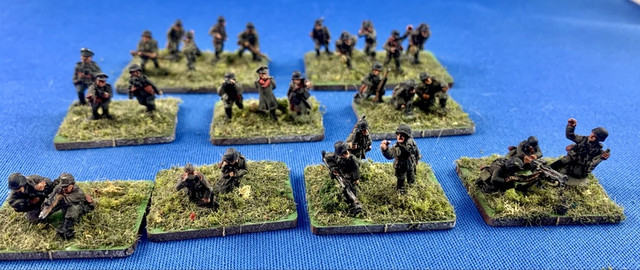
The figures are a mix of Battlefront and Old Glory that I bought in a mass order with some friends some years back.  The OG figures are, frankly, a mixed lot, some downright ugly, but they mix well enough with the BF figures.  I filled up enough painting sticks to do several platoons of generic Heer infantry with supports and command.  I put two man LMG figures on separate small bases to stretch the number of figures, so one LMG stand, with a five man infantry stand, is more or less a section.  Seems legit.

The figures were mass produced, and with a “good enough” attitude towards the final outcome.   I am not ashamed to say that I bought a can of Army Painter Field Gray spray primer to give me a base coat, and then picked out the flesh, weapons, helmets and gear.  Everything got a final wash of Windsor and Newton Nut Brown ink, a trick I saw from someone who uses it as a wash for 6mm Napoleonics, and I was happy with the end result.  The bases are coloured FOW size bases from 4Ground, covered with a blend of model railroad turfs.  I'm a slow painted, but I raced through all these figures in about five one hour sessions.

Two tripod mounted MG sections, a tank hunting team with ATR, a sniper team, a 50mm mortar, a section of combat engineers should cover most support options for smaller scale actions using TFL’s Chain of Command.

Finally, I had enough senior figures to make two command stands suitable for company or battalion level.  The fellow with the fancy overcoat has ben dubbed General Von Klinkerhoffen, in tribute to the late Hilary Minster of Allo Allo.

That should be enough for a decent sized engagement.   It’s pleasant to work in this scale again and not be too overly fussed over mistakes on a single figure.  I have a company of Battlefront Commonwealth infantry in the queue as I have become quite excited about 1st Canadian Division in Italy, but that’s another story.

Thanks for looking and blessings to your brushes!

MP+

Thursday, February 25, 2021

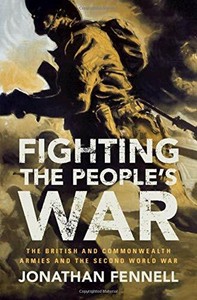
Book Review: Jonathan Fennell's Fighting the People's War: The British and Commonwealth Armies and the Second World War


Jonathan Fennell, Fighting the People’s War: The British and Commonwealth Armies and the Second World War (Cambridge UP, 2019), 932 pages.


Fighting the People’s War (FPW) was not a reading project that I approached from a wargaming point of view, but simply out of a desire to try and stay current with cutting edge military history on WW2.   After reading this massive book, though, I see some of our wargaming preoccupations with morale, troop quality, and national characteristics with new eyes.

Jonathan Fennell is a youngish scholar, who lectures at the Defence Studies Dept. of Kings College, London.  His first publication was Combat and Morale in the North African Campaign; FPW is far more ambitious, with the goal of a single-volume history of the British and Commonwealth Armies of WW2.  Rather than focus on generals, weapons systems, or battles per se, Fennell wants us to understand “the personal concerns of troops, their broad social and political perspectives, and their willingness to fight” (9).   To understand these concerns, Fennell did extensive research on the censorship summaries produced in each formation by officers who censored the troops’ outgoing letters.  These summaries were frequently produced and passed up the chain of command to help senior leaders gauge the moral and effectiveness of their men.

Fennell also focuses on the social composition of the armies that were brought into being after the outset of war.   The British and Commonwealth armies were raised from populations that were “far less fervent and less deferent” than those who supposedly flocked to the colours in 1914.  The British government knew that conscription would be necessary from the outset:  of the three million men raised to join the Army of 700,000 under arms in September 1939, three-quarters were conscripts (63).  The Commonwealth armies were volunteer forces at the start of the war, but there was little “widespread enthusiasm” to join these armies, while minority populations (Canadian French, South African Afrikans) were particularly reluctant to volunteer and even less happy about conscription.   Deferments of professional and skilled workers meant that “semi-skilled and unskilled classes … were particularly represented” in the armies.  

Why did the British and Commonwealth armies perform so poorly from 1939-42, what Fennell calls the “great crisis of the Empire”?  A huge reason was lack of training.  In June 1941, for example, only ten percent of the British Army were fully trained regulars.  There was a shortage of equipment, uniforms, and training areas sufficient for a whole brigade to exercise (221).   The quality of officer training was often poor, and theatre-specific training was often left up to unit COs to implement if they felt like it, so, for example, many of the units defending Malaya were wholly unfamiliar with jungle training.  

Besides the training deficit, there was what Fennell calls an “ideological deficit”.  Governments expected their soldiers to fight the Nazis and preserve the Empire, which required an “innate commitment and fighting ability of its citizens and subects” (255).   The problem was that most troops had little commitment to the British Empire (especially Indian troops), were dissatisfied with their poor pay and treatment compared to the high wages earned by skilled workers in the war industries, and had memories of the poor treatment and unemployment of demobilized soldiers after the Great War.    Generals lamented that their troops were “readier to surrender” than their foes and realized that “many of the troops still want to know what we are fighting for” (255).    After the defeat of Eighth Army at Gazala in 1942, 88 per cent of all casualties were men reporting sick or who had surrendered.   British commanders like Auchinleck asked the government to reinstate the death penalty for cowardice and desertion; these requests were refused.

By 1944, the British and Commonwealth armies had improved training, focused extensively on soldier welfare, and had learned to conserve their dwindling manpower by doctrines such as Montgomery’s set-piece “Colossal Cracks” battles.    Commanders learned to only ask “of their troops what they were capable of and trained to do” (688).   However, hard limits were reached.  The New Zealand troops essentially mutinied over a botched 1943 furlough scheme, the South African populace had largely ceased to support their government’s war effort, and the Canadian government’s attempt to introduce conscription was a military and political failure. 

With victory in sight, what soldiers wanted most was an assurance that things would be better after the war – that better housing, better employment, better education would be a tangible reward for their sacrifice.  Army education schemes to help the soldiers understand what they were fighting for ironically radicalized the troops politically, which explains in part why Churchill, who cared more the survival of the Empire than he did for social engineering projects, lost the 1945 election.   Philip Zec’s famous 1945 cartoon sums up the hope of the soldiers that the peace would finally be an opportunity for the working classes.  One example of this radicalization that I didn’t know of in my own country’s history is that in 1945, Canadian progressive parties won 58% of the civilian vote and a whopping 71% of the votes of soldiers who had recently fought in NW Europe.

Fennell’s book has a demythologizing agenda, to be sure – he wants to debunk the idea that British and Commonwealth soldiers were “stolid … apolitical and uninterested in the broader meaning of the war” (697).   They were brave, they learned, and by the end of the war they were effective and well-trained armies that also “yearned for the camaraderie and equality of the battlefront to be present on their return to civvy street” (697).  

I’m glad I persisted in reading this massive book because it took me a little closer to the mindsets of the troops who did the bulk of the fighting and dying on the ground.   As a Canadian who used to be quite the Anglophile, I always thought that the pluck and elan of the British and Commonwealth troops always got them through a tight scrape – I am sure I’d internalized old propaganda films like The Way Ahead.    In fact, the history of those armies up to 1942 is often a series of lamentable disasters as poorly trained, unmotivated, and poorly led troops learned their business the hard way while the Empire collapsed around them.    For wargaming, even in a small-scale action, Fennell’s book should lead us to question our first assumptions about troop quality, morale and training.  We can ask these questions without questioning the bravery or heroism of these soldiers.
Wednesday, February 24, 2021

Happy Heinkel

Hello friends:

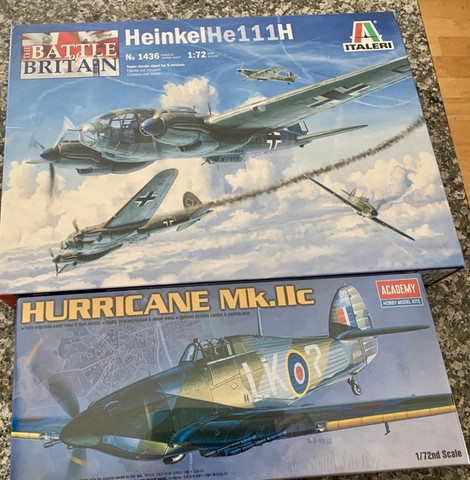
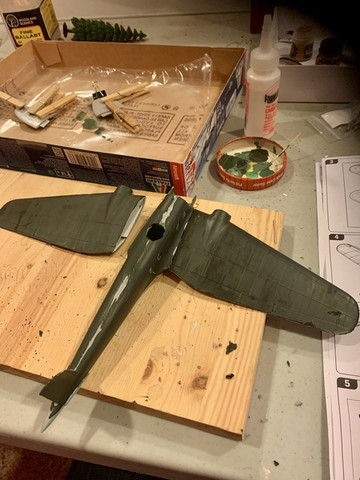
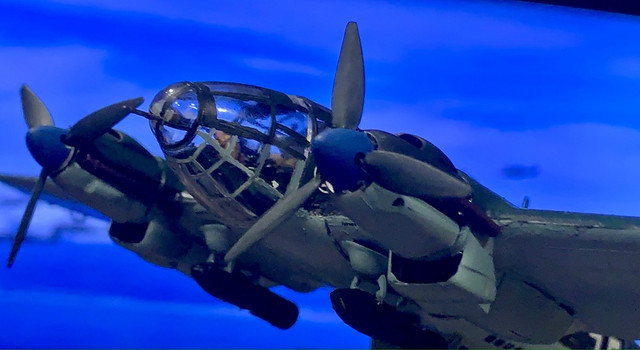
One way of dealing with Covid fatigue for me has been returning to a teenage obsession with model airplanes.  May have ordered these (from Wheels and Wings in Toronto, excellent store) after watching the Battle of Britain recently.

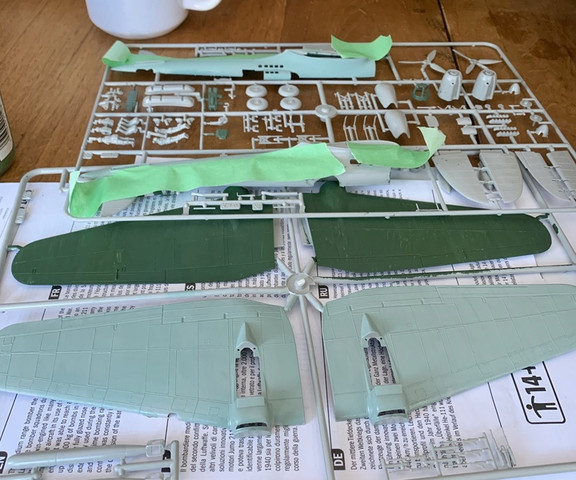
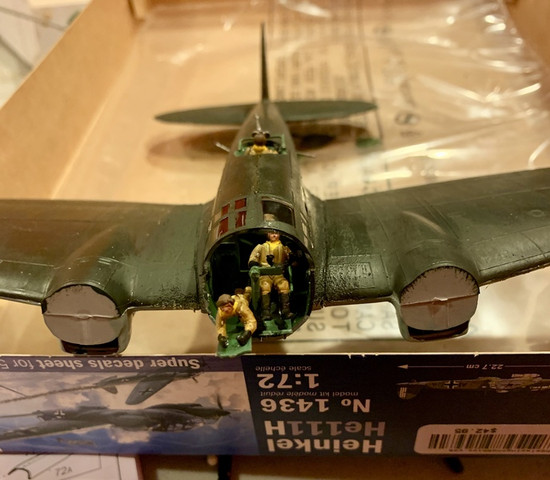
I crowdsourced which one to build on Twitter through my @Marshalluigi account and the Heinkel got slightly more votes, so off I want.  The Italieri 1/72 kit is fairly simple, not a lot of complex parts, which is kind of a blessing after the recent Lysander kit.


Oddly the kit included crew figures but the instructions said don’t use them.  Instructions be damned, I said.

Another excuse to watch The Battle of Britain.  “Tomato Eins en Alle, Tomato Eins en Alle, noch zehn Minuten bis Ziel!"  

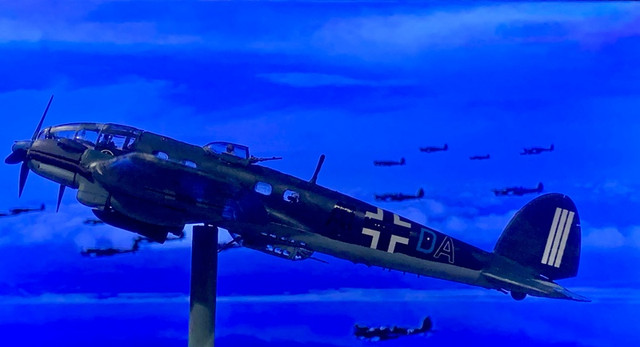
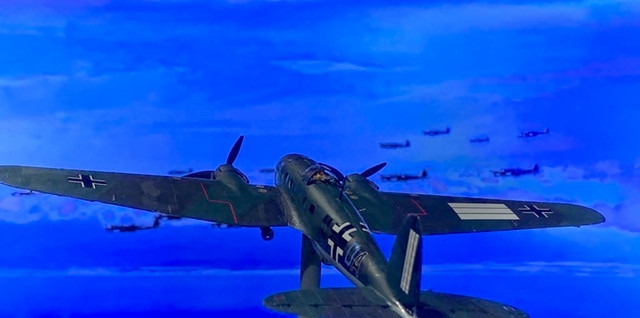
There is something sleek and rounded about the HE111 that is quite graceful.  While it looks terribly vulnerable in the film, an HE111 carried a LOT of machine guns, six in this model variant.

I dreaded painting the nose canopy but it turned out well enough if viewed at a distance.

I suppose a distant project might be making a handful of BoB 1/72nd models for a game TFL’s Bag the Hun, though I might just hang it from the ceiling as teenage me used to do.

Thanks for looking.  Blessings to your models,

MP+

Blog Archive

Followers