Thursday, December 12, 2013

A Fall Visit To Antietam

So as I was saying recently on my other blog, the God Blog, my first term of graduate school has kept me busy.  There were a few games that I managed to get in, which gave James Manto and I much mirth, but mostly a lot of reading and writing and only a little painting, none of which I am ready to show off here.

One thing I did manage this fall, which I think is relevant to this blog, was to travel south to the National Park at Antietam, MD, in the company of a friend from reenacting days, Kevin, and his son (my godson), Brendan. 

It was a warm day in early October, and the place looked more autumnal than it would have on Sept 17, 1862, when most of the trees were still green and leafy and the crops, particularly the infamous corn, had only just started to be gathered in.

This shot was taken by the visitor centre.   in the background, behind the canon, you can just make out the observation tower by the Bloody Lane.   Not far beyond that tower is Antietam Creek, with the hills of South Mountain visible in the far background. 


Brendan and his godfather outside the visitor centre.   Brendan and I were both wearing dinosaur themed Tshirts, so we decided that our tour was happening on "Walk and Talk Like a Dinosaur" day.   Brenday knows more about the civil war than most eight year olds - for example, he knows the difference between a Napoleon and a Parrot cannon.   He comes by this knowledge thanks to having a huge ACW nerd as his dad, though I have to admit, Dad made an excellent and knowledgeable tour guide.


The Dunker church.  Matthew Brady's famous photograph of wrecked Confederate artillery and dead artillerists was taken not far from this spot.


The famous cornfield, with the East Woods visible to the right.  James MacPherson writes in his Antietam book, Crossroads of Freedom, that "Many cornfields were the scene of fighting during the Civil War, but this one was ever after known as the Cornfield."  Here elements of Hooker's and Mansfield's Union Corps collided with the Confederate divisions of Stonewall Jackson, and storied units like Hood's Texans and the Iron Brigade annihilated each other.   Here, as one soldier of the 6th Wisconsin described it, "Men, I cannot say fell; they were knocked out of the ranks by dozens" (MacPherson, Crossroads, 115).


The Bloody Lane, a natural trench which appears, choked with corpses, in Alexander Gardner's famous photograph.   This view is taken looking towards the visitor centre, with the observation tower directly behind.  One thing I noticed walking the cornfield to the right of the photograph is that there is a hill in the centre, so that the Union brigades attacking through it towards the Lane would have been concealed from sight until perhaps 100 metres from the Confederates lining the fence rails.   At that range, in their massed formations, it would have been difficult for any shot to have missed.


Monument to the Irish Brigade at the Bloody Lane.   By an odd and sad coincidence, we learned that the sculptor of the bronze bas-relief on this monument, Ron Tunison, died on 19 October, just a few days after out visit.


Mr. Tunison's work.  He was a talented gentleman.


This picture was taken from the grounds of Union commander McLellan's HQ at the Pry House, on the east side of the Antietam creek, looking west towards the cornfield and the East and West Woods.   McClellan never stirred from these grounds during the battle, relying on couriers and signallers to manage the battle.   You can judge for yourself how effective a 19th century commander would have been in such a position, managing a battle a mile distant.    In his Antietam book, Landscape Turned Red, Stephen Sears calls McClellan a spectator of the battle, and quite rightly so, I think.   McClellan never managed to send more than 20,000 men into the fight at any one time, despite outnumbering Lee's Army several times over during the whole battle.  By contrast Lee managed the battle directly, positioning himself directly behind his iines and using the turnpike to move and see the situation as required.


The famous Burnside Bridge, seen from the heights on the west side where a handful of men from two Georgia regiments were able to hold up Burnside's IX Corps for several key hours, allowing A.P. Hill to march from Harper's Ferry and halt Burnside when he finally crossed the bridge and threatened Lee's right wing late in the day.  From this range, it's hard to imagine a trained and experienced shooter, as those Georgians must have been, from missing his target.

 A view across the bridge.   Would you be brave enough to dash forward across this, through a hail of minie balls?   


A view of the McKinley Monument, near the Burnside Bridge.   I took it because I thought this comely lass was fetching, though her manner was cold and stony and did promise any dalliance.   McKinley was one of two future US presidents to serve in the Union army at Antietam, the other being Rutherford Hayes.


The day after our Antietam tour, before we headed home, Kevin and I visited several of the battlefields that are collectively known as South Mountain.   After he was fortunate enough to learn of Lee's dispositions thanks to the missing orders intended for D.H. Hill, McClellan had the means to destroy the Confederate army in detail, but moved sluggishly.   The next day, Sept 14th, after a long delay, he moved against the small rebel detachments holding the three passes through the chain of hills called South Mountain.  This handsome monument at Fox's Gap remembers the North Carolina troops that tried to hold long enough to buy Lee time to regroup.  They might have died in vain, if McClellan had not been more aggressive, but he waiting until the 17th to attack Lee at Sharpsburg/Antietam.  We found this monument after a long walk through some woods, and it was worth the searching.   A Union Corps Commander, Jesse Reno (IX Corps) and a Confederate Brigadier, Samuel Garland, died near this spot on the 14th.


One last picture.   This stone church is found at the summit of Turner's Gap on South Mountain, another skirmish that occurred on 14 September.   I knew nothing about it until I stumbled on it.  It's called the Dahlgren Chapel, built in 1881 in honour of the wife of the Union Admiral John Dahlgren, and for a while was a Roman Catholic chapel.   I j had the chance to walk around it and peek inside the windows.  A lovely place in the Gothic style that is still available for weddings, if you want to get married in Maryland.


 If you are interested in Antietam, I would recommend two books, both mentioned above.  One is James M. McPherson's Antietam: Crossroads of Freedom, a short book that sketches out the battle but does a brilliant job of situating it within the political and military context of 1862.   If you want a blow-by-blow account of the battle, Stephen Sears' Landscape Turned Red is the book for you.   McPherson notes that this battle may well be the most important of the Civil War, because it was the victory that made Lincoln's Emancipation Proclamation possible and thus ended any chance of a pro-Confederate intervention by the great powers of Europe.   While Gettysburg has military significance, Antietam, one could argue, is the battle that effectively ended slavery and thus changed American history forever.   

It's impossible not to walk this battlefield and read about it without concluding that McClellan lost it may times over.   Had he been anything like Robert E. Lee, he would have smashed Lee's army, instead of giving it time to gather and fight for its life.   At every turn, Lee and his generals were active, vigorous, courageous and effective.   By contrast, McClellan's generals were mostly ineffective, timid, or disgruntled with one another and with their commander.   This is a problem that any war-game simulation of the battle has to model, for if the Union player representing McClellan has freedom of action, the battle is pretty much a foregone conclusion.   That is the problem addressed in SPI's famous Antietam monster game,  A Gleam of Bayonets, which sits on my shelf awaiting its moment.  Perhaps when I retire.


Friday, October 4, 2013

Chris Weuve On Wet Navies In Space


I was noodling around the Foreign Policy website today and was delighted to find an interview, first published last year, with US naval analyst Chris Weuve on how science fiction models naval warfare, including "Air Craft Carriers in Space". The models Weuve discusses come from popular culture: Battlestar Galactica, Star Trek, Star Wars and Babylon 5, and he makes some very clever and insightful comments on how science fiction models and sometimes anticipates trends in warfare of the day. Here's a taste:

" But science fiction is the literature of "what if?" Not just "what if X happens?" but also "what if we continue what we're doing?" In that way, science fiction can inform policy making directly, and it can inform those who build scenarios for wargames and exercises and the like. One of the great strengths of science fiction is that it allows you have a conversation about something that you otherwise couldn't talk about because it's too politically charged. It allows you to create the universe you need in order to have the conversation you want to have. Battlestar Galactica spent a lot of time talking about the war in Iraq. There were lots of things on that show about how you treat prisoners. They never came out and said that directly. They didn't have to. At the Naval War College, one of the core courses on strategy and policy had a section on the Peloponnesian War. It was added to the curriculum in the mid-1970s because the Vietnam War was too close, so they couldn't talk about it, except by going back to 400 BC. "

Wargamers and military/SF nerds will find a lot to like in this article. Wargamers intuitively understand the idea of modelling reality, and those of us who remember games like Star Fleet Battles, or who play current games which draw Great War air combat a la Wings of War into the Star Wars X-Wing vs Tie Fighter franchise, have thought about the assumptions involved in translating air or naval games into space combat. One of the gaps I did notice in the interview with Wueve was David Weber's Honor Harrington series of space opera, which to my knowledge (and to my unscientific mind) is the most interesting and detailed thought experiment in what strategic and tactical naval warfare in space might look like. I'd welcome suggestions on author others whom you think "get it right".

Friday, September 27, 2013

Canadian History - So Not Boring


After my last post here on a wargame which turned out NOT to be the battle of Ridgeway but a post Ridgeway what if (I shouldn't fall asleep in O Groups), I received a charming email from a reader of this blog who told me that he too used to think Canadian history was rather dull.  However, the reader told me that he discovered some information on the Battle of the Plains of Abraham which made him rethink his position.  Apparently the French army was thinking more of the local ladies than the security of the position, which is always a fatal mistake.

To provide more evidence that the Plains of Abraham, like the rest of Canadian history, is not boring, I offer this cartoon from Kate Beaton.   I referred to Ms. Beaton in my last post, and she is to my mind the Official Muse of Canadian History, or at least one of its foremost practitioners.   In fact, I urge you all to go out and buy her book of cartoons, Hark A Vagrant!, from Amazon. 

Did you like the cartoon?  Good.  Then be a good chap and go buy her book.

Sunday, September 22, 2013

Canadian History Is Not Boring! Comic Operaish Yes, At Times, But Not Boring

There is a school of thought that Canadian history is dull, a debate which is conveniently summarized here by Kate Beaton.  Consider the Battle of Ridgeway as an example of how Canadian history is actually quite exciting.  On the one hand, a bunch of Irish-Americans nationalist  yobbos, many of whom had not received their fill of the horrors of the American Civil War, and who wanted to stick it to John Bull by having a go at Canada (which is rather like getting revenge on your big, frightening neighbour by kicking his little dog tied up in his front yard).  On the other hand, you have the Canadian militia, made up of local farmers and University of Toronto students who got to dress up in Gilbert and Sullivan style uniforms, go fight in a battle, and get a cheesy monument erected in honour of those unfortunate enough to get shot.

You have to admit, that is a much more impressive way to go that choking on your vomit at a weekend frat kegger, but I digress.

Yesterday much of the brain trust and secret society behind SW Ontario's Hot Lead Gaming Convention assembled to celebrate the fiftieth birthday of one of our own, Postman Pete, or WO Garnham as some are unfortunate enough to have to call him.   Among the day's events was a 28mm battle of Ridgeway by Keith, who had brought an impressive assortment of Fenians, looking suspiciously like Perry Bros ACW infantry in greenish uniforms.  Opposing them were the Canadians, stout chaps in gorgeous red uniforms like this fine fellow.

I believe that the Canadian minis are a mix of Empress Victorians and Foundry from their Indian Mutiny range, and that some were painted by James Manto, but I will let others confirm that.  Suffice it to say, they looked good.

Here is the table provided by Postman Pete, with the Canadian side prepared to defend the stream, with their one gun guarding the bridge in the centre.  Our two better units are posted forward, while our less effective militia units are in reserve, but surely those Irish rebel scum won't get as far as the second line of fences!

The Fenian side of the table, showing the Fenian dispositions.  Spirited demonstrations by Rico (Fenian right, Cdn left) and by Patrick (Fenian left, our right) will try to pin the flanks while the main force under James and Brian will aim to pierce the centre.


Having introduced the armies, I should say that the rules we used were Black Powder (my first time playing them) with Keith as game master.


On the Canadian left, defenders shake out into skirmish and move forward to check Rico's push on our left flank.  The redcoats will soon rethink this policy and fall back on their supports.


Rico's gobshites crash into Postman Pete's militia and a fierce punch up along the fenceline begins.  This melee will rage for most of the battle.

On our right, Fenian Patrick watches in satisfaction as his yobbos sully Ontario's fair stream with their dirty brogues and tear into Mikey's militiamen, who had taken the worst of the musketry so far and were beginning to falter.  As the Cdn CinC, I soon had a lot to worry me.

My chief worry was in the centre, where Brian massed an entire battalion, but paused longer than he wished while he tried to get a good orders roll to sort them into a column of companies for the assault over the bridge.  This gave my gunners time to do some damage and disorder, but I had trouble getting my infantry supports to shift over behind them.  I was hoping I could withdraw the gun and plug the bridge with infantry.

Alas, it was not to be.  The Fenians charged, the gunners panicked and fired their double shotted grape high, and were cut down.  I did manage to get several companies of redcoats to plug the gap, but their die rolls weren't much better.  There was much Fenian mocking of the cool bearskins my lads were wearing, but as a gentleman soldier scholar knows, chicks love bearskins.


After a few pokes with  bayonets, the bearskins remember that they have a big varsity game tomorrow, and skedaddle.  The mass of the Fenians break through the centre, shrugging off Canadian counter attacks, while James pushes some of his boys over the stream against poor Mikey's last survivors from his fight downstream with Patrick.


On our right, Patrick's Fenians have overrun Mikey's lads and pitched into our second and last line of defence.  Barry's militiamen try to hold at the apple orchard but quickly decide that Ontario has more than enough fruit to share, and they fade away.  The pressure on Barry's unit prevents him from shifting enough forces to check James and Brian in the centre.

The final view of Fenian victory.  

The Canadians are rolled back everywhere and have done a fraction of the damage that was inflicted on them.   There will be much mourning among the belles of Toronto, and a lot of lads with excellent excuses for late term papers.  The cry among the Fenians was "On to Hamilton!", but in real life, after winning at Ridgeway but discovering that the Canadians did not welcome their visit, the Fenians decided enough was enough and went home before the British Army showed up. 

All told, a very pleasant game with some terrific looking figures and with a very unusual "Redcoats in the American Civil War" feel to it.  The rest of the day was spent in sillier but equally amusing pursuits.  So happy birthday Postman Pete and thanks for your hospitality.  

Tuesday, September 10, 2013

The World Is Flat! (And What I Did About It)

After my friend James came by last week and we fought the battle of St. Mikhail's, I had a look at the table afterwards at the table we used and was dismayed at how flat it was.  I even got a carpenter's level and the bubble was dead in the middle.  So flat!  St. Mikhail's must have been located somewhere in Saskatchewan!

Recently there was a thread on the Too Fat Lardies' Yahoo group about a chap who used a bunch of heavy blankets to add texture and contours to his wargaming table. This was a somewhat more substantial procedure than just draping a thin sheet of green cloth across some books.   So I started with some books.


I then took several old quilts and blankets and spread them over the table, trying not to smooth and straighten them too much - this image isn't super helpful but it conveys the general idea.


Once I had the quilt and blanket scrunched into some contours, I overlaid them with the sheet of fabric I usually start with and then started adding terrain features.   These led to some actual contours, such as folds in the ground and dips in this road leading to a village church.

Or, on the other side of the church, a field of wheat that actually follows the side of a hill, rather than looking as flat as the Canadian prairie (which is actually not as flat as one would think).

A small side road with sufficiently high banks and hedges to conceal a section of infantry moving tactically.

The table in its final form.  I am pleased that the final look isn't so deadly flat.  While the church in the centre still dominates, there is enough dead ground around it to make approaches possible for both attackers and reinforcements sent to its relief.  

So apologies to those of you for whom this is not especially novel or profound.  I am rather like the Irish novelist George Moore, of whom Oscar Wilde once quipped that he conducted his education in public.  To me at least this is a bit of a breakthrough in table design.  I have just started using this layout for a solitaire run through of the new Too Fat Lardies rules, Chain of Command, and I hope to have some results and thoughts to share with you by this weekend.

Sunday, September 8, 2013

Two Faces From The (Near) Past

In my last post I bragged on my godson Brendan, and mentioned that his dad Kevin and I became friends during our American Civil War reenacting days.  I found this image today in my papers.  Kevin and I had this tintype taken at a reenactment sometime around 2000.  I'm the bear die standing on the right.  I recall getting a lot of stick from my relatives when I showed up for a reunion in this facial hair and they thought I had gone all Grizzly Adams.

The interesting thing about a tintype is that it takes forever (well, at least a minute or two) for the exposure to take, which explains why you don't see many period pictures of Cviil War chaps laughing and grinning.  I suspect for most of them, who might have had one or two images taken in their lives, it was a serious business getting one's image taken.

If you're good, I may post a picture of a Civil War chaplain gorging himself on pie.


Saturday, September 7, 2013

With My Painting Padawan


One of the advantages of being back in eastern Canada is that I have the opportunity to pick up with old friends, including my buddy Kevin from my ACW reenacting days with the Columbia Rifles.   The CR was an authentically-minded group of living history buffs that Kevin and some friends founded in the late 1990s, and they were kind enough to take me in when I stupidly thought that lying on the cold ground wrapped only in a period correct natural fibre blanket would be fun.   Actually, it was kinda fun at the time.

Kevin and his lovely wife Maureen soon became fast friends and seven years ago they adopted a lovely chap from Guatemala whom they named Brendan.  I had the honour of becoming his godfather but hadn't seen him or his parents for the last five years.   When Kevin and Maureen invited us down to Buffalo, NY for the Labour Day weekend, I was told that Brendan really wanted to paint Zouaves with me.  How could I resist?

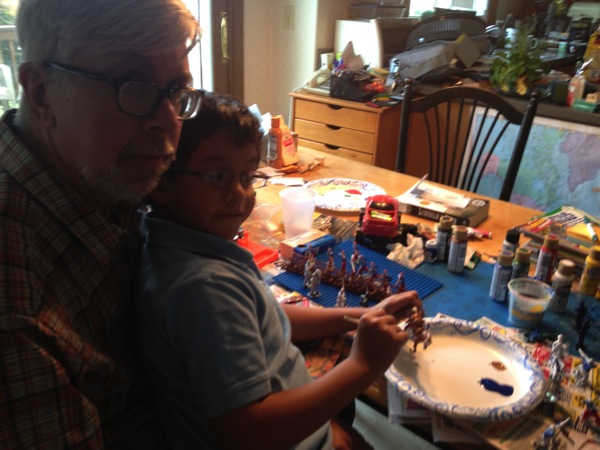
Here we are last Sunday.  Brendan quickly picked up some basic principles such as the importance of figure prep, a quick undercoat, block painting and using a palette for his paints.


IMG 2033


Here are some of Brendan's Zouaves, painted an illustration from Dad's book of Don Troiani prints of the 5th New York at Gaines' Mill.

IMG 2037


A desperate battle at Lego Farm!   As I was leaving, Brendan was mixing up some flesh tones for his fellows, and was going to try mixing a dark gray for his rebs.   I expect great things of young Brendan and hope to show off more of his work here in the future.

Blog Archive

Followers