Sunday, June 12, 2022

First DBA Army Completed: 15mm Early Hebrews

Back in October I announced here a project called “Getting Biblical”.  A friend of mine had previously expressed surprise that I as a wargaming clergyman had shown no interest in biblical era armies and battles, and I thought, “good point, why is that?”  The question was especially perplexing as, early in 2020, I spent a month in Ethiopia teaching the book of Isaiah to some young seminarians, and I thought at the time, what great inspiration.   Every power of the Middle East - Egypt, Ethiopia, Assyria, Israel and Judah, and Babylon - is mentioned in that book.

In the last few months, I was introduced to DBA, and that made the whole project seem far less daunting.   Working in 15mm, generating 12 bases for a complete early Hebrew army, that all seemed doable.   So, I dug out the Fighting 15/Gladiator ancients figures I purchased last year and got to work.  It’s hard to find dedicated ancient Jewish figures, but the Fighting 15 Syrian/Canaanite range seemed close enough.  It didn’t take me that long to get these figures finished and based.  Don’t ask me about the shields, I just had fun with them.
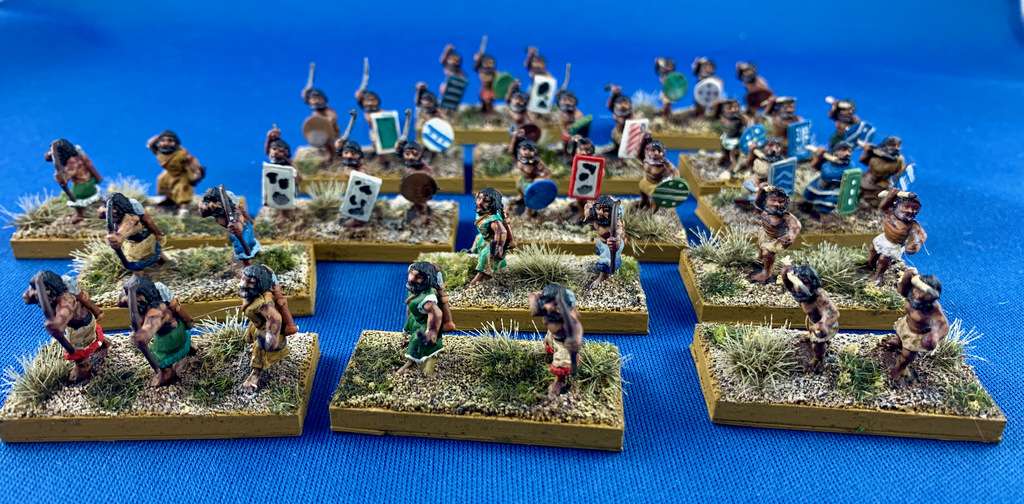
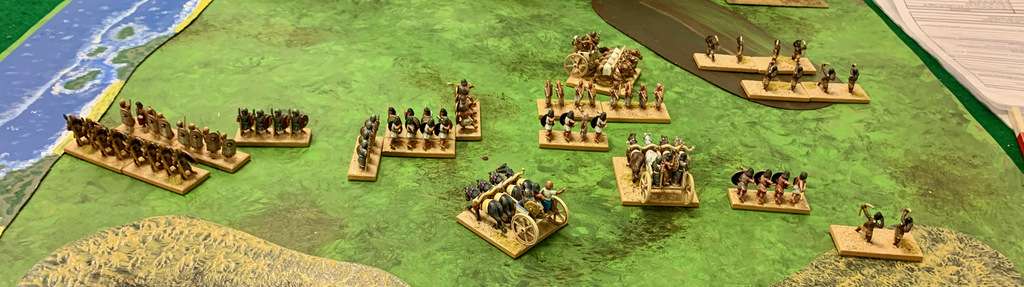
 Out of these figures I can assemble this army, which in DBA parlance is 1/27 Early Hebrew c 1250BC - 1000BC.  Baker and Laflin-Barker write: “This list covers the Hebrew armies from the selection of Joshia a Judge until David’s accession as King and is largely based on the Biblical - which, unreliable as this may be as history, is often the only source available” (DBA 3 WRG 2014 p. 42).  

The lighting here is uneven, but in the front row left there are 2 X Gadite or Issacharian skirmishing javelin men (Psiloi), with the choice of third unit of Ps front right.  I could have chosen either retained mercenaries - 4 Aux (Auxiliary), but I wanted the whole army to be Fast and the extra unit of Ps to exploit rough terrain (the only battlefield on which this army survives).

In the middle row, starting on the left, is 1 X Benjamin archers or slingers - 3 Bw (Bow), then 2 X Simeonites or Ephraimites - 3 Wb (Warband) - and on the right the General based as 3 Ax.  In the rear rank are 5 X other tribesmen (3 Ax).
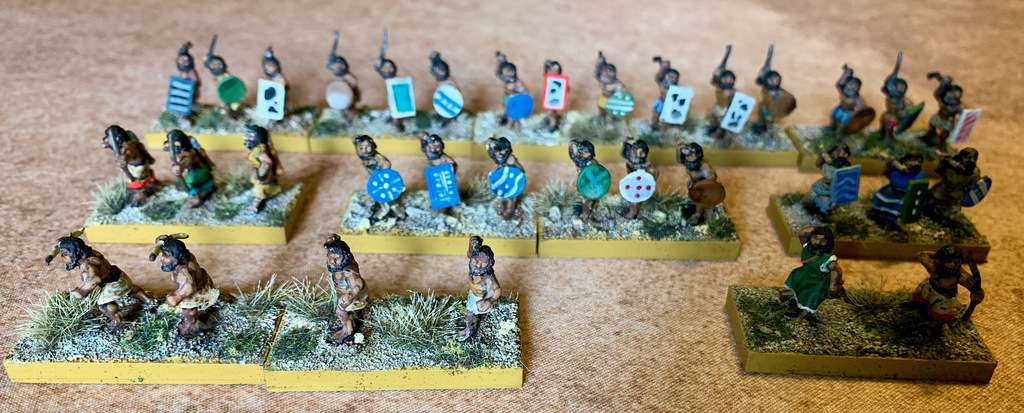
Historical opponents for this army include 1/6b Midianite or Amalekite Army or early Arab Army, 1/20a Ugarit Army, 1/20b Other Syro/Canaainite Army, 1/22a or 1/22b New Kingdom Egyptian, 1/29a or b Philiistine, and 1/31a or b Neo Hittite/Later Aramean Army.

I have four chariot stands complete which I’ll save for another post, which would give me the nucleus of a Syro-Canaanite army, but a Hebrew/Philiistine matchup would be fun and would take me back to Sunday school days.    I mentioned the Book of Isaiah at the start of this post, and all of the armies mentioned above pre-date the period of the two kingdoms, the exile, and post-exile.   Never fear, a recently arrived order from Essex gives me three DBA armies to paint and play with: Late Hebrew, neo-Assyrian and Babylonian, so I’m quite spoiled for choice, really.

Blessings to your brushes!

MP+

In the 

Wednesday, June 1, 2022

My Napoleonic Game at LardEh - Wertingen1805

Following on the heels of my last post, about the LardEh games day in Hamilton, here’s a report on the Napoleonics game I ran in he afternoon.  It was the first time I’ve stepped into the role of Games Master at an event, so I was quite nervous and wanted to have the game right, balanced, fun, and looking good.   The rules I chose were Too Fat Lardies’ large battle Napoleonics rules, General d’Armee (GdA), by Dave Brown and published by TFL’s Reisswitz Press imprint.

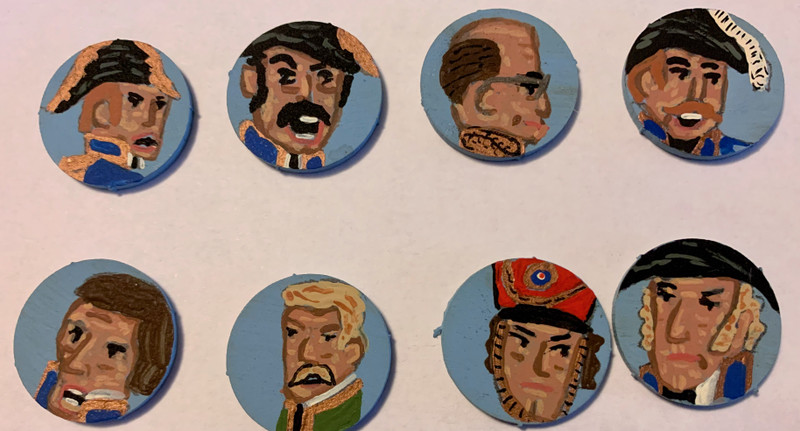
My first challenge was to finish the French ADC chits, to go with the Austrian ADC chits I made last year.   In GdA, ADCs are like command or initiative points in other rules sets.  They are a finite number of opportunities for the player as the CinC to influence the battle by giving orders to his brigades, and hopefully getting them to overcome the friction of the battlefield and actually do what he the commander wants.   Here are eight French officer caricatures, shouting at the player or giving looks of disdain at their lack of battlefield prowess.  I wanted something to add period colour and a little humour to the game.

 Now to decide on the battle.  I have been thinking about Wertingen, the opening fight of the Ulm campaign, which in turn led to Austerlitz and Napoleon’s stunning defeat of the Third Coalition of Russia and Austria.   As the Grande Army advanced through Bavaria, two French corps (Murat’s Cavalry Reserve and Lannes’ III Corps) ran into an Austrian infantry corps under Auffenburg that Mack rashly sent swanning about on an ill-conceived reconnaissance in force.   Historically the French made short work of the Austrians, but in the GMT Command and Colors scenario which introduced me to the battle, it seemed like an even and manageable fight.  

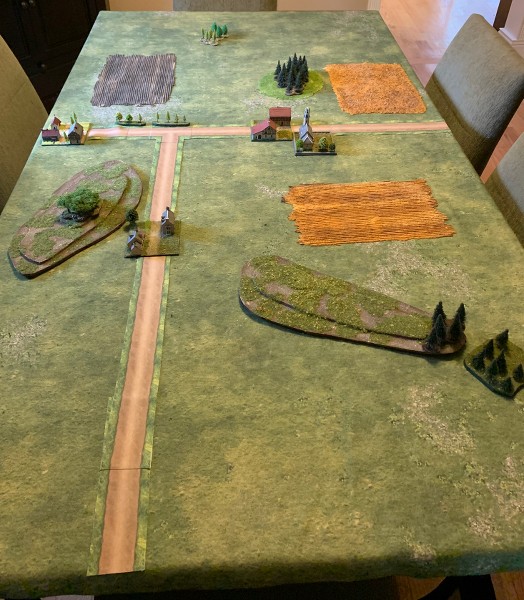
Here’s the playlets table, kept fairly simple as I didn’t want the players interacting with terrain pieces when they could be fighting.   I find that for 6mm games with lots of troops on the table, simple is better.  The cloth mat and roads are from Geek Villain (UK), the fields are latex from Barrage Miniatures (Sp), the buildings are Timecast and the hills are scratch built.


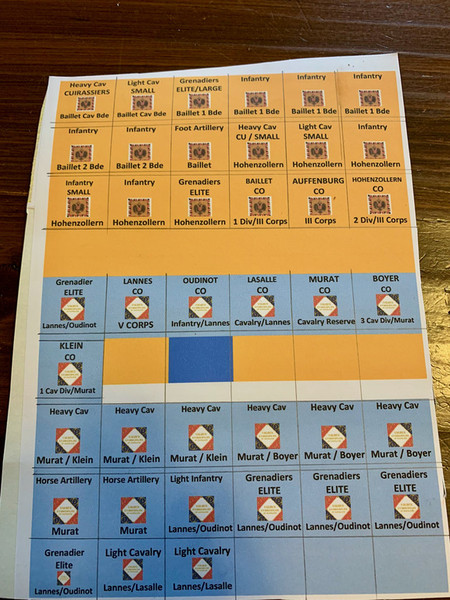
Here is the order of battle, printed on individual unit markers that will be fixed onto 3D printed unit markers courtesy of Aaron at Project Wargaming.   Each marker is for a regiment or for an individual commander.  There were some mistakes that I caught when I took a closer look at the rules.  In GdA only Guards units are Elite, whereas good units like your typical Grenadier unit would be rated as Veteran.  Thus I told the players that for Elite, read Veteran, and for Heavy Cavalry, unless marked Cuirassier in the case of the two Aus units, the French cavalry are considered Battle Cavalry, which in GdA is most well horsed line cavalry (Hussars, Chasseurs, Dragoons).   The French still outnumber the Austrians 2-1 in cavalry units, with two of the Aus regiments being Small or understrength.

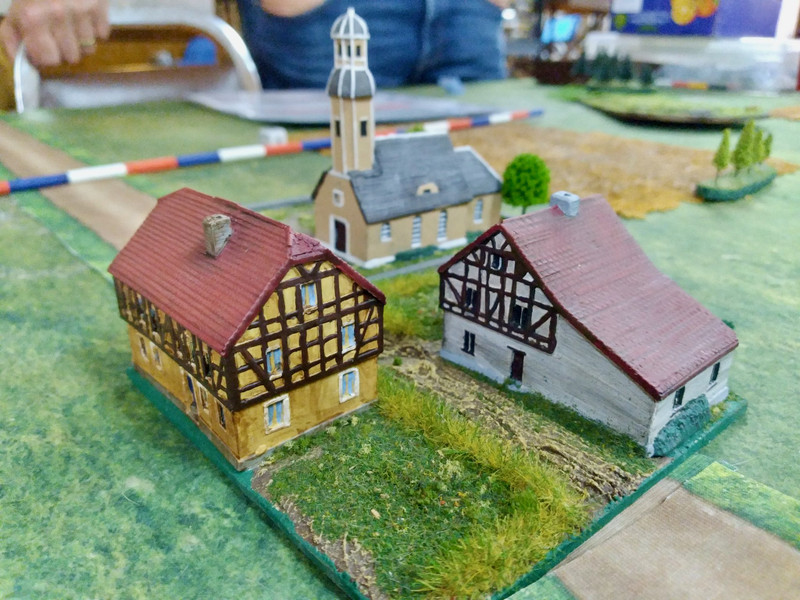
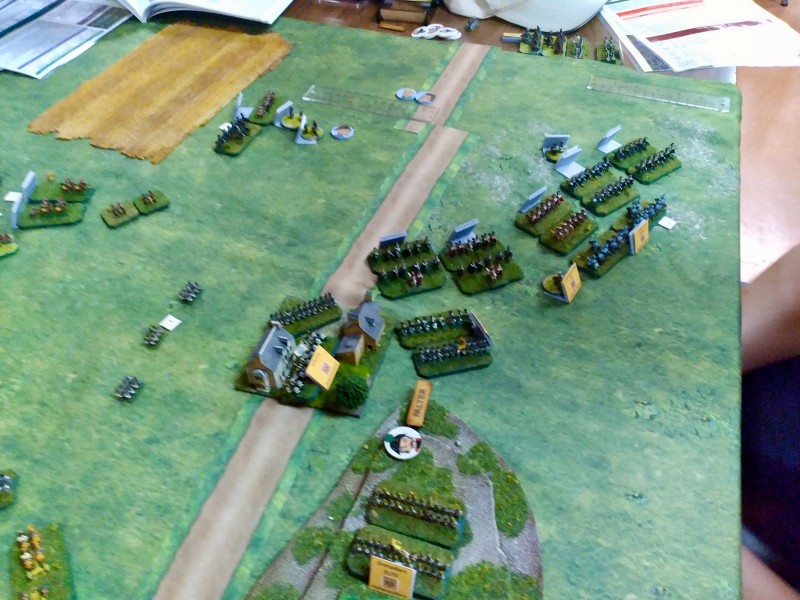
All is quite in the village of Wertingen.

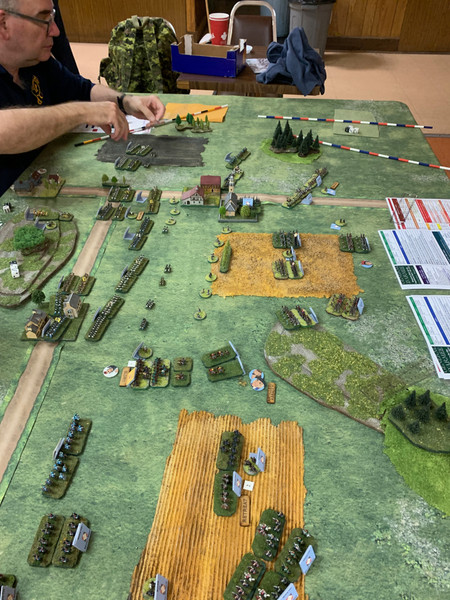
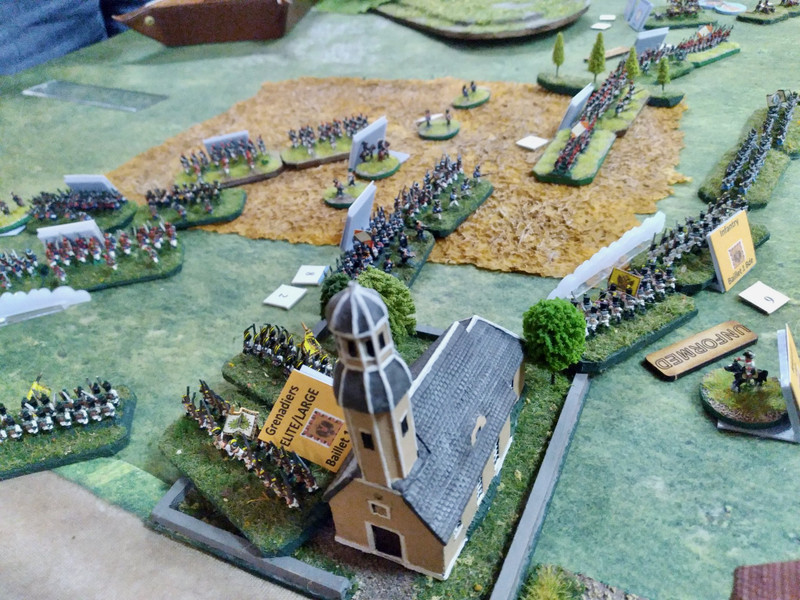
A view of the dispositions early on.    That’s one of the voices of the Canadian Wargamer Podcast, James, setting up the Austrians at top left.  The Austrians have to hold on the road intersection for 12 turns to win.  In all the photos that follow, two bases placed together indicate a single cavalry or infantry regiment or battalion.

The two French players put both of Murat’s cavalry divisions and both his batteries of horse artillery on their left, with Lanne’s corps on the right.   The French tried to get off to a fast start, realizing the clock was against them, but had trouble coordinating their advance in the centre.

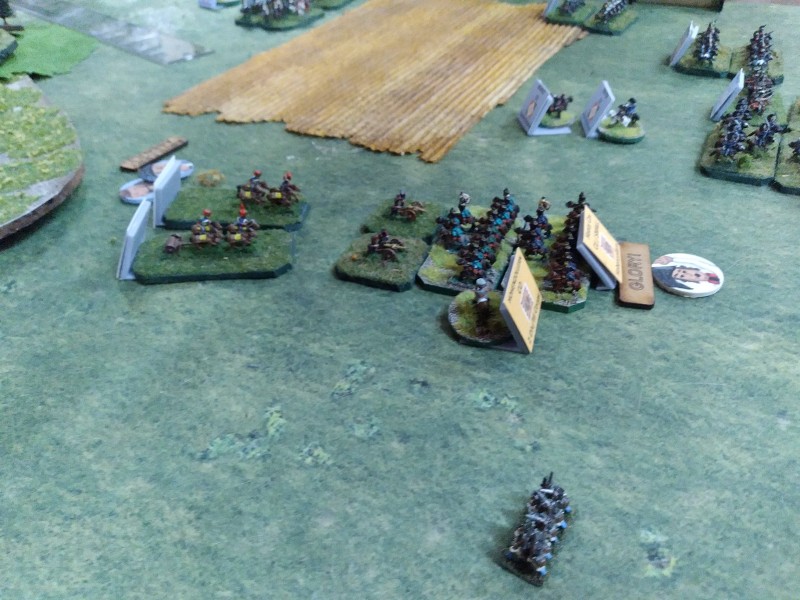
One of the Austrian players sees a chance when the French rashly push their horse artillery forward and attack with a regiment of hussars, still in column.   The Austrians suffer terribly from canister, but remarkably the survivors close, and in the melee that follows, the French gunners manfully stood by their guns and saw off the chargers.  It was one of several remarkable upset results.  Charging is always a bit of an uncertain business in GdA, it’s a two-edged sword indeed. 


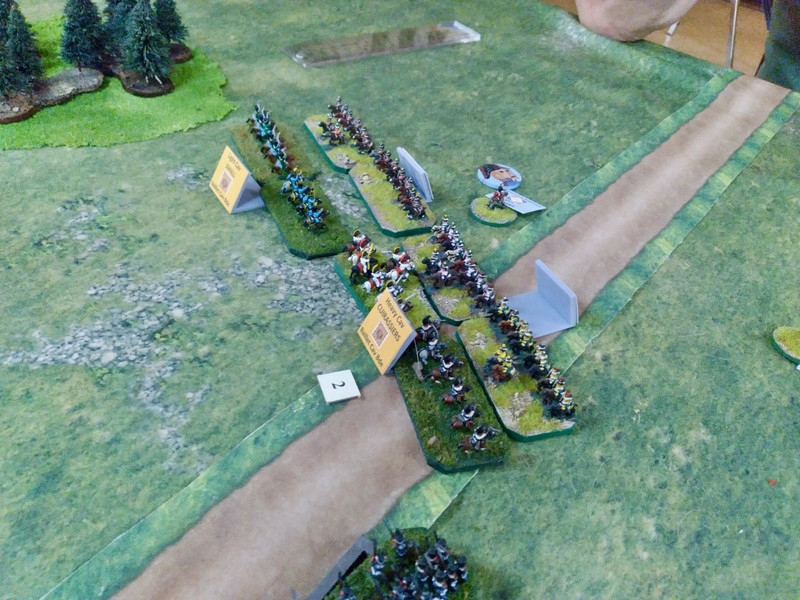
In another case of a surprise result, the Austrians throw their horse at Lasalle’s hussar brigade that is holding Lanne’s right flank, and despite their advantage of having one regiment of cuirassiers, they are thrown back.

James realized that the key to survival was aggression, and pushed his infantry forward.   A fortunate volley drove the French light foot out of the north half of the village (the church square) and that reversal seemed to perplex the French players, who never used their four veteran grenadier regiments to full advantage after that.

On the Austrian right, Murat’s two dragoon brigades are slowly and relentlessly pushing forward, but they are too far away from the intersection and it is too late in the day for this to be a disaster.

With the Austrians firmly holding the centre of the table, and only a few turns remaining, the French players conceded defeat.

I had worried that the game would be a one-sided affair, with the French cruising to an easy victory, but in fact it was a close battle and the Austrians, ably and aggressively handled, had a convincing victory.   Most importantly, the players had fun, I gained enough confidence to run another game at another event, and I got to know the rules much better.

Perhaps I’ve made the same fudge that the designers of the Command and Colors Wertingen scenario did by giving the Austrians more units on the table than the historical battle would suggest - from what I’ve been able to gather, the French had a 3-1 advantage.  Perhaps I could adjust that by taking away one of the Austrian cavalry regiments, but I’d like to play this though again with some other players to see if there’s a different encounter.    Hopefully I’ll write up this scenario for one of the magazine.

Cheers, thanks for reading, and blessings to you die rolls!

MP+

Tuesday, May 31, 2022

A Too Fat Lardies Game Day in Canada

Last Saturday I made the two hour trek south from Barrie to Hamilton, Ontario, for LardEhs, the second such event run by some dedicated Canuck gamers, the first being in November.    The name LardEhs is a play on Canadian speech patterns (IYKYK, if not, Bob and Doug will explain it to you here).  I ran a game in the afternoon, of which more in a subsequent post, but here quickly are some of the photos I had time to take in the morning.  The event attracted about 40 game masters and players, a small but impressive selection of vendors, and brought in at least one person from out of province.

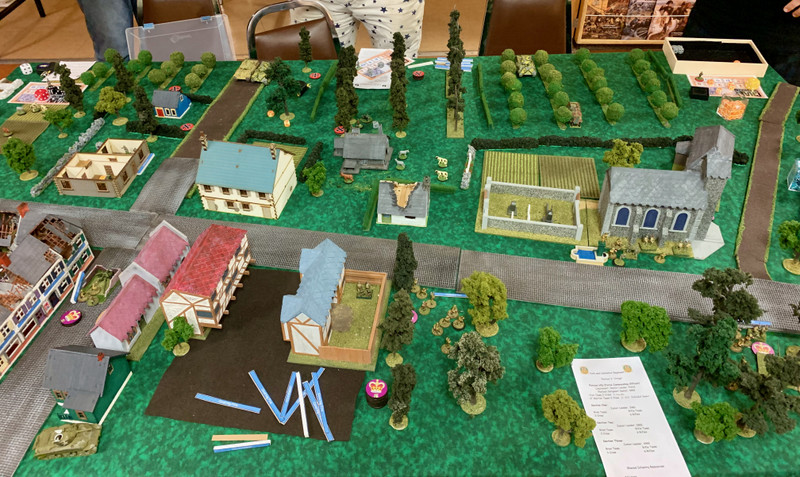
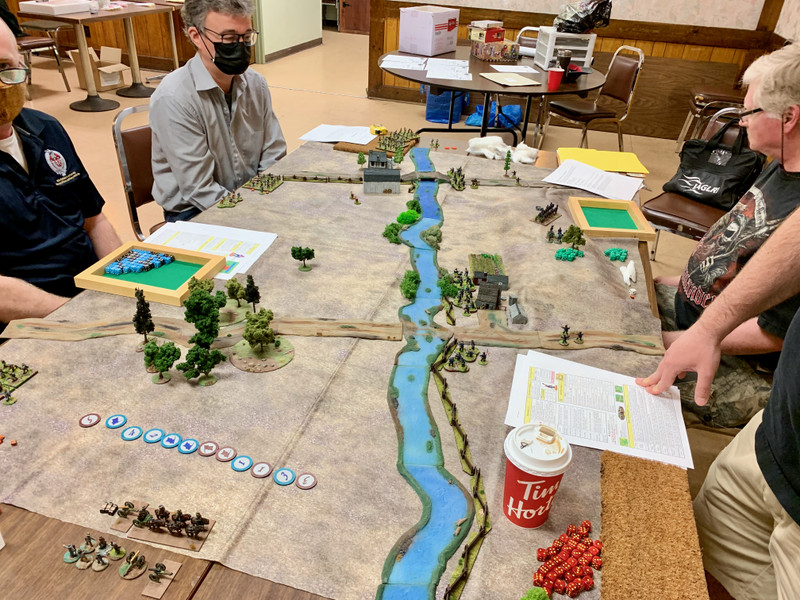
Thomas Sero ran a Large Chain of Command game in 20mm featuring British and German troops fighting for Rauray, Normandy.   Thomas’  village, seen here, featured many of his own scratch-built structures, including a rather fine looking church.  I ran the British armour, and made the mistake of rolling too far forward in my Sherman, paying the price for not looking to my right and noticing the Panther in the orchard (top right).   It was a close fought game still in the balance when we had to finish the session.   Well done Thomas!

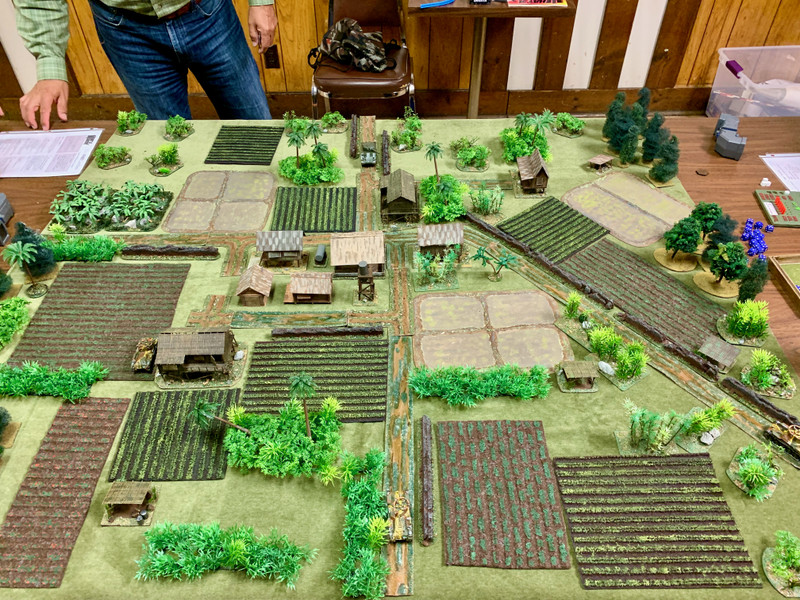
Howard Tulloch made an even longer drive than I did, coming down from Orillia to host morning and afternoon games of What A Tanker!  Howard’s skills running games, honed running DBA events for years, were fully on display here, with a novel and very interesting table taking the players to somewhere in Burma later in the war.    

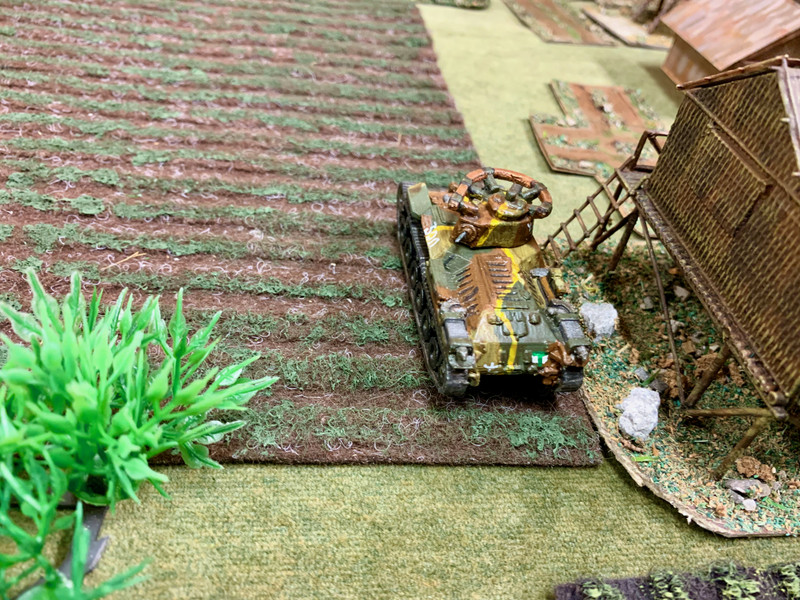
 Japanese tanks, not often seen on the wargames table, stalked British Shermans and Stuarts for much of the day.    Tanks were continuously exploding, new players came and went, and much laughter was heard.   

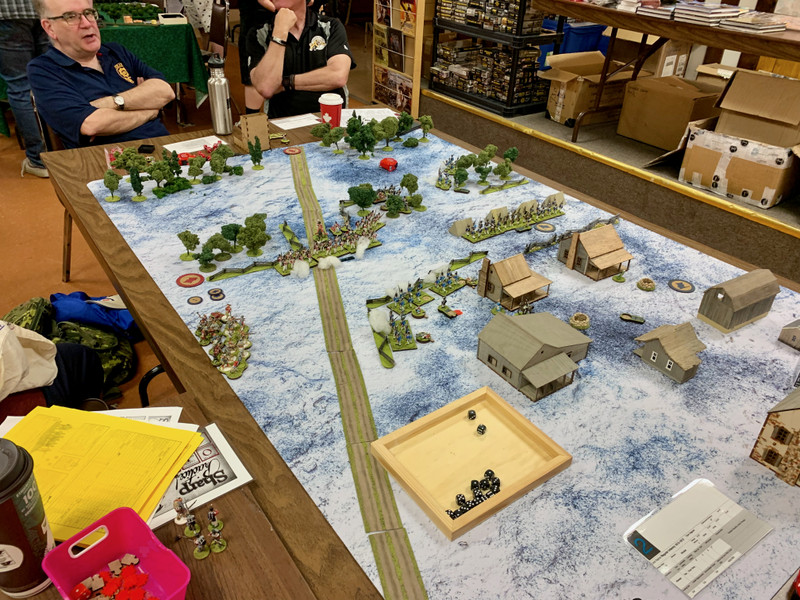
 Roger Chrysler hosted one of two games of Sharp Practice, featuring a War of 1812 scenario by the late Mike Hobbs in which British troops and their First Nations allies are wreaking their revenge on Americans as they stumble out of their tents.   My friend and podcast partner James (top left) along with Dan played the British/Indians, and appeared to have victory well in hand as the Mohawk warriors were last seen crashing into what was left of the American flank.  Ouch.

 Sean Malcomson ran a game of Infamy! Infamy! pitting angry Britons against Claudian Romans, seeking to impose their evil metric ways.   I played in Sean’s Infamy game at Hot Lead this March, and was glad to have the chance again to see his colourful armies on the table.

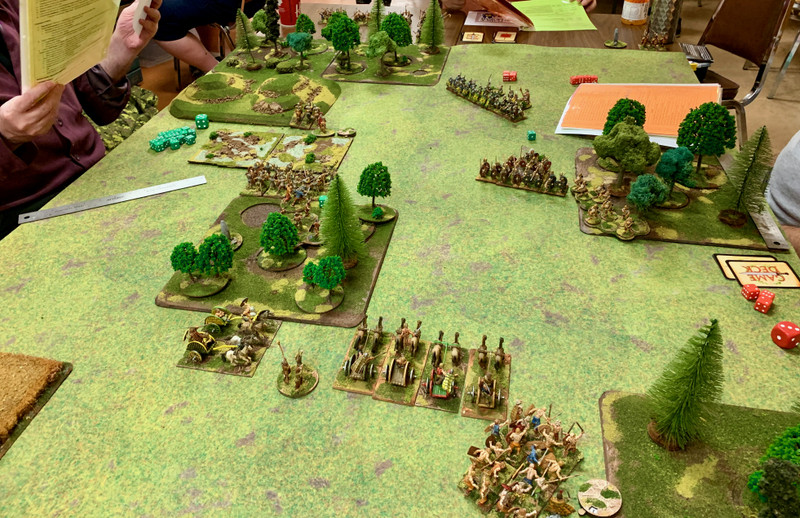
 I do love me a chariot.  These are very tasty.  Somebody should write a chariot rules set called “Wicker and Whinnies”, I’d buy it.

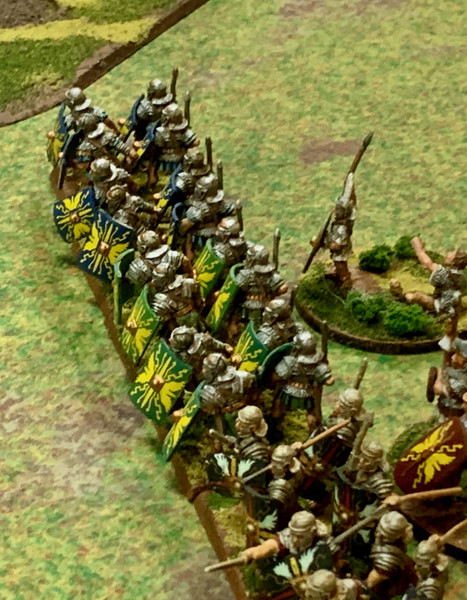
Romans grimly hold the line.  I didn’t see how the game finished, but it looked like the Romans were a tough nut to crack.

Chis Robinson, a friend of the Canadian Wargamer Podcast, ran another game of Sharp Practice, an ACW battle that featured abundant numbers of cavalry.   Chris ran two distinct but linked games, with the morning game having a bearing on how the afternoon game played out.  Chris’ 18mm figures are highly distinct, sitting in the sweet spot for size and detail between 15s and 28s, and are very well painted.  Both Chris’ games were popular and well subscribed. 

 A high point of this event was the $400ish dollars raised from the charity raffle to support the local university children’s hospital foundation.   I want to thank Richard Clarke of TFL for donating a handsome number of red Lardies dice, which we sold as part of the fundraiser.   That along with other prizes donated by various vendors and by a certain Canadian podcast show the spirit of our Lardies community.

There were a few notable absences - no games of I Aint Been Shot Mum or its successor, O Group, no flying games, and it seems that the latest Lardie publication, Mark Backhouse’s ancient big battles rules, Strength and Honour, haven’t made it over the water yet.   There will be a LardEh 3 in late September, I hear, so maybe we’ll see the newest Lardie game then.  It would also be wonderful to see Lardies fans in other parts of Canada follow Ontario’s lead and run similar events.

Well done to Chris, Barnaby, and all the good folk who made this event a success.

Blessings to your die rolls!

MP+

Thursday, May 26, 2022

Canadian Wargamer Podcast Episode 15 Is Out

Hello friends:

It's been a few weeks since James and I released the May edition of our podcast.  We took a distinctly Too Fat Lardies approach since our guest is one of the most prolific Lard ambassadors in the Great White North.   A wide ranging, longish conversation with the usual natter between me and James after the interview.  Very gratifying that we are ticking towards 4500 downloads since we started this a year ago.   There's a give-away contest as well, have a listen for the details, answers here are eligible.   Will be doing the draw at the end of May.  Cheers, and thanks for listening, MP


It's been over a month since we published Ep 14, so here's TWO AND A HALF HOURS of nonsense and yakking to make up for our absence.

In the first half, we talk to Montreal-based gamer Pierre-Yves Troel, who wowed us all in March at HotLead with his participation game of What a Cowboy, a much-anticipated western gunfight game soon to be published (we hope) from Too Fat Lardies.   P-Y (Mike totally mangled his name and variously called him Y-P, P-J, and God knows what else, though our guest was too polite to say anything) talks about his gaming career, discovering the TFL community through online gaming, and his growing expertise in 3D printing.  We also talked about the gaming scene in La Belle Province of Quebec.
In the second half, during our Canadian Content Corner (CCC),  friend of the podcast Chris Robinson checks in to give us a update on LardEh, Canuckistan's  TFL-themed gaming day returning to Hamilton, Ontario on 28 March.  Chris also tells us about what he and Big Rich chatted about when Chris was a guest of the TFL Oddcast.    Rounding out the CCC, Mike reports on what he's learned about how the Canadian Army faced a massive challenge training an NCO Corps from scratch in WW2.   We also chat about about the Guadalcanal Campaign, about gaming WW3, James' WW3 Imaginations (Mantovia and Borduria), Mike's discovery of DBA (talk about coming late to the party) and how many figures a horse and musket unit really needs.  It's a wide ranging convo, good for an extra-long painting session.

Our Guest:

Pierre-Yves on Twitter: @iwouldlike2rage

P-Y's minis and painting website: http://www.iwouldliketorage.com

P-Y's contributions to the CWP Virtual Library:

Churchill's Secret Warriors: The Explosive True Story of the Special Forces Desperadoes of WW2 by Damien Lewis.  Quercus Publishing, 2014.

https://www.amazon.ca/Churchills-Secret-Warriors-Explosive-Desperadoes/dp/1848668554

Behind Japanese Lines: With the OSS in Burma  by Richard Dunlop.  Skyhorse Publishing, 2014.  

https://www.amazon.ca/Behind-Japanese-Lines-OSS-Burma/dp/1626365385


Other Subjects Mentioned In This Podcast:

Events:

LardEh, Hamilton, May 28: https://twothreesixmm.blogspot.com/2022/03/lardehs-game-day-ii.html?fbclid=IwAR03DIVymyCg_GqCWmHkxIwb7LcUEUCQhJuLZOZg6bzh5Z4Kq-w1HGTYBm0

Frozen Lard Facebook Group: https://www.facebook.com/groups/frozenlard

Books Mentioned:

Battlegroup! The Lessons of the Unfought Battles of the Cold War, by Jim Storr (Hellion, 2021).

https://www.helion.co.uk/military-history-books/battlegroup-the-lessons-of-the-unfought-battles-of-the-cold-war.php

Neptune's Inferno: The US Navy at Guadalcanal, by James D. Hornfishcher.  (Bantam, 2012).

https://www.amazon.ca/Neptunes-Inferno-U-S-Navy-Guadalcanal/dp/0553385127/ref=asc_df_0553385127/?tag=googleshopc0c-20&linkCode=df0&hvadid=312844313495&hvpos=&hvnetw=g&hvrand=9475770318543822771&hvpone=&hvptwo=&hvqmt=&hvdev=c&hvdvcmdl=&hvlocint=&hvlocphy=9000801&hvtargid=pla-454531967423&psc=1

Building the Army's Backbone: Canadian Non-Commissioned Officers in the Second World War, by Andrew L. Brown (UBC Press, 2021).

https://www.ubcpress.ca/building-the-armys-backbone

George MacDonald Frazer, Quartered Safe Out There. (2007)

https://www.amazon.ca/Quartered-There-George-MacDonald-Fraser/dp/1602391904/ref=asc_df_1602391904?tag=bingshopdesk-20&linkCode=df0&hvadid=80127001872958&hvnetw=o&hvqmt=e&hvbmt=be&hvdev=c&hvlocint=&hvlocphy=&hvtargid=pla-4583726555030834&psc=1

DBA 3.0 Rules, by Phil Barker (WRG).

https://www.amazon.ca/Bellis-Antiquitatis-Version-3-0/dp/024469768X

Our Closing March:

The Meeting of the Waters (Quick March of the Rocky Mountain Rangers), played by the band of the Royal Highland Fusiliers:

https://youtu.be/K6vw45WlSoY

Contest:

Listen closely to the podcast for details on how to win some of Bob Murch's fabulous Cossack miniatures, proceeds go to the UN High Commissioner for Refugees Fund for Ukraine. 

Contact Us:

Canadian Wargamer Podcast Facebook Page:

https://www.facebook.com/canadianwargamerpodcast


Mike: madpadre@gmail.com

@MarshalLuigi

www.madpadrewargames.blogspot.com

James:

jamesmanto@gmail.com

@JamesManto4

www.rabbitsinmybasement.blogspot.com

Monday, May 23, 2022

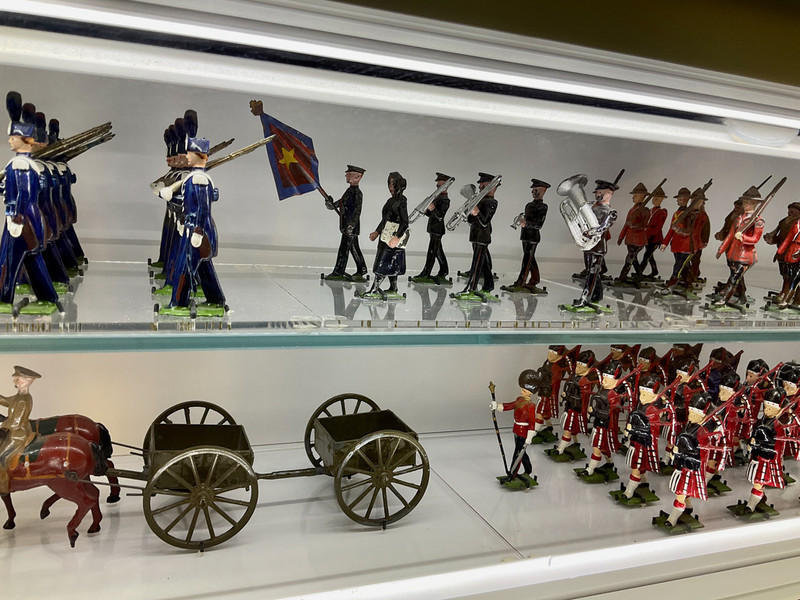
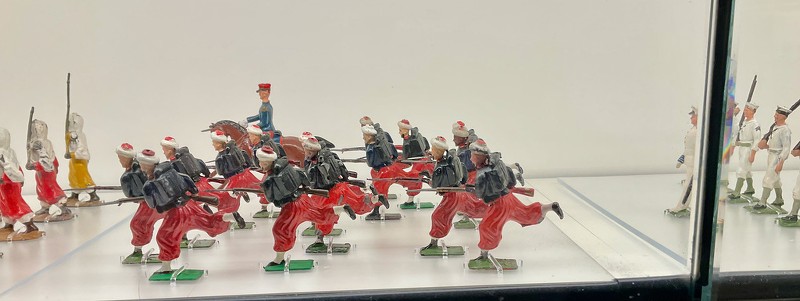
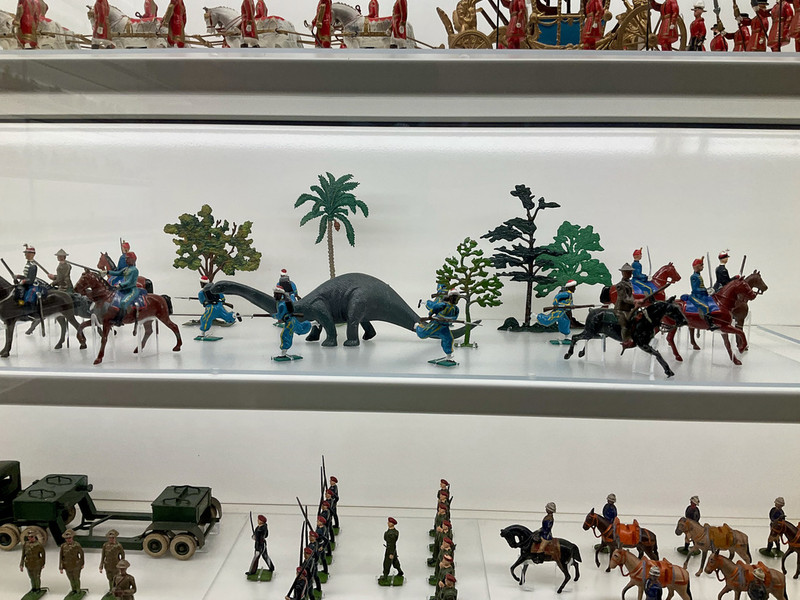
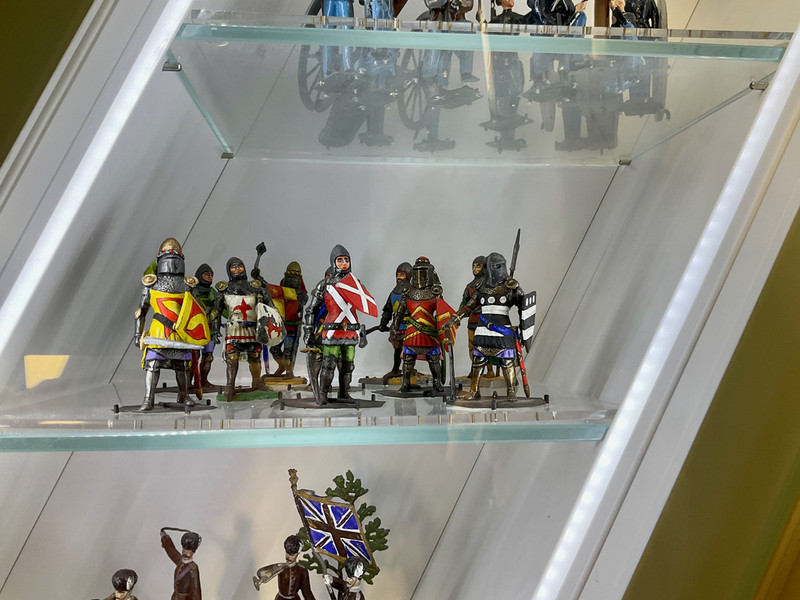
The Royal Ontario Museum Toy Soldier Collection

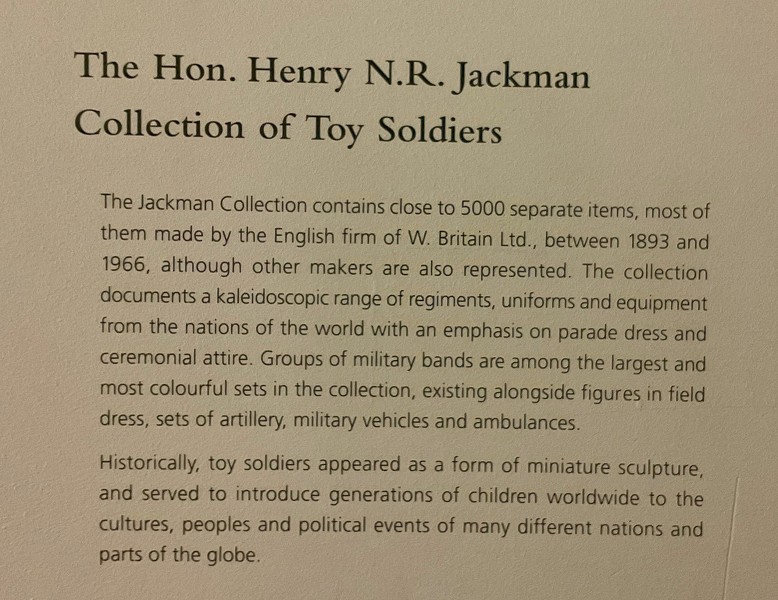
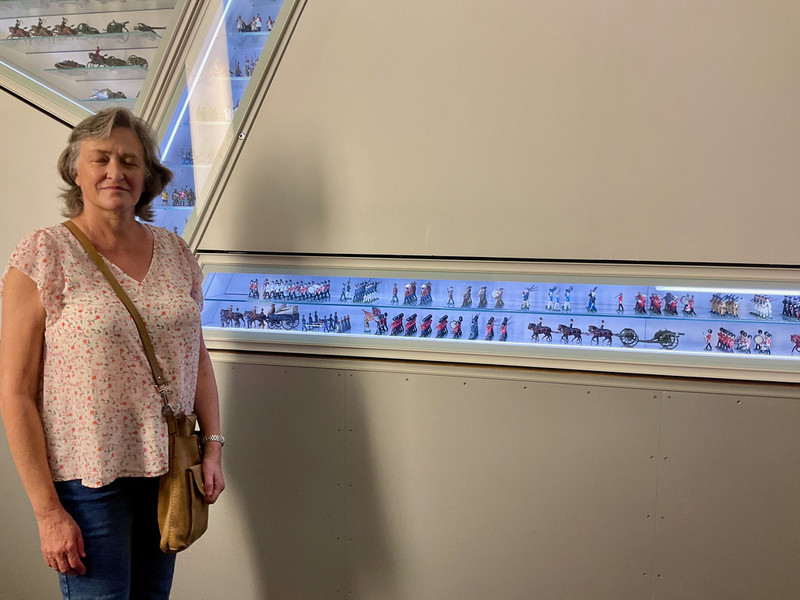
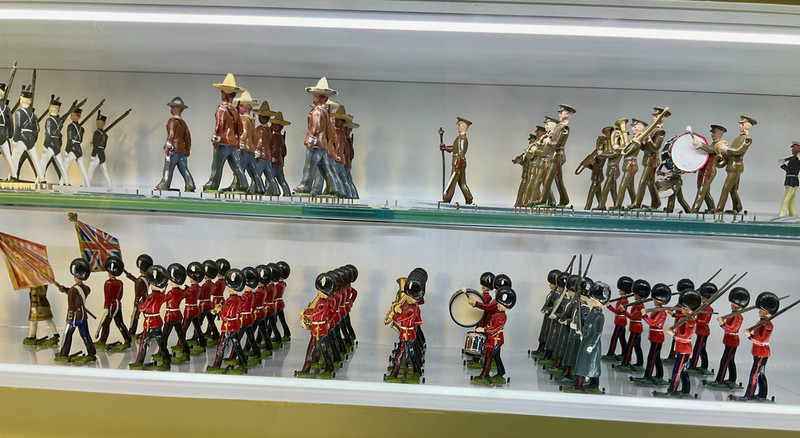
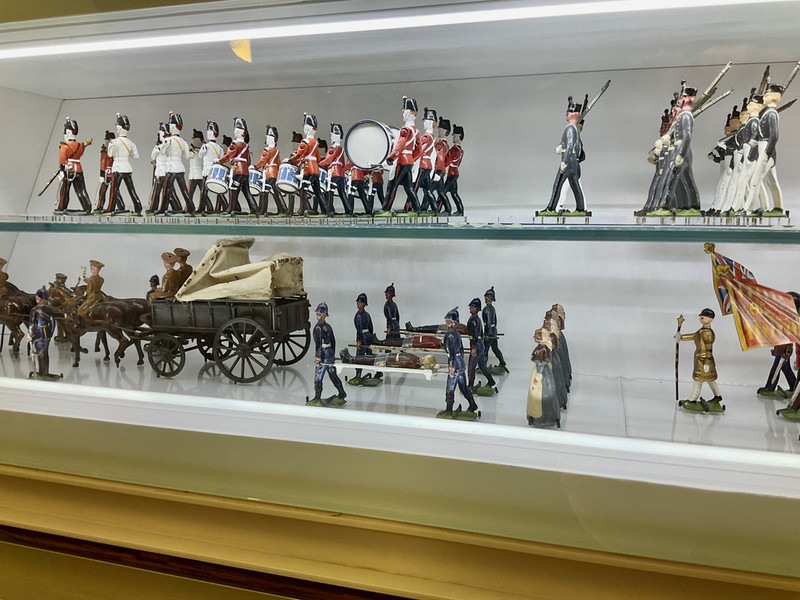
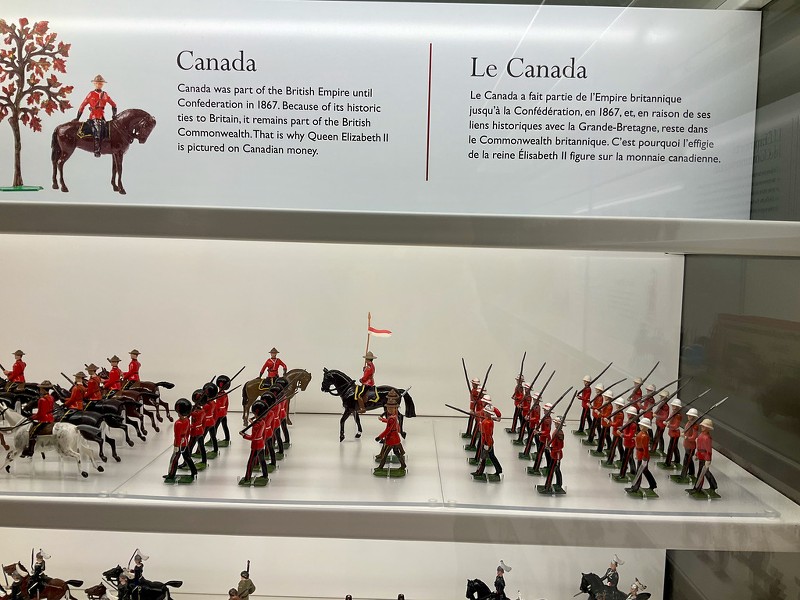
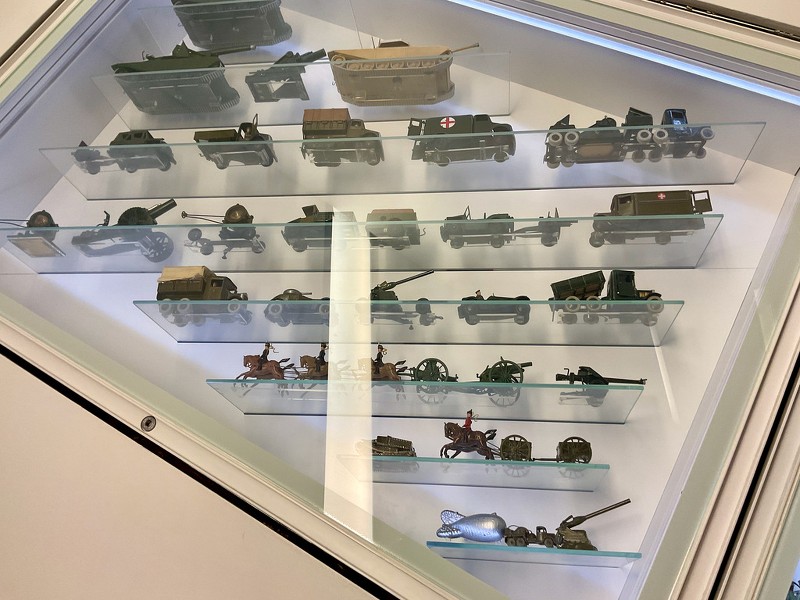
Picking up on yesterday’s post’s mention at the end of my visit to the Royal Ontario Museum last Saturday, I’m happy to share some photos of the ROM’s vintage toy soldier collection.  The collection was donated by Henry Jackman, billionaire businessman, Chancellor of the University of Toronto, Lt. Governor or Ontario in the 1990s, Honourary Colonel of the Governor General’s Horse Guards, Conservative Party bundler, so a fairly serious chap.  As a child he played with toy soldiers (I imagine his dad bought him a LOT of them) and as an adult he collected them, so if anyone tells you that you’re not a serious adult because you’re a wargamer, say “Pfffftttttt” and refer them to Hal Jackman.

What a lucky fellow I am, that when we got to the ROM, my beautiful wife told me “You gotta come see the toy soldiers”.  Here they are.  Blessed is the fellow whose spouse takes such an interest in his hobbies and passions.

Marching bands from various countries, including fellows in what appear to be sombreros.

Even the wounded are allowed to take part in the parade, under the careful scrutiny of the nursing sisters.

A Salvation Army band played, and the children drank lemonade.

Zouaves demonstrating their characteristically athletic foot drill.  Kick, one, two, kick, one two!

Not really sure what the brontosaurus is doing here.  Possibly the TARDIS is behind those palm trees nearby.

Some very finely painted knights.

Canada is well represented.


A fine cross-section of modern transport and equipment, including searchlights!

I now have a plan for my miniatures collection, as I approach the checkout lane.   I’m sure there’s a world class museum out there that will want the Peterson Toy Soldier Collection.

Cheers and blessings to your travels this summer!

MP

Sunday, May 22, 2022

Further Down the DBA Rabbit Hole: Chariot-era Battle With Howard


I’m picking up the ancients gaming theme of my last post today, which I finished by saying that I’ve been enjoying my discovery of small-scale ancients and learning to play DBA (De Bellis Antiquitatis), Phil Barker's small battles rules from WRG that have been around longer than many games today have been alive.  I’ve been aware of DBA for years, and was familiar with the usual potted descriptions - “like chess, very stylized, ok if you like fast games, it’s about how many sixes you can rol, etcl”.  I wasn’t prepared for just how entertaining it could be.

Charles, one of the regulars at the Barrie group, has played it for years and was kind enough to introduce me to it, using several of his well-used and much loved armies.  I found that I enjoyed it’s almost zen-like simplicity.  With just twelve units, a few pages of simple yet subtle rules, and sudden death if I lose four units, DBA provides interesting tactical challenges and a clear cut result in an hour.  It’s also a fairly simply gateway into what is, for me, complicated and unfamiliar world of ancients gaming.   Pick a period, pick an army (or borrow one, I’ve found that veteran DBA players have lots of armies and are very generous with them), learn the basic troop types, paint between 30 to 40 figures, and you have an army!

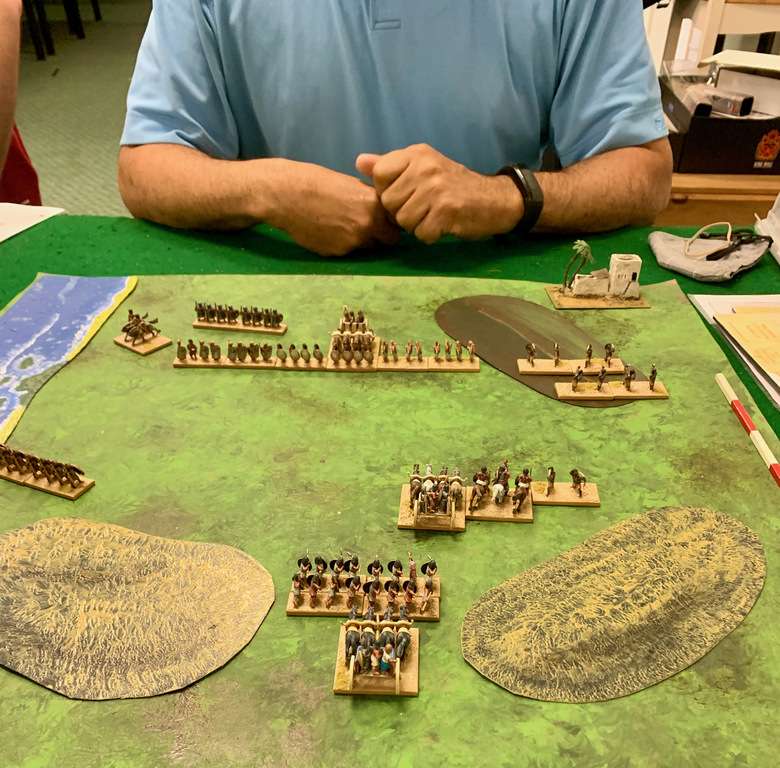
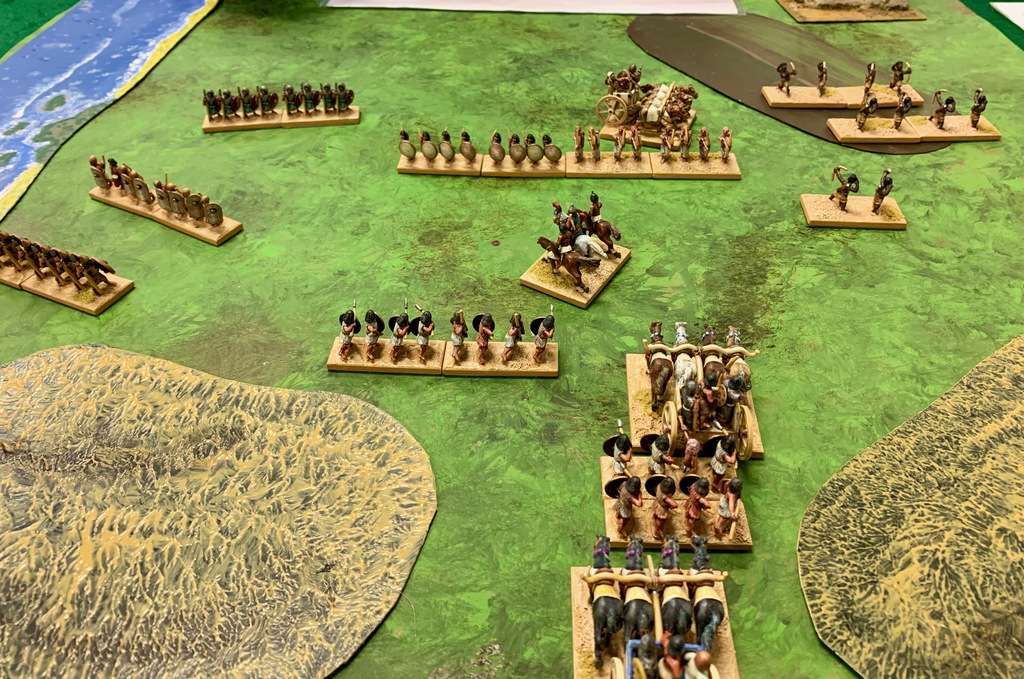
Last Thursday I was fortunate enough to play a game with an experienced player, Howard Tulloch, who has organized DBA tournaments in the southern Ontario area for years.  Knowing that I am interested in the biblical period, he brought two chariot-era armies, Cypriot-Phoenician (1/35) and Kushite Egyptian (1/46), both beautifully painted.    I took the Phoenicans, since I have an earlier Sea Peoples army on order from Essex and wanted to see how the Phoenicians as descendants of the Sea Peoples handled.  

I had a bad run of luck with the terrain setup.   Howard placed two dunes in my deployment area, which along with the sea coast really hemmed me in before I could get out the gate.   The only saving grace for me was that, as a Littoral army, the Phoenicians can deploy up to three elements anywhere along the water board edge.  I chose to place my two best Auxiliary infantry units in the middle of the table on the left edge, as a bit of a check on the Egyptians to keep them from swarming me as I emerged from between the two dunes.

Initial rounds saw my getting a lucky victory over the Egyptian light cavalry, but then Howard’s royal archers shot my own cavalry off their horses, tying the score at 1 to 1.    Our psiloi (light infantry) faced off on the hill to the right, but never actually exchanged blows, while Howard checked my Aux infantry with two stands of his own.    One of the things I’ve learned about DBA thus far is that when the odds are basically even, as they were on our flanks, battles can easily go either way and leave one in the hole on the lost unit count.  Better to seek a win where you can mass more units against you opponent and thus stack the odds in you favour.

Which was exactly what happened.  In the centre left, you can see two units from each side facing in a kind of “Z” shape, with each side having a unit on the other’s flanks, known as “closing the door” in DBA terms.    Once a unit is flanked, if it loses a combat and has to retreat, it is destroyed.   Thus, whoever would win this fight was almost certain to win the game, and it stayed locked that way for FOUR TURNS, with both of us rolling the same numbers to tie, forcing the battle into extra rounds.  Finally I was able to get my chariots into Howard’s archers, and with two lucky die rolls I managed a 4-1 victory, though it could easily have gone either way.

Moved up in the painting queue as a result of these games is a clutch of 15mm figures, which when finished should allow me to field an Early Hebrew or Syro-Canaanite army for DBA.  I was originally intending these figures for an ADLG army, but I think I’ll go the DBA route to get armies on the table sooner, which makes sense, as there are DBA players to hand and no one in our group plays ADLG.

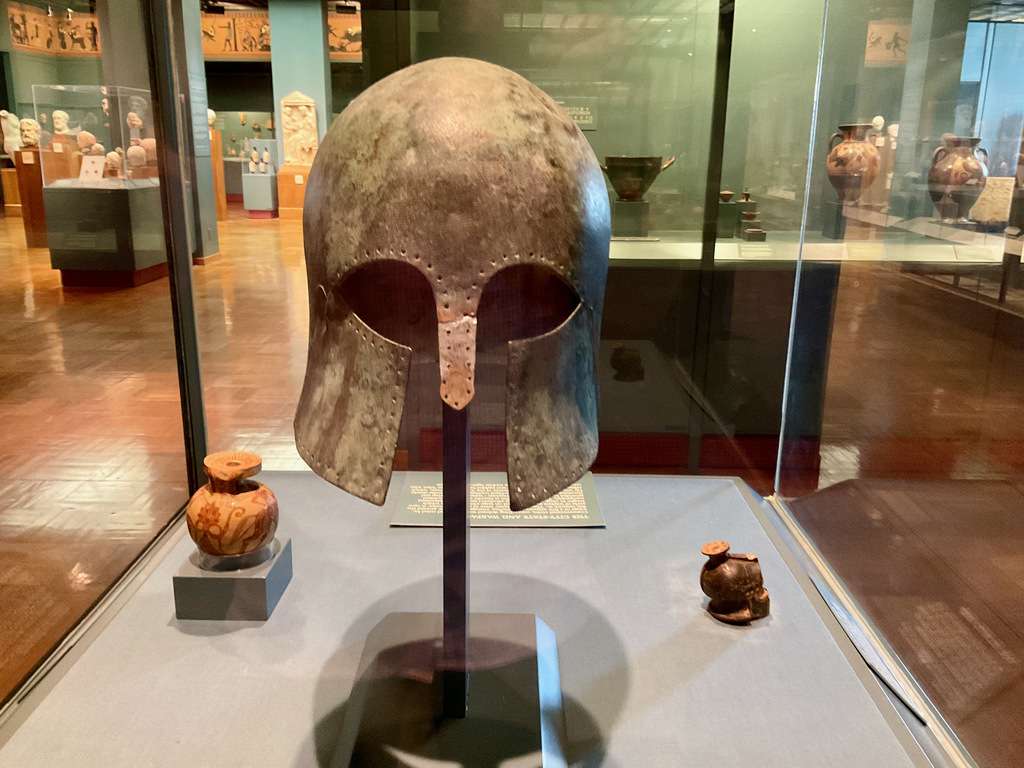
For extra ancients inspiration, Joy and I visited the Royal Ontario Museum yesterday, where we had the classics section to ourselves for a brief while before the parents and kids arrived.  Here’s a lovely Corinthian style helmet for you to admire, supposedly found at Marathon and dating to about 500 BC, though there is some uncertainty about its provenance .

\

Blessings to your die rolls!

MP

Saturday, May 14, 2022

Some Ancients Gaming: Clash of Spears at the Club

Hello friends and welcome back to this semi-moribund blog.  April was a bit of a write-off for me, what with the Easter season (a busy time for a wargaming vicar) and then winding down my contract at All Saints, King City, which ended on 1 May.   Since then I’m not sure if I’m retired or just between jobs.  Next week I have a chat with my bishop, who will try to tempt me into another gig of interim ministry, so May has been a bit of a rest, getting the garden ready, and some gaming.  

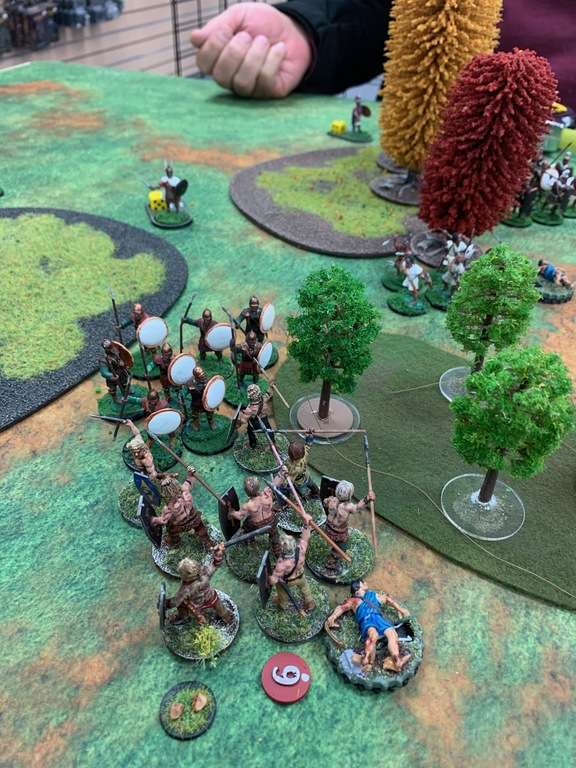
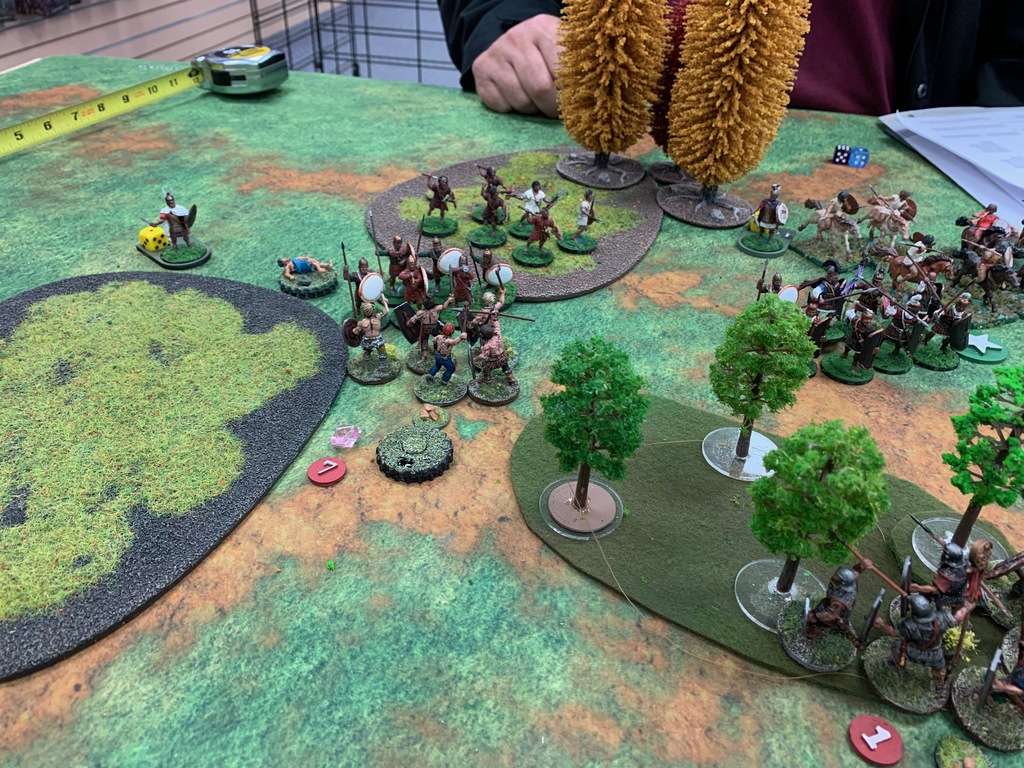
Recently I was at what passes for our local club in Barrie, Sir Games-a-lot, playing Clash of Spears with my friend Charles.  CoS as I’ve mentioned here before is currently getting a lot of play, it’s a skirmish level ancients game that might be compared to TFL’s Infamy, Infamy.  In this recent game, I took my freshly painted Victrix Germans and Charles took a Punic (!?) force.   Not sure what they were doing in the forests of Germania, but my guys wanted to send them home.  In this scenario, both sides are competing to control the green/white star tokens.

I was more fortunate in the terrain selection this time, giving Charles fewer opportunities to get all his troops into action.  Here a swamp on the left and woods on the right allow me to defeat one of his light units early on.    I quickly learned that while my German barbarians come be had cheaply on the points list, thy aren’t much good without sufficient leaders.  I had seven units and only two leaders, so six command points between them each turn, which wasn’t enough to take advantage of my numbers.

Charles’ auxiliaries don’t fare much better vs my raging tribesmen.  The dead chap on the dial marker is used to indicate fatigue.  Units acquire fatigue quickly in battle, and unless thy can be pulled out of the battle line for a breather while a fresh unit steps in, things go badly quickly.

I quickly learned that light horse archers can be deadly.  I pushed a unit forward in the wide open area on the right of the battlefield, the horse archers came up a half move and shredded the lightly armoured barbarians, then rode back, then did it again!   I have invested in some Victrix Gaulish horse to stand in as mounted Germans, not plentiful on the CoS Germanic list (found in their Clash of Eagles supplement for the early Empire era) but there if you want them.   


Final stage of the fight.   Both of us ended controlling an objective marker, but lacked the strength to take the second.   With those deadly light horse supporting Charles’ heavily armoured foot, I decided to split the honours.

M

As someone once said, is furies Romae, Romano vivid more, or to translate, when the other guys are playing ancients, play ancients also.   I once swore that I’d never take up ancients gaming, and had a lot of fun with CoS, so I’ve taken one step into the 28mm world, and have some Victrix early imperial romans on order, on the theory that one should always have two armies for solitaire gaming.  

I also have some adventures in smaller scale ancients gaming to report on, so my next post will describe how I discovered and enjoyed DBA.

Cheers and blessings to your die rolls,

MP

CoS haClash of Spears


Blog Archive

Followers