Friday, April 30, 2021

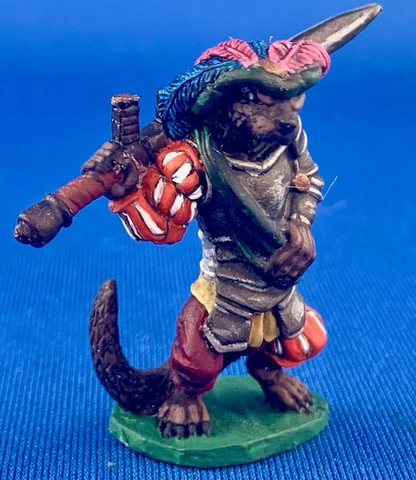
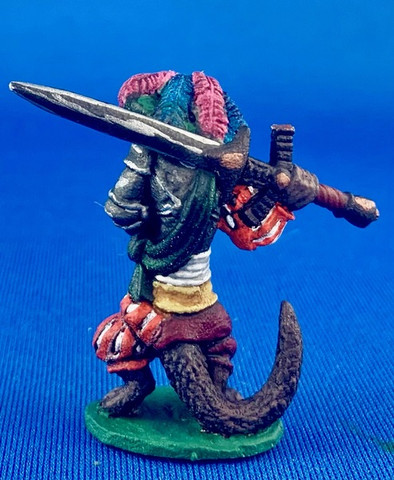
Fantasy Friday: Landsknecht Otter

I painted this 28mm Oathsworn figure at the request of my son, who is an RPG guy and is into Burrows and Badgers.  It was a heck of a lot of fun to paint, beautiful sculpt.   Very tempted to order some for my self, but I really don't need another gaming/painting interest!

If you follow me on Twitter (@marshalluigi), you’ll know that I have a pretty good GIF game that often features cute otters.   This fellow is definitely not cute or cuddly.  I texted these photos to John in BC and he wrote back “Full of bravado, full of himself”.

Thanks for looking.   I have a figure lined up for next week’s Fantasy Friday but it’s certainly not as cute.

Cheers and blessings to your brushes.  A happy bank holiday to my UK and Irish readers.

MP+

Wednesday, April 28, 2021

Battle of Seven Pines (ACW): Gaming the Battle, Piece by Piece (1)

 Hello friends:

Recently someone said on gaming Twitter that they preferred actual battles with stories and backstories to random X points per side battles, and I confess I've been leaning that way myself lately.   Since I wanted to return to Dave Brown's Pickett's Charge ACW rules and employ some newly painted figures, I opened Vol. 1 of my copy of The West Point Atlas of American Wars  at random and picked a corker of a battle, Seven Pines, the beginning of the end of the Peninsular Campaign of 1862.

Seven Pines was a terribly fought battle on both sides, and brings little credit to anyone except the ordinary soldiers who fought and died there.   McClellan's Army of Potomac had crawled its way slowly towards Richmond, giving the Confederates ample time to mass their forces.    At the end of May, 1862, McClellan was within a few miles of Richmond, but had inexplicably pushed two of his corps (Keyes' IVth and Heintzelan's  III corps) across the swollen Chickahominy River, making them a tempting target for CSA commander Joe Johnston.

The Union line was arranged in what has sometimes been described as a fishhook, with the most exposed Corps, Keyes', being the least trained.   Some accounts say that the regiments in the furthest forward Division, that of Brig. Gen. Silas Casey, were raw recruits, armed with inferior Austrian muskets.  As one historian put it, "Casey's division, the smallest and greenest of McClellan's vast arsenal, was inexplicably ordered to lead the army's advance on to Richmond".  These poor guys had been marching and working for days, exposed to torrential rains, often without their shelter halves and coats, so they were pretty used and abused going into the battle.
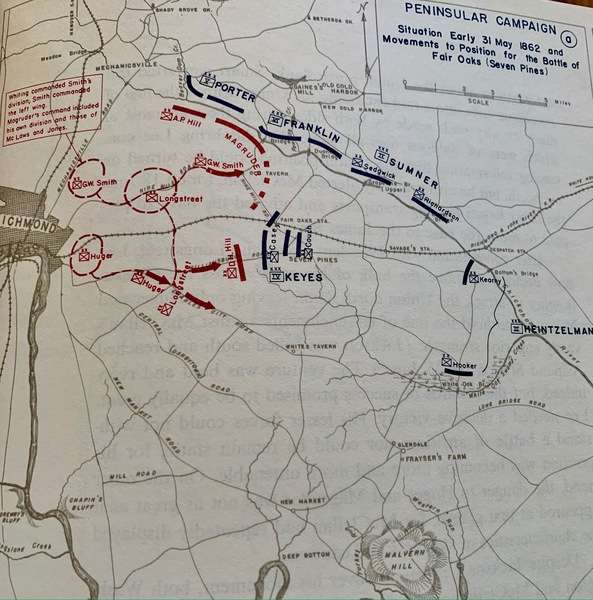

Johnston decided that Keyes' Corps was too tempting a target to pass up, even though by May 30 the CSA command knew that the Union IVCorps was digging in around Seven Pines.  Johnston's   plan was that D.H. Hill's division would attack it from the front, up the Williamsburg Stage Road, supported by Longstreet's division, while Huger's division would move south to hit the Union left and Whiting's division would move to hit the Union right.  

It was a good plan in theory, but there were several problems.  First, a heavy rain on the night of 30 May left the roads that the CSA divisions must use a wet soggy mess.   That would slow down the rebels, but it was hoped that the same rains would prevent the rest of the Union army from crossing the Chickahominy to help Keyes.   

The plan required far too much coordination for an army of the period, especially considering that the chain of the command of Johnston's army was complicated and inefficient and Longstreet basically got in Huger's way because he thought he knew best, while Huger's orders were unclear, leaving Hill to wait impatiently and finally launch the attack on his own.  Or something like that.  It was basically a big mess and many of the troops Johnston assigned to this movement never made it to the fight. If you have an hour to spare, there's a good lecture here on the leadup to the battle.

GAMING THE BATTLE

This would be an easy battle to recreate as a whole in the smaller scales, but since I do ACW in 28mm, the only way to recreate it is in sections.  Fortunately the timeline of the fighting meant that the battle on the first day unfolded as a series of episodes, which is how I intend to proceed.

EPISODE 1:  Garland Vs Keyes

I found this map from the US Civil War Preservation Trust to be most helpful.   It shows the initial dispositions of both sides as well as the Confederate plans.  Modern maps are no help, as the entire battlefield has been developed, including a substantial portion which is now covered by the Richmond airport.

The Confederates had done enough reconnaissance to know that Casey's division was deployed in an open space that had been cleared of the surrounding trees, and bisected by the Williamsburg Stage Road.   Roughly 800 yards east of the start of the clearing were two buildings known as the Twin Houses, about 135 yards south of the road, and in front of them Casey's troops had constructed a redoubt with a battery in the centre.


At the west end of the clearing, the Union had felled enough trees to form a substantial abatis on the north side of the road, and had posted a picket line of troops drawn from Casey's three brigades.     Just before 10:00 hrs, after abundant signs that an attack was coming,  Casey sent an additional regiment, the 103rd  PA, to support the picket line.  

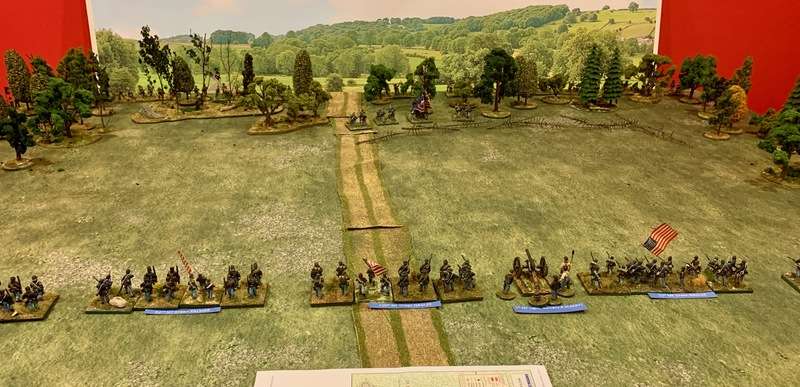
Working with the Pickett's Charge rules ground scale of 9" = 150 yards, with a 6' by 5' table, this is what I came up with.  The clearing is about 60" north to south, with Casey's first line, two regiments each from Naglee's and Palmer's brigades, about 27" back from the start of the clearing.   I've used model railroad pine trees to represent the abatis.  As I figure the ground scale, Casey's redoubt is about 36" back from the first line, so there is no room to represent them on the table in this first episode.  However, Casey's two batteries in the redoubt line (1 NY Co A, 7 NY) can fire from off the table if the rules permit.   From what I can read of the maps, this part of the battle was dead flat, so no need to model elevations.   Some of this clearing was planted, and possibly had snake rail fences, but I am guessing that after a few days camped here, Casey's men would have dismantled them and used the wood.


The first minutes of the fight in the woods doesn't need to be modelled, which is a good thing because it was absolutely terrible terrain.  In his report after the battle, Garland wrote that: 

The difficulties of the ground were almost insurmountable. The recent rains had formed ponds of water throughout the woods with mud at the bottom, through which the men waded forward knee-deep and occasionally sinking to the hips in boggy places almost beyond the point of extrication. The forest was so thick and the undergrowth so tangled that it was impracticable to see the heads of the several regiments as they moved forward, and the deploying intervals were in consequence very imperfectly preserved. 

The accounts agree that the Union pickets were driven in without much resistance.   Stephen W. Sears, in his book To the Gates of Richmond: The Peninsula Campaign, has an account by one Yankee skirmisher who hid himself when he saw the first of Garland's men:  "I [then] left the place and took a course to get away".   

Thus, Garland's brigade will activate on the first turn within inches of the hapless 103rd PA, while Rode's brigade will have to spend several turns moving through the woods (difficult terrain) before they can get into the fight, as per the battle.   


Troop ratings are easy to figure out for the Union - every regiment in Casey's division is rated Green, while Casey himself was a competent and brave commander (he was chosen for the job because he'd written an important drill manual before the war).   I don't know how to rate the three US brigade commanders - Palmer, Naglee, and Wessells - I'm assuming that they were competent.   Rating Hill's division is a little more difficult, but considering the relative quality of the ANV in 1862, I'd rate them as Veteran with a few regiments being Elite, just to reflect the qualitative difference between the two divisions.  I hope I'm not buying into rebel mythology here, but these same troops will be carried over to the next episode where they have to face the redoubt (which historically they did), so they will need some staying power.

I'd be happy to hear your thoughts/comments before I kick off the battle, hopefully tonight.  If this works, my plan is to work on a set of scenario notes for Seven Pines that might be publishable somewhere in our hobby.

In the meantime, blessings to your dice rolls!

MP+

Tuesday, April 27, 2021

Terrain Tuesday: Winter Terrain for My Canadian Pulp Project

I’m happy that I’ve posted on this subject three Tuesdays in a row!   

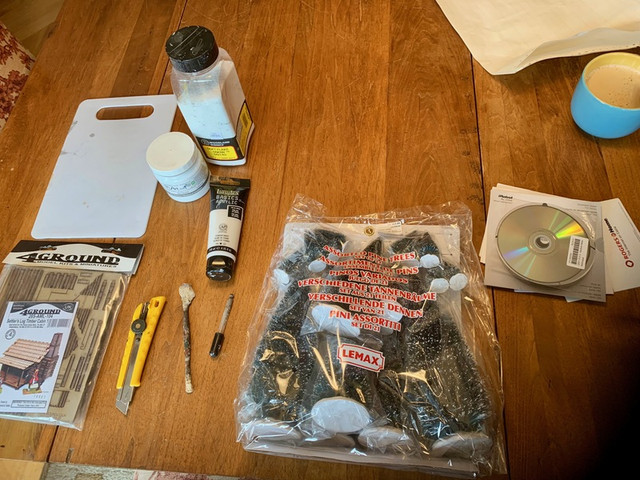
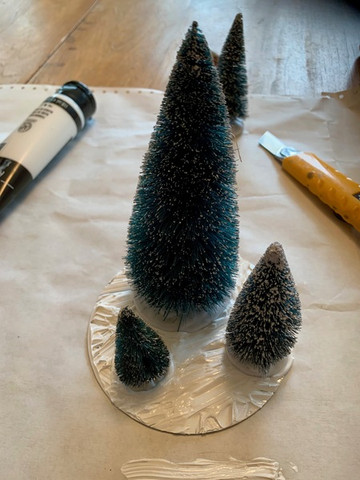
Yes, this is for my The Rockies Ablaze Project, which I am taking off the back burner for a while.    I need some more scenery and a cabin before I introduce a new character.

These craft store trees will need more snow than this!

Check in again next Tuesday to see the final result.  Check in again earlier than that for the start of a 28mm ACW project, The Battle of Seven Pines.

 In the meantime, blessings to your tiny landscapes.

MP+

Thursday, April 22, 2021

Napoleonic Thursday: Some Player Aides and Figures for General d'Armee

Good afternoon friends:

My first foray into General d’Armee by Too Fat Lardies/Reisswitz Press showed me that I needed some player aides to better manage some of the core mechanics, one of which is Aides de Camp.   When I served, an ADC was just a luckless very junior officer who got tasked with picking up a GOFO (General Officer/Flag Officer) at the airport, getting him to his guest quarters and turning his sheets down, and other sundry details, the indignity of which far outweighed the privilege of wearing the ADC’s aiguillette, the ceremonial length of braided cord worn on the shoulder of the dress uniform.   

n Napoleonic battlefields, ADCs were ambitious and dashing young men of good families who rode around with orders and goads from the General commanding, like the unfortunate Lord Hay at Waterloo.   In Dave Brown’s GdA, ADCs, as we’ve seen, are the limited resources of time and attention to detail that allow the player to try and exercise _some_ control over the battlefield.   So how to represent them in 6mm?

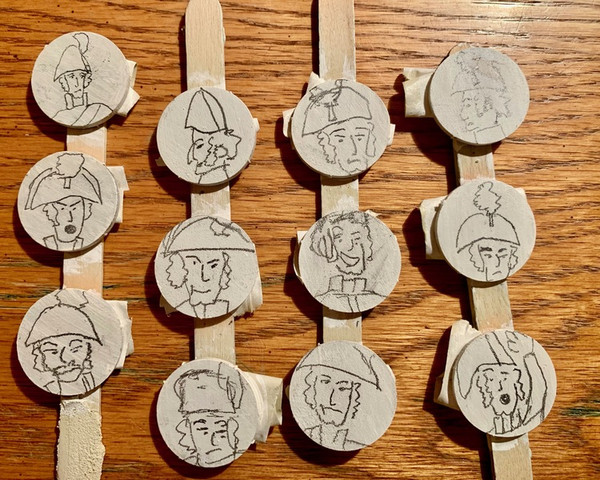
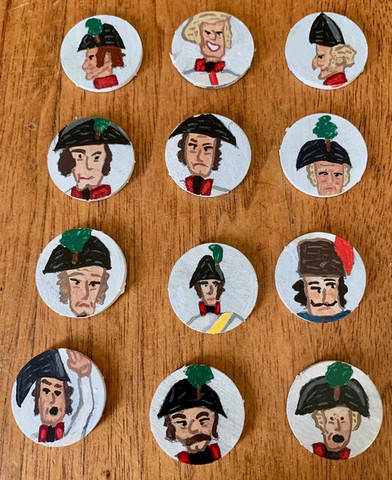
I thought of simply ordering some officer figures to single base as ADCs, but decided against it, as it would take a while to get them and paint them (Baccus is swamped with orders at present and I have no idea if other companies like Adler are any more responsive) and I already have single-based command figures in the pipeline to represent brigade level commanders.   I then hit on the idea of trying my dubious artistic skills to sketch some caricatures, starting with Austrians, so I painted some discard sabots from multi-bases in white and then went to work with an HB pencil.  I found as I went that I was remembering some officers from my military service as I went, like the fellow with the big hair and the easy smile.

 Final result.  Started colouring them with the grandkids’ pencil crayons, but the results were quite uneven and so I decided to revert to acrylic paints.   I’m quite happy with the final result.   Can’t wait to try them in my next game of GdA

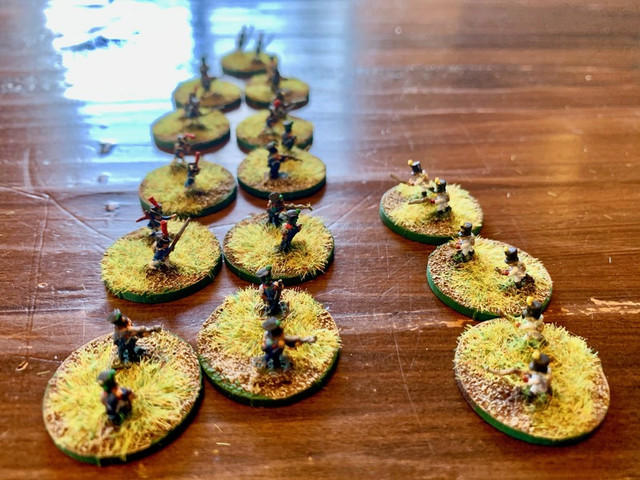
Also finished this week are some skirmish stands so I can try out the Skirmish rules in GdA.   I still need to do more Austrians, but I figure the French are more likely to deploy skirmishers than their opponents.  Some of the French figures (left) are by Baccus, painted by me, and some are from the collection I purchased.  The Austrians on the right were in that same purchased collection.

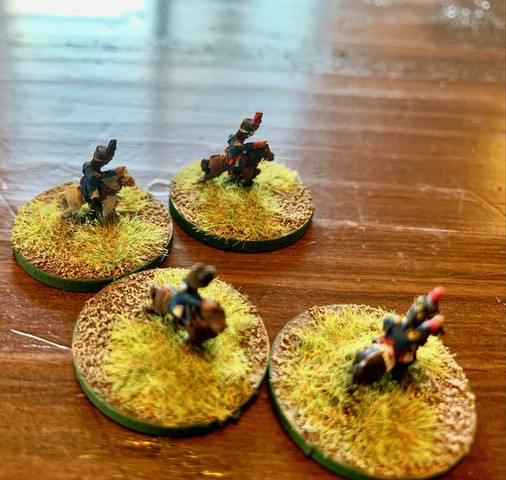
Finally, since I was on a basing jag, four brigade commanders for the French.   While I could also employ these figures as ADCs, I like my approach better.

Hopefully we’ll see all this kit in action soon.    Thanks for looking and blessings to your brushes!

MP+

Tuesday, April 20, 2021

Terrain Tuesday: 28mm Sarissa Manassas Stone House

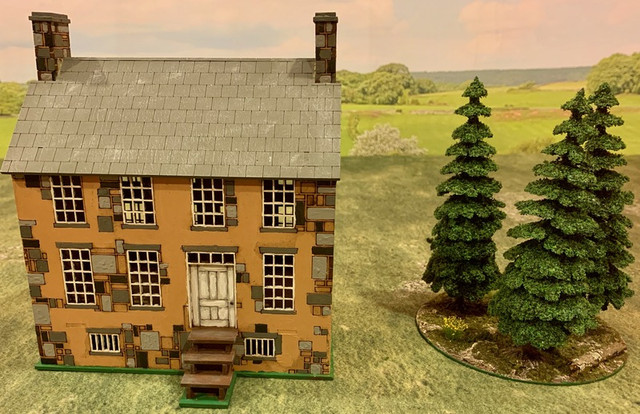
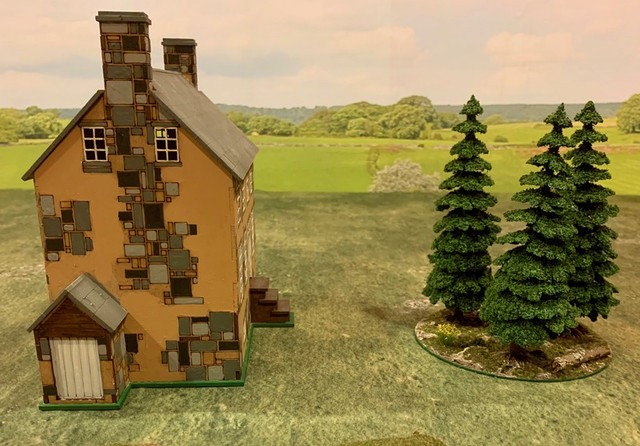
It’s Tuesday again and time to show off another piece of scenery for the war-games table.   This is the Sarissa Manassas Stone House in 28mm which was a fairly easy build from the flat-pack, though I did manage to get the root cellar door on the wrong side wall and only discovered that when the glue had set.   One overestimates MDF kits at one’s peril!   It sits beside a stand of pre-made trees which I bought at a show and glued onto an old Windows CD with some ground texture and flocking, so perhaps this counts as two terrain pieces.  Hooray! 

 The house will work for my ACW and alt-ACW battles.  It has a big footprint on the table, so perhaps more suited for skirmish games.   I didn’t apply any texture to the walls.  Rather, I focused on the laborious task of picking out the stonework in every shade of grey at my disposal, to give the impression of an old field-stone farmhouse that one still sees in my part of SW Ontario.

Having the self-imposed deadline of a blog post on terrain gave me the incentive I needed to finish this piece and get it off the work desk.  Hopefully it will feature here soon, as an ACW battle is next in the gaming schedule.

Blessings to your projects!  

MP+

Monday, April 19, 2021

Podcast Recent Listens and Recommendations

Hello friends:

I've been doing a bit of a deep dive into wargaming and military history podcasts lately, which I listen to either on long walks or at the painting bench.  I thought some of you might be interested in a roundup of listens that I've recently enjoyed and which might be of interest.

Big Lee from Posties' Rejects (of which I'm an honourary member!) offers some wise thoughts about how to get the younger generation into the hobby of wargaming,   As a wargaming vicar, I found this conversation very similar to the debates we have about the greying of the church and where the next generation will come from.  As a grandparent blessed with little ones, I found his suggestions most encouraging
. 


I'm a great fan of Zack White (@zwhiteHistory), an English PhD student and a tireless online promoter of Napoleonic history - usually on his podcast, The Napoleonicist.    He's an erudite and gracious interviewer, and his guests are usually topshelf.   Recently I had the pleasure of contributing my meagre voice talents to a collage of readers he put together for Voices of Ireland, bringing select letters and diaries of Irish soldiers and civilians to life.   I'm the one with the flat Toronto accent.    Conrad Kinch (@questingvole) has heard me try my Irish accent, but has tactfully kept his silence.

Ken Reilly (@yarkshiregamer) has a podcast featuring those long, free-wheeling conversations that I associate with British wargaming podcasts (aka the late Meeples and Miniatures).   I really enjoyed his conversation with Dr. Chris Brown, a Scottish historian and wargamer.  Chris is funny, acerbic, and very much a character - in other words, a Scot.   I'm currently reading Chris' book Arnhem: Nine Days Battle and while it's not my wargaming area of interest, it is a brilliant piece of military history.   Chris also has a wargaming presence on Facebook - S.P.I.T. Wargames (Stupid Projects in Twenty-eight)  - which is worth checking out.


Speaking of interviews, there's a very good one with Andrew, the host of Firepowergaming, in conversation with Tom Egan (@tomjegan).   Tom is an army officer in the Irish Defence Forces and an ardent wargamer.   In this conversation they talk about gaming as well its applications to Tom's day job which is training junior officers to plan and conduct operations in the field against a variety of threats and challenges.   Not that I'm trying to imitate Irish accents (see above), but Tom's Cork accent has thus far defeated me.  :)

Another interview that I enjoyed recently was between Sean Clark (@GodsOwnScale), host of the God's Own Scale podcast, and Jon Bleasdale, who runs a blog called Grymauch 's Solo Gaming.  I am fond of Sean's podcast, he has an easy, gentle style and is what I call a "down the pub" sort of podcast.  Jon's Grymauch blog is incredibly ambitious and shows a multitude of large 6mm battles in a variety of periods.  I think I could learn something from how Jon does campaigns.

Finally, I want to say how glad I am to have discovered the Old Front Line podcast by Great War historian Paul Reed (@sommecourt).   His depth of knowledge and the way he brings minutiae to life are stellar.  For example, in a discussion of the role of estaiments (small restaurants) in the life of the Tommies, I learned that our slang word "plonk" for cheap wine comes from the soldier's adoption of "vin blanc", which along with cheap beer was the booze on offer at soldier's estaiments - the red wine was for officers and was quite expensive.   Paul's discussion of the Lijssentheok military cemetery is a great example of Paul's erudtion, and covers the development of British military medicine in the Great War, the role of women nurses, railways and transport, soldier's eating and drinking habits, and the layout of military cemeteries.  Top shelf.


Thursday, April 15, 2021

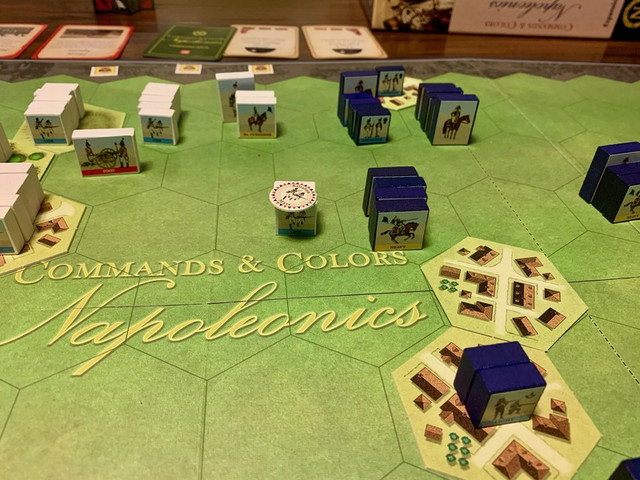
Command and Colours Napoleonics and the Battle of Wertingen: A Test Fight

So now that I’ve resurrected my French and Austrian 6mm miniatures and am frantically painting more while the mini-mojo courses through my bloodstream, what to do with them?   I could just fight some more random battles using points or whatever forces catch my fancy, but that seems somewhat below the noble historical calling of Napoleonic wargaming (said slightly tongue in cheek).  I invested in GMT’s Command and Colours Napoleonics for precisely this reason, as a simple wargaming guide to the campaigns and battles of the era.

I had spent a long evening putting stickers on the blocks for the CCN Austrian expansion (I have every CCN set and have gotten quite good at it), so I started at the beginning of the scenarios in this set with Wertingen.   The Battle of Wertingen, a town in Bavaria south of Augsburg, was the opening of the 1805 Ulm campaign.  It looks like a modestly sized fight ideal to recreate in 6mm.   

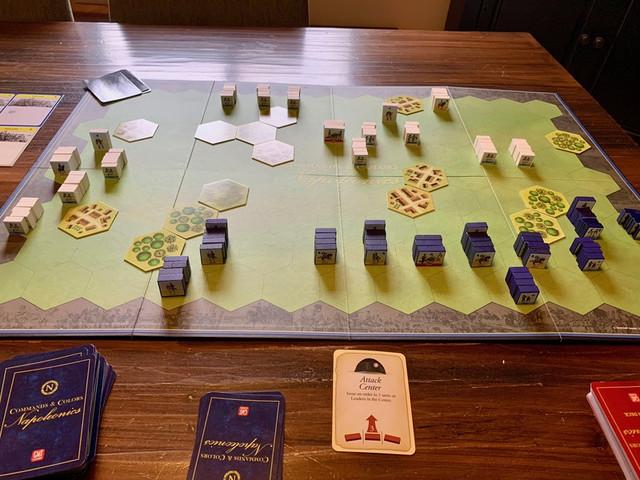
Here’s the initial setup, mirroring the historical situation.  Murat and Lannes arrived with several divisions of light and heavy cavalry, and Oudinot’s grenadier division was coming up on the right.    This was bad news for the Austrian commander, von Auffenberg, who had been told to take his infantry division, with two small battalions of horse, and go scouting.   Given the rock/paper/scissors nature of the horse and musket period, running into a cavalry heavy opponent when all your guys are on foot is not a strong omen of success.  Here the Austrian infantry is divided into three wings - most are the large, five-block Austrian foot, which are one of the Austrian advantages in CCN, along with several unit of grenadiers.  The Austrians have a light cavalry regiment on their right, and a heavy (cuirassier) regiment in their rear centre.  Historically the Austrian guns were lighter than the French and so were outmatched in range by Murat’s horse artillery, but in CCN terms Foot Artillery is Foot Artillery so that unit is one of the stronger cards in the Austrian hand.

Speaking of cards, I was using the Tactician cards and the new Command deck which are in the CCN 5th edition.  This was my first outing with hem, and I found that they add much more period flavour and choice to the game.  There is a video on YouTube showing how the system for card-driven games devised by Stuka Joe can be used to make solo play in CCN more interesting, and I shall try that next time I play CCN.

The opening went as the battle started, with the French horse getting stuck into the Austrians and causing some grief.  However, the Austrian line infantry in CCN can form Battalion Mass, which ineffectively a square but does not require the Austrian player to sacrifice a command card for each unit in square.   The rule reflects the Austrian tactics’ favouring of the defensive, and requires the French player to use horse, horse artillery and infantry in Combined Arms attacks.

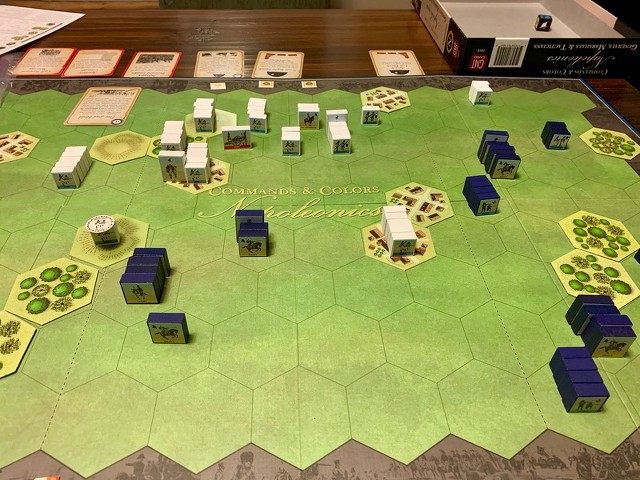
Mid game.  The Austrian light horse have caught the French horse artillery and obliterated it.   Also, the French have lost a general (two sabres came up on the casualty dice when his unit lost a block) so at mid game the Austrians are up 3-1.


 By the end game the tide was turning French as Oudinot’s grenadiers came up on the right.   The Austrian foot was in a protective crouch, using the defence advantages of the terrain, but a terrible run of cards left the defenders unable to answer the French weight moving to the right wing, and a series of persistent attacks, always with the terrible weight of French horse in reserve, took their toll.  Result, 5-4 French win, much closer than the actual battle, which augurs well for a more interesting miniatures game, perhaps. 

Next steps, do some background reading (I’m currently going through F.N. Maude’s book The Ulm Campaign 1805: Napoleon and the Defeat of the Austrian Army, which is an old chestnut but very readable and dead cheap as a Kindle version.   There’s also a very helpful entry on Wertingen in the invaluable Obscure Battles website which gives a detailed OOB for both sides that will be invaluable when I try to translate the battle to either General d’Armee (battalion level) or Blucher (brigade level).   One thing I noticed immediately in the OOB is how CCN fudges the numbers to create a more even contest:  the Austrians have a LOT of blocks for their 5500 men whereas the French should, one would think, have more blocks for their 20,000 men. It may look much more one-sided as a miniature battle.   

However, CCN proved its worth as a useful overview of a battle and an incentive to learn the wider context (I am still very much a newbie at Napoleonic history), so hopefully by the end of April I’ll have tried Wertingen as a tabletop battle.

Blessings to your die rolls!

MP+


Blog Archive

Followers