Saturday, December 26, 2020

Review of White Dog Games' The Mission

The Mission by White Dog Games is one of those rare games where you genuinely feel like you are learning as you play.   Designed by the highly prolific Ben Madison, The Mission is a solitaire game covering the whole of Christian history from the death of Jesus to the beginning of the First Crusades.   During that time your job is to spread the Christian gospel throughout the known world, establish the church, and then defend it from enemies within and without.   At games’ end, in the 12th century, your score will determine whether Christianity survives as a world religion or as a small cult practiced in some backwards region.

The Mission is a 4X game with emphasis on the first three Xs: Explore, Expand, Exploit.  The fourth X, Exterminate, is something you try to avoid.   At first things seem easy, as the original apostles move out from Jerusalem with the gospel of Jesus.   Soon they will die and their bones will become relics, which may help you financially later in the game, but before they pass away they have, hopefully, won a foothold in each of the six geographic tracks of the game board. 
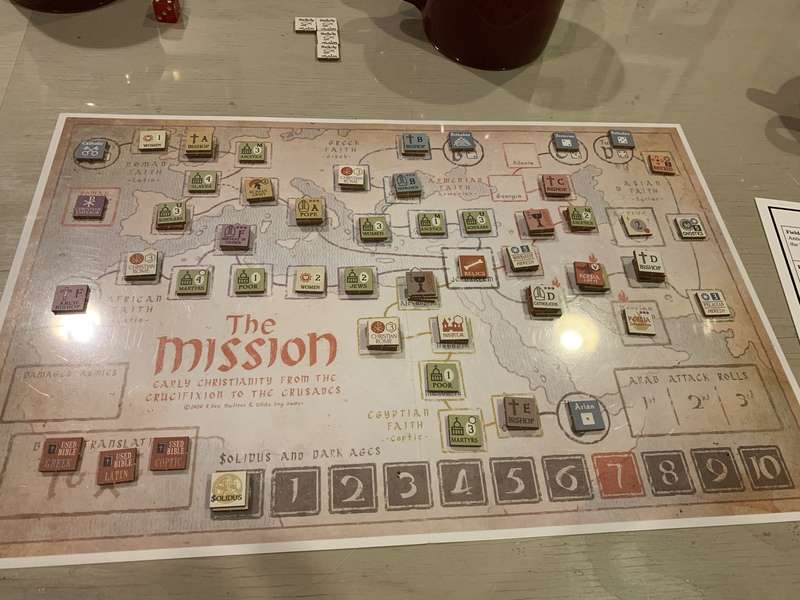
In the first phase of the game, you move further out on each of these tracks, attempting to convert regions which in turn give you revenue to fund missionaries and bishops, build key infrastructure (hospitals, monasteries, and universities), and translate the bible into regional languages (Latin, Greek, Armenian, Coptic, and Syriac).  Before Constantine, the Roman Empire can hinder or tolerate you, depending on the policies of various Caesars.   After the Empire becomes Christian, you make hay while the sun shines, because it gets tougher later on when the Empire collapses.   

In the Dark Ages stage of the game, you now try to defend the five tracks against various hordes of people pushing towards the centre over 28 turns, each covering a varying number of decades.   After the fall of Rome, some of these encroaching peoples can be converted if you work at it (always convert the Saxons if you can), and others have to be resisted as best you can.  Good luck with North Africa, you’ll need it.    Later on, when you’ve hopefully got the hordes under control, the rise of Islam means that various jihads emanate from Jerusalem in the centre and try to conquer their way outwards. so you’re always fighting fires and trying to keep regions from being conquered and slipping into apostasy.   Translating the bible helps, as do various great theologians, but at the same time you’ll face challenges from local despots, schisms where various regions choose their own popes and stop talking to you or sending you money, and that perpetual annoyance, heretics.    As regions fall into heresy, you can either sweet talk them back into the orthodox faith or ruthlessly suppress them, though cruelty can work against you in the long run.

I’ve taught church history in my profession as a vicar so I thrive on this sort of thing, and don’t think there’s been a game on this subject so good since Jim Dunnigan’s venerable SPI title Empires of the Middle Ages, though the two games are only roughly comparable.  If your worldview is secular but you’re interested in the ancient or medieval histories, this game does a good job of showing you the transition from the first to the second.  

White Dog Games uses a print on demand business model.  The components are attractively designed and presented, and the counters are on thick laser cut cardboard.   You’ll need four mugs or containers to hold various sets of random chits, and the game board gets more crowded as the centuries proceed.  My first game went fairly well.  The rules and player aid charts are well laid out and the rules explain themselves as you go along.

I did reasonably well for Christianity in my first game, and look forward to trying it again.  Highly recommended.  The Mission gets the Mad Padre blessing.

MP+


At f

Monday, December 7, 2020

Perry Brothers Union Cavalry Horseholder and Confederate Officer

 Hello friends:

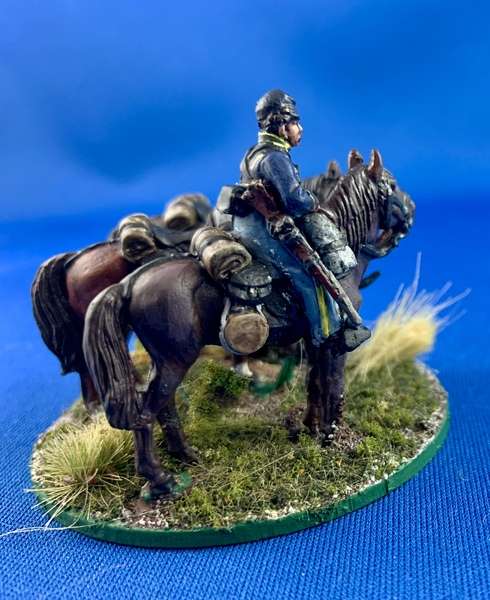
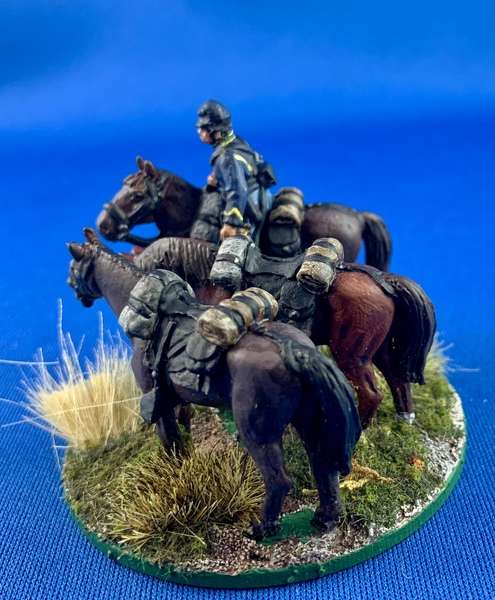
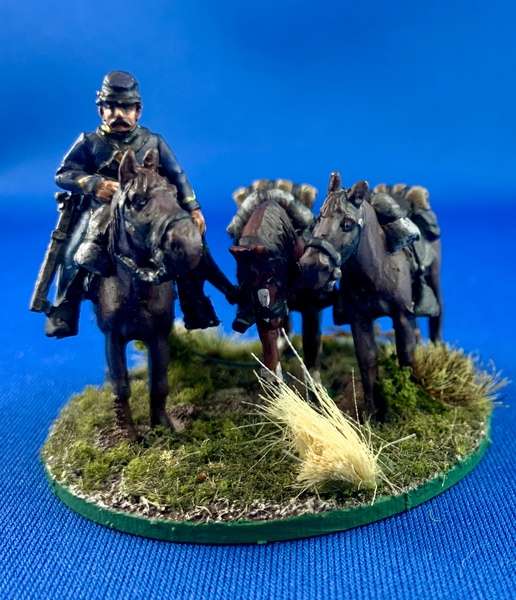
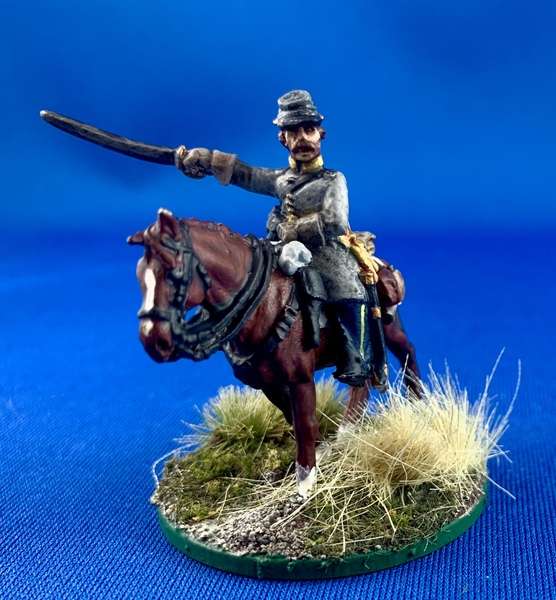
Taking a moment to document some small ACW painting projects.  28mm Union cavalry horseholder by Perry Brothers:  

These are the type of figures, like casualties, that might make the more practically minded ask - why?  My answer is that I have enough mounted and dismounted figures to represent a small Union cavalry brigade, so now I can represent where the horses are if the dismounted troops have moved some distance away during the fighting.  Could be an important detail.  Also, I like the aesthetic, they add a bit of a diorama feel to the table.

There was a fourth horse figure in the set, but it got misplaced in a small mound of metal horseflesh on a corner of my bench, as I am also currently working on a large unit of Canadian militia horse for my alt-ACW project.  I will find a use for this AWOL nag.


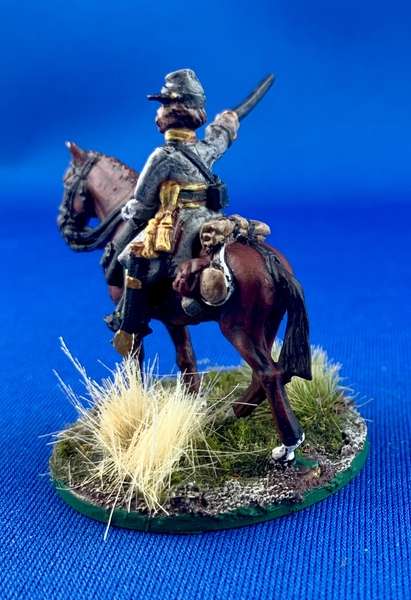
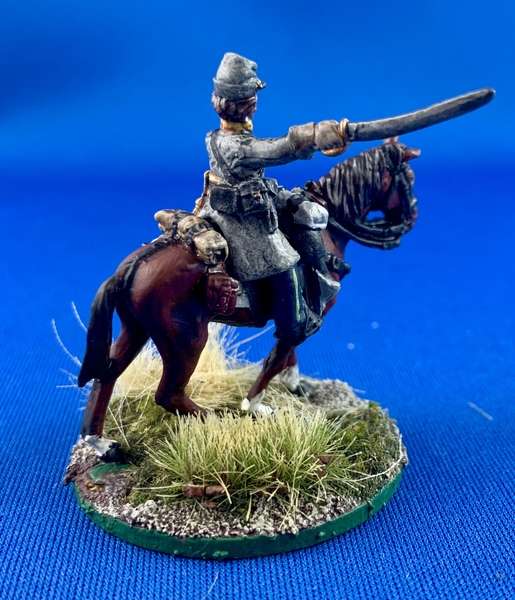
Mounted officer sculpt from the now-defunct French producer, Forgotten and Glorious.  I quite love their ACW line and have some in the painting queue.

This fellow was listed as a Union officer, but I need more rebs to serve as command figures in Sharpe Practice, or as Staff Officers in Pickett’s Charge, so he ended up in gray.


Blessings to your brushes!

MP+


Wednesday, December 2, 2020

Sunk Hopes for Avalanche Press' Russo-Japanese War

My old friend and gaming adversary James (@JamesManto4) recently observed on social media that he’s puzzled by my fascination with extremely granular hex and counter war-games.  It puzzles me too.   I fell into bad company as a young teen and got introduced to SPI monster games by older, debauched boys is all I can say.

It’s generally true that I divide my time unprofitably and inefficiently between paper hex and counter games and miniature games, and that I probably have more unpunched cardboard than I can get through in whatever years remaining that the good Lord graces me with.   I find that operational and strategic level paper games afford a vantage point and level of interest that most miniatures games can’t give me, and when I want a good skirmish or tactical game, out come the minis.   Also, both types of games have their own kinds of aesthetic appeal for me.  

Are you still reading this?  I haven’t even gotten to my main point yet.  So here it is.   I gave up half way through Russo-Japanese War by Avalanche Press.  I just couldn’t pretend that I was enjoying it any longer and having recently turned 58, I am more and more aware that life is short.

Here’s the problem.   Even through pre-dreadnoughts, those ungainly, smoke-belching, baroque iron castles of the sea, have their own fascination, and even though the Russo-Japanese naval war has its many fascinations - doomed fleets of a doomed empire, valour, technology at the cusp of change - the game itself is less than fascinating.   How could it not be inspiring?

                                            So inspiring!

The problem is that it’s not a very interesting war to game because the quality of the two sides was so varied.  The Japanese were a highly drilled, efficient and well-led naval service, and the Russians, well, were not.   Any game which wants to model this qualitative asymmetry has to penalize the Russians, so in this game, while you hit on a 6 on a d6 at long range (5 o 6 on a d6 at close), if you’re the Russian player you then have to roll a second confirmation roll (5 or 6 a d6 for each hit) to see if the shell actually hits its target.  The Russian confirmation gets slightly easier (4-6 on a d6) after eight rounds of combat, but the handicap against the Czar’s ships is still very severe.

RJW follows Avalanche Press’ Great War at Sea rules system, with a host of variations for the pre-dreadnought era.   With two players, the strategic game might be interesting as both sides have to secretly plot their moves, though the general objectives are fairly obvious - in the first phase of the war, the Japanese are guaranteed to show up at Port Arthur in force at a certain time after sailing from their home ports because that’s the main prize.  I suppose the Tsushima part might be more interesting for two players, but as a solo game, even with some random directional die rolls to make things fun, the COAs for both sides were fairly obvious.  There is some strategic challenge for the Japanese because their total fleet numbers are inferior and so their margin for error is slim, but realistically and historically, they can sink the Russians in two job lots with little fear of disaster.

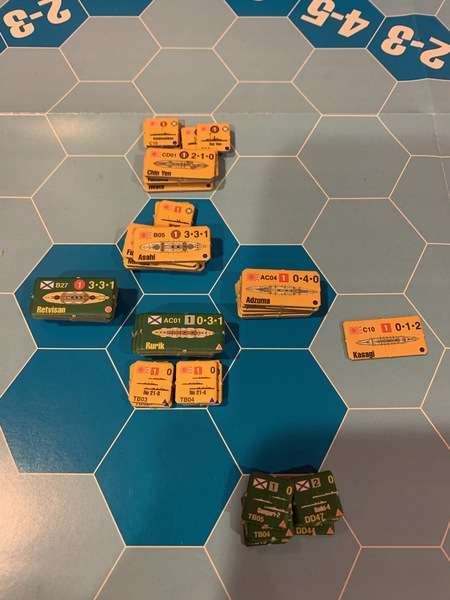
As a tactical game, RJW isn’t that much fun, to be honest.  I decided to sortie the whole Russian fleet from Port Arthur to try and stop the Japanese from landing troops on the Korean peninsula, which meant that they ran into the main Japanese force early on.    I then deployed all the ships to the tactical map.

                       Not so inspiring.

The tactical phases are IGO/UGO start with random determination of initiative, through logically the Japanese, being better sailors, should always have initiative.   Ships of different speed classes are then moved in sequences,  each speed class getting its own sequence with fastest going first, and between each sequence there is a round of gunfire and then torpedoes if close enough, and the incentive to get close gives the game a sense of Age of Sail. There is a stacking limit of capital ships per hex, and the movement rules are too abstract to allow for subtleties like trying to cross the enemy’s T as in Jutland.  You just get in close and then it’s Fire Away Flanagan.  Ships have Primary, Secondary, and No armour ratings.  Likewise there are three gunfire ratings: Primary, Secondary, and Tertiary.  Primary shells penetrate all armour and do extra damage for lightly armoured ships.  Secondary shells only penetrate secondary or no armour, and Tertiary shells only damage unarmored ships such as destroyed and torpedo boats.   Torpedoes are bow mounted (less effective) and hull mounted (more effective) and are basically close range weapons with a more destructive effect.

Damage is marked off as Hull hits, Gun hits, Torpedo hits, and occasionally critical hits, using ship logs.  For a large action like my Port Arthur battle, it becomes a dreary round of checking the firing ship to see if it has lost any gun factors, rolling dice, and then marking off boxes on the target ship as necessary.   I remember playing with ship logs as a kid with Avalon Hill’s Wooden Ships and Iron Men and that didn’t seem a bother then, but as I said earlier, life is shorter now.  It boils down to lots of die rolling, lots of paper consulting, and lots of marking off boxes.  To make a long story short, the Russians were getting the worst of it and their battleships were generally in a bad way, with one sunk.   There was some prospect of the Russian torpedo boats getting into the IJN line of battle, but it was a faint hope.   Honestly I couldn’t be bothered finishing it.

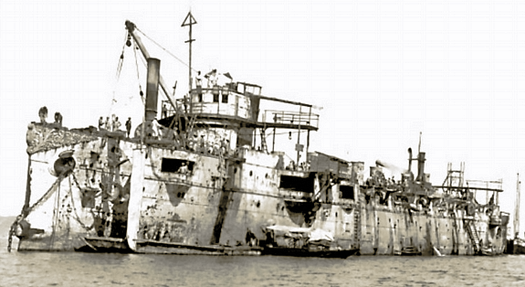
To be fair, the RJW scenario book as a ton of history and detail, and the full OOBs for both sides are represented in the counter mix, so the game could be a great resource for someone who wanted to play this era using miniature ships.   Smaller actions might be fun, particularly if you abandoned history and made both sides equal in capability.   It might also be fun to introduce British, German and American ships.  However, out of the box, as is, my hopes for RJW sadly foundered and then sank under the waves.

Image:  the author’s hopes for a fun game.


Tuesday, November 17, 2020

Perry Brothers Royal Artillery for the American Civil War

Greetings friends.

Slowly chipping away at my stock of Perry Brothers British Intervention Force figures ordered at the start of Covid.   I don’t think I’ve told the story of how I ordered a whack of figures very early into Covid, back in April.   By August I emailed PBros to report their non-arrival here in Canada (I’ve had good experiences pre-Covid getting prompt shipments from the UK to my town one hour N of Toronto).   PBros agreed they were likely lost and reshipped the order without question or extra charge.   Very classy.   Of course, the original shipment, postmarked May 4, arrived about a week after the re-shipment of the order, so I paid for the duplicate which was by then in transit.    Bonus me, I now have twice as large a pile of figures to paint.   So well done Perrys!

Royal Artillery gun crew with 12 pounder Armstrong.  I had a bit of a struggle assembling the gun, so it likes slightly wonky in the second photo.


I don’t know much about the history or employment of this type of gun but I recall that in the old SPI monster game, Terrible Swift Sword, there was a Confederate battery equipped with Whitworths and it could hit anything on the map, so I am guessing that this thing has some range!   I suspect that it should be treated as similar to Union rifled artillery such as Parrott guns.


My source, the Osprey volume, Canadian Campaigns, 1860-1870, doesn’t show any artillery uniforms, but I did some googling and found the the uniforms of the time generally seemed to be dark blue with red trim, yellow cuffs, and yellow bands on the pillbox hats.

I always debate whether to just mount the figures on the base of the artillery piece so it looks realistic, but I always decide to bass them separately, in case I need to represent casualties in the battery or gun few, depending on the scale being played.

I have two more Perry Whitworths and crew to start, and am currently working on a large unit of Canadian volunteer cavalry, so I almost have enough figures finished for a small skirmish, which is always exciting when a project starts to come together.

Thanks for looking, be well, and blessings to your brushes!

MP+

Saturday, October 24, 2020

The Rockies Ablaze, Part Two

Near Camrose, Alberta, February, 1937.


It took Frenchy Lamoreux a day and a half to snowshoe down from the mountains and into town.   Normally he gave the Mounties a wide berth, as did most of the trappers.   It wasn’t that he had anything to hide, he was as honest as any man, but where the redcoats were, it wasn’t long before the surveyors and the mining men and the road crews appeared, taking his way of life away bit by bit.


He shrugged when he reached the simple cabin of the RCMP detachment.   “Tant pis.  On fait ce qu’il faut.”


“Sergeant Craig’urst”, he nodded to the man in red serge behind the desk, as a friendly, hawk-nosed face looked up.   Craighurst was well known to the trappers as a fair and decent policeman, someone who knew the woods and mountains as well as any one.


“Frenchy!”  Bill Craighurst’s bantam figure rose easily as he offered his hand.   “What brings you down to town?”


“Not any t'ing good, Sergeant.  Maybe you ‘ave coffee on dat dere stove?”


“Of course.   Sit down.”   Craighurst poured thick strong coffee into an enamel mug and handed it to the trapper.   “Tell me your news.”  He could see something haunting the other man’s face as Lamoureux sipped the coffee and gathered himself.


“You know old Grainger, ‘ee ‘as dat claim up on Indian River, nearby of me?”


“Scotty Grainger, yes.   Keeps to himself, but never troubles anyone.   By all accounts a good neighbour.  What of him?”


Lamoureux stared out the window behind the mountie’s desk for a moment.   "I t’ink ee’s dead, Sergeant.”  He told the story about finding the blood-soaked snow.


“The last time Grainger was in town, he spoke ill of another trapper, the Serb, Gligic.  Accused him of stealing his furs. Even threatened him.  Do you think there was bad blood between the two?”


The trapper shrugged.  “Peut ĂȘtre.  Is true dey not les amis.  But I do not t’ink it was any man what killed ‘eem.  It was … some t’ing h'else.”


Sergeant Caighurst’s big husky growled faintly and looked apprehensively at his master.   “Easy, Laurier.   Easy, boy.  Well, Frenchy, I think I’d best go have a look.”


One look at the trapper’s face told Craighurst not to ask for his company.  The man was clearly spent.  “Eh, you go if you want, Sergeant.  But as dey say, attache ta tuque."

Saturday, October 10, 2020

Some Good Pulp Doggoes

Hello and Happy (Canadian) Thanksgiving.

Here are two Very Good Doggoes (are there any other kind?) for my 1930s pulp project, The Rockies Ablaze.   These good puppers are from Bob Murch’s Pulp Figures range of Yukon Adventure figures.

My wife Joy has had two Siberian huskies in her life, both sadly gone across the Rainbow Bridge, but our house is replete with pictures, which I used as inspiration.   Joy holds that huskies are the most beautiful animals that God ever made, and I am inclined to agree with her.

Of course, Mounties need husky sidekicks.  Maybe not Constable Benton Fraser from the TV series of the 1990s, Due South, but perhaps his grandfather.

“Let’s go, Fang, there’s trouble out there!"

Sadly our house no longer has a resident dog.  Our very good girl Dinah came to the end of her road last week.   Joy adopted her three years ago after her owner passed away.  Dinah was already elderly then, and while she got deaf and started losing her sight, she had a good life until recently  when her ability to walk and keep clean declined, and we decided to let her end her life in peace and dignity.  I suspect the only dogs here in future will be miniature dogs, as we hope to travel once Covid is over, but you never know.


Blessings to your brushes and to your furry friends!

MP+

Thursday, October 1, 2020

It's Fat Bear Night!

ghhhrgergerge


I’m always on the lockout for whimsical figures for my pulp gaming project set in the Canadian Rockies, including animals.   Hikers in the Rockies know all about bears, and what could be more dangerously Canadian than a bear?    I found this fellow on the Northstar Minis website, a Frostrgrave model, I think, and he looked the part.   Why he is up and angry in the middle of winter?   I’d be cross too if someone woke me from hibernation!


Once I noticed it in this photos, I wasn’t happy with the yellow blobs of glue left around the winter tufts by my white carpenter’s glue, so I went back with some white pain and cleaned them up.  Sometimes it takes a camera to see things.

If you think the winter bear is a chonk, meet his resin friend from Thistle and Rose miniatures, their B01 Were Bear model.  He is HUGE by comparison.  He has a forst/grass base because he will be a possible option for my Elven Woodland Forest army for Dragon Rampant, a single base model.


Serious chonk!  I like a bear with a big butt and I cannot lie.   That paw could take out an orc shield wall in one fell sweep, and then open up a pot of hunnee.

 Finally, if you like big bears, I encourage you to check out Fat Bear Week, a bracket contest featuring actual brown bears in an American wilderness park in Alaska. 

Blog Archive

Followers