Saturday, March 6, 2021

On To Paris! By Compass Games Turns 1 and 2

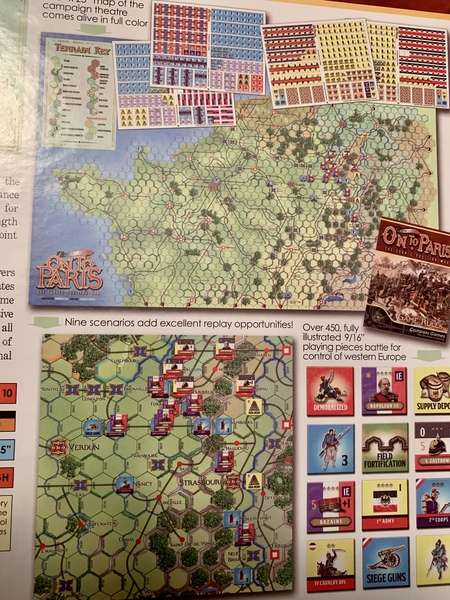
Currently on the Mad Padre’s hex and counter table I have open On To Paris (OTP), an operational/strategic treatment of the Franco-Prussian war, designed by Milan Becvar for Compass Games.  I understand the game system is ported over from an American Civil War publication from Victory Games, which I’ve never played.   I gather OTP has had a complicated production history, and there are some noted graphics issues which others have noted - in brief, I find the board and the charts hard to read because of strange font and colour choices, but I’ll leave that for now.

Here’s the back of the box to give you a sense of the game’s look.

OTP is a bit of a head-scratcher for a bear of little brain like myself, but I’m slowly working it out.  The building blocks of each side are infantry and cavalry strength points.   Infantry can be left as SPs for duties like garrisoning fortress, but are best organized into corps which can be attached to armies for maximum flexibility.  Cavalry are organized into divisions which can likewise be attached to armies.   

The turn sequence is a series of random impulses in which each side uses dice-driven random allocations of Command and Initiative Points to organize and reinforce, maneuver, and fight.   Amies have some reactive capability so the non-phasing player can sometimes move to counter the phasing player’s operations, depending on things like commander abilities, which gives it a fairly fluid feel.

Prussian armies are somewhat better at command and control than the French and so are more maneuverable.   There is some historical chrome:  French artillery problems at the beginning of the war mean that French combat strength is reduced in the early battles, though Prussian massed infantry tactics at the stat of the war mean that they take higher casualties.  Both sides have chances to improve their processes over time.

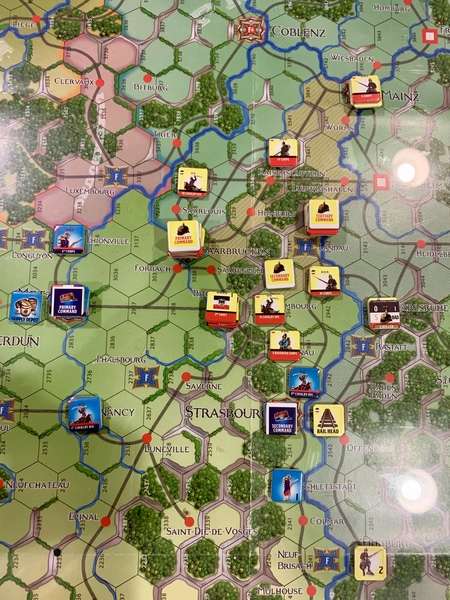
I’m playing a long scenario starting in July 1870.  Here two Prussian amies are massing near Saarbrucken, while a third menaces French forces gathering around Strasbourg.  One Prussian army has crossed the border and is besieging a French corps in the fortress of Bitche (cue puns here).


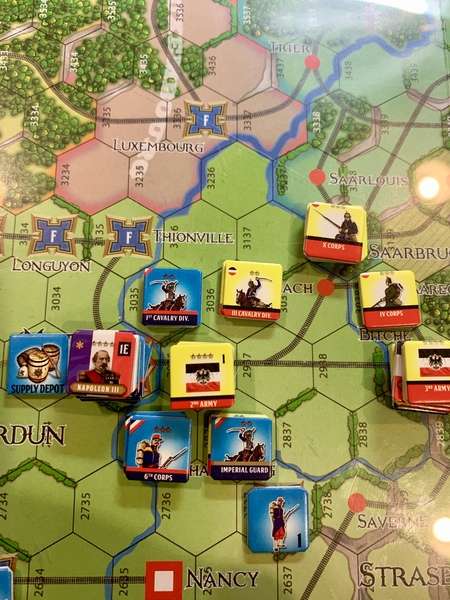
Turn 2 - with the largest Prussian army, the Second, with four corps, bearing down on Metz, the French command sees an opportunity to encircle and defeat it before reserves can come up.  A risky strategy as it would be better to entrench behind the river and rely on Metz’s defence, but (Gallic shrug) en avant! is the cry, as the French sally forth under the gaze of Napoleon III.  If the French get lucky and win the next initiative, they might have a chance of encircling and even destroying Second Army.  Battle has been joined as I slowly work out the combat mechanics.   More to follow.


Tuesday, March 2, 2021

Little Landsers: Getting Ready for OGroup

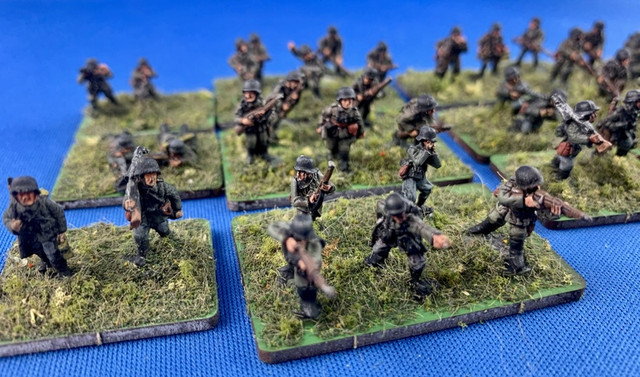
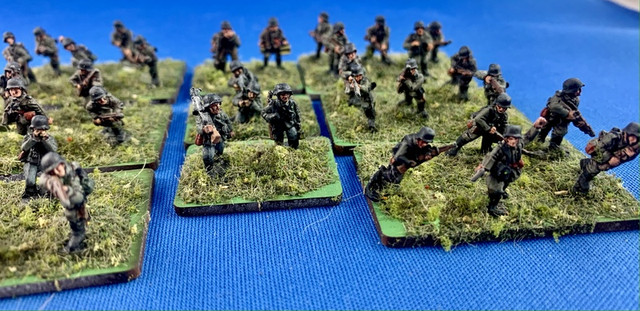
I suspect that like a lot of people in the Too Fat Lardies community that are excited about the release of David Brown’s O Group rules for battalion sized battles, I have gone back to the 15mm WW2 part of my lead mountain to see what I could find.  There is a LOT in my 15mm lead mountain, some of it dating back to the release of Flames of War.   I decided the first thing to do was to increase the number of my early war Germans - a useful force, as I already have a massive number of 15mm Russians for them to contest the steppes with.

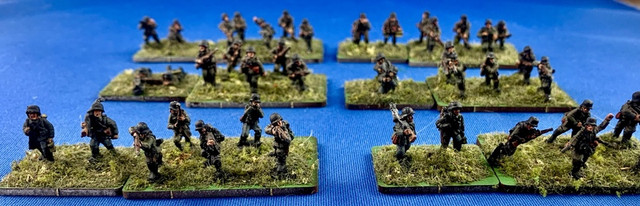
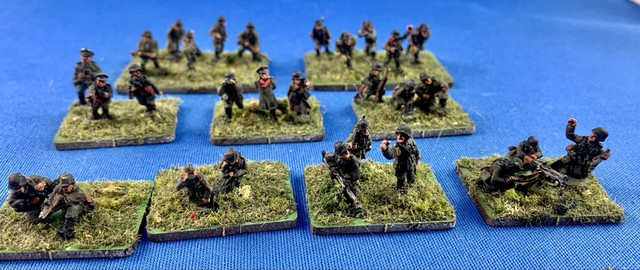
The figures are a mix of Battlefront and Old Glory that I bought in a mass order with some friends some years back.  The OG figures are, frankly, a mixed lot, some downright ugly, but they mix well enough with the BF figures.  I filled up enough painting sticks to do several platoons of generic Heer infantry with supports and command.  I put two man LMG figures on separate small bases to stretch the number of figures, so one LMG stand, with a five man infantry stand, is more or less a section.  Seems legit.

The figures were mass produced, and with a “good enough” attitude towards the final outcome.   I am not ashamed to say that I bought a can of Army Painter Field Gray spray primer to give me a base coat, and then picked out the flesh, weapons, helmets and gear.  Everything got a final wash of Windsor and Newton Nut Brown ink, a trick I saw from someone who uses it as a wash for 6mm Napoleonics, and I was happy with the end result.  The bases are coloured FOW size bases from 4Ground, covered with a blend of model railroad turfs.  I'm a slow painted, but I raced through all these figures in about five one hour sessions.

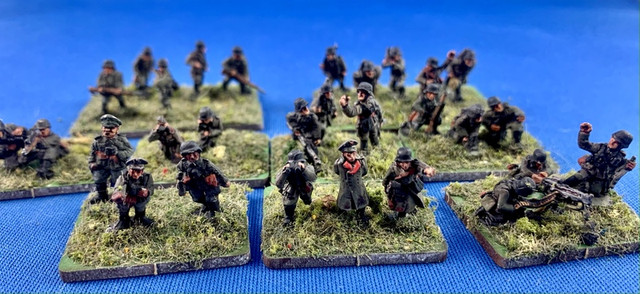
Two tripod mounted MG sections, a tank hunting team with ATR, a sniper team, a 50mm mortar, a section of combat engineers should cover most support options for smaller scale actions using TFL’s Chain of Command.

Finally, I had enough senior figures to make two command stands suitable for company or battalion level.  The fellow with the fancy overcoat has ben dubbed General Von Klinkerhoffen, in tribute to the late Hilary Minster of Allo Allo.

That should be enough for a decent sized engagement.   It’s pleasant to work in this scale again and not be too overly fussed over mistakes on a single figure.  I have a company of Battlefront Commonwealth infantry in the queue as I have become quite excited about 1st Canadian Division in Italy, but that’s another story.

Thanks for looking and blessings to your brushes!

MP+

Thursday, February 25, 2021

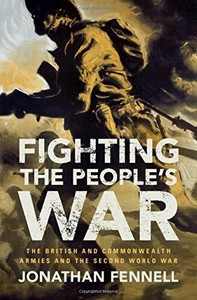
Book Review: Jonathan Fennell's Fighting the People's War: The British and Commonwealth Armies and the Second World War


Jonathan Fennell, Fighting the People’s War: The British and Commonwealth Armies and the Second World War (Cambridge UP, 2019), 932 pages.


Fighting the People’s War (FPW) was not a reading project that I approached from a wargaming point of view, but simply out of a desire to try and stay current with cutting edge military history on WW2.   After reading this massive book, though, I see some of our wargaming preoccupations with morale, troop quality, and national characteristics with new eyes.

Jonathan Fennell is a youngish scholar, who lectures at the Defence Studies Dept. of Kings College, London.  His first publication was Combat and Morale in the North African Campaign; FPW is far more ambitious, with the goal of a single-volume history of the British and Commonwealth Armies of WW2.  Rather than focus on generals, weapons systems, or battles per se, Fennell wants us to understand “the personal concerns of troops, their broad social and political perspectives, and their willingness to fight” (9).   To understand these concerns, Fennell did extensive research on the censorship summaries produced in each formation by officers who censored the troops’ outgoing letters.  These summaries were frequently produced and passed up the chain of command to help senior leaders gauge the moral and effectiveness of their men.

Fennell also focuses on the social composition of the armies that were brought into being after the outset of war.   The British and Commonwealth armies were raised from populations that were “far less fervent and less deferent” than those who supposedly flocked to the colours in 1914.  The British government knew that conscription would be necessary from the outset:  of the three million men raised to join the Army of 700,000 under arms in September 1939, three-quarters were conscripts (63).  The Commonwealth armies were volunteer forces at the start of the war, but there was little “widespread enthusiasm” to join these armies, while minority populations (Canadian French, South African Afrikans) were particularly reluctant to volunteer and even less happy about conscription.   Deferments of professional and skilled workers meant that “semi-skilled and unskilled classes … were particularly represented” in the armies.  

Why did the British and Commonwealth armies perform so poorly from 1939-42, what Fennell calls the “great crisis of the Empire”?  A huge reason was lack of training.  In June 1941, for example, only ten percent of the British Army were fully trained regulars.  There was a shortage of equipment, uniforms, and training areas sufficient for a whole brigade to exercise (221).   The quality of officer training was often poor, and theatre-specific training was often left up to unit COs to implement if they felt like it, so, for example, many of the units defending Malaya were wholly unfamiliar with jungle training.  

Besides the training deficit, there was what Fennell calls an “ideological deficit”.  Governments expected their soldiers to fight the Nazis and preserve the Empire, which required an “innate commitment and fighting ability of its citizens and subects” (255).   The problem was that most troops had little commitment to the British Empire (especially Indian troops), were dissatisfied with their poor pay and treatment compared to the high wages earned by skilled workers in the war industries, and had memories of the poor treatment and unemployment of demobilized soldiers after the Great War.    Generals lamented that their troops were “readier to surrender” than their foes and realized that “many of the troops still want to know what we are fighting for” (255).    After the defeat of Eighth Army at Gazala in 1942, 88 per cent of all casualties were men reporting sick or who had surrendered.   British commanders like Auchinleck asked the government to reinstate the death penalty for cowardice and desertion; these requests were refused.

By 1944, the British and Commonwealth armies had improved training, focused extensively on soldier welfare, and had learned to conserve their dwindling manpower by doctrines such as Montgomery’s set-piece “Colossal Cracks” battles.    Commanders learned to only ask “of their troops what they were capable of and trained to do” (688).   However, hard limits were reached.  The New Zealand troops essentially mutinied over a botched 1943 furlough scheme, the South African populace had largely ceased to support their government’s war effort, and the Canadian government’s attempt to introduce conscription was a military and political failure. 

With victory in sight, what soldiers wanted most was an assurance that things would be better after the war – that better housing, better employment, better education would be a tangible reward for their sacrifice.  Army education schemes to help the soldiers understand what they were fighting for ironically radicalized the troops politically, which explains in part why Churchill, who cared more the survival of the Empire than he did for social engineering projects, lost the 1945 election.   Philip Zec’s famous 1945 cartoon sums up the hope of the soldiers that the peace would finally be an opportunity for the working classes.  One example of this radicalization that I didn’t know of in my own country’s history is that in 1945, Canadian progressive parties won 58% of the civilian vote and a whopping 71% of the votes of soldiers who had recently fought in NW Europe.

Fennell’s book has a demythologizing agenda, to be sure – he wants to debunk the idea that British and Commonwealth soldiers were “stolid … apolitical and uninterested in the broader meaning of the war” (697).   They were brave, they learned, and by the end of the war they were effective and well-trained armies that also “yearned for the camaraderie and equality of the battlefront to be present on their return to civvy street” (697).  

I’m glad I persisted in reading this massive book because it took me a little closer to the mindsets of the troops who did the bulk of the fighting and dying on the ground.   As a Canadian who used to be quite the Anglophile, I always thought that the pluck and elan of the British and Commonwealth troops always got them through a tight scrape – I am sure I’d internalized old propaganda films like The Way Ahead.    In fact, the history of those armies up to 1942 is often a series of lamentable disasters as poorly trained, unmotivated, and poorly led troops learned their business the hard way while the Empire collapsed around them.    For wargaming, even in a small-scale action, Fennell’s book should lead us to question our first assumptions about troop quality, morale and training.  We can ask these questions without questioning the bravery or heroism of these soldiers.

Wednesday, February 24, 2021

Happy Heinkel

Hello friends:

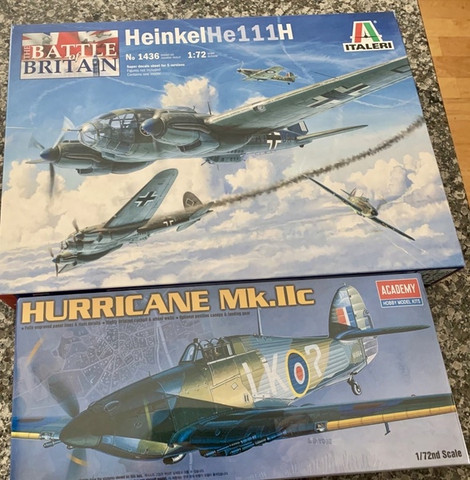
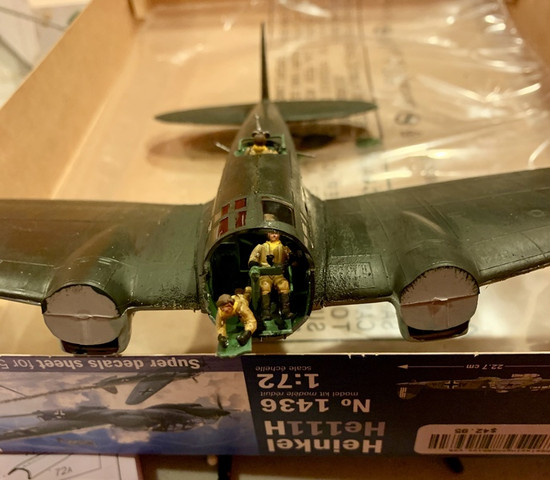
One way of dealing with Covid fatigue for me has been returning to a teenage obsession with model airplanes.  May have ordered these (from Wheels and Wings in Toronto, excellent store) after watching the Battle of Britain recently.

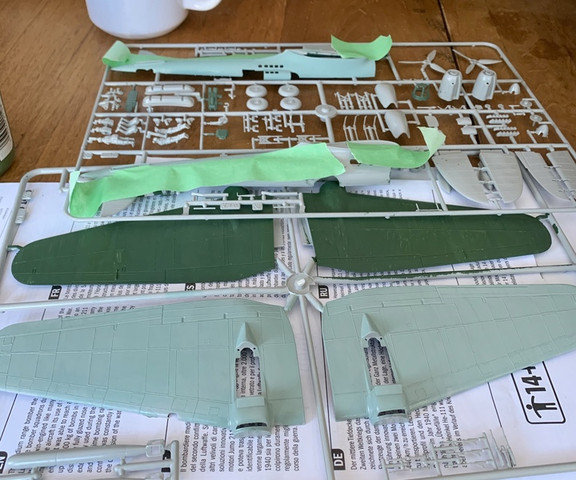
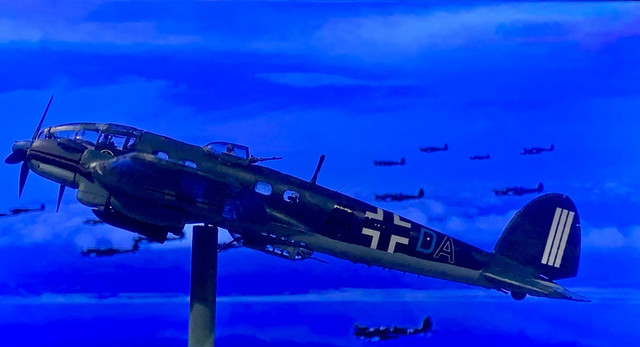
I crowdsourced which one to build on Twitter through my @Marshalluigi account and the Heinkel got slightly more votes, so off I want.  The Italieri 1/72 kit is fairly simple, not a lot of complex parts, which is kind of a blessing after the recent Lysander kit.


Oddly the kit included crew figures but the instructions said don’t use them.  Instructions be damned, I said.

Another excuse to watch The Battle of Britain.  “Tomato Eins en Alle, Tomato Eins en Alle, noch zehn Minuten bis Ziel!"  

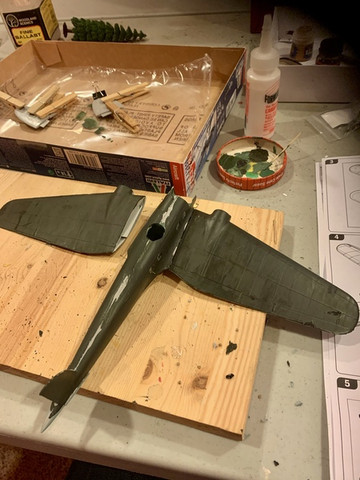
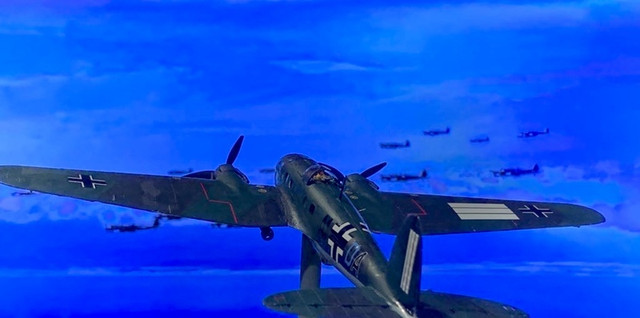
There is something sleek and rounded about the HE111 that is quite graceful.  While it looks terribly vulnerable in the film, an HE111 carried a LOT of machine guns, six in this model variant.

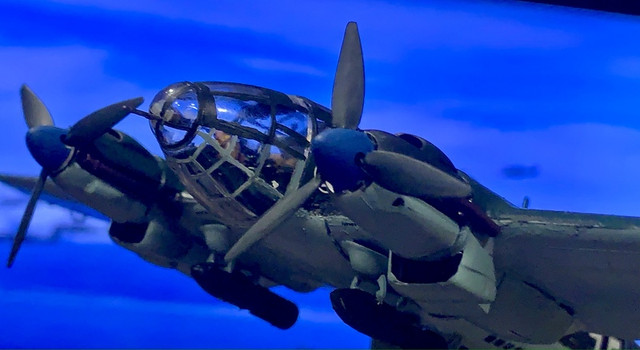
I dreaded painting the nose canopy but it turned out well enough if viewed at a distance.

I suppose a distant project might be making a handful of BoB 1/72nd models for a game TFL’s Bag the Hun, though I might just hang it from the ceiling as teenage me used to do.

Thanks for looking.  Blessings to your models,

MP+

Tuesday, February 16, 2021

Living With A Paradox: Thoughts On Wargaming and Ethics in Light of Jay Arnold's Recent Veteran Wargamer Podcast

Ethics in wargaming isn’t a new topic.  I’m old enough to remember the arguments in the 1970s and 1980s in the hex and counter community about games such as Squad Leader fetishizing the SS with black counters and special “super-soldier” abilities.   So while it covered well-trodden ground, there were three things that made Jay Arnold’s Wargaming Ethics Roundtable podcast and panel discussion interesting and refreshing.

First, the podcast was a conversation rather than a debate.  Rather than framing it as an argument with those who might say “this is all a game, why are you ruining our fun by taking it so seriously and being so judgey?”, a conversation that Annie Norman of Bad Squiddo Games said she has had her fill of, the tone was thoughtful and respectful.   All the participants agreed that this tone should be the quality we take around our gaming tables.   Admittedly there might be some people who reveal their true colours (eg, wearing a “Adolf Hitler European Tour, 1939-45” concert style shirt) and who thus might be best avoided, there are issues that we could raise in friendly, conversational, and non-accusatory fashion, so thanks to the participants for modelling that tone in their discourse.

Second, the participants addressed the question of the representation of suffering which can be the elephant in the room for wargamers, so I was grateful for their honesty.   William Tecumseh Sherman wrote to a friend that  “ I am tired & sick of war. Its glory is all moonshine. Even success, the most brilliant is over dead and mangled bodies”.  Like Jay Arnold I served in the military, and as a chaplain I’ve tried to help others with moral, physical, and psychological wounds.   I’m an avid student of military history.  I have, or should have, no illusions.  Yet here I am, with painted and cardboard armies of many periods in my house.  My collections include casualty figures, which Jay’s guests confessed some discomfort with.  So what’s my excuse for persisting in this hobby?

Dr. Samuel Johnson once said that "Every man thinks meanly of himself for not having been a soldier, or not having been at sea."  He was, I think, pointing at the mystique of the profession of arms, its celebration of heroism, gallantry, and self-sacrifice, the glamour of the dress uniform, that encourages many today into the phenomenon of “stolen valour”.   That mystique has waxed and waned over the centuries, but it persists.  I grew up in an Army family, with a decorated veteran father who was sparing with his love but still inspired me and some of my brothers to become soldiers.    The paintings of a Lady Butler or Don Troiani, like our favourite war movies, capture the aesthetic of war, even while antiwar movies (Paths of Glory), novels (The Good Soldier Schweik) and art (Dali, Dix) are difficult to ignore.    I think it’s fair to say that wargamers are under the spell of the aesthetic of war, even while knowing at some conscious level that it is a species of enchantment. 

For example, I can look at a photo of a dreadnought of the Great War, at speed and guns blazing, and find it inspiring, even beautiful, while knowing something of what a fourteen inch shell could do when bursting in a confined space, or how the money spent on these behemoths could have benefitted millions of slum-dwellers.  Every glamorous image has its shadow side.  All this to say that I would happily play a dreadnought game, knowing (in order of active cognition at the time) first that it is a game, second that it might teach me something about history, and thirdly knowing something of the reality underlying the game.  That’s the best I can do with the issue of the representation of suffering.

Third, I’m grateful to the participants for their focus on who we represent.  Their conversation touched on issues of race, gender, and how history is far more complex than it is in our representations.  For example, a Crusader army would have included soldiers from what we would today call the Middle Eastern countries, so why paint all Crusaders as Caucasians?   We might do so because if you’re like me, your default flesh tone is Citadel’s Cadian flesh, but that doesn’t have to be the case.   Why is representation important, and not just a kneejerk response to trendy diversity requirements?  Because many of our games lend themselves to narratives of race war with an overlay of civilization versus barbarism.  My blonde elves and Rohirrim resisting tides of dark skinned monsters may just be an innocent fantasy trope, but it too has its shadow side.

I will never forgot trying to get my wife to watch the “Men of Harlech” scene from Zulu, a film beloved of wargamers.  To my horror, all she saw was white soldiers mowing down black men.  “I could have lived the rest of my life without ever watching that”, was all she said.   That was a shock, but it reminded me that what to us are gallant episodes from Queen Victoria’s Little Wars just look like colonial massacres to others.   Jay’s guests didn’t have a solution to this, and certainly didn’t advocate the cancellation of colonial gaming.   However, they did suggest that we at least think about the common practice of recycling native figures to sustain the game, and what it represents, or to educate ourselves and others about the complexity of indigenous cultures in order to tamp down the “civilization vs barbarism” narrative.  These battles are more imbalances of technology than they are of civilization.  As Hillaire Belloc mordantly noted, “Whatever happens, we have got / the Maxim gun, and they have not”.  A little more self-awareness along these lines is all that the panelists were asking of us.

A final thought about who we represent.  When I was an American Civil War reenactor, I belonged to a group that usually portrayed Federal infantry, and I was okay with that, because they were the good guys.   When I went down south to American events, the Confederate reenactors grew more and more numerous and were often very political.  You would see bumper stickers in the event parking lots with slogans such as “North 1, South 0: Half Time”.  I didn’t want any part of that, but once, I was persuaded to don gray and go to an event as a Rebel.   I’ll never forget passing by a group of African American reenactors portraying US Coloured Troops, and how I felt a moment of visceral shame to be marching under the Confederate battle flag.  I couldn’t divorce the politics and history of the present from the history we were supposedly bringing to life.   That being said, the Civil War is a passion of mine, and I have a large and growing collection of figures, including numerous CSA regiments, because I game solo usually, and for that you need both sides.  If I was at an event, where I met a fellow with a tooled up Confederate army, wearing a grey kepi and a Robert E Lee t-shirt, I would at the very least want to have a respectful conversation with him about who he was representing and why.  Hopefully it would be educational, and not confrontational.  

As I bring this to a close, I am aware that I have just laid out a game about RAF night bombers flying over the Third Reich, and I’m also aware that the anniversary of the bombing of Dresden occurred quite recently.   There is a terrible paradox there, and as I write these lines, I realize that I don’t want to solve the paradox one way or another.  I acknowledge the incredible bravery of those young men who flew for Bomber Command, as well as the reality of what their actions did to those living in or near their targets.   I love the lines of a Lancaster bomber while I’m haunted by the photos of gutted German cities.  Perhaps all I can do as a wargamer is to live with that tension.

Thanks for reading.  I'd love to read your own thoughts.

MP+

Saturday, February 13, 2021

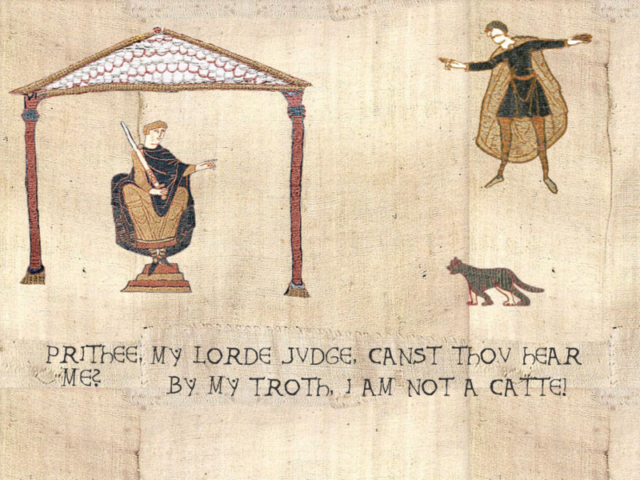
The Bayeux Zoom Session

It amused to make this.  Any reference to a recent viral Zoom video is intentional.  You can make your own here.

Sunday, February 7, 2021

Union Reinforcements from Perry Miniaures

I hope this finds you well!

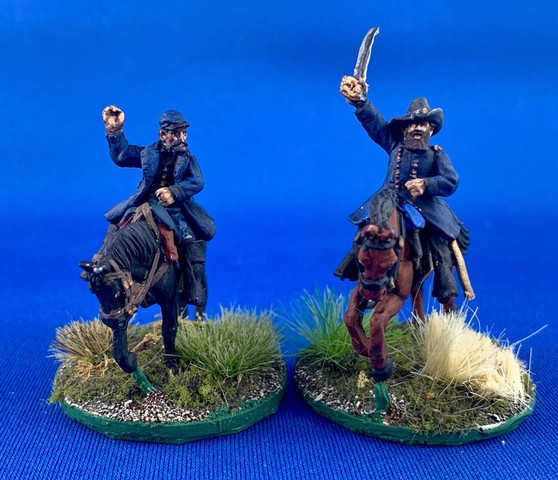
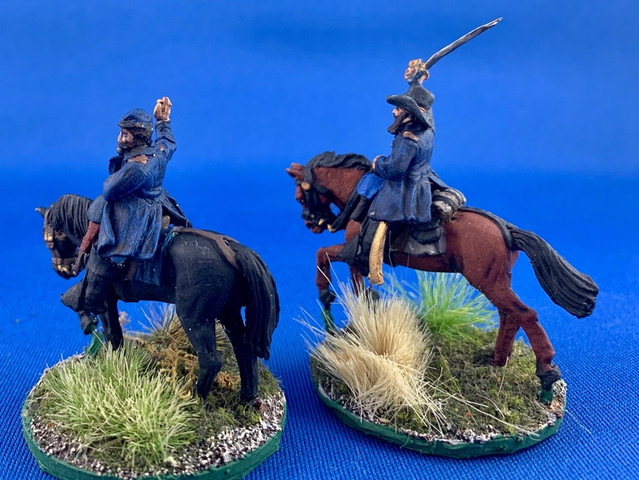
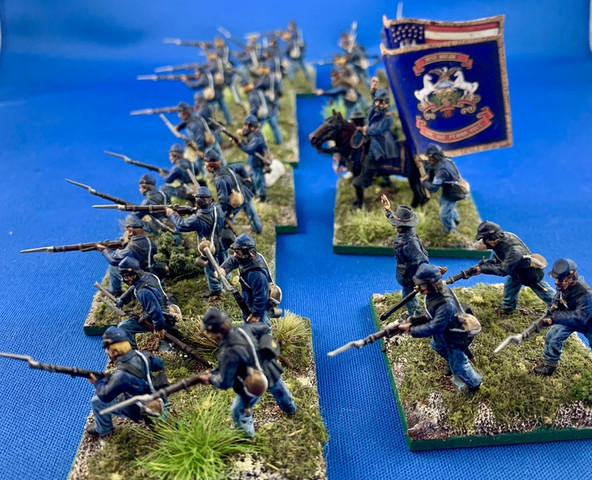
I dedicated most of my hobby time in January to finishing some American Civil War figures languishing in the Mad Padre’s painting chapel, including three lead mounted officers from Perry Miniatures.   Two are based separately for either Sharpe Practice or to use as Staff Officers in Pickett’s Charge, which I hope to revisit soon.

The third figure in the Perry set, a duplicate of the chap in the kepi with his hand raised, was pressed into service as the colonel of the newly raised 116th Pennsylvania Volunteers.

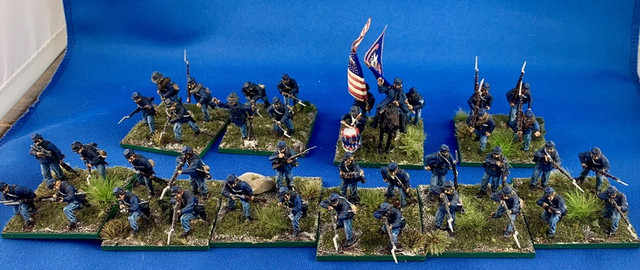
The foot figures are also Perry Miniatures, from their plastic box set, Union Infantry Skirmishing. I don’t like assembling plastic infantry as a rule, but ten bases worth of 28mm figures for about $1.25 Can a figure was a good incentive to stick with it.

The flags are by GMB.   I had them set aside for a someday purchase of a third regiment for the Irish Brigade - I was looking at the Steve Barber figures with the Irish Brigade heads, but the flags included in the Perry Box, for a US Regular regiment, didn’t work out, so …    I found the detail on these figures somewhat lacking, and could definitely have achieved a better result with lead figures, but as I said, cheap and cheerful.  I’d give this box set an A for economy and a B for detail.

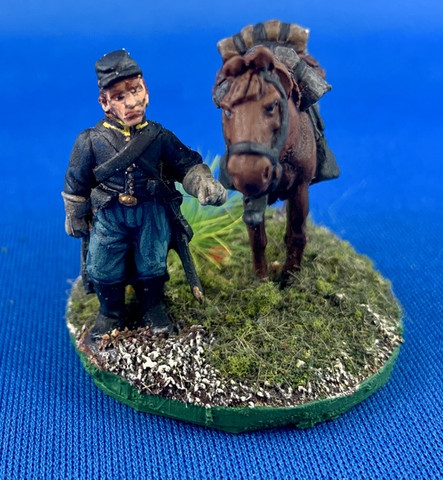
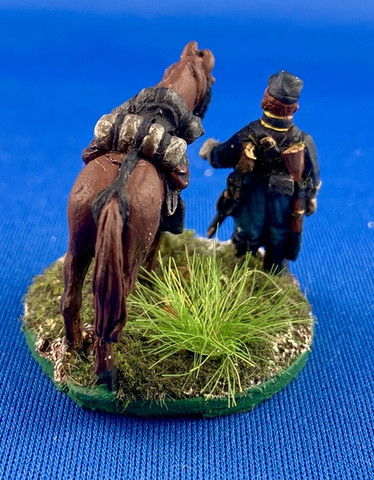
Finally, I had this Foundry Union cavalryman in my finished and orphaned box for a long time, so gave him the fourth horse from the Perry Union horseholders set.  

He makes a nice little vignette, maybe a deployment marker for Sharpe Practice.  

With all these figures added to the ranks, I should definitely put them all on the table and give the Pickett’s Charge rules another look.  Who knows, perhaps these troops will be deployed to the Canadian border.  I hear that there’s trouble brewing there.

Thanks for looking.  Blessings to your brushes!

MP+

Blog Archive

Followers