Friday, February 5, 2021

Raid On The Elven Woodland Realm: A Dragon Rampant Report

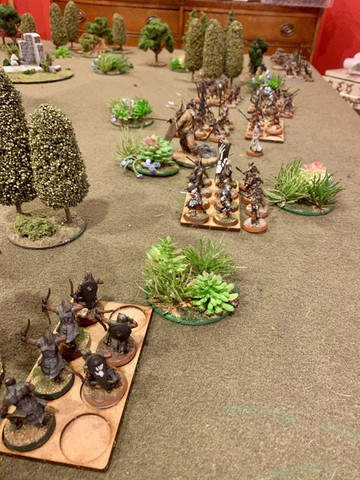
Not feeling up to some more complicated historical rules, much as I enjoy them on occasion, I wanted to get my fantasy collection on the table and give some new figures an outing.   Thus, the Wizard La Main Blanche rallied his unspeakable hordes and marched on the Elven Woodland Realm to pillage its magical mushrooms, or some such.   Orc army of about 60 its in Dragon Rampant terms, with an Elite Spellcaster and a heavily armoured troll (Great Warbeast).

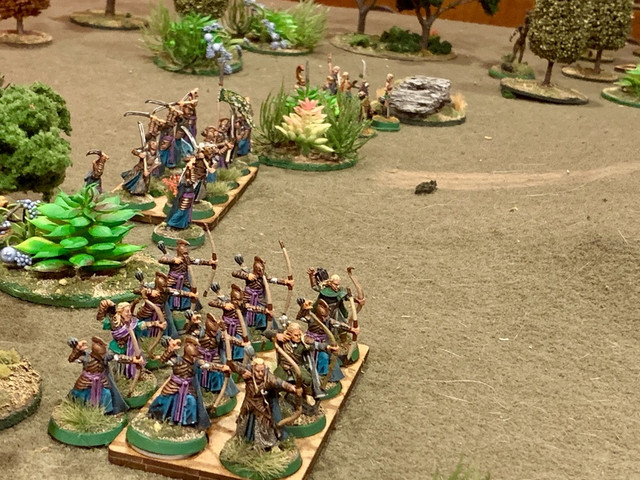
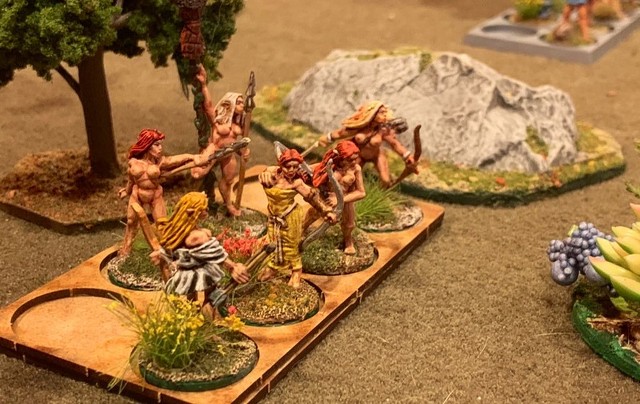
In the centre, the Lady of the Wood, also an Elite Spellcaster, places herself along with her best foot: heavy archers, heavy foot, and elite foot.  

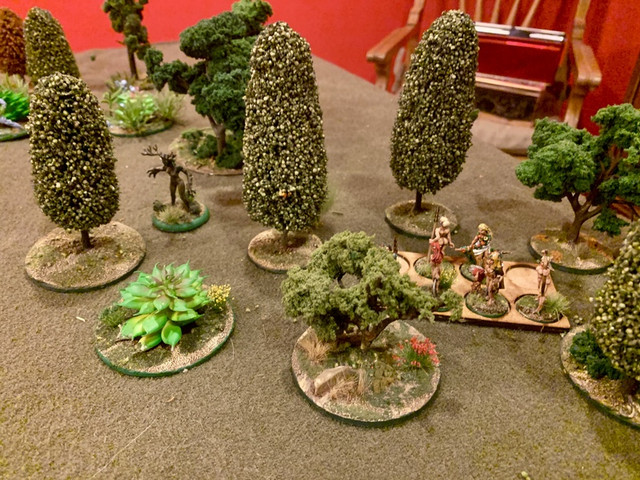
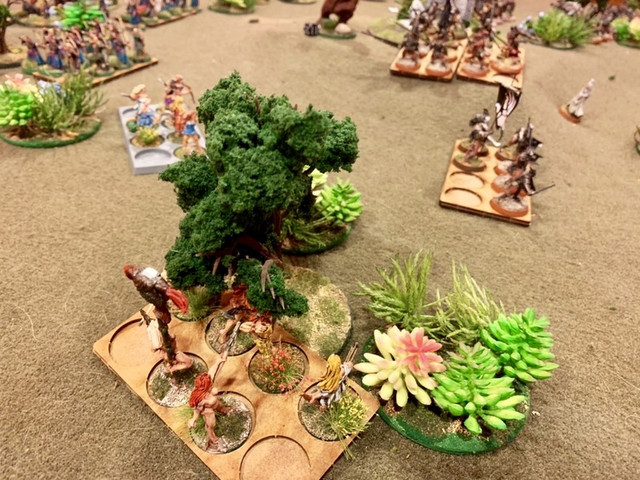
On her right, she places one of three units of Wood Nymph scouts and the Dryad Queen (Great Warbeast Cunning).  On her left, two more units of Nymph scouts and the Lord of the Bears (also Great Warbeast Cunning).  To reflect the home field advantage, I made the woods impassable to any Evil units except those with the Ranger ability.

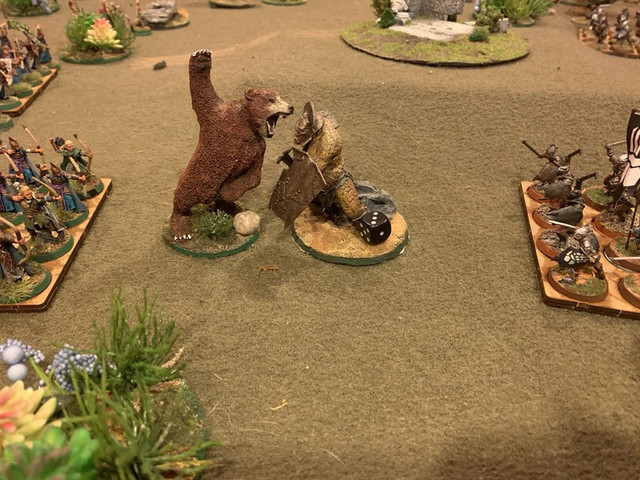
With only one leader one per side, I played the Initiative rules fairly strictly, so a lot of false starts, but in one good turn the entire army of the Wizard lurched forward.  On the Wizard’s left the Troll got off to a fast start and might have closed with and bashed the Elven Heavy Archers but for a missed initiative roll.   That gave the archers time to pepper him at close range and the Bear Lord closed to deliver some serious Bear Bashes/

Having smashed the Troll, the Bear Lord then decided that he wanted to pick his teeth with some orc swords.  With some favourable initiative rolls, he basically ran the table in the centre, smashing the orc foot unit by unit as they slowly made its way forward.

Elven nymph scouts on the flanks made life miserable for the advancing orc foot with their missile fire.

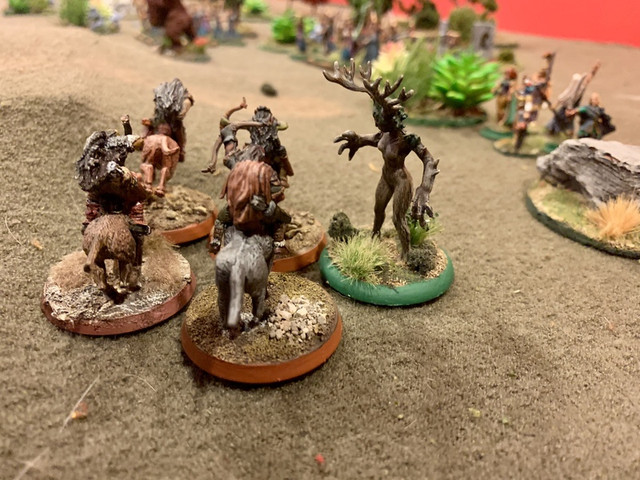
The Wizard’s wolf riders (Heavy Riders Missile) attempt to put pressure on the elf centre,  but the Dryad Queen has other ideas once the riders get within range of her Wild Charge.

As the Wizard’s right flank crumbles, the Nymphs begin to lap around the flank, and with the Wizard’s army now below 50% and the Elven Host barely scratched, I decided to call it a game.

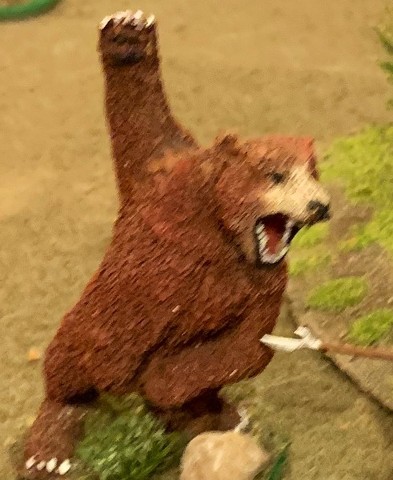
The star of the game.  This lovely resin model from Thistle and Rose miniatures really fits into the overall theme of my Elven army and did extremely well on its first outing. He will definitely get a pot of honey after the battle.


While I could have tried to remember the Oathmark rules, Dragon and Rampant was a perfect way to while away a snowy afternoon.  These remain my go-to rules for cheerful fantasy gaming.   

With the Wizard and his surviving host still at large, I am sure that the Elven Realm still faces greater threats.

Blessings to your die rolls!

MP+


Monday, February 1, 2021

Banner Blunder!

Good morning and happy February!   I hope this finds you and those you love well and healthy, and that we all get good news from the groundhog tomorrow (is there a COVID groundhog, I wonder?).   In January, my main effort at the Mad Padre’s painting chapel has been finishing a box of Perry Miniatures plastic Union Infantry Skirmishing.  They are finished and just waiting the final touches in the Basing Barracks before they muster into service, but I wanted to share a small tale of woe with you.

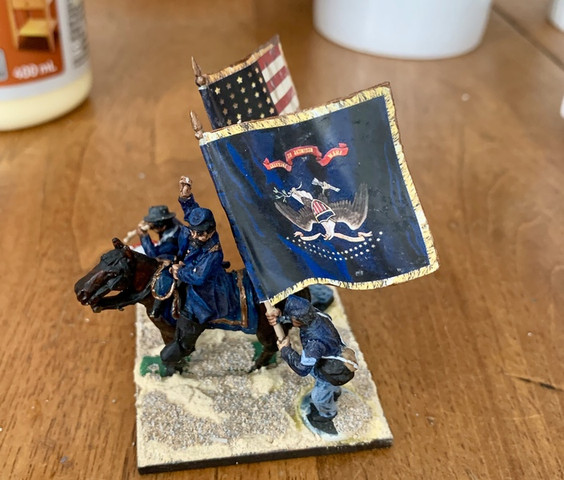
Notice anything wrong?

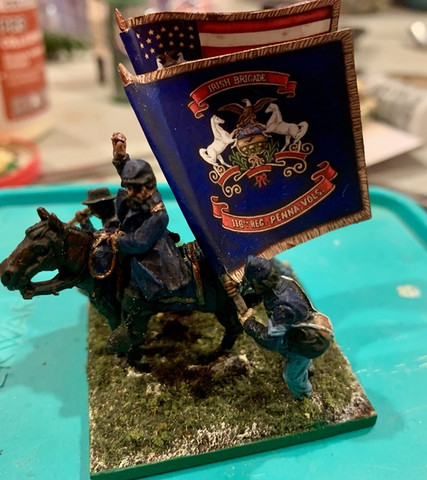
Probably shouldn’t have put the regimental banner on dark and early after only half a cup of coffee.   Looks like the Union is in trouble!   Good thing I got the national flag right.   A great pity, as these banners were included with the figures in the box, and the print and paper quality were sufficiently high that I was quite happy using them to make this a new unit of US Regulars.  Alas, trying to get the regimental flag off the pole intact proved impossible and it had to be sacrificed.

Fortunately I spoke to the War Department and we agreed to muster this unit into the Irish Brigade as the 116th PA, as I fortunately had the GMB Designs flag set for that unit in my stores.   This will allow me to bring the strength of the Brigade up to three regiments, which is quite respectable on a 28mm table.   Col. Meagher will be quite pleased.

Morale of the story, go slow and drink lots of coffee!   I won’t mention the slight damage I did to myself with a new Olfa blade when I finally decided to remove the old flag - that’s another story, but these chaps now march on a bloody battlefield.

Cheers and blessings,

MP+

Sunday, January 24, 2021

Revisiting a Hex and Counter Classic: Napoleon's Last Battles

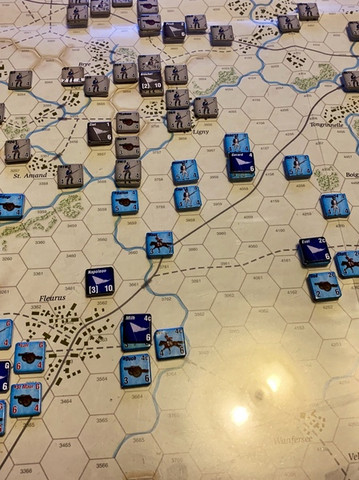
Back in 1976, in the heyday of disco, detente, high inflation, and my vain attempts to get Madeleine Bennett to notice me in Grade 6, Simulations Publications Inc.  published Napoleon’s Last Battles, one of the classic war-games systems.  It was designed by Kevin Zucker, one of the galaxy of talent that SPI’s Jim Dunnigan gathered around him like Napoleon and his marshals.    Kevin went on to found his own company, OSG, and is widely considered one of the authorities on Napoleonic board gaming today.

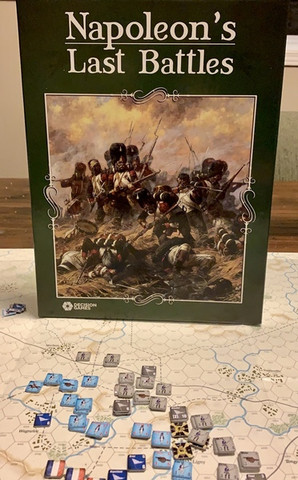
There is a great review of NLB, including photos of the original counter set, and a thoughtful appreciation of its impact on many subsequent titles, on the sadly inactive Map and Counters blog . on I bought the re-edition of NAB published by Decision Games, which picked up most of the old SPI titles after TSR acquired them.   NLB now comes in a shiny box with new artwork, and the original counters have been updated.  


The scale of NLB is operational, with individual counters representing brigades with combat and movement factors.   Optional rules allow for basic command and control; for example, Napoleon can only give orders to three divisional commanders in a turn if they are within his command range of five hexes, and the divisional commanders can only fully employ their units if they are within three hexes.  Combat is hex to hex, though artillery can add their combat factors if two hexes away.  Combat is a simple ratio worked out on a Results Table that only gets bloody if the odds are 4-1 or above, or 1-3 or below.   Otherwise units will safely retreat unless all possible retreat hexes are within the Zone of Control of an enemy unit.  Hex and counter gamers of a certain age will remember what being ZOCed is and why it is fatal.

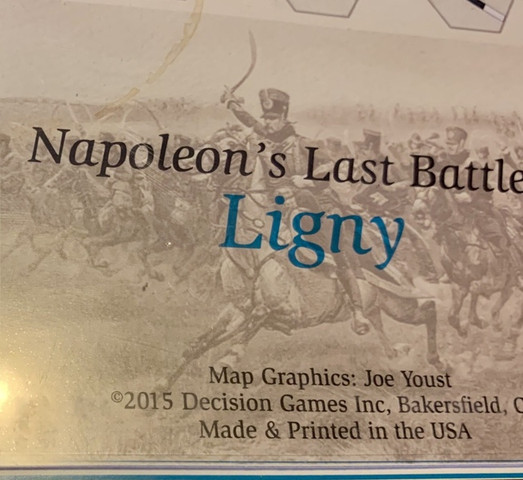
NLB comes with four games (it was the original SPI Quadrigame) of the Hundred Days: Ligny, Quatre Bras, Wavre and La Belle Alliance.  There are of course rules to play all four games as a campaign game.  

As time only permitted me to play one game, I chose Ligny. 

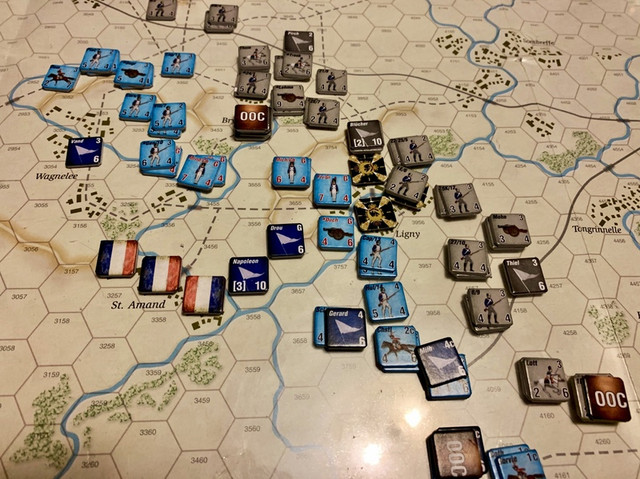
As in the battle, the French player only has six hours of daylight to inflict serious harm on Blucher’s three scattered corps.   The Prussian must hold with Zeiten’s and Pirch’s corps while bringing von Thielmann’s III corps to the rescue.

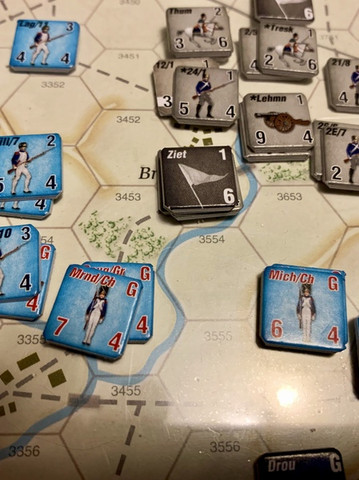
Alas for France, my first run-through did not go so well, as it took me too long to remember how to use ZOCs to my advantage.  At game’s end, Gerard’s Fourth Corps had suffered a mauling at the hands of Von Thielmann’s troops, while the Guard and Vandamme’s III Corps had taken Fleurus easily but were being forced out of Ligny proper.

Hero of the game:  Zieten, who held off Napoleon’s last big attack before twilight and who sent the Imperial Guard packing.  Prussian victory!

NLB is one of those simple game systems that remains fresh and interesting after fifty years, despite it’s new coat of paint in the Decision Games re-issue.  While it might seem dull because its woefully lacking in the chrome that we have since become accustomed to (although SPI’s monster Waterloo Game, Wellington’s Victory, also published in 1976, has all the complexity one could wish for), NAB does the job.  It presents an operational problem in sufficient detail to challenge the player, and delivers a clean result in a few hours, and works well enough as a solo game.  I would be delighted to play it against you on Vassal, if you care to.

 I’m very pleased to have it in my library and look forward to revisiting it again.

Blessings to your die rolls!

MP+

Saturday, January 16, 2021

Lovely Lysander

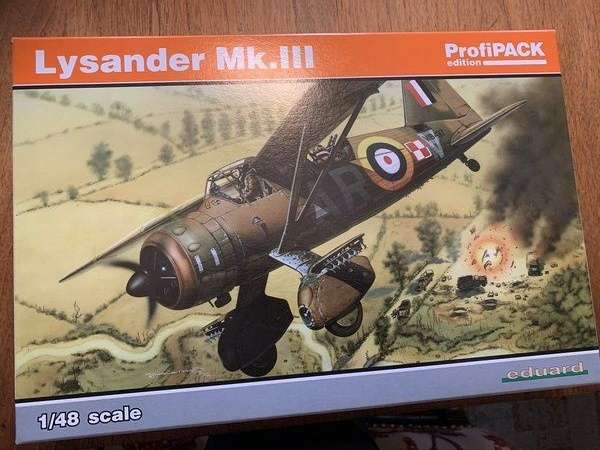
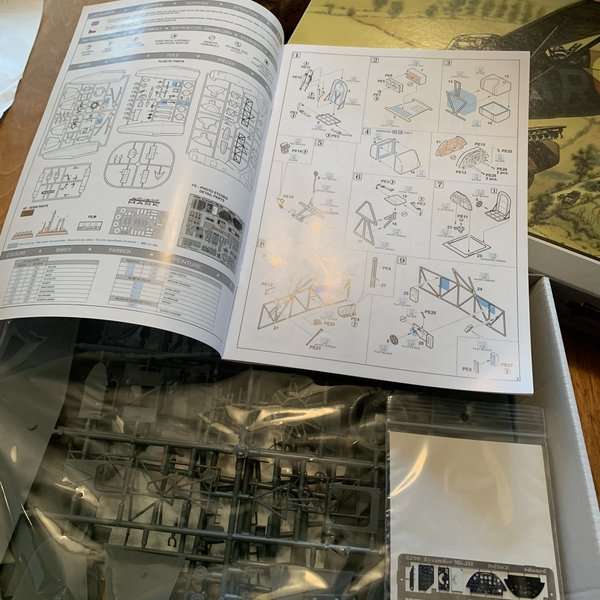
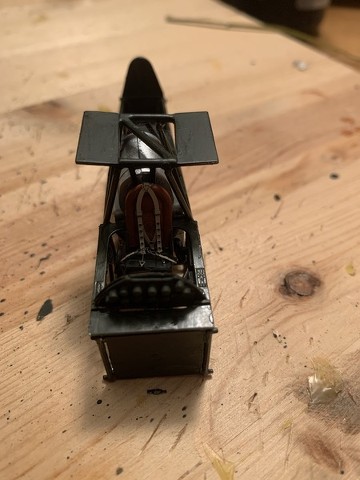
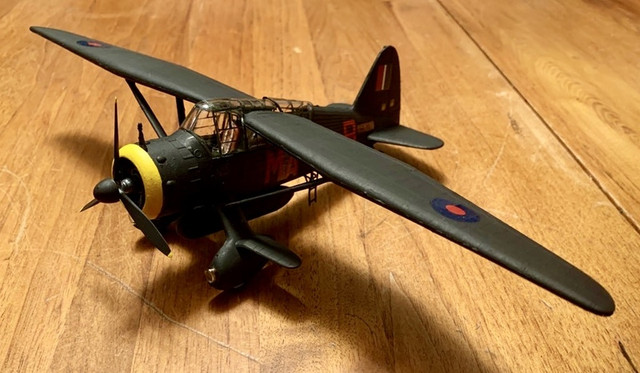
Good day!  Since this is my first post of 2021, I wish you a happy new year - may it be happier for all of us.  Over the Christmas holidays I started the traditional plastic model kit build - a 1/48 scale Lysander for my Weird War 2/ Pulp project.  I had opened the box back in the summer of 2020 and the myriad of small parts therein seemed more complicated than the time I had on hand would allow for.

The kit is by an eastern European company, Eduard, which I gather is a gold standard for WW2 games, though I found the instructions somewhat less helpful than I would have liked.

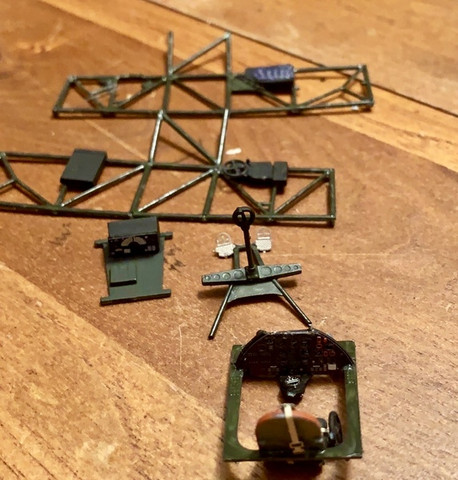
This time I kept my nerve and forged on, going as slowly as was necessary, as it required some nerve doing things like gluing the brass-etched parts like the foot pedals onto the cockpit assembly - totally unnecessary for gaming, but if you’re going to do a thing, do it well as my dad said when he vainly tried to teach me how to make the balsa wood airplanes he had made as a kid.

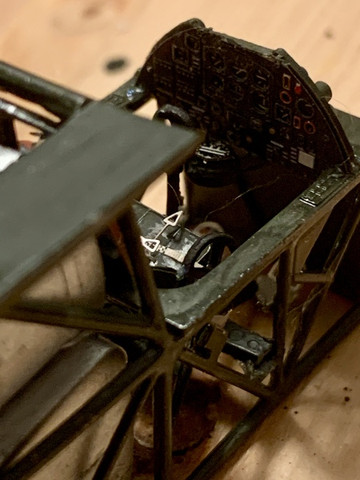
Brass-etched seatbelts, cockpit instrument panel, and pilot’s compass.

g

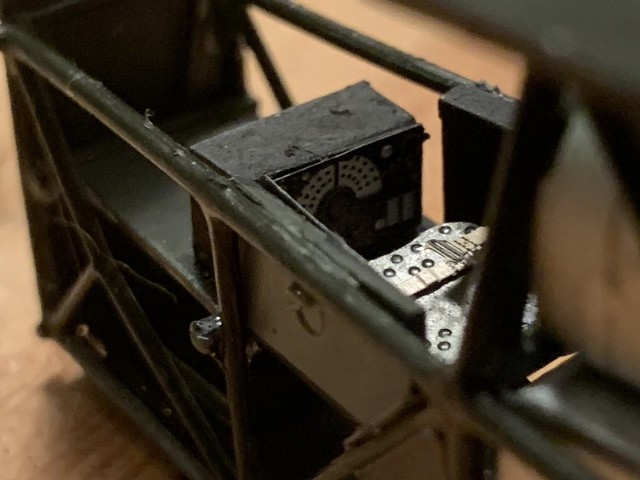
Wireless set.

The interior fuselage assembly complete.  I had a discouraging moment when I broke off the wing roots at the top of the frame with some  misapplied press from my clumsy fingers and had to re-glue them.

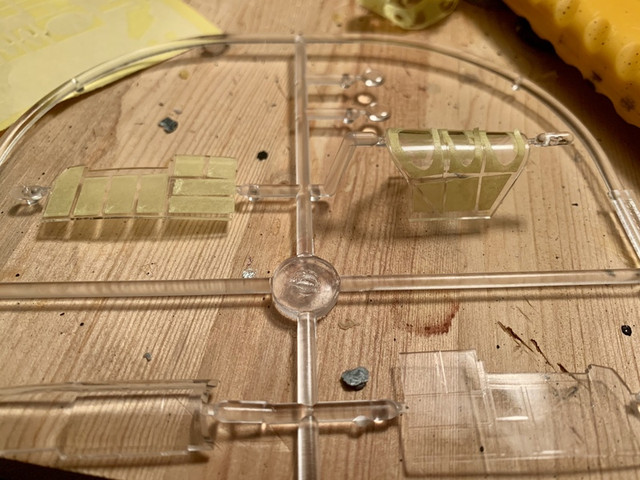
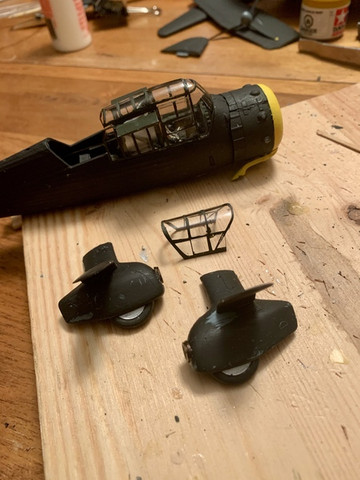
The Lysander has a huge canopy and the Eduard kit came with precut masking tape, which I had to carefully apply with my wife’s best tweezers.  That was fun.

The masking tape certainly helped the final product.

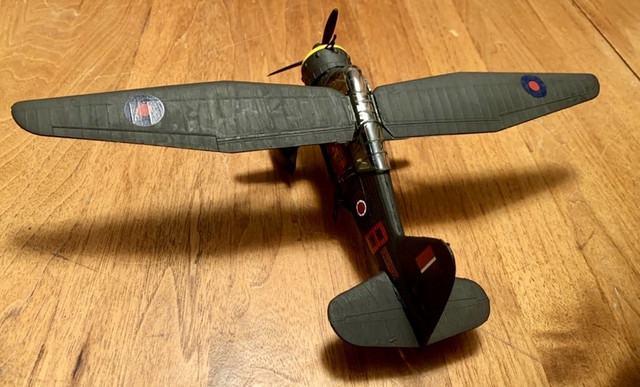
And finished!  Because of the gaming it might support, I chose the all-black paint scheme used by RAF 141 Squadron, which supported SOE operations in Occupied Europe.

 Those huge struts supporting the wings give the kit a lot of stability.   There is also an underslung fuel tank for greater range, and a ladder to help passengers enter and exit the aircraft.


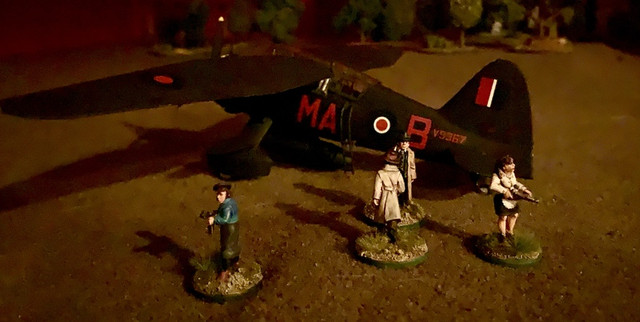
Somewhere in occupied France.  Yvette of Cafe Renee and Michelle of the Resistance keep watch as the RAF delivers something vital to the war effort.   

Thanks for reading.  Again, may 2021 bring happier lives and gaming to all of us.   Stay safe, and blessings to you brushes.

MP+

Thursday, December 31, 2020

Perry Brothers Miniatures Canadian Volunteer Cavalry for the American Civil War

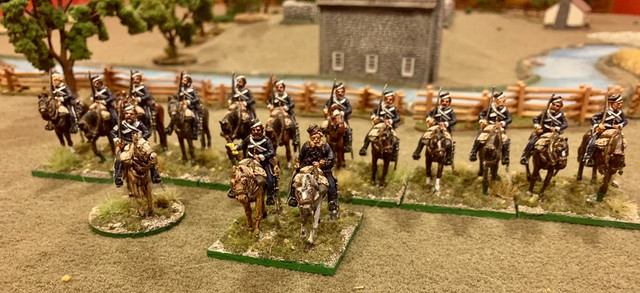
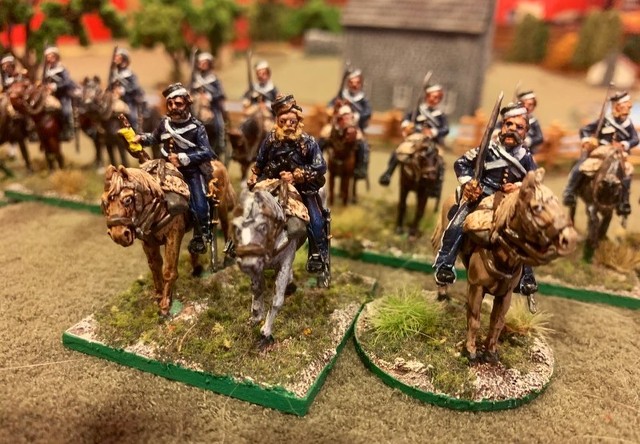
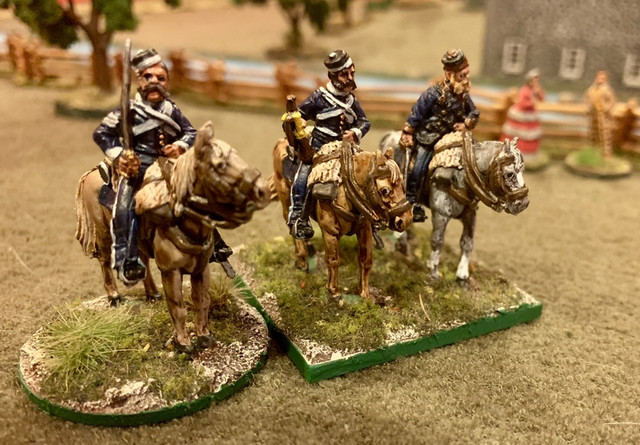
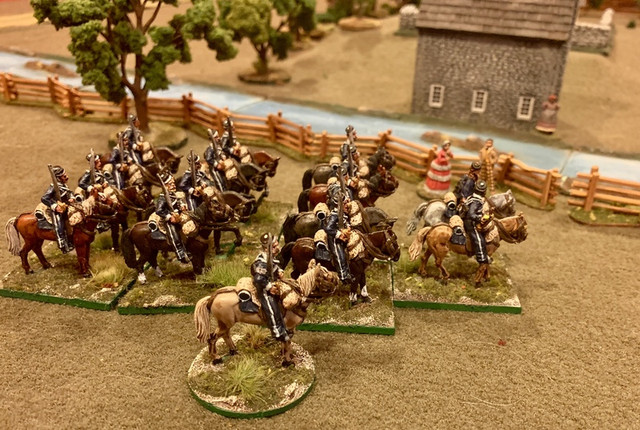
With four hours here in Ontario before the old year sees itself out, it seems like a good time to unveil my last completed project of the year.   Cracking on with my alt-ACW project, here are Perry Miniatures’ Canadian militia or volunteer cavalry from their British Intervention Force range.  The figures are product codes BIF 32 (Command) and BIF 34, standing with shouldered swords and stabled jackets.  I don’t know much about the organization and uniforms of the militia cavalry from this period.   There are some regiments in the Canadian Reserve Force, like the Governor General’s Horse Guards or the Queens’ York Rangers, that have pedigrees dating back to the  War of 1812, but I haven’t found much on their dress.  The uniform is my guess from one of the plates in the Osprey Book, Canadian Campaigns 1860-1870 - blue with white piping.  I have the figures for another regiment so I may do it in blue with yellow piping, just for contrast.

 Sadly they don’t have a guidon bearer, though I have no idea where to source the appropriate flag or whether British cavalry units typically carried flags of any sort.  The Sergeant is single based, for use as a leader in Sharpe Practice.

 If they were anything like most Canadian militia units of the period, these fellows would most likely be gentlemen and more prosperous farmers, able to afford the horse and uniforms, hoping to impress the ladies, and probably not trained to anything near a professional standard.  Put them in the field against a trained Union cavalry unit of the 1862-63 era, and I think they’d be eaten for lunch.  You may have noticed that none of the figures are sculpted with carbines.   Again, I have no idea if carbines were issued to British cavalry of the mid-Victorian period, but having seen what Sharp breechloaders can do in my previous post, I would fear for these figures on a battlefield.  I suspect they would be employed mostly for scouting and as line of communications troops once the British Army began arriving in Canada en masse.


 On weekend training, impressing the locals.

2020 saw me make a decent start on this project.  There are at least as many unpainted figures to go as you see here, so that will be a steady focus of 2021, and hopefully some battles to follow. 

With that, I bid 2020 a less than fond adieu.   Joy and I were blessed with good health, and unlike many, we were fortunate enough to remain mostly sheltered in comfort, wanting for nothing, so we refuse to moan about our lot.  I missed friends and gaming in person, and I hope to see some of that resume in 2021.   May the New Year treat you and your loved ones more kindly.

Blessings from the Mad Padre’s Painting Chapel.

MP+

Wednesday, December 30, 2020

Skirmish at Hickory Farm: An ACW Sharpe Practice Battle Report

 Relocating my gaming table to a roomier part of the basement has given me an incentive to get out my ACW figures, revisit Too Fat Lardies’ Sharpe Practice, and throw some dice.  I especially wanted to give my small but growing cavalry some love. The descriptions were written while I tweeted the game using my @MarshalLuigi account.  The table was randomly set up by placing a random selection of Terrain Cards from Sam Mustafa’s Longstreet rules in 12 sections of the table.

Tennessee, 1862. Captain Morrison O’Harnett, commanding C Company, 15th Illinois Cavalry, is ordered to scout a farm along a road designated for a divisional advance the next day. He has four troops of cavalry rated as Dragoons in Sharpe Practice terms.
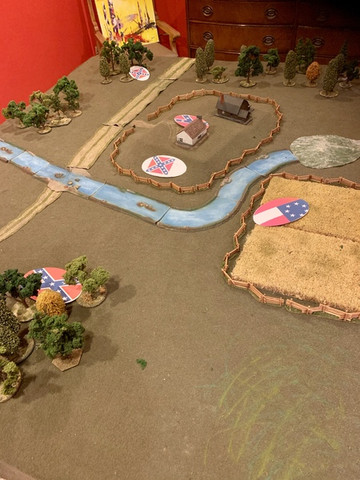
 O’Harnett orders Lt. Thaddeus (Tad) MacQuarrie to take two dismounted troops and scout the woods on either side of the road approaching the farm. Tad takes one side and orders Sgt Esau Landiss to take the other side.
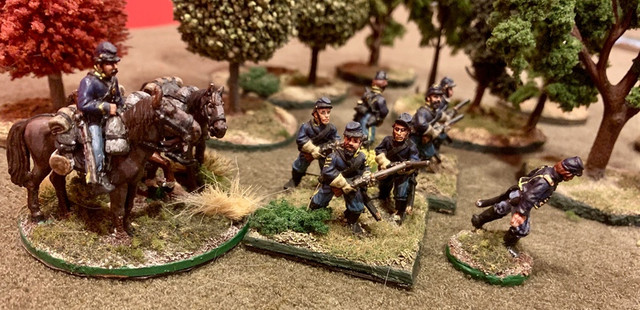
 O’Harnett keeps his other two troops in the saddle, ready to move forward as required. (Tables I wrote to make it interesting).
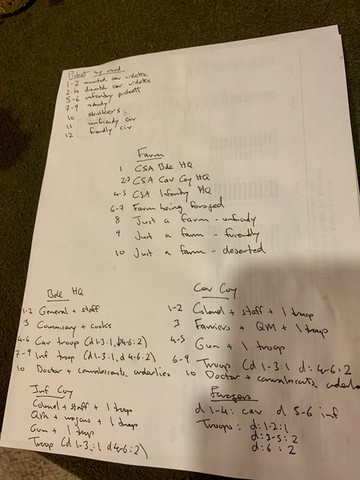
Sgt Landiss and his men warily approach what looks like a campsite in the woods south of the road but the die roll says nobody. Just an old fire pit and some junk. There are no Rebs in the wood. Perhaps pickets went off to a neighbouring farm to beg some hot johnnie cakes, but it’s a lucky break for the Union.
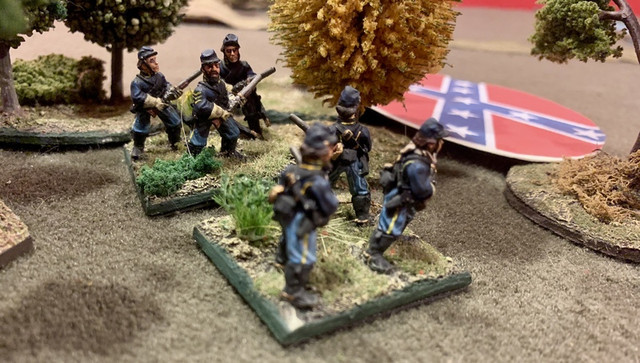


Lt. MacQuarrie now has two dismounted troops in the woods with a good view of the farm. He pulls out his spyglass to have a look see. The Lt. whistles softly. He sees a troop of cavalry being watered in the stream by the field, while at the farm he sees some wagons, and comfortable looking men in nice uniforms lounging with cigars. “Confound me if that’s not a headquarters of some sort!”

Lt. MacQuarrie reports the situation to Capt. O’Harnett. “Not a lot of Johnnies, and they all seem free and easy. Reckon we could ride in and scoop them up pretty neatly.” The Captain strokes his luxuriant moustache thoughtfully for a moment.
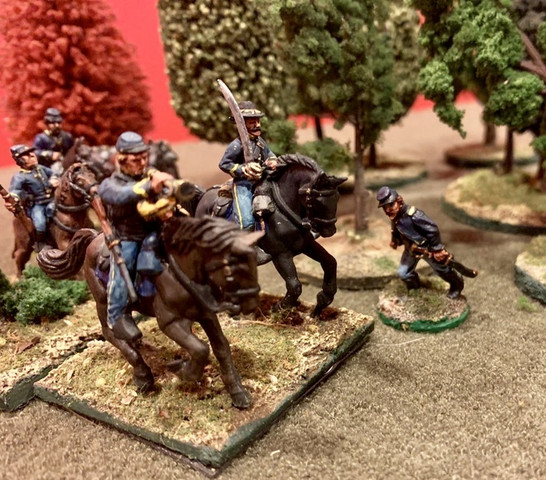
 

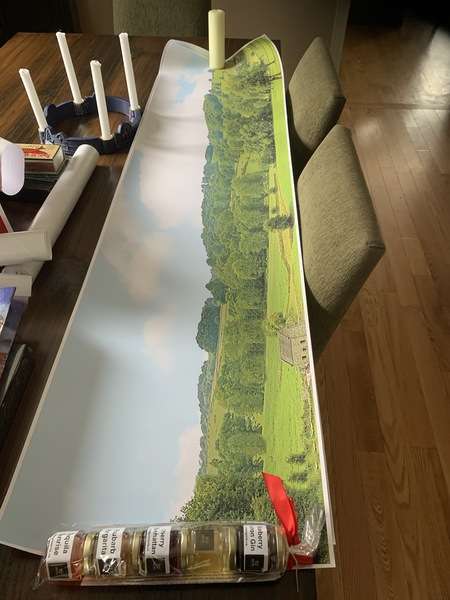
 So, quick aside, you’ve probably noticed the red paint on the walls (very 1990s!) which makes the battle look like an old set from the original Star Trek.  Santa gave me some model railroad backdrops which will get set up in due course.
 

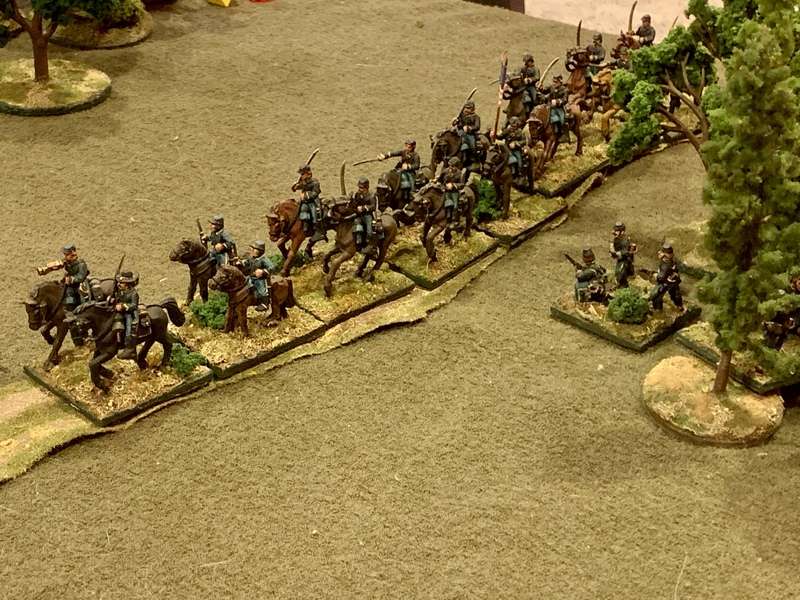
Capt. O’Harnett decides it would be a fine thing to bag a rebel HQ and orders two mounted groups forward in formation at the canter. They come into the table and move briskly down the road towards the ford.
 Sgt. Landiss and his dismounted group open a brisk fire with their cavalry carbines on the rebel troopers watering their horses, but score no hits.
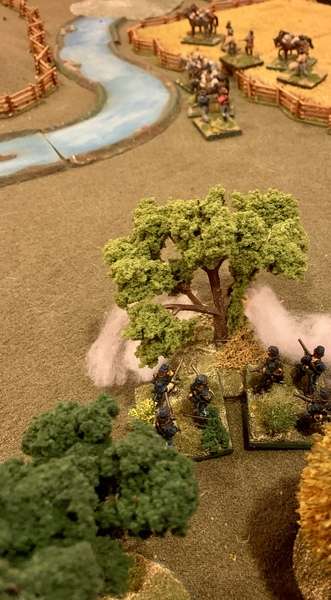
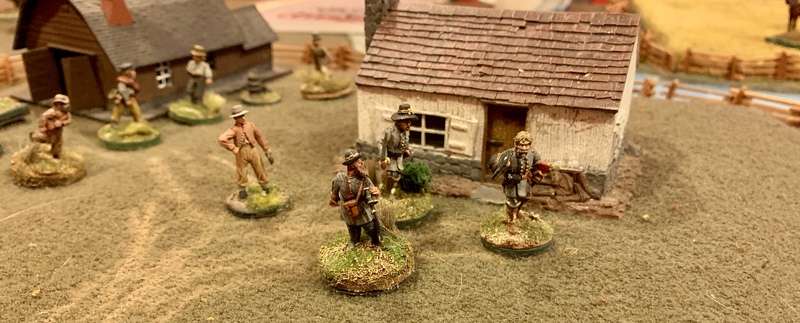
At the farm, Colonel Robert Thoroughgood, 14th Mississippi Cavalry, is enjoying a cheroot when he hears the carbines and sees the Yankees hove into view. “Damn their eyes, what are my confounded pickets doing, letting them fellows so close?”
 

 Sgt Alonso Harker of the 14th MS Cav and his men were lounging about, playing cards and cooking. He starts getting his group into their saddles.
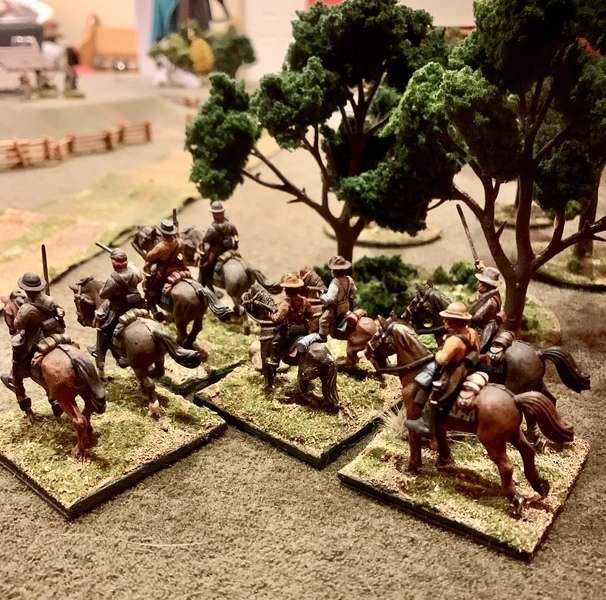
 Capt O’Harnett has four command chits and uses them to give his formation of two mounted groups a bonus move. They lose their canter bonus while crossing the ford but are in a good position to burst into the farm before the rebs can react.
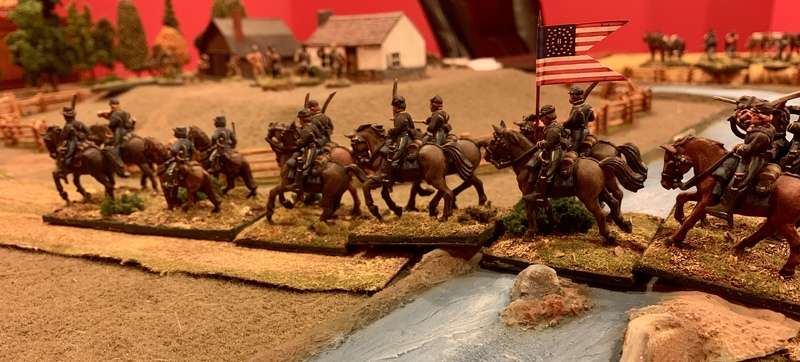


Sgt Landiss’ Yank troopers get to shoot again. I realize that with their breech loading carbines, in #SharpePractice they don’t spend an action reloading, so they get two shots each. Two pts shock on the Rev troopers who are frantically looking for saddles, tack and weapons.

On the receiving end of this fire, Sgt Lucius Biggs is a man with a plan. He uses the two rebel command chits in play to boost his Initiative to three, rallying away the shock, getting the horses back, and shoving his men into a firing line at the fence.
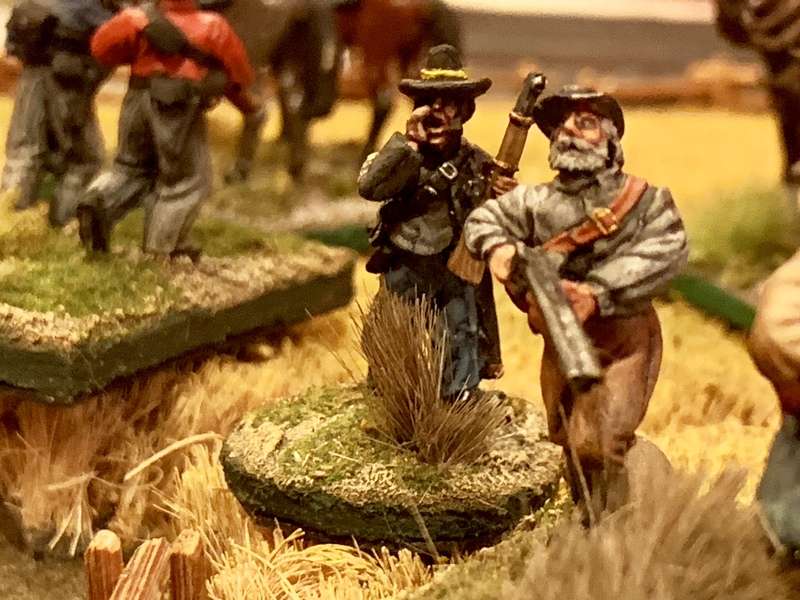
 

 O’Harnett’s column rides like thunder and turns into the farmyard while the rebel headquarters staff are highly confused. Finally the reb Colonel gets his chit and does the only sensible thing, ordering his men into the farmhouse and barn.
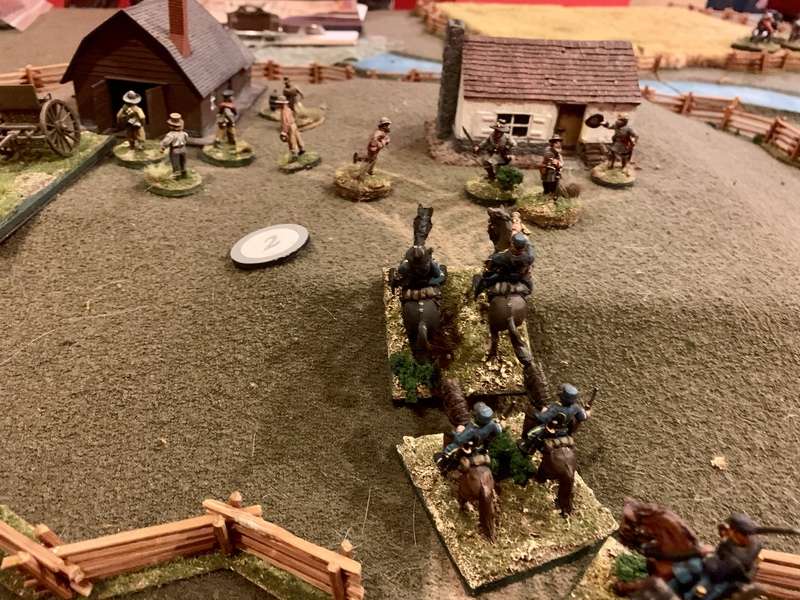
 Sgt Alonso Harker urges his men forward at the canter. “C’mon boys, let’s go pull the Colonel’s bacon out of the fire and maybe he’ll share some of his corn liquor!”
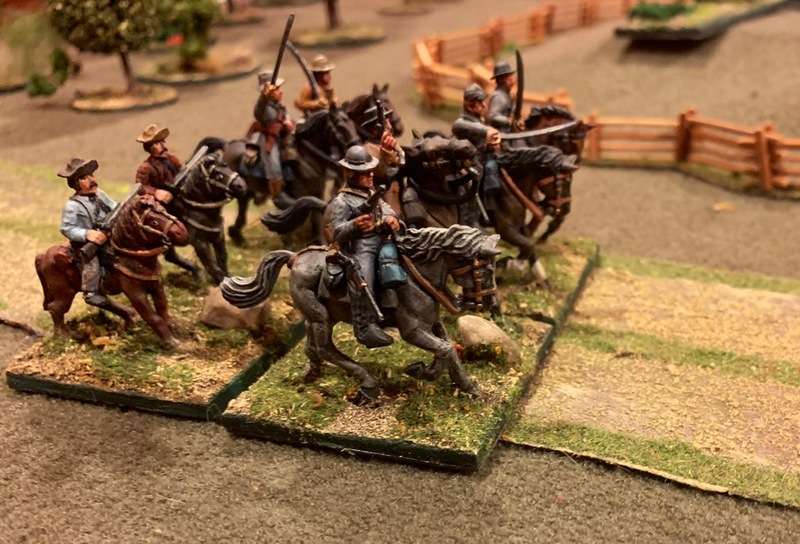
 Captain O’Harnett decides that it would foolish to ride around the buildings as targets. He spends his turn ordering the lead group to dismount and detaches his second group to face the one group of rebel cavalry that pose a threat.
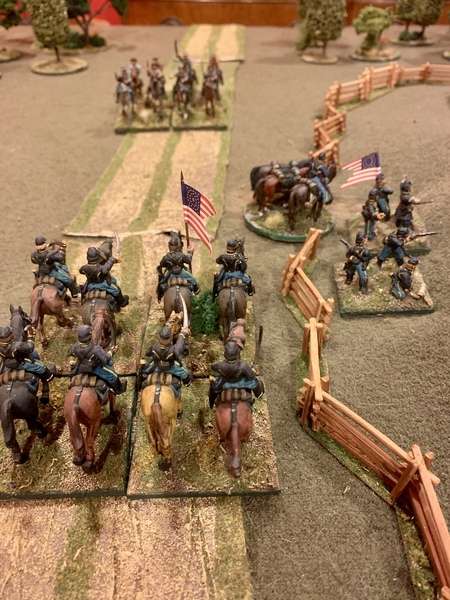
Lt. MacQuarrie’s dismounted troopers fire at Sgt. Harker’s advancing horsemen, causing too points of shock. “Cmon boys, they can’t shoot! At the gallop!” Harker’s Mississippians crash into the group of Illinois cavalry, who surprisingly hold firm.
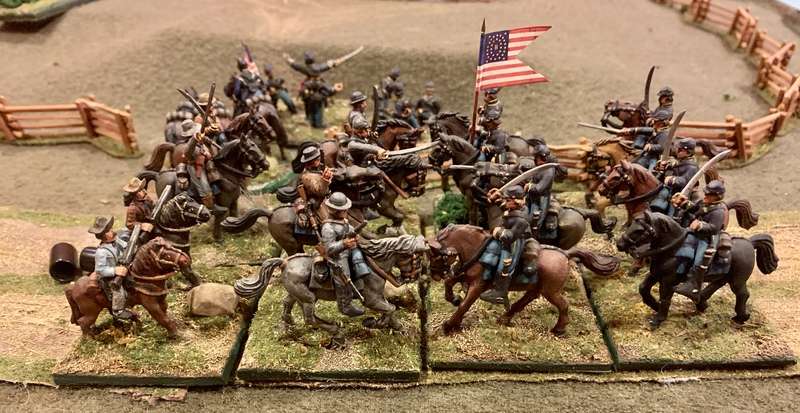
 In two rounds of Fisticuffs, they hold their own. Both groups lose four figures, but the rebs fall back when their Shock goes to 5.
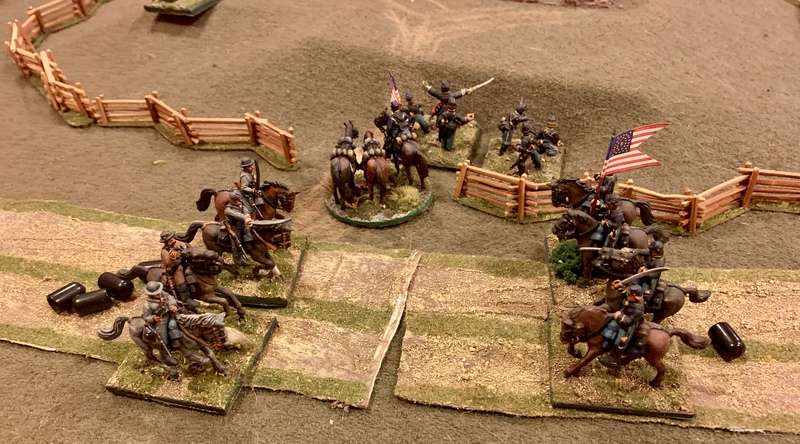
 Col. Thoroughgood and three of his staff officers fire ineffectually at longer range with their revolvers. It was probably a bad plan that all four officers ran into the house and a group of leaderless troopers ran into the barn. A random event (3 command chits drawn in a row) mean that the reb troopers in the barn panic their mounts when they start shooting with their carbines. The horses spook and run around the barn, causing chaos.

Capt O’Halloran’s six troopers pepper the farmhouse with their Sharps carbines, killing Major Wood, the 14th Mississippi’s adjutant, as he peers out the window 
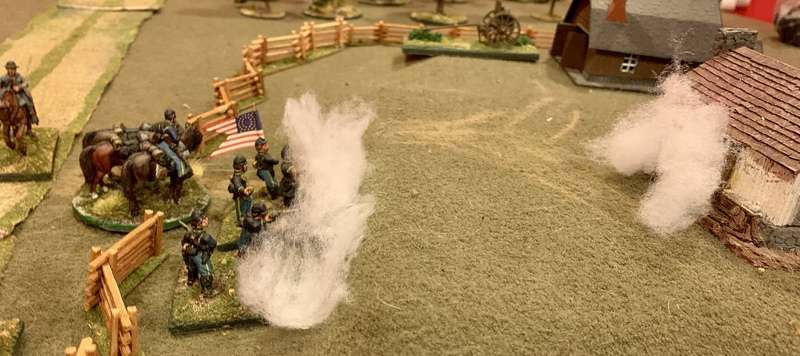
Chaplain Windman and Quartermaster Murray trade shots with the dismounted US troopers. Their revolvers vs Sharp breachloading carbines aren’t a fair fight, but they distract enough that Col. Thoroughgood can sprint across the farmyard. Thoroughgood runs like the wind (double 6es on his movement roll) and dives through the barn door in a hail of bullets, which kill two of the rebel troopers covering him. The Yankee fire on the farm is viciously effective. 
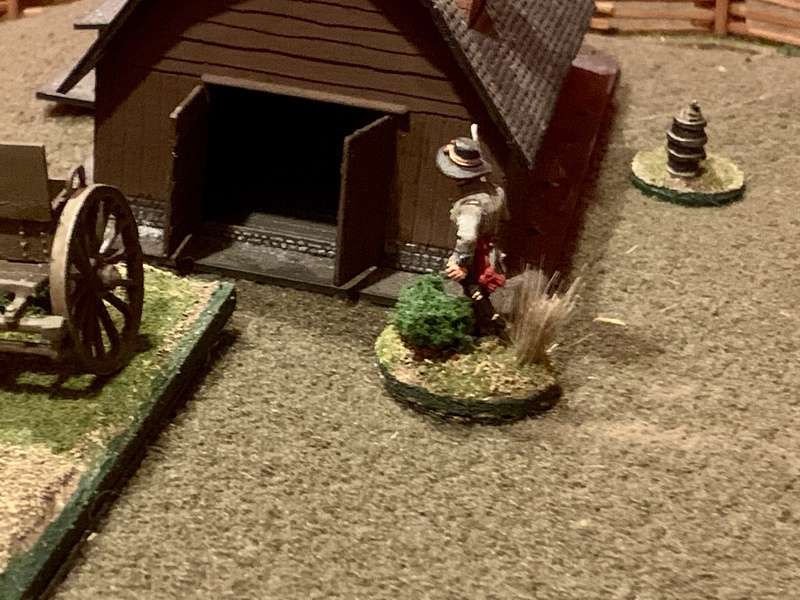
Captain O’Harnett dismounts his remaining four troopers and has them join his firing line. The surviving Mississippi horse are retiring and no immediate threat. Lt MacQuarrie is bringing his group up to provide flank cover for the assault on the farm.

In the barn, Thoroughgood watches as another fusillade of Yankee gunfire shreds the farmhouse. The remaining two defenders, Chaplain Windman and QM Murray, both go down in the hail of carbine fire. “Boys, if we stay here, we die. Mount up and get ready to ride like hell”.
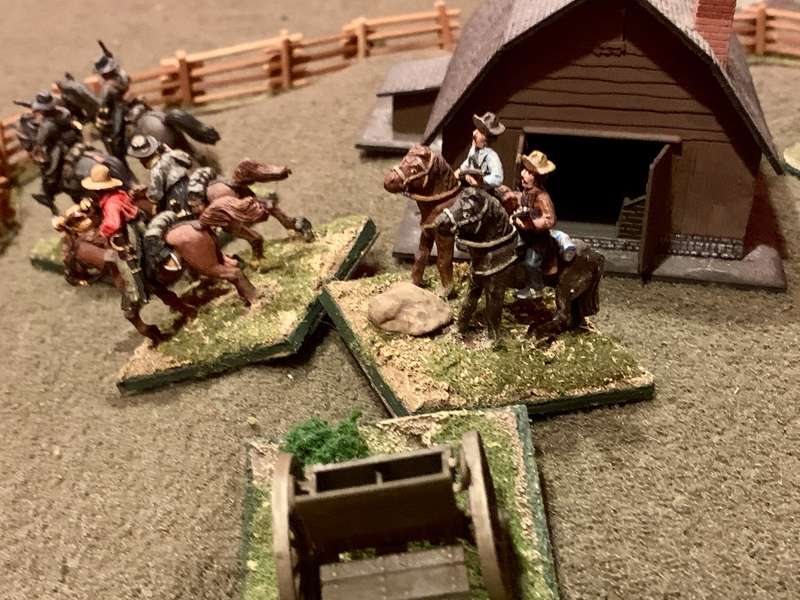
Thoroughgood and his six surviving troopers catch the Yanks off guard and are mostly able to escape. Sharps carbines bring down the rear two troopers, but Thoroughgood and his men leap the fence and escape into the woods.
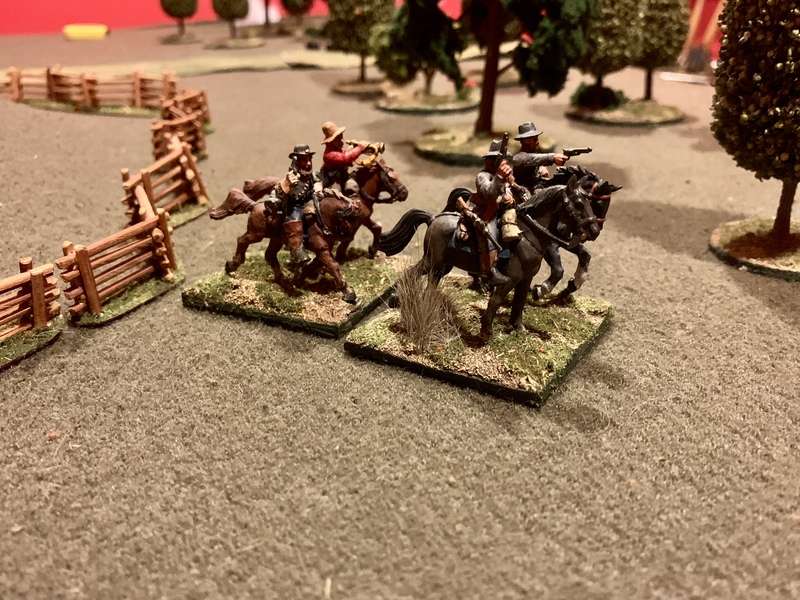
 Meanwhile, in the meadow by the stream, Sgt Biggs is trading shots with the Yanks in the woods. Unfortunately a random effect means that an eager trooper discharged his carbine into the Sergeant’s left buttock. Cursing, he is hauled away by his troopers as they break contact.

This concludes the fight for Hickory Farm. Inside the bloody farmhouse, Captain O’Harnett finds papers and maps giving rebel dispositions in the region. His colonel will be pleased. The Illinoisian troopers are equally happy to have captured Col. Thoroughgood’s liquor and cigars.

 It was fun to get out Sharpe Practice and reacquaint myself with the rules. A randomly generated table and some chance dispositions at the start made an interesting game for my available cavalry figures. The US were lucky to gain surprise and exploited it well, while the rebels never really got off their back foot. One lesson is that breechloading weapons are a huge advantage in a firefight as, unlike muzzleloaders, it doesn’t take an action to reload them. US cavalry can thus be quite fearsome when dismounted, and this advantage could be reasonably offset by giving the CSA superior numbers.

Maybe we will see some of these characters in another skirmish. Cheers and thanks for reading.

Blessings to your die rolls!

MP+


Monday, December 28, 2020

More Murch Pulp Progress

As the year winds down, I’ve been finishing some small and large batches of figures.

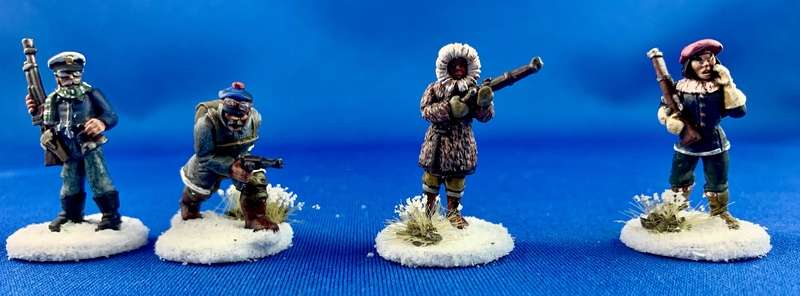
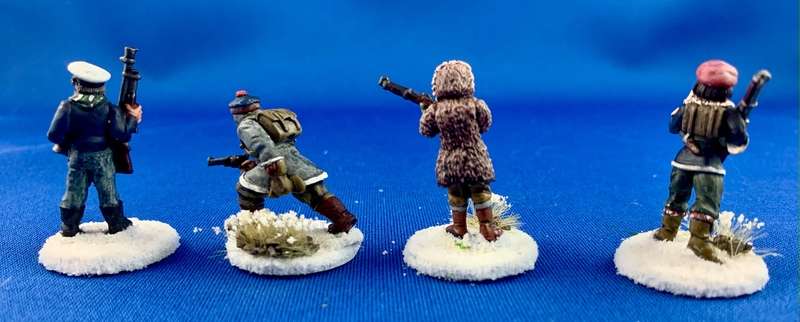
Here are four more heroes of the north for my Rockies Ablaze project from Bob Murch’s Pulp Figures range.   I haven’t had time to think up names and backstories for them yet, but I am sure they will come to life soon.  


As faithful readers of this blog know, I love me a Murch figure.   


Early in 2020 I plan to get my Murch Zeppelin Troopers on the bench and do them in one big batch, after which things will undoubtedly heat up.

Cheers and blessings to your bushes!

MP+


Blog Archive

Followers