Tuesday, February 16, 2021

Living With A Paradox: Thoughts On Wargaming and Ethics in Light of Jay Arnold's Recent Veteran Wargamer Podcast

Ethics in wargaming isn’t a new topic.  I’m old enough to remember the arguments in the 1970s and 1980s in the hex and counter community about games such as Squad Leader fetishizing the SS with black counters and special “super-soldier” abilities.   So while it covered well-trodden ground, there were three things that made Jay Arnold’s Wargaming Ethics Roundtable podcast and panel discussion interesting and refreshing.

First, the podcast was a conversation rather than a debate.  Rather than framing it as an argument with those who might say “this is all a game, why are you ruining our fun by taking it so seriously and being so judgey?”, a conversation that Annie Norman of Bad Squiddo Games said she has had her fill of, the tone was thoughtful and respectful.   All the participants agreed that this tone should be the quality we take around our gaming tables.   Admittedly there might be some people who reveal their true colours (eg, wearing a “Adolf Hitler European Tour, 1939-45” concert style shirt) and who thus might be best avoided, there are issues that we could raise in friendly, conversational, and non-accusatory fashion, so thanks to the participants for modelling that tone in their discourse.

Second, the participants addressed the question of the representation of suffering which can be the elephant in the room for wargamers, so I was grateful for their honesty.   William Tecumseh Sherman wrote to a friend that  “ I am tired & sick of war. Its glory is all moonshine. Even success, the most brilliant is over dead and mangled bodies”.  Like Jay Arnold I served in the military, and as a chaplain I’ve tried to help others with moral, physical, and psychological wounds.   I’m an avid student of military history.  I have, or should have, no illusions.  Yet here I am, with painted and cardboard armies of many periods in my house.  My collections include casualty figures, which Jay’s guests confessed some discomfort with.  So what’s my excuse for persisting in this hobby?

Dr. Samuel Johnson once said that "Every man thinks meanly of himself for not having been a soldier, or not having been at sea."  He was, I think, pointing at the mystique of the profession of arms, its celebration of heroism, gallantry, and self-sacrifice, the glamour of the dress uniform, that encourages many today into the phenomenon of “stolen valour”.   That mystique has waxed and waned over the centuries, but it persists.  I grew up in an Army family, with a decorated veteran father who was sparing with his love but still inspired me and some of my brothers to become soldiers.    The paintings of a Lady Butler or Don Troiani, like our favourite war movies, capture the aesthetic of war, even while antiwar movies (Paths of Glory), novels (The Good Soldier Schweik) and art (Dali, Dix) are difficult to ignore.    I think it’s fair to say that wargamers are under the spell of the aesthetic of war, even while knowing at some conscious level that it is a species of enchantment. 

For example, I can look at a photo of a dreadnought of the Great War, at speed and guns blazing, and find it inspiring, even beautiful, while knowing something of what a fourteen inch shell could do when bursting in a confined space, or how the money spent on these behemoths could have benefitted millions of slum-dwellers.  Every glamorous image has its shadow side.  All this to say that I would happily play a dreadnought game, knowing (in order of active cognition at the time) first that it is a game, second that it might teach me something about history, and thirdly knowing something of the reality underlying the game.  That’s the best I can do with the issue of the representation of suffering.

Third, I’m grateful to the participants for their focus on who we represent.  Their conversation touched on issues of race, gender, and how history is far more complex than it is in our representations.  For example, a Crusader army would have included soldiers from what we would today call the Middle Eastern countries, so why paint all Crusaders as Caucasians?   We might do so because if you’re like me, your default flesh tone is Citadel’s Cadian flesh, but that doesn’t have to be the case.   Why is representation important, and not just a kneejerk response to trendy diversity requirements?  Because many of our games lend themselves to narratives of race war with an overlay of civilization versus barbarism.  My blonde elves and Rohirrim resisting tides of dark skinned monsters may just be an innocent fantasy trope, but it too has its shadow side.

I will never forgot trying to get my wife to watch the “Men of Harlech” scene from Zulu, a film beloved of wargamers.  To my horror, all she saw was white soldiers mowing down black men.  “I could have lived the rest of my life without ever watching that”, was all she said.   That was a shock, but it reminded me that what to us are gallant episodes from Queen Victoria’s Little Wars just look like colonial massacres to others.   Jay’s guests didn’t have a solution to this, and certainly didn’t advocate the cancellation of colonial gaming.   However, they did suggest that we at least think about the common practice of recycling native figures to sustain the game, and what it represents, or to educate ourselves and others about the complexity of indigenous cultures in order to tamp down the “civilization vs barbarism” narrative.  These battles are more imbalances of technology than they are of civilization.  As Hillaire Belloc mordantly noted, “Whatever happens, we have got / the Maxim gun, and they have not”.  A little more self-awareness along these lines is all that the panelists were asking of us.

A final thought about who we represent.  When I was an American Civil War reenactor, I belonged to a group that usually portrayed Federal infantry, and I was okay with that, because they were the good guys.   When I went down south to American events, the Confederate reenactors grew more and more numerous and were often very political.  You would see bumper stickers in the event parking lots with slogans such as “North 1, South 0: Half Time”.  I didn’t want any part of that, but once, I was persuaded to don gray and go to an event as a Rebel.   I’ll never forget passing by a group of African American reenactors portraying US Coloured Troops, and how I felt a moment of visceral shame to be marching under the Confederate battle flag.  I couldn’t divorce the politics and history of the present from the history we were supposedly bringing to life.   That being said, the Civil War is a passion of mine, and I have a large and growing collection of figures, including numerous CSA regiments, because I game solo usually, and for that you need both sides.  If I was at an event, where I met a fellow with a tooled up Confederate army, wearing a grey kepi and a Robert E Lee t-shirt, I would at the very least want to have a respectful conversation with him about who he was representing and why.  Hopefully it would be educational, and not confrontational.  

As I bring this to a close, I am aware that I have just laid out a game about RAF night bombers flying over the Third Reich, and I’m also aware that the anniversary of the bombing of Dresden occurred quite recently.   There is a terrible paradox there, and as I write these lines, I realize that I don’t want to solve the paradox one way or another.  I acknowledge the incredible bravery of those young men who flew for Bomber Command, as well as the reality of what their actions did to those living in or near their targets.   I love the lines of a Lancaster bomber while I’m haunted by the photos of gutted German cities.  Perhaps all I can do as a wargamer is to live with that tension.

Thanks for reading.  I'd love to read your own thoughts.

MP+


Saturday, February 13, 2021

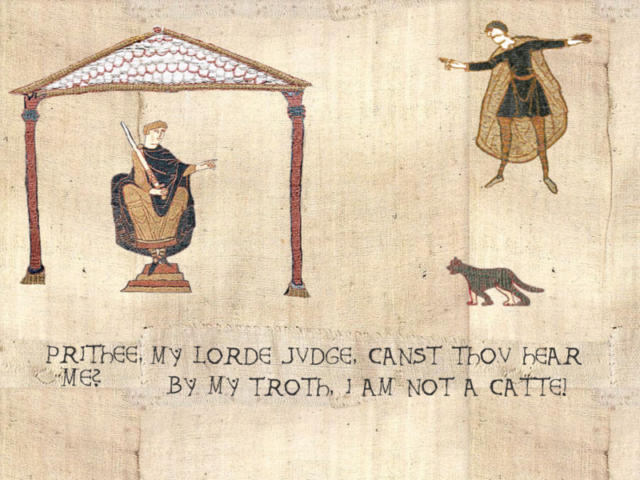
The Bayeux Zoom Session

It amused to make this.  Any reference to a recent viral Zoom video is intentional.  You can make your own here.

Sunday, February 7, 2021

Union Reinforcements from Perry Miniaures

I hope this finds you well!

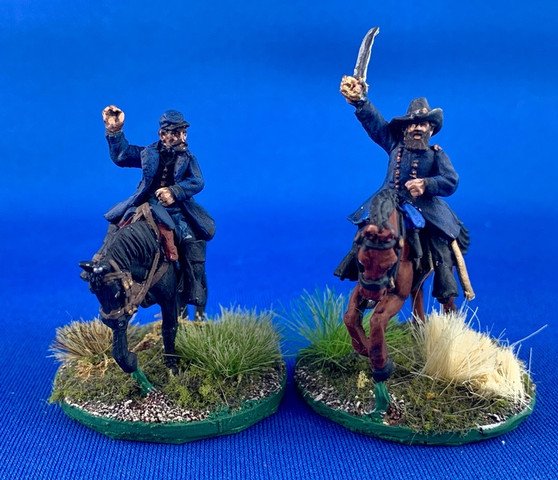
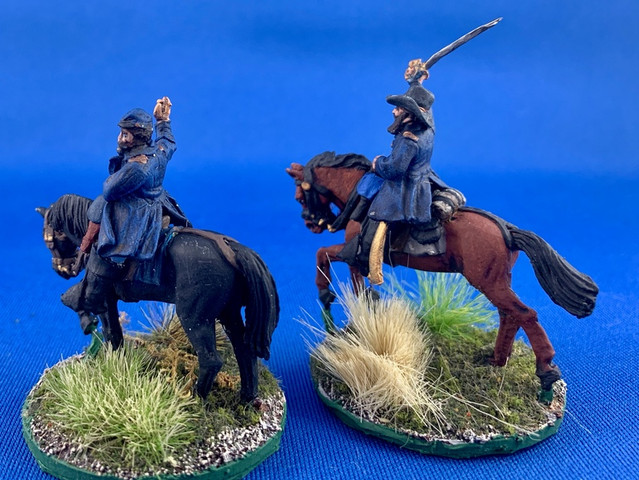
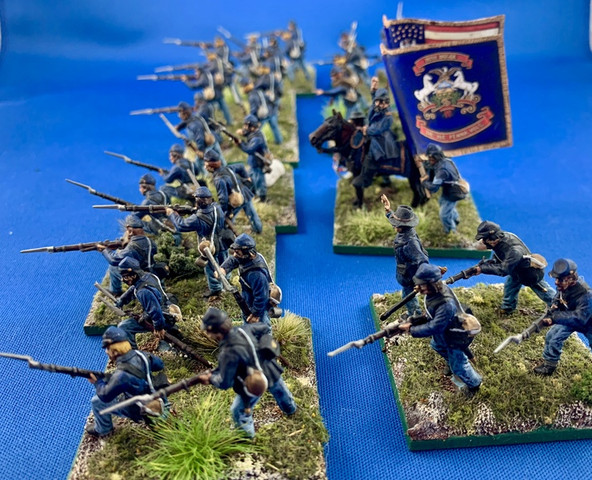
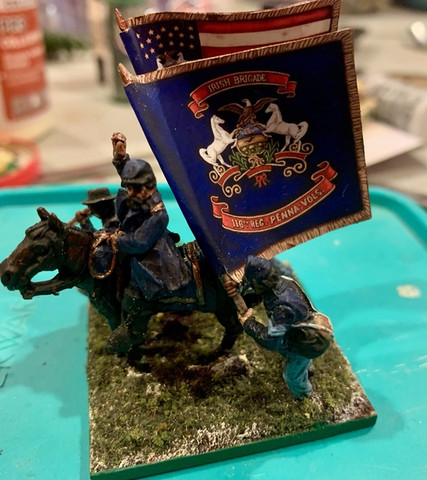
I dedicated most of my hobby time in January to finishing some American Civil War figures languishing in the Mad Padre’s painting chapel, including three lead mounted officers from Perry Miniatures.   Two are based separately for either Sharpe Practice or to use as Staff Officers in Pickett’s Charge, which I hope to revisit soon.

The third figure in the Perry set, a duplicate of the chap in the kepi with his hand raised, was pressed into service as the colonel of the newly raised 116th Pennsylvania Volunteers.

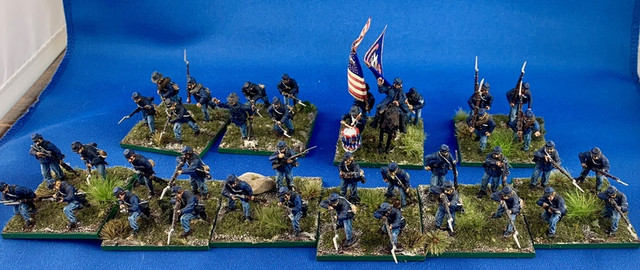
The foot figures are also Perry Miniatures, from their plastic box set, Union Infantry Skirmishing. I don’t like assembling plastic infantry as a rule, but ten bases worth of 28mm figures for about $1.25 Can a figure was a good incentive to stick with it.

The flags are by GMB.   I had them set aside for a someday purchase of a third regiment for the Irish Brigade - I was looking at the Steve Barber figures with the Irish Brigade heads, but the flags included in the Perry Box, for a US Regular regiment, didn’t work out, so …    I found the detail on these figures somewhat lacking, and could definitely have achieved a better result with lead figures, but as I said, cheap and cheerful.  I’d give this box set an A for economy and a B for detail.

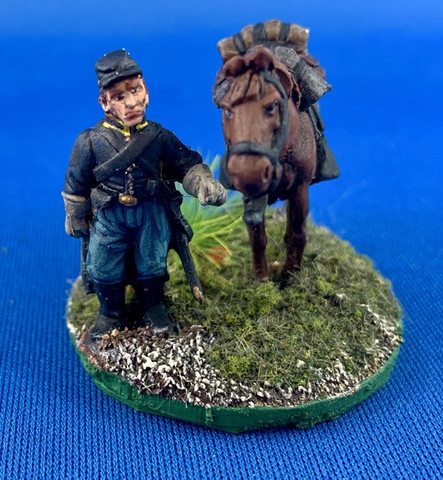
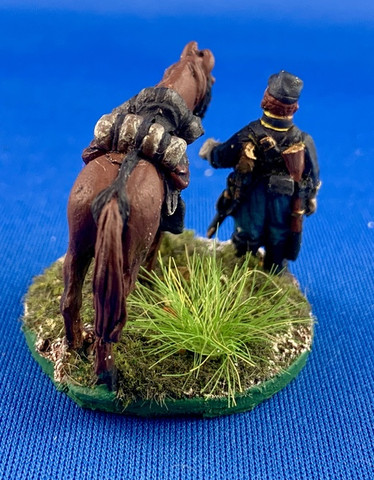
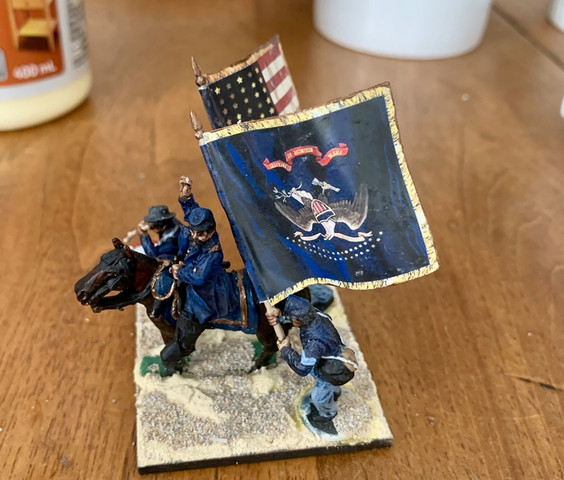
Finally, I had this Foundry Union cavalryman in my finished and orphaned box for a long time, so gave him the fourth horse from the Perry Union horseholders set.  

He makes a nice little vignette, maybe a deployment marker for Sharpe Practice.  

With all these figures added to the ranks, I should definitely put them all on the table and give the Pickett’s Charge rules another look.  Who knows, perhaps these troops will be deployed to the Canadian border.  I hear that there’s trouble brewing there.

Thanks for looking.  Blessings to your brushes!

MP+

Friday, February 5, 2021

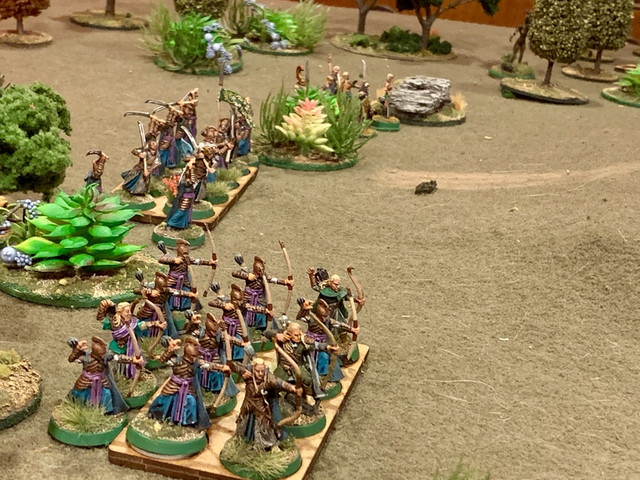
Raid On The Elven Woodland Realm: A Dragon Rampant Report

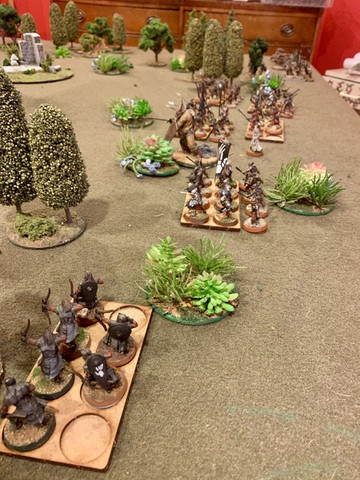
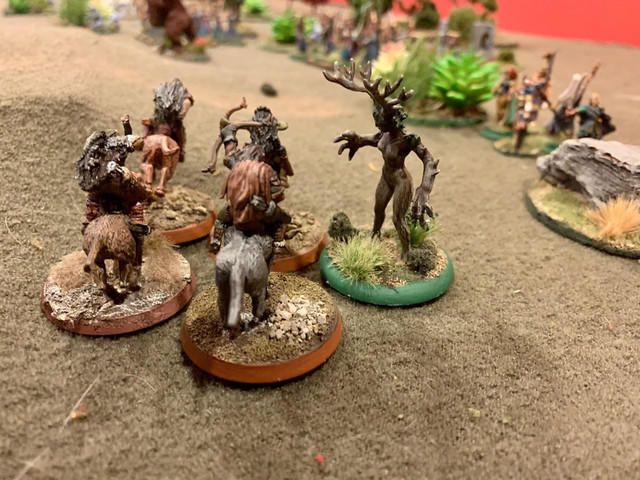
Not feeling up to some more complicated historical rules, much as I enjoy them on occasion, I wanted to get my fantasy collection on the table and give some new figures an outing.   Thus, the Wizard La Main Blanche rallied his unspeakable hordes and marched on the Elven Woodland Realm to pillage its magical mushrooms, or some such.   Orc army of about 60 its in Dragon Rampant terms, with an Elite Spellcaster and a heavily armoured troll (Great Warbeast).

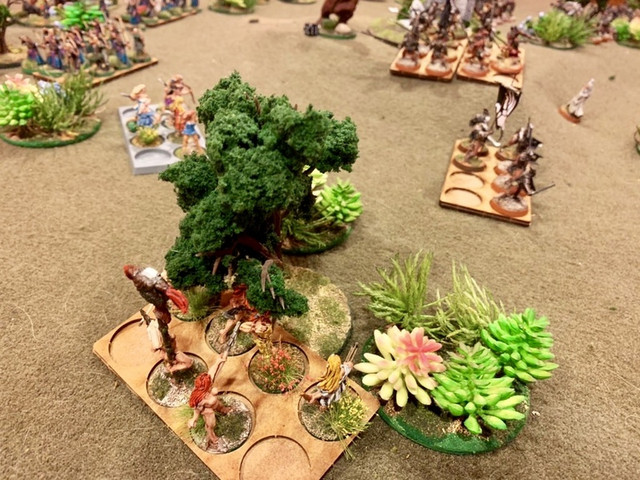
In the centre, the Lady of the Wood, also an Elite Spellcaster, places herself along with her best foot: heavy archers, heavy foot, and elite foot.  

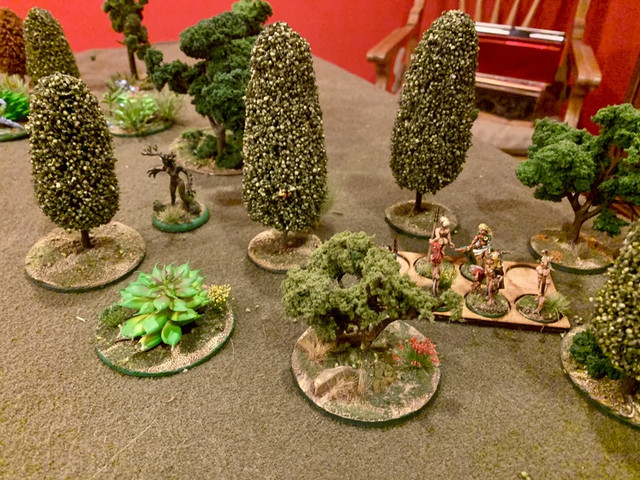
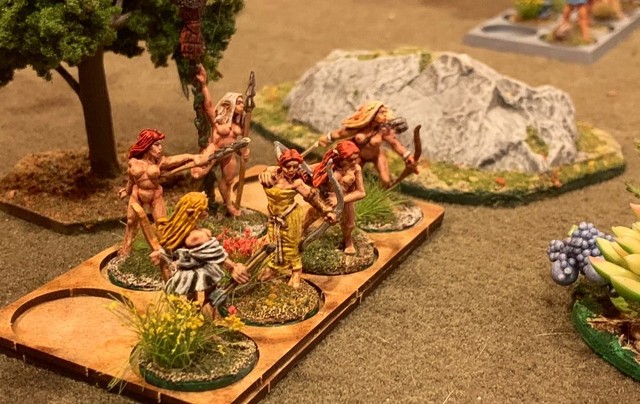
On her right, she places one of three units of Wood Nymph scouts and the Dryad Queen (Great Warbeast Cunning).  On her left, two more units of Nymph scouts and the Lord of the Bears (also Great Warbeast Cunning).  To reflect the home field advantage, I made the woods impassable to any Evil units except those with the Ranger ability.

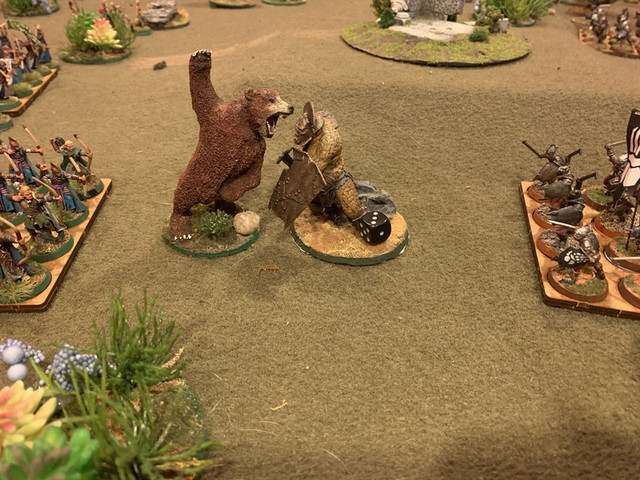
With only one leader one per side, I played the Initiative rules fairly strictly, so a lot of false starts, but in one good turn the entire army of the Wizard lurched forward.  On the Wizard’s left the Troll got off to a fast start and might have closed with and bashed the Elven Heavy Archers but for a missed initiative roll.   That gave the archers time to pepper him at close range and the Bear Lord closed to deliver some serious Bear Bashes/

Having smashed the Troll, the Bear Lord then decided that he wanted to pick his teeth with some orc swords.  With some favourable initiative rolls, he basically ran the table in the centre, smashing the orc foot unit by unit as they slowly made its way forward.

Elven nymph scouts on the flanks made life miserable for the advancing orc foot with their missile fire.

The Wizard’s wolf riders (Heavy Riders Missile) attempt to put pressure on the elf centre,  but the Dryad Queen has other ideas once the riders get within range of her Wild Charge.

As the Wizard’s right flank crumbles, the Nymphs begin to lap around the flank, and with the Wizard’s army now below 50% and the Elven Host barely scratched, I decided to call it a game.

The star of the game.  This lovely resin model from Thistle and Rose miniatures really fits into the overall theme of my Elven army and did extremely well on its first outing. He will definitely get a pot of honey after the battle.


While I could have tried to remember the Oathmark rules, Dragon and Rampant was a perfect way to while away a snowy afternoon.  These remain my go-to rules for cheerful fantasy gaming.   

With the Wizard and his surviving host still at large, I am sure that the Elven Realm still faces greater threats.

Blessings to your die rolls!

MP+


Monday, February 1, 2021

Banner Blunder!

Good morning and happy February!   I hope this finds you and those you love well and healthy, and that we all get good news from the groundhog tomorrow (is there a COVID groundhog, I wonder?).   In January, my main effort at the Mad Padre’s painting chapel has been finishing a box of Perry Miniatures plastic Union Infantry Skirmishing.  They are finished and just waiting the final touches in the Basing Barracks before they muster into service, but I wanted to share a small tale of woe with you.

Notice anything wrong?

Probably shouldn’t have put the regimental banner on dark and early after only half a cup of coffee.   Looks like the Union is in trouble!   Good thing I got the national flag right.   A great pity, as these banners were included with the figures in the box, and the print and paper quality were sufficiently high that I was quite happy using them to make this a new unit of US Regulars.  Alas, trying to get the regimental flag off the pole intact proved impossible and it had to be sacrificed.

Fortunately I spoke to the War Department and we agreed to muster this unit into the Irish Brigade as the 116th PA, as I fortunately had the GMB Designs flag set for that unit in my stores.   This will allow me to bring the strength of the Brigade up to three regiments, which is quite respectable on a 28mm table.   Col. Meagher will be quite pleased.

Morale of the story, go slow and drink lots of coffee!   I won’t mention the slight damage I did to myself with a new Olfa blade when I finally decided to remove the old flag - that’s another story, but these chaps now march on a bloody battlefield.

Cheers and blessings,

MP+

Sunday, January 24, 2021

Revisiting a Hex and Counter Classic: Napoleon's Last Battles

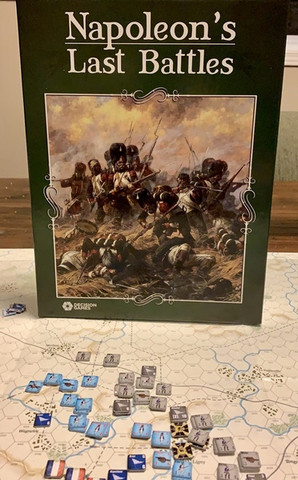
Back in 1976, in the heyday of disco, detente, high inflation, and my vain attempts to get Madeleine Bennett to notice me in Grade 6, Simulations Publications Inc.  published Napoleon’s Last Battles, one of the classic war-games systems.  It was designed by Kevin Zucker, one of the galaxy of talent that SPI’s Jim Dunnigan gathered around him like Napoleon and his marshals.    Kevin went on to found his own company, OSG, and is widely considered one of the authorities on Napoleonic board gaming today.

There is a great review of NLB, including photos of the original counter set, and a thoughtful appreciation of its impact on many subsequent titles, on the sadly inactive Map and Counters blog . on I bought the re-edition of NAB published by Decision Games, which picked up most of the old SPI titles after TSR acquired them.   NLB now comes in a shiny box with new artwork, and the original counters have been updated.  


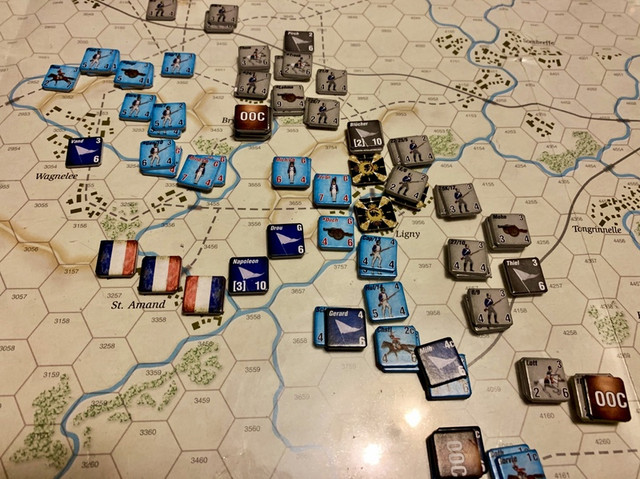
The scale of NLB is operational, with individual counters representing brigades with combat and movement factors.   Optional rules allow for basic command and control; for example, Napoleon can only give orders to three divisional commanders in a turn if they are within his command range of five hexes, and the divisional commanders can only fully employ their units if they are within three hexes.  Combat is hex to hex, though artillery can add their combat factors if two hexes away.  Combat is a simple ratio worked out on a Results Table that only gets bloody if the odds are 4-1 or above, or 1-3 or below.   Otherwise units will safely retreat unless all possible retreat hexes are within the Zone of Control of an enemy unit.  Hex and counter gamers of a certain age will remember what being ZOCed is and why it is fatal.

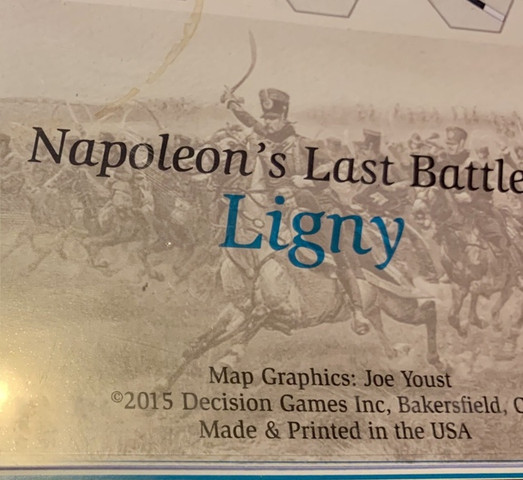
NLB comes with four games (it was the original SPI Quadrigame) of the Hundred Days: Ligny, Quatre Bras, Wavre and La Belle Alliance.  There are of course rules to play all four games as a campaign game.  

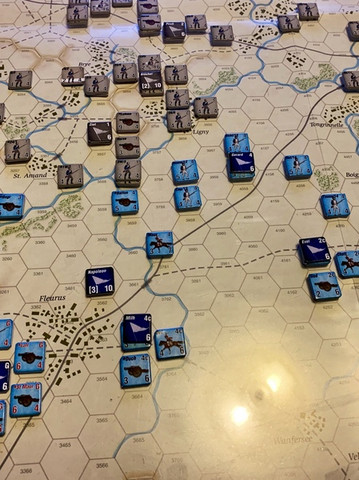
As time only permitted me to play one game, I chose Ligny. 

As in the battle, the French player only has six hours of daylight to inflict serious harm on Blucher’s three scattered corps.   The Prussian must hold with Zeiten’s and Pirch’s corps while bringing von Thielmann’s III corps to the rescue.

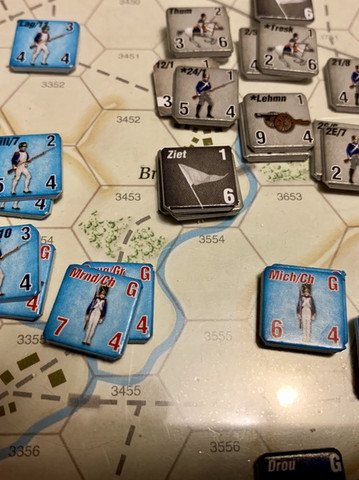
Alas for France, my first run-through did not go so well, as it took me too long to remember how to use ZOCs to my advantage.  At game’s end, Gerard’s Fourth Corps had suffered a mauling at the hands of Von Thielmann’s troops, while the Guard and Vandamme’s III Corps had taken Fleurus easily but were being forced out of Ligny proper.

Hero of the game:  Zieten, who held off Napoleon’s last big attack before twilight and who sent the Imperial Guard packing.  Prussian victory!

NLB is one of those simple game systems that remains fresh and interesting after fifty years, despite it’s new coat of paint in the Decision Games re-issue.  While it might seem dull because its woefully lacking in the chrome that we have since become accustomed to (although SPI’s monster Waterloo Game, Wellington’s Victory, also published in 1976, has all the complexity one could wish for), NAB does the job.  It presents an operational problem in sufficient detail to challenge the player, and delivers a clean result in a few hours, and works well enough as a solo game.  I would be delighted to play it against you on Vassal, if you care to.

 I’m very pleased to have it in my library and look forward to revisiting it again.

Blessings to your die rolls!

MP+

Saturday, January 16, 2021

Lovely Lysander

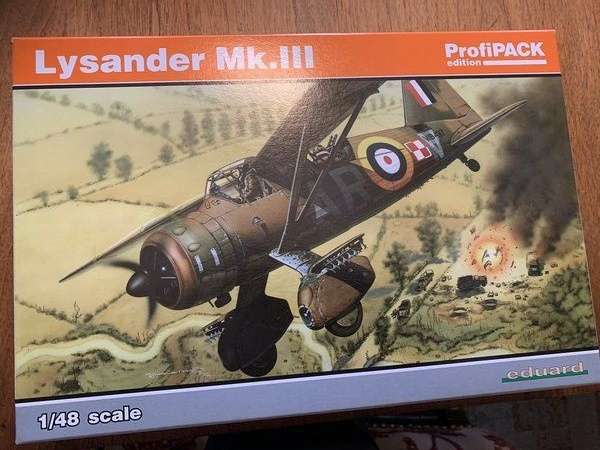
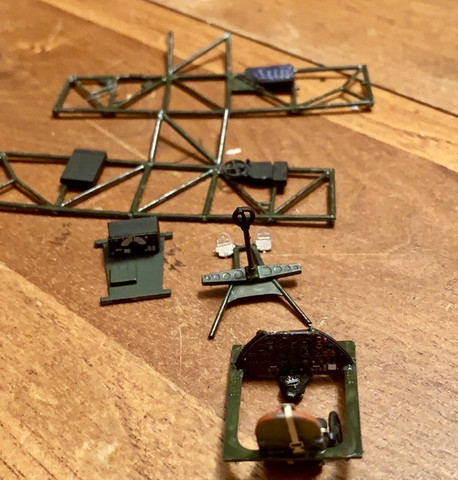
Good day!  Since this is my first post of 2021, I wish you a happy new year - may it be happier for all of us.  Over the Christmas holidays I started the traditional plastic model kit build - a 1/48 scale Lysander for my Weird War 2/ Pulp project.  I had opened the box back in the summer of 2020 and the myriad of small parts therein seemed more complicated than the time I had on hand would allow for.

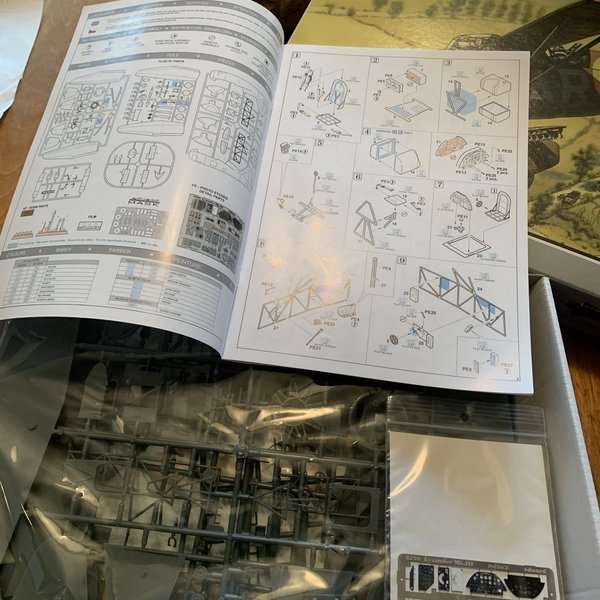
The kit is by an eastern European company, Eduard, which I gather is a gold standard for WW2 games, though I found the instructions somewhat less helpful than I would have liked.

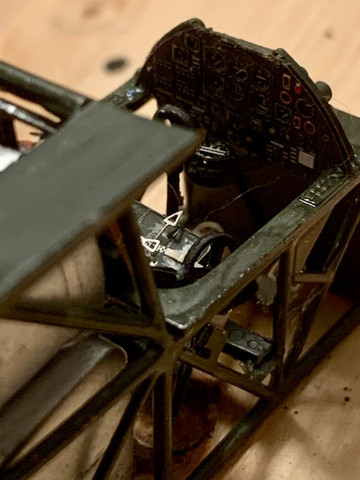
This time I kept my nerve and forged on, going as slowly as was necessary, as it required some nerve doing things like gluing the brass-etched parts like the foot pedals onto the cockpit assembly - totally unnecessary for gaming, but if you’re going to do a thing, do it well as my dad said when he vainly tried to teach me how to make the balsa wood airplanes he had made as a kid.

Brass-etched seatbelts, cockpit instrument panel, and pilot’s compass.

g

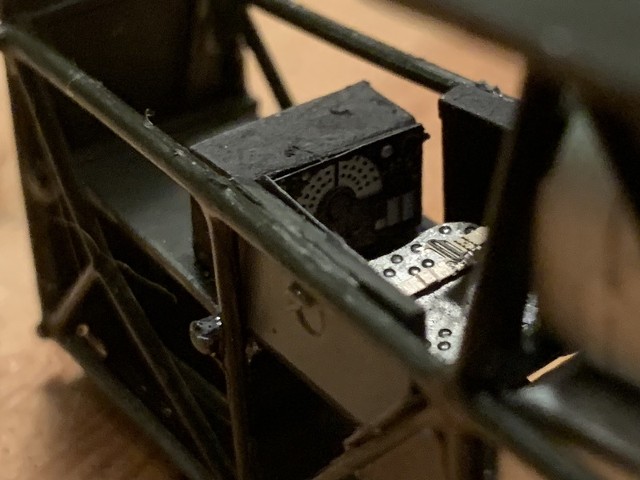
Wireless set.

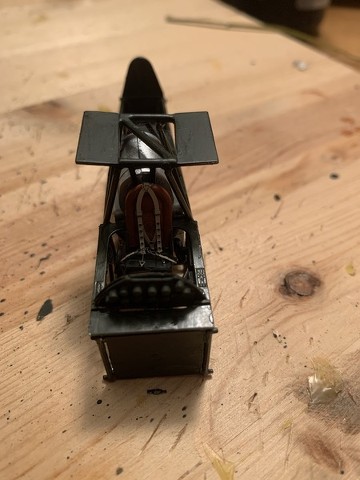
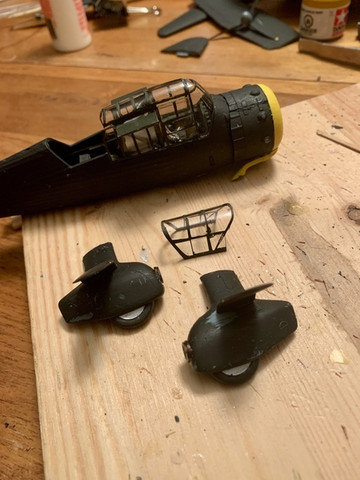
The interior fuselage assembly complete.  I had a discouraging moment when I broke off the wing roots at the top of the frame with some  misapplied press from my clumsy fingers and had to re-glue them.

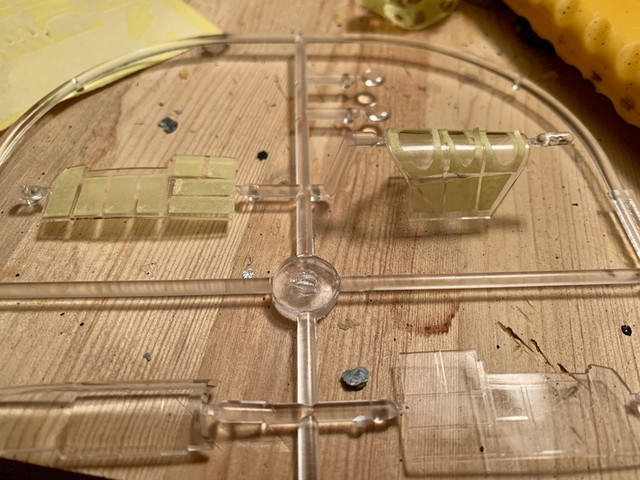
The Lysander has a huge canopy and the Eduard kit came with precut masking tape, which I had to carefully apply with my wife’s best tweezers.  That was fun.

The masking tape certainly helped the final product.

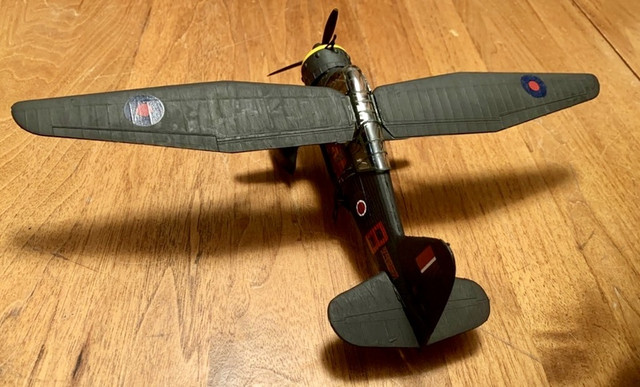
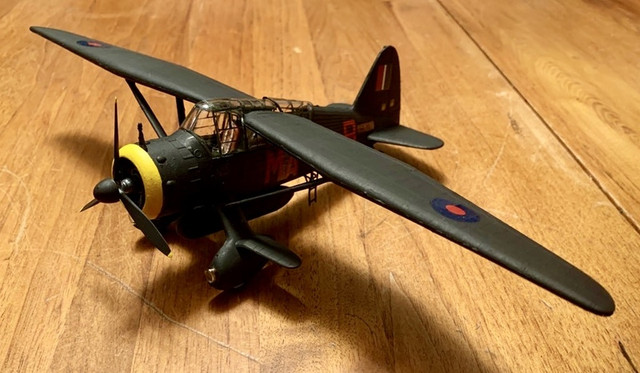
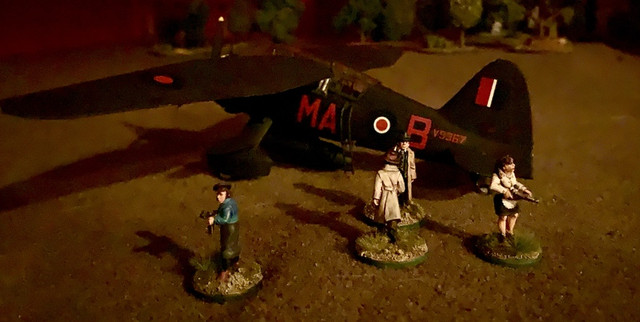
And finished!  Because of the gaming it might support, I chose the all-black paint scheme used by RAF 141 Squadron, which supported SOE operations in Occupied Europe.

 Those huge struts supporting the wings give the kit a lot of stability.   There is also an underslung fuel tank for greater range, and a ladder to help passengers enter and exit the aircraft.


Somewhere in occupied France.  Yvette of Cafe Renee and Michelle of the Resistance keep watch as the RAF delivers something vital to the war effort.   

Thanks for reading.  Again, may 2021 bring happier lives and gaming to all of us.   Stay safe, and blessings to you brushes.

MP+

Blog Archive

Followers