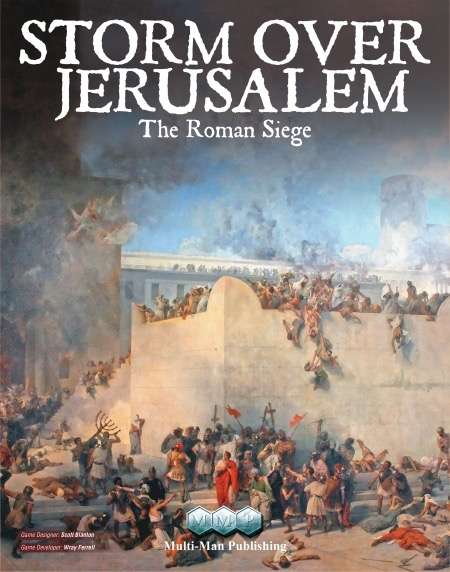
I've now finished two solo plays of Storm Over Jerusalem, MMP's game of Titus' siege of Jerusalem in AD 70. It's a winner. It has fairly simple mechanics (a very slim and well written rulebook) that are reminiscent of those old area movement games of the past, most famously Avalon Hill's Storm Over Arnhem.
It's a fairly short game (eight turns) in which the Romans have a daunting task of getting over the walls of Jerusalem (so many walls!). There are two vital areas, the Second Temple and Herod's Palace, and if the Romans can take both in the same turn they win automatically, but that's easier said than done.
The new town (top of the map) is easier to take because the defensive bonuses are slightly less than they are in the old town and the terrain around the new town areas is conducive to siege engines and siege towers which can partially negate the wall defensive bonuses. So the Romans can make initial headway taking these areas but they aren't vital to the Jewish defenders and they can chew up valuable time.
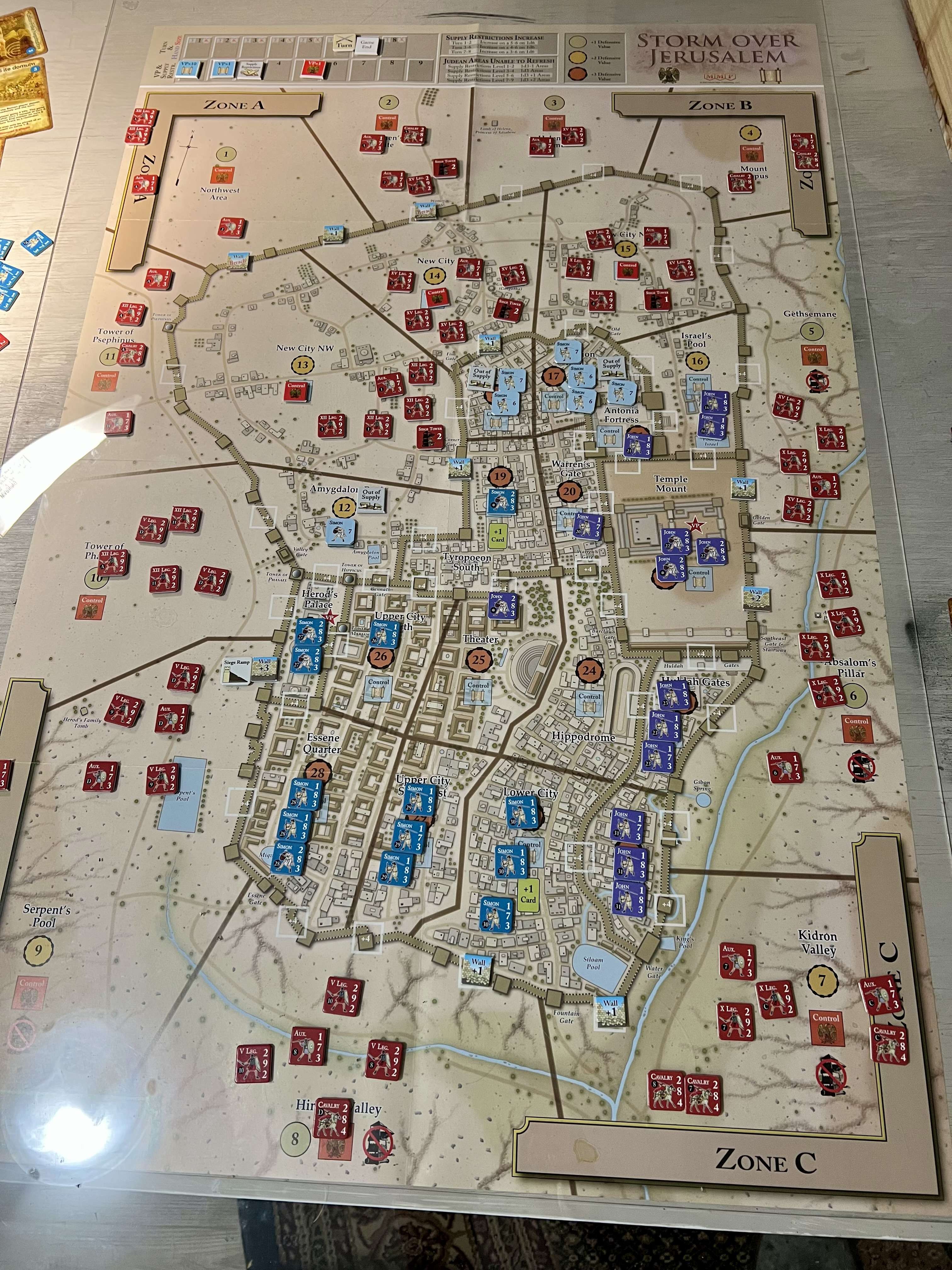
The Romans have a lot of troops but they don't all start on the map oat once and can only be brought on from four specific reinforcement zones. The Roman stacking limit is five units per zone, so the Roman player has to develop attacks carefully and plan to reinforce them.
The game is card driven, in that each player gets a hand of cards with fresh draws per turn and the cards convey certain bonuses and allow strategems, such as gradually cutting off Jewish supplies, upgrading Jewish units with captured Roman weapons, onager and ballista attacks, siege ramps, and such. Some cards can negate others, so if the Roman plays the battering ram card and if the Jewish player has the flaming brand card, it cancels the battering rams. If you like the flavour that cards bring, you'll like this game.
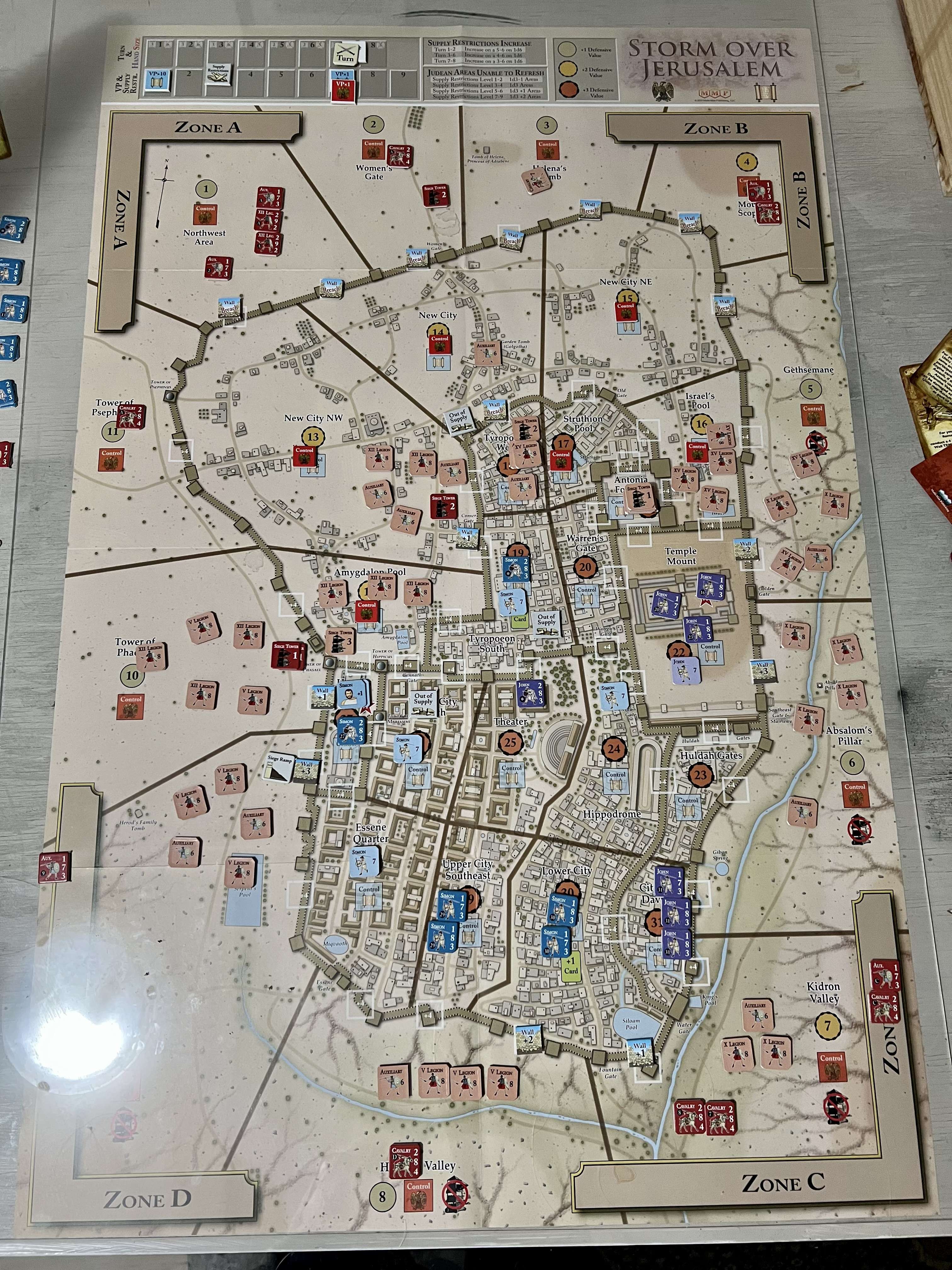
Here's the situation at the end of the second of two play throughs. The Romans have thrown their full might at Herod's Palace (left) and the Temple (right) and in both case the Jewish defenders hung on grimly. The game ended a turn early because of card play, and it was a tie simply because the Romans inflicted massive casualties on the Jewish garrison.
Siege games have a lot appeal for me. For the attacker they can be interesting problems to solve, and for the defenders while there may not be lots of maneuvre choices, the tension of hanging on is always fun. And the advantage of a paper game like this one is that I don't have to build a model of Jerusalem and to paint both armies, the game's all in the box.
Physically the counters are oversize, colourful and well printed. While mounted mapboards seem to be a thing of the past, it's a lovely and educational map and the cards are well done. Full marks for the game's components.
This is a game I would definitely play again.
Cheers and blessings to your die rolls,
MP+

This blog is informative, easy to understand, and well-structured. It provides valuable insights and keeps readers engaged throughout reading.
ReplyDeleteThis blog clearly explains how ticket exchange works, making it easy for beginners to understand buying, selling, and transferring tickets securely. The step-by-step guidance and practical tips help avoid common mistakes and ensure a smooth ticket exchange experience.Ticket Exchange Info, ticket exchange process, buy and sell tickets, ticket transfer guide, secure ticket exchange SeatGeek phone number customer service and Ticketmaster Customer Support phone Number
A rather attractive board design, Michael. It was rather bad luck for the Jews to run up against such able Roman commanders like Vespasian and Titus!
ReplyDeleteCheers,
Ion