Showing posts with label American Civil War. Show all posts

Tuesday, November 12, 2024

Perry Brothers ACW Union Cavalry Muster Into Service

"Around her neck, she wore a yellow ribbon ...and if you asked her, why it was she wore it, she said it was for her lover who was in the cavalry."

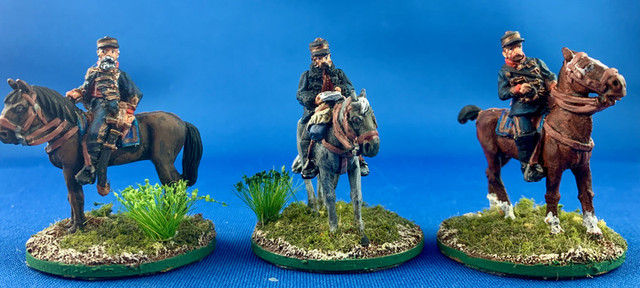
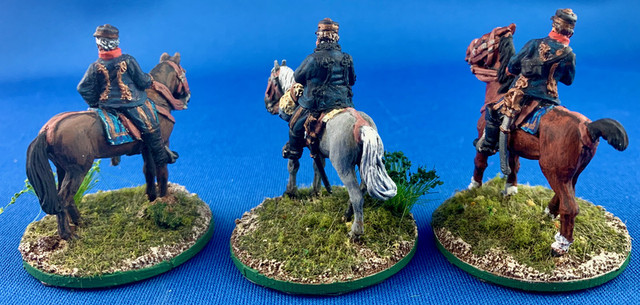
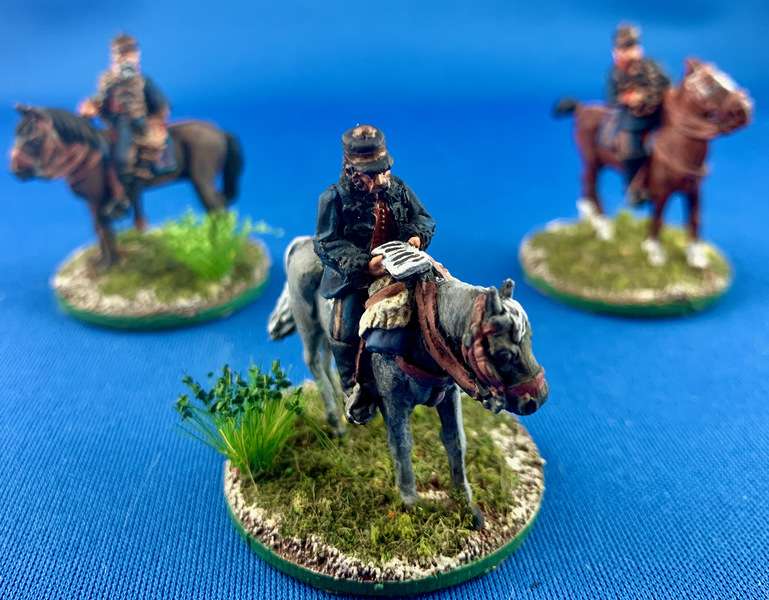
I might have been whistling that tune as I finished flocking these troopers the other day.   They represent the contents of a Perry Brothers box of plastic 28mm American Civil War cavalry, assembled and painted as Union cavalry.  I could have assembled the figures with carbines or pistols in hand, but the look of the sabres is iconic, even though probably not very common in the later war period.  At any rate, I'm very happy to muster this new unit into service.

Not a huge complaint, but after painting the three mounted Roman gents I showed here recently, these Perry figures felt like a slight step down in quality.   To be fair, the Perry brothers were fairly early adopters of injection plastics, a decade or so ago now, whereas Victrix is probably benefiting from newer design and production technologies.  the Victrix human faces are sharper, and the horses have much more texture in muscles, manes and tails.     However, when you paint a dozen of the Perry figures, the overall impression is still impressive.


This batch was mostly painted using Foundry paints.  The tri-tone system gives good results for the horses, and the Union blue for the tunics and kepis looks especially good.  I free-handed the yellow piping, and some came out better than others, especially the tunic collars.  The flag is by Adolfo Ramos.


These gallant lads, together with what's already in my collection, gives me two brigades of Union cavalry, or three groups of eight, depending on the rules and game scale.   There are many mounted actions that would make great games, such as the cavalry encounters before Gettysburg or actions in the Valley, so we may some rebel riders in the painting queue at some point.

Thanks for looking.  Blessings to your brushes!

MP+

Saturday, November 9, 2024

A Second Look at Mark Herman's Rebel Yell: Chancellorsville

Back in July, I posted here on my first thoughts about Mark Herman's much discussed ACW game, Rebel Fury, published earlier this year by GMT.  It's a fairly simple, divisional level game that covers six battles:  Fredericksburg, Chancellorsville, Chickamauga, Chattanooga, The Wilderness and Spotsylvania.  The mechanics are very similar to Dan Fournie's ancients game, Baetis Campaign, published in C3i magazine earlier this year and reviewed here.

Chancellorsville (henceforth referred to as Cville) uses the same map as the solo introductory game, Fredericksburg, which frankly was not a lot of fun.   Cville promises more sport for the Union as half the federal forces begin on the south side of the map, at Fredericksburg,  under Sedgewick, while the other half enter from the north map edge under Hooker.   The Union has the initiative for two turns, as per the game's Turning Movement rules, but after that the Confederates inevitably get to move first because of their superior generals, Lee and Jackson. 

Playing solo, I found it posed an interesting challenge for the rebs:  how many divisions should I pull out of the entrenchments across the Rappahannock from Fredericksburg to send north to try and stop Hooker?   In my solo game, the answer was just enough to slow the Union forces on either end of the map.   As you can see below, the Union came close to their victory conditions, establishing a road route from south to north that is entirely more than two hexes removed form any Confederate unit, while likewise clearing the rail line south from Fredericksburg from Confederate influence.    I got close, but not close enough.


However, if you look at the little red cross "Casualty" markers in the photo below, that is history repeating itself with a vengeance, as both Jackson and Lee became casualties, or at least enough of their HQ staffs to render them hors de combat.  Herman has a clever rule whereby one can use a commander's combat rating, called "battle stars", to influence a fight, but there is a good chance that the commander will become a casualty.   As the Confederate player, one has to resist the temptation to use the commanders in combat roles.   For the Union player, at least in this scenario, Sedgewick and Hooker have less ability to influence a combat outcome, so it's best leaving them in maneuver mode so they can enable their units to cover more ground, and for the Union, maneuver, as I learned, is the key to success.  

Judging by this podcast, not everyone is sold on this system, but I like what I've played of it so far, and I would be interested to retry this scenario to see if I could manage a Union victory.  

Rebel Fury offers beautiful maps, well produced components, and an intriguing variant on the IGO / UGO movement mechanic.  Definitely worth a look for ACW boardgame fans.

Blessings to your die rolls,

MP+


Saturday, August 17, 2024

EX THUNDERING DICE 2-24: A Wargames Weekend

It's been ages since I've posted any sort of games reports here, and truth be told, I do very little face to face gaming these days due to a lack of local opponents.   However, my friend James and I managed one of our occasional gaming weekends, which we have christened EX THUNDERING DICE.   I think this was our fourth or fifth over as many years.   Last weekend James made the two hour drive and as the host I could offer the gaming room in the upstairs of the old rectory where I currently live.  It's a lovely space and filled with natural light during the day.


 It was also a chance to give James this piece for his Napoleonics collection, a 28mm Front Rank figure, Archduke Charles, for James' Austrian force.   Seeing as James usually plays Sharp Practice, the Archduke may qualify as the biggest of Big Men.  He certainly has a big hat!  He's painted using the Foundry tritone system.   I don't paint or collect 28mm Napoleonics, but Front Rank's figures may yet tempt me.


James and I started by playing an 18th century game using my 28mm collection of Prussians and Russians.   We had a friend of mine, David, an avid scale modeller who was getting his first test of miniature wargames.   We used Keith Flint's Honours of War rules from Osprey, and chose the introductory scenario, in which four units deploy to protect a river crossing, from five attacking units.   It might make more sense to defend the other side of the river, but that would have made for a tedious game.   Both sides had one regiment of line cavalry, which immediately charged.  David's Prussians were eliminated, while the Prussians barely survived with only one hit remaining, and would sit out much of the fight to recover.


From then on, David had to divide his remaining force of two infantry regiments and one gun section against three Russian infantry regiments.  It was a brave effort, but he was eventually swamped by numbers.  We had enough time remaining to reset the table and try another battle with more troops, just to give David another chance to move some troops and roll some dice.   I think he enjoyed it, and left with a stack of surplus wargaming magazines and a promise to try it again.    


We were not very familiar with the HoW system but we found it fairly easy to pick up.   The challenge with these rules is to keep a reserve and, if possible, pull units back before the accumulate five hits and are then removed from play.    Given that musketry is quite deadly, this is not easy to do, especially in a game like our first scenario which uses a small number of units, in which case it's a quickly resolved knife fight.  It took us a few turns to remember the shooting rule which makes it slightly harder to cause a hit against superior troops (eg grenadiers) but easier to cause a hit against inferior troops such as friekorps.  As James pointed out to me, this rule reflects the varying morale and cohesion of targeted units rather than the shooter's marksmanship.

The game also reminded me that I have more work to do on my SYW collection of Russians and Prussians before I can offer a game with more than two small brigades per side, so I had better get cracking.

In the evening we played a boardgame of a Punic Wars battle in Spain (Baetis Campaign from the most recent issue of C3I magazine, which was a kind concession from James since his taste doesn't run to hex and counter games.  I'll post a review of that game separately.

The next day was mostly taken up with Quar, which is James' latest passion project.  I only managed to get a few photos of the table before we began.   Once we started I was occupied trying to run a very large force, and did poorly.  There are more photos on James' blog here.

I have huge respect for the way James dives in a project and single-mindedly pursues it.    The Quar, a race of sentient and warlike anteaters, have clearly seized his imagination.    It's World War One but in a transposed setting, I suppose in the same way that Flintloque transposed Napoleon's into a fantasy setting.   I confess that I don't quite get it, as the troops look like WW1 French and English troops only with pot bellies and snouts, and I'm not sure why one wouldn't just play WW1 straight up.  On the other hand, I like the whimsy of it, which steers clear of the grotesque aspects that make Turnip28 rather repulsive to me.    We used the Osprey SF rules, Xenos Rampant, which seemed to work well enough. 

I had what I thought was a decent plan, but a bad run of dice over several straight turns, which made me a little grumpy, for which I do heartily repent, as grumpiness in a gaming partner is never attractive and can be a deal breaker over time.  


After dinner we reconvened and broke out my ACW collection, which includes some old Minifigs that I first painted while watching CNN's coverage of the first Gulf War, so that shows my age, I guess.  We decided to revisit Sam Mustafa's Longstreet rules, which James and I played a lot of about a decade ago when we lived closer to one another.     We each took five infantry units (3 Eager Recruits and 2 Seasoned Veterans) and a battery.  James threw his two Texan regiments against a wood defended by one of my regiments, and quickly shot them out of it.   We discovered that in these rules, defending in covering terrain messes up your shooting for little gain in return.


The main action was in the wheat field, which changed hands repeatedly.  I had an edge here, as my battery was within canister range for much of the fight, and, as they say, dealt terrible execution.  It took us a few turns to remember that in Longstreet, firing zones are straight ahead, without the customary 45 degree arcs to either side.  At the end of the fight, I had pushed the rebs back across the wheatfield, and my fighting Irish in reserve had contained the Texans that had won the fight in the woods.  A close victory to the Union.


It had been a while since we'd played Longstreet, and I think we were both favourably impressed.   Our memories of the card playing was that it could seem gamey, in that one can have the perfect attack teed up only to be foiled when the other guy plays one of the rare but annoying interrupt cards.   However, cards are usually better employed for different reasons, such as ordering a move through difficult terrain, or trying to preserve units from multiple shooting hits against them.    It's always a choice, and the choices do a good job of simulating a commander's limited bandwidth in a horse and musket battle.   While we had both instinctively put commander figures on the table, they had little to do, as the command and control rules all live within the card play.  Perhaps we missed some rules about command radii affecting card play?  All in all, Longstreet is a fun and playable system for a brigade sized battle that can be resolved in a  few hours.

We finished the second day with a viewing of the old Kubrick film, Paths of Glory, which James had never seen but which came up as we were playing our Quar game.  James was a little surprised that the second half of the film was a courtroom drama, but it's a masterpiece of the antiwar genre, and brilliantly shot in black and white.   The tracking shot of Kirk Douglas as Col. Dax walking through the trench and among his men prior to the attack is one of the memorable scenes in cinema.

We said goodbye after breakfast and hope to meet again over the gaming table sometime this winter.   Good to see a dear old friend and to get some games in.    I shall spend the next months looking harder for a gaming opponent in or near Collingwood.  Maybe David will want to try again?

Blessings to your die rolls.

MP+


Thursday, July 18, 2024

First Look at Rebel Fury by GMT and Mark Herman

Hello friends:

Not a lot of activity here due to time constraints but the gentler pace of summer beckons, I devoutly hope.   Some gaming and painting happening nevertheless.

Recently I had a chance to open and play a recent tabletop game purchase, Rebel Fury: Battles of the American Civil War by legendary designer, Mark Herman, and published by GMT Games.   It promises to be the first in a series of games using the same rules and mechanisms.  It's a somewhat abstract game, at divisional scale, but with an interestingly fluid turn sequence rather than the traditional IGUGO approach.

I only had the chance to play the introductory scenario, Fredericksburg, using the solitaire rules, which is basically a chance to learn the basic game system and not have a good time as the Federal player.  

Here's the initial setup.  The glossy counters on the river are the pontoon bridges.   Most of the Federal force is well back and the limited number of turns (four if I recall) mean that the Union divisions will be committed piecemeal.   In the solitaire rules the Confederates don't move, they just sit in their entrenchments and blaze away.  It's a stark realization of what a foolish battle plan this was.

The game uses a fairly conventional ZOC mechanic which can favour the attached if the attacker can get a supporting unit into the same ZOC as the defence, which can work in the first attacks if the Union is lucky with die rolls.   Here French and Getty were able to dislodge one of McLaw's units and force their way onto the Heights.   However, in most of the attacks, when one attacker is destroyed or forced to retreat, its adjacent friends have no support and their attacks will inevitably fail.

At the end of the game, the Union had two divisions inside the Confederate positions, which was a better result than I expected, but the US needs five units inside the Confederate lines to win the game.

I replayed the game without the solitaire rules, which gives the Union more freedom of maneuver, but it's hard to outflank the Confederates because in the two-player scenario they get extra units which can enter the map from the south and fill in the lines.   So other than learning the combat mechanics, the Fredericksburg scenario is as much fun as a root canal.  Even so I liked the mechanics, and found the combat resolution quite simple once I mastered the basic system of modifiers.   There is command and control, but it's not overly constraining.   Herman's basic idea here, I think, is to help players understand what brittle instruments Civil War armies were.  Divisions can burn out quickly and players should husband their forces for decisive strokes and broad flanking maneuvers.

I look forward to playing the Chancellorsville scenario using the same map, it promises to be much more interesting.

Blessings to your counters,

MP+


Tuesday, March 22, 2022

Games at Hot Lead 2022

Hello friends:

On of Canada’s most well-known miniature tabletop gaming events is now in the books, and can be counted a success.   After two years of Covid-induced suspension, the games were back, the players were a little fewer in number and all masked and well behaved.   Congratulations to my friend James and his crew of redshirts for making it a success.  You can read James’ account of HotLead and see his own photos here.  There are lots more photos and videos on the Hot Lead Facebook group page here.

This was the first time I’ve stayed over at the Arden Park hotel, the venue space.  Previously I’ve cheaped out and couch surfed at my friend James’ expense, but this time I went all out and my lovely bride Joy came with me to sample Stratford’s shopping delights and to do some anthropological studies of the wargaming tribe.  She said “your friends are weird but nice”.  Truth.

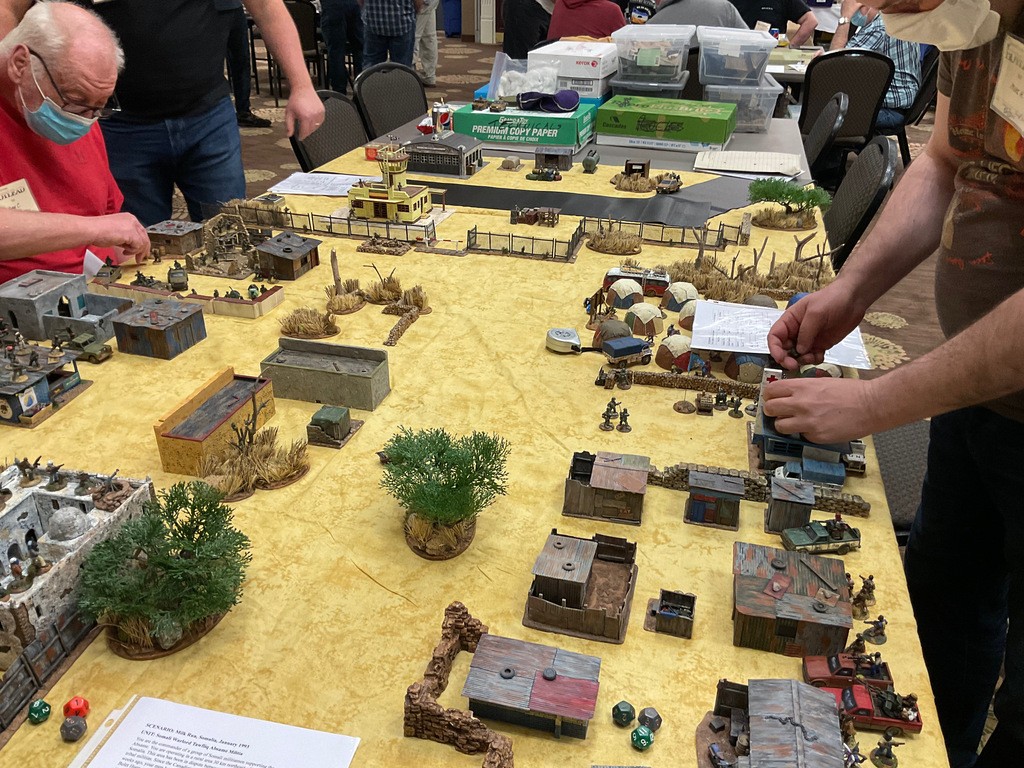
My own brief account of what I played in and what I saw begins on Friday night with on of Dan Hutter’s signature multi-player rules, where no one is a friend and the guy sitting beside or across from you is probably gunning for you, so best gun him first. The game was set in Somalia during the disastrous UN intervention there in the early 1990s: several factions of Somalis, UN peacekeeping troops, and secretive mercenaries all had their own agendas and bullets soon flew in all directions.  Rules were a very simple and mostly playable version of FUBAR.  Grand start to the weekend.
 

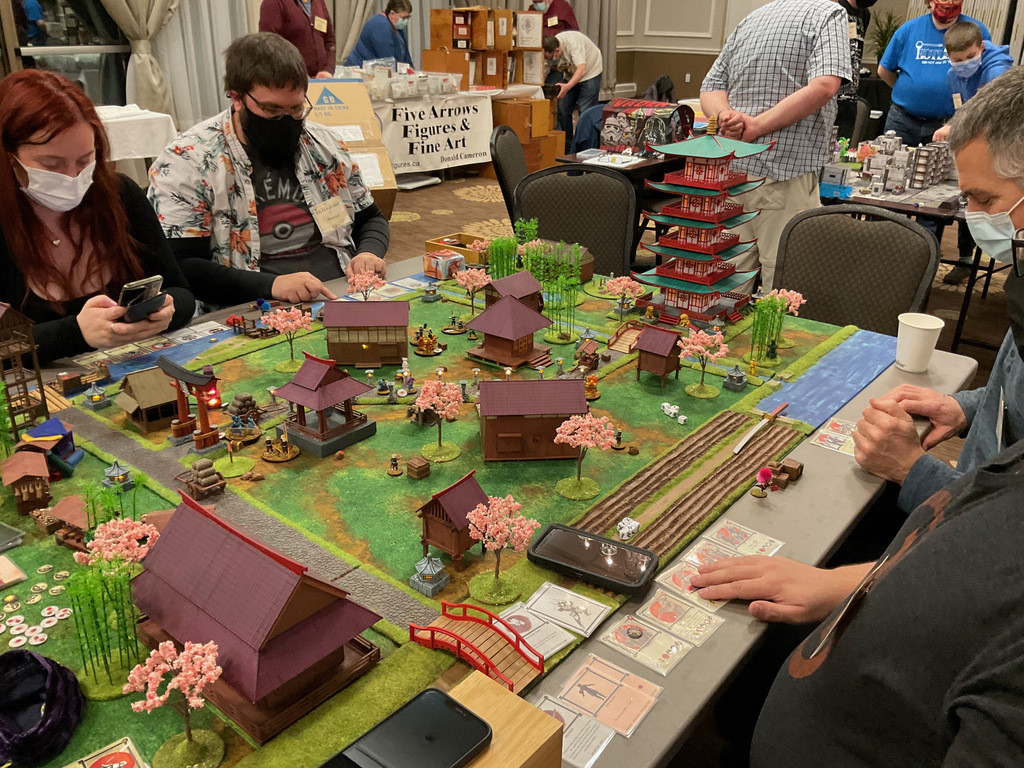
Test of Honour samurai game going down on Friday night, lovely table. 
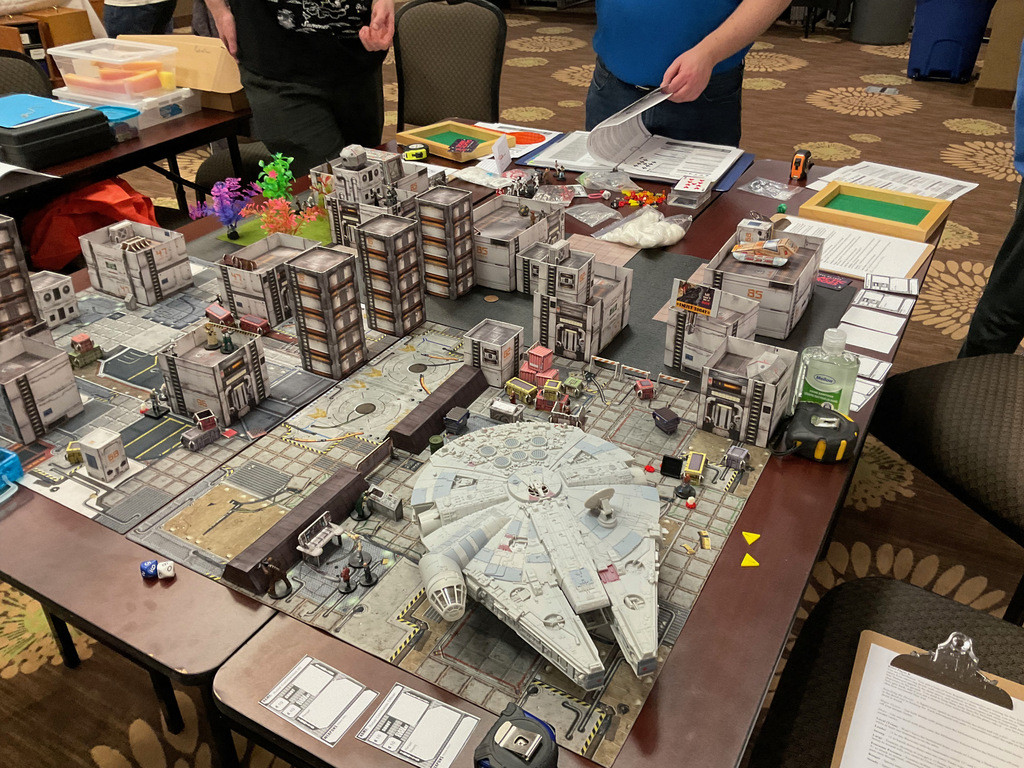
 Chris Robinson, a friend of the Canadian Wargamer Podcast and normally an historical guy, put on a Star Wars game that looked quite attractive.  It was good to hear that the young players enjoyed it.
 Some of the Hot Lead crowd were playing this impromptu Victorian SF game on Saturday morning, involving big steam powered clanks AND dinosaurs. 


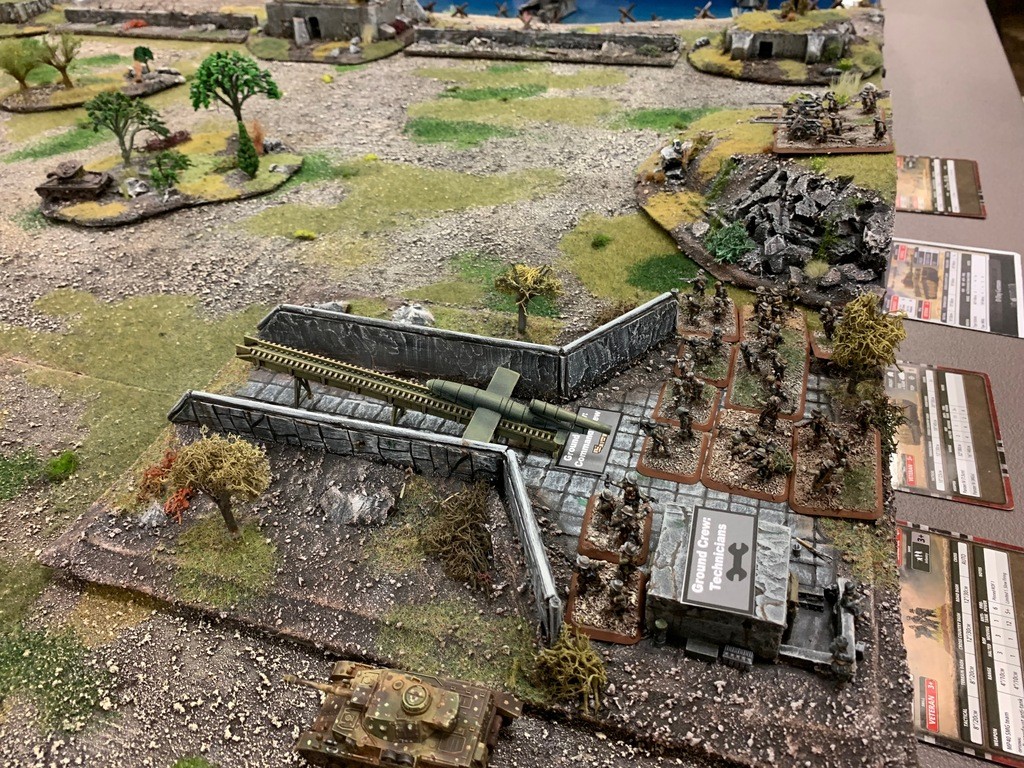
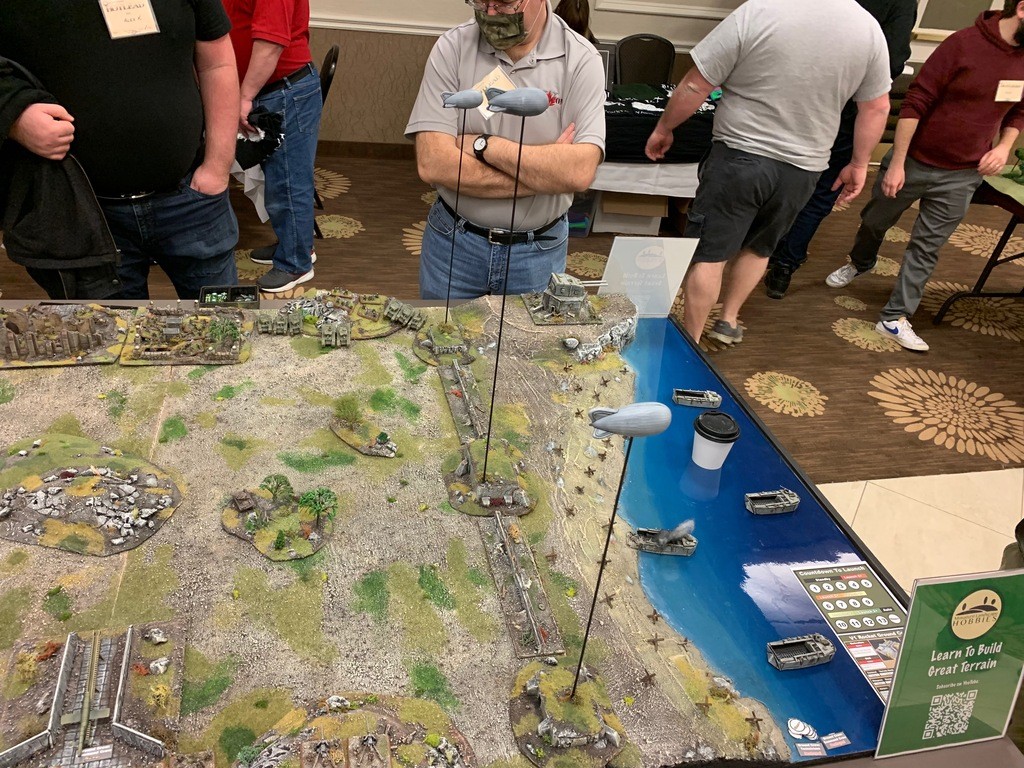
Saturday morning I played in this beautiful WW2 game hosted by Joe Saunders of Miniature Landscape Hobbies.  Joe is a friend of the Canadian Wargaming Podcast and a lovely guy. 
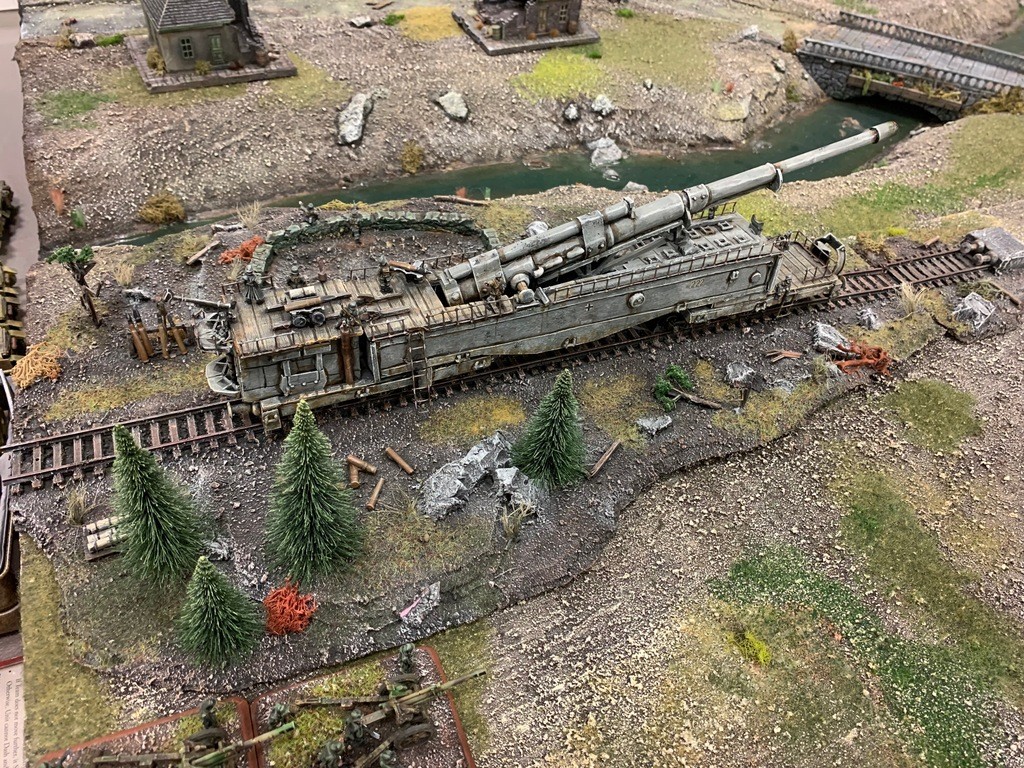
 This scratch built railway gun was done by Joe and part of the table dressing.
 

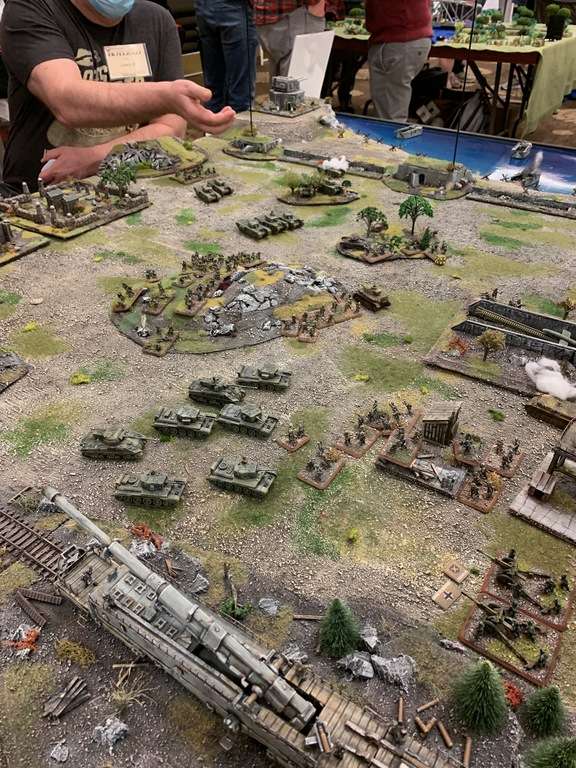
The game was called “Countdown to Launch” and featured the Germans trying to delay the Allied onslaught long enough to fuel, arm, and fire off this V1 rocket.  

 It was quite an onslaught.  The Germans died in droves but managed to fire off the rocket.  I confess that tanks massed track to track are an example of why I don’t personally like Flames of War, but it did deliver a fast game, and at this sort of event, with three hour game slots, you need quick fast games.

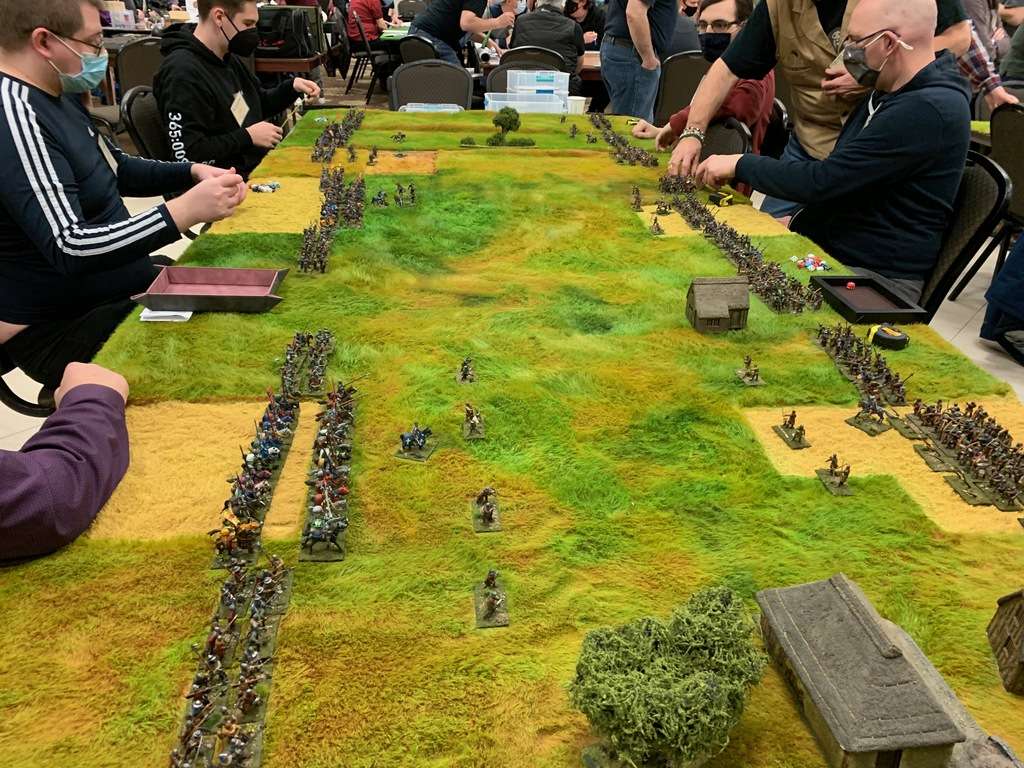
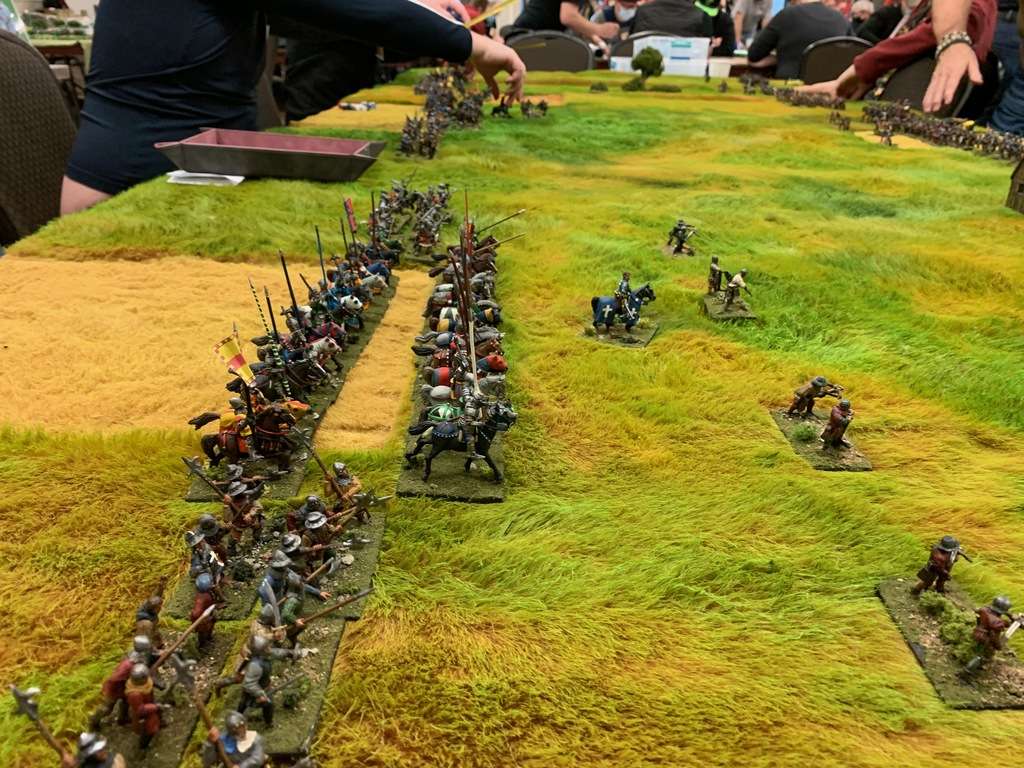
 This beautiful medieval game, the Battle of Tewkesbury, was hosted by Ian Tetlow, who always puts on good looking games at Hot Lead.
 

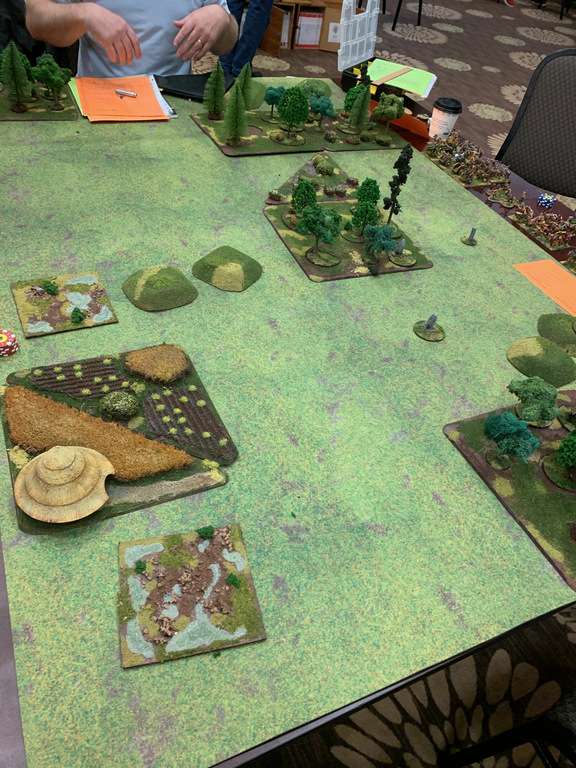
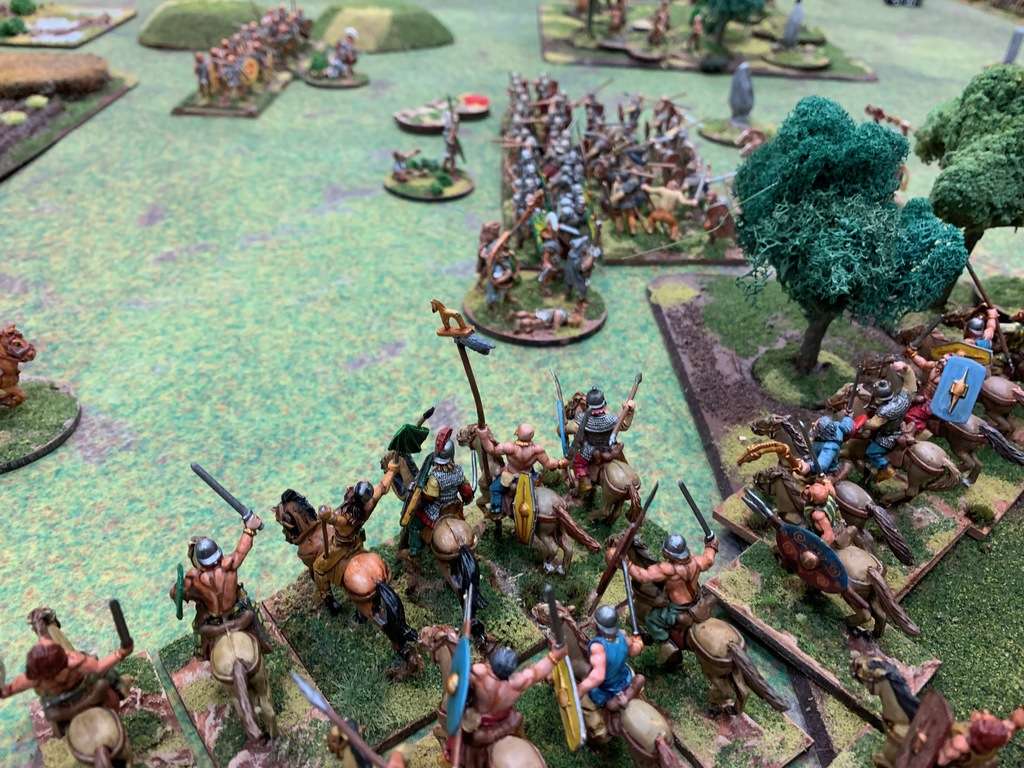
 On Saturday afternoon I played in Sean Malcomson’s “Hard Brexit” ancients game using Too Fat Lardie’s Infamy, Infamy rules.  The object was for the Roman players to move a herd of (unfairly) taxed cattle across this table to safe harbour.  The British, strong believers in No Taxation Without Representation, were trying to stop them.
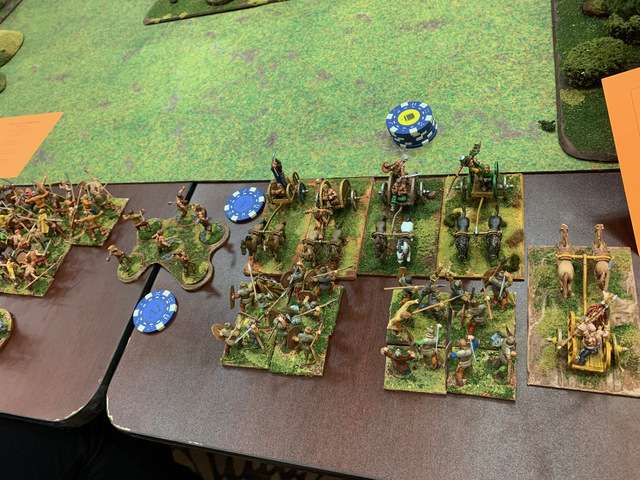
 Some of Sean’s beautiful ancient British figures.   The British deployed from a series of ambush points.
 Life got quite difficult for the Romans.   Their legionaries stood in line like rocks while their auxiliary reserves ran back and forward plugging gaps and counter attacking.  
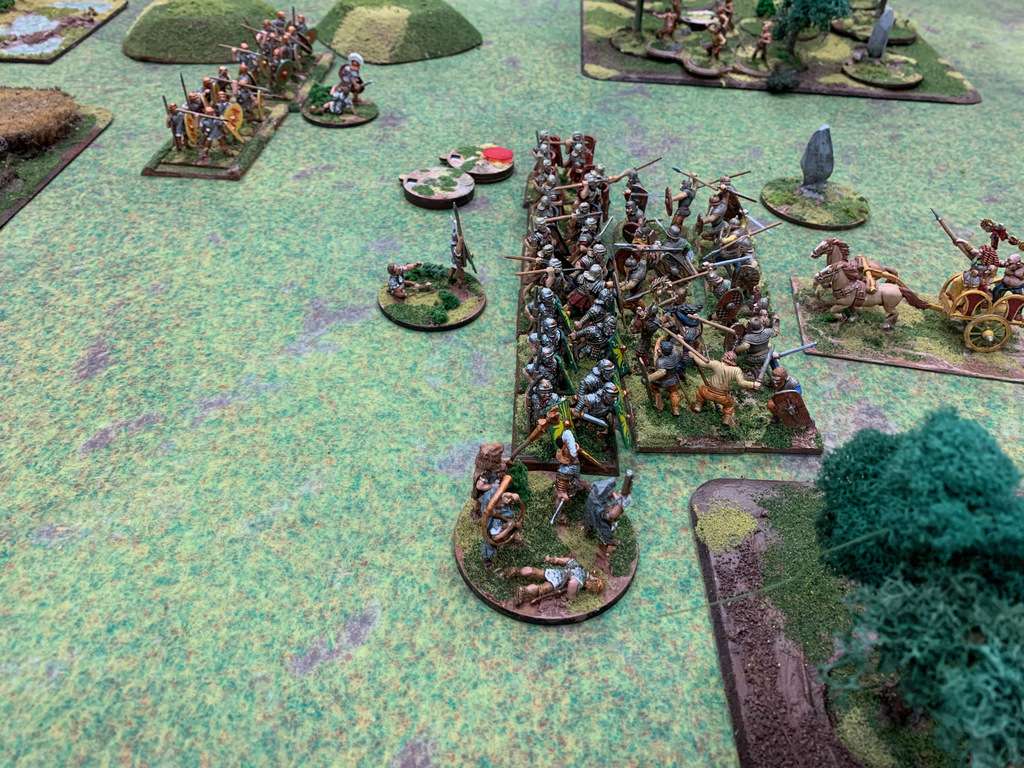
The British skirmish cavalry, seen entering here, were annoying but not decisive.   In the end, we ran out of time but called it a British win.  I found these rules similar enough to Sharp Practice that I got the hang of it fairly quickly, and would try them again as an excuse to get some Romans to oppose my Germanic war band.
 

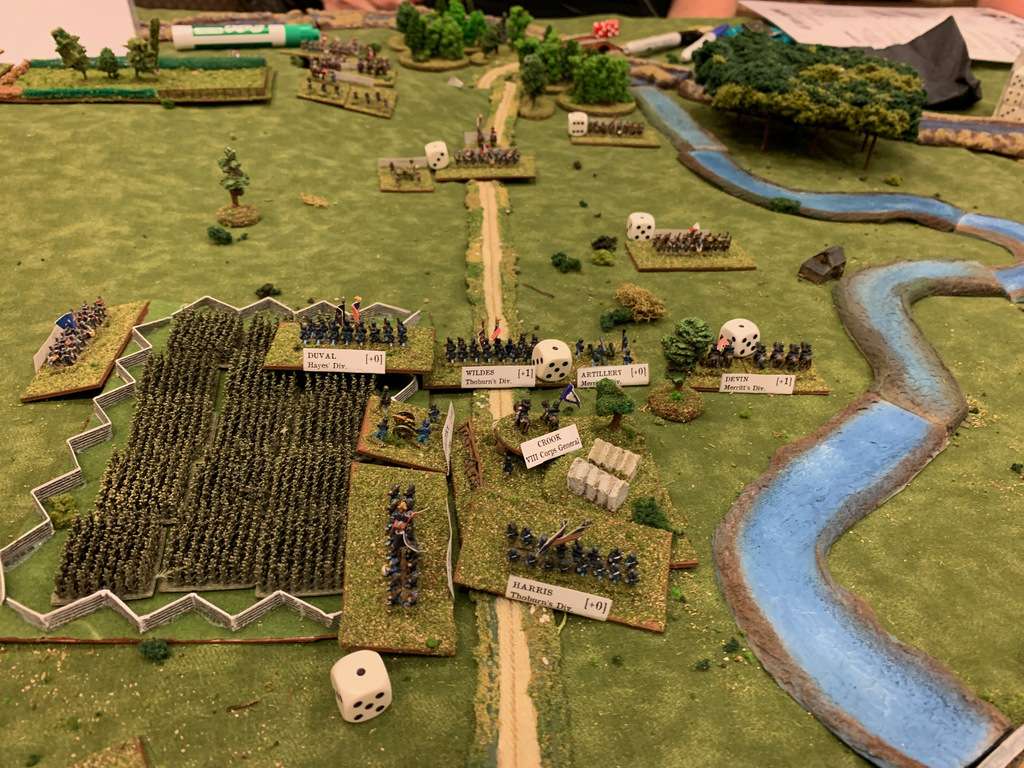
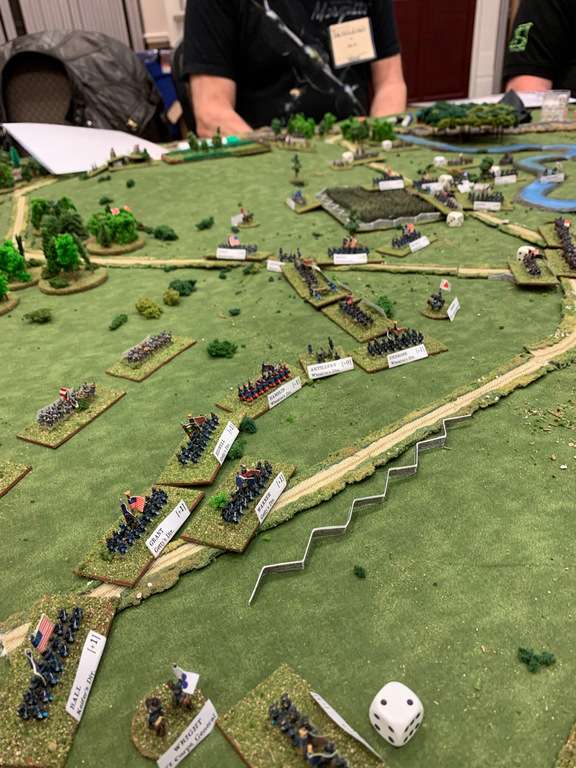
My last game at HotLead was on Saturday night.  Brian Hall, one of our local masters of 6mm, hosted an ACW corps-level game featuring the Battle of Cedar Creek.   Since the battle began in confusion and alarm for the Union, both forces started under blinds, with three of the four Union corps well back from the start of the action and thus the Union in a poor position to stop the Confederate advance. 
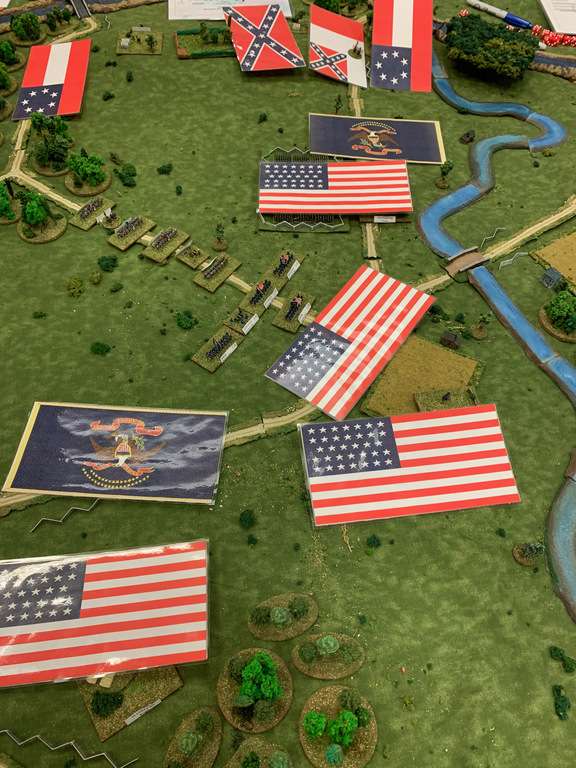
 By this point the Union had stabilized a line and were beginning to hold.    The rules were Altar of Freedom, which I found fast playing and quite bloody.   With each manoeuvre unit in the game a brigade, whole divisions were being quickly shattered, but the rebels lost too many men to sustain the assault, ending in an historical outcome.

Since a lot of my playing is solitaire, I found the points bidding initiative system in AofF to be a bit of a turn off, but as Brian noted to me, a card drive initiative system could easily be bolted on to the core combat rules for solitaire gaming.
 and 


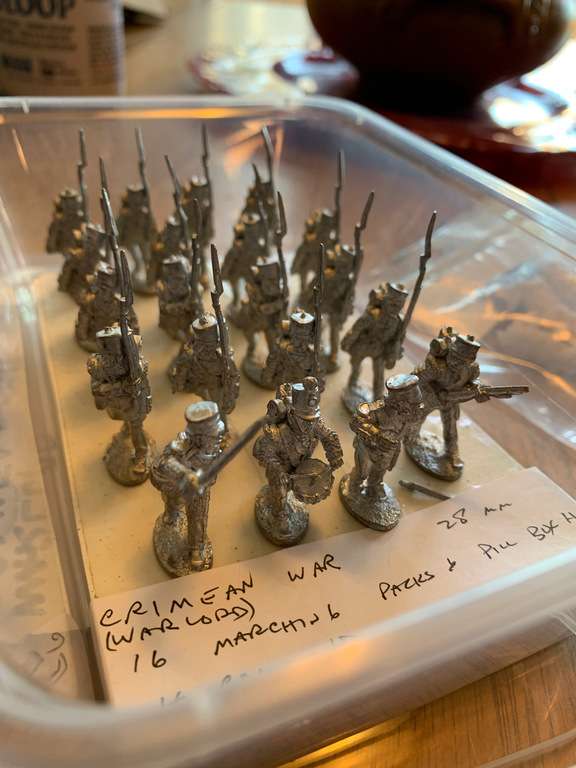
Finally, it wouldn’t be a convention report with the usual haul of goodies.  My dear friend MikeB gifted me these Warlord Crimean War sculpts by Paul Hicks for use in my Alt-ACW project, which was kind of him.
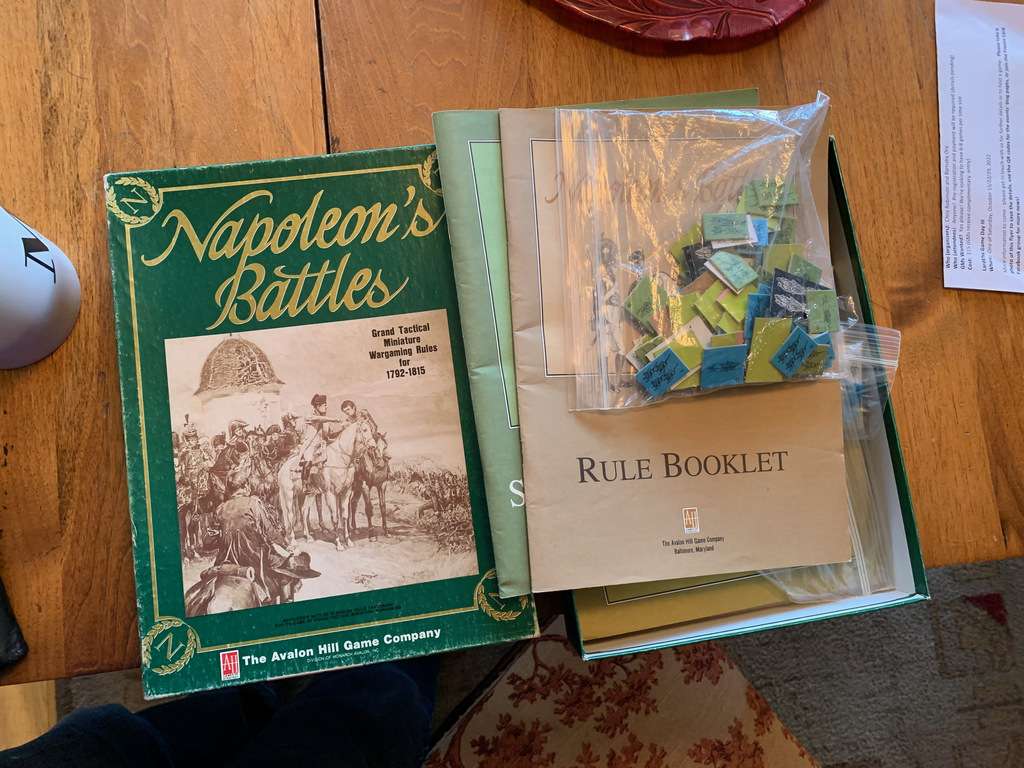
Another friend sold me these antique Avalon Hill rules for Napoleonics, which are more of a collector’s item than a viable gaming system, though I gather they were once influential and I will try them out some day.  I gather it was AH’s equivalent of GDW’s System 7 Napoleonics, though the cardboard counters in the AH set were designed to give players a taste of the system and motivate them to buying miniatures.  There are some vintage adverts from minis companies of the era in the rules books.
And I stocked up on tree and basing material.

So that was Hot Lead.   I ran out of stamina after four games in 1.5 days, but as I said goodbyes on Sunday it was grand to see the crowd getting ready for the traditional mass VSF game.  

Huge congrats to James, Elizabeth, and the crew for making this revered event happen and I look forward to returning next year without a face mask!

Cheers and blessings,

MP
Thursday, January 13, 2022

28mm Foundry Victorian Civilians

Hello friends:

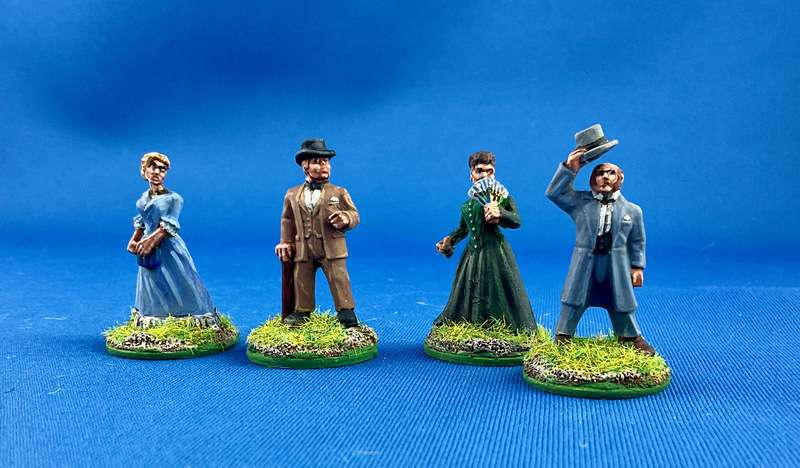
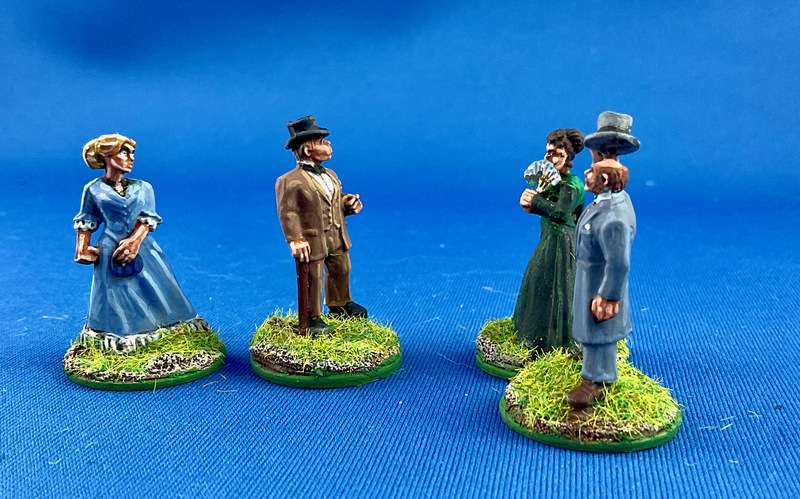
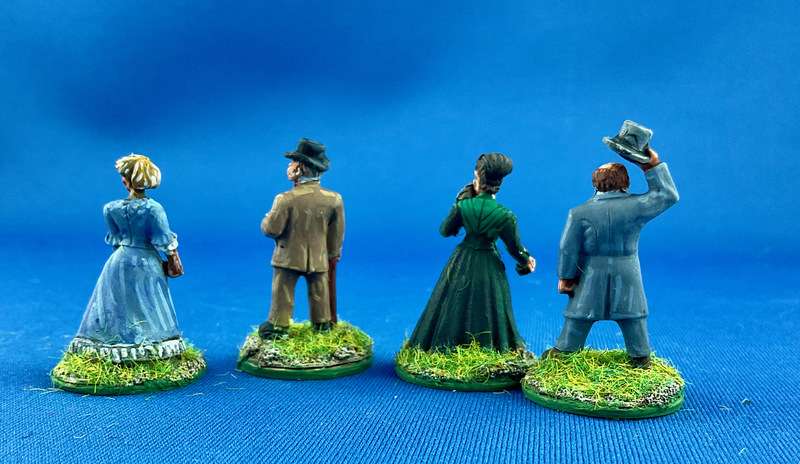
I can’t believe it’s almost the middle of January and I still have some finished projects from 2021 that I haven’t blogged here, so today I can offer these four Victorian ladies and gents from Foundry.

These minis were primed in Citadel Corax White and then painted with the Foundry tri-tone paint system, which I’m slowly feeling more comfortable with.  I’m happy with some of the colour gradients in the men’s suits and the blue dress.

These four were a test paint from several bags worth of Foundry’s Victorian civilian range.   I’m happy with them and plan to paint the rest for ACW (and my alt-ACW) tables.

Cheers and blessings to your brushes,

MP+

Monday, July 26, 2021

Perry Brothers Command and Artillery Figures for Upper Canada/Alt-ACW

I’m happy to have finished another batch of figures for my alt-ACW project, all from the Perry 1860s British Intervention Force range.   

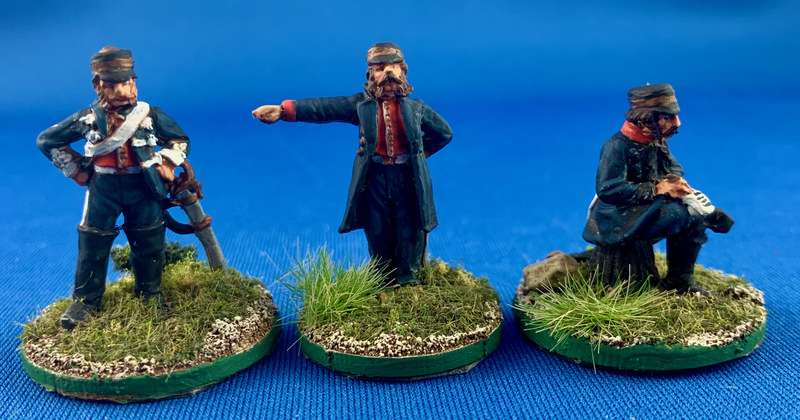
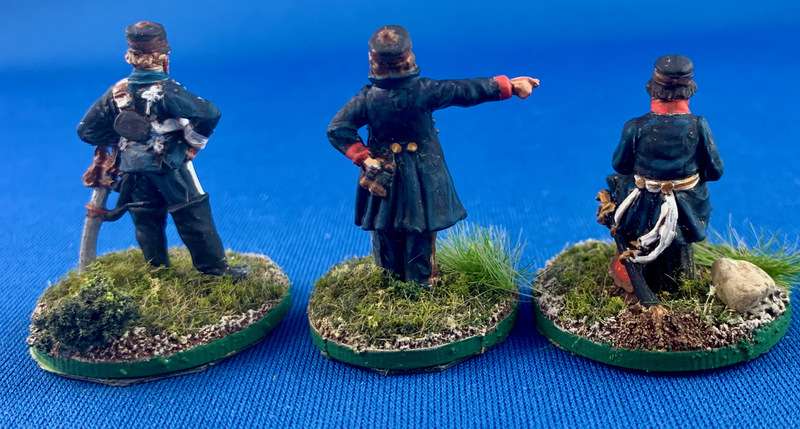
Command figures from set BIF 44, which are modelled on figures of the period such as Garnet Wolseley.  They’re painted using the Foundry tri-tone paint system, which I may slowly become a fan of.  The blue of the uniforms came out quite glossy, but the dullcote finish toned it down nicely.


“I say, chaps, it says here that we lost the Euro Cup to Italy!  Damn bad news, what?"

Bossy foot types.  Chap sitting on the stump is writing “Dearest mother, Canada is full of swamps and mosquitos.  Any chance Uncle Bertie can get me back to Horse Guards?"


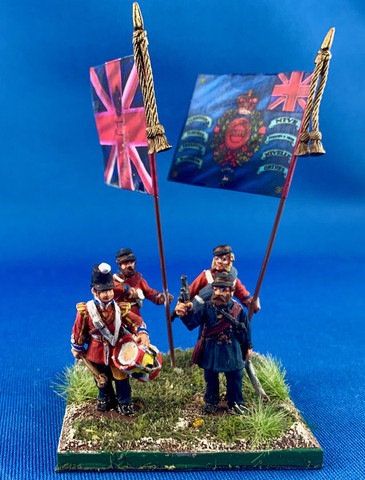
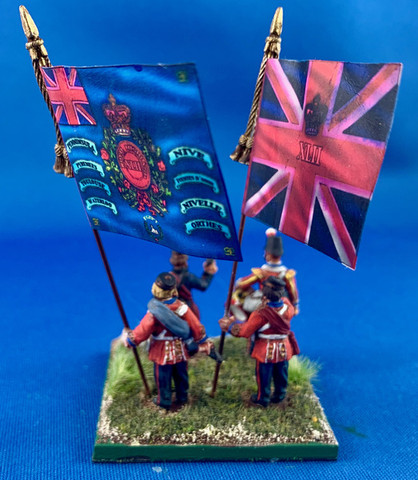
Command stand for a second unit of Canadian militia.   The flags are from Adolfo Ramos from his Crimean War range.  The battle honours might seem a bit spurious for a Canadian unit, but I can always say that this is a militia battalion affiliated with a famous British regiment and therefore entitled to carry its colours.  Or something to that effect.  At any rate, Adolfo’s flags are brilliant.


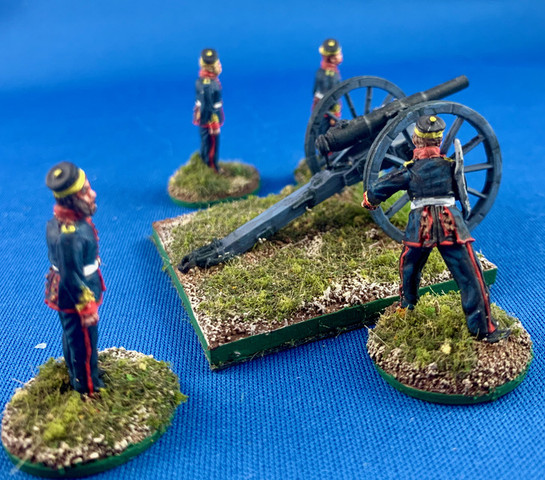
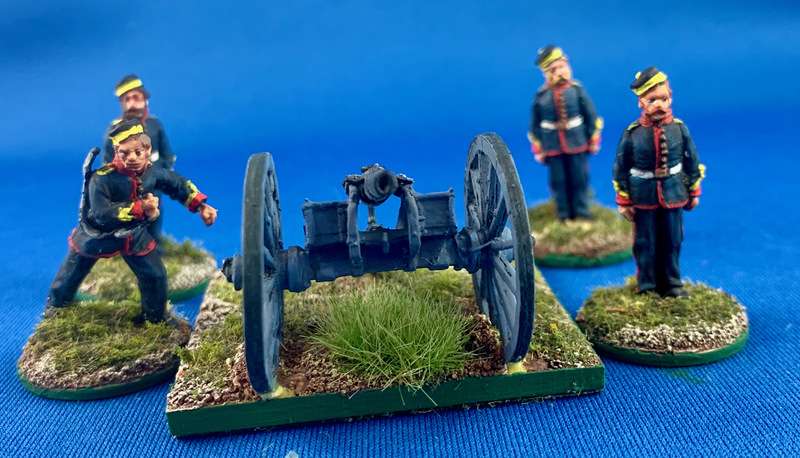
Finally, the Royal Artillery expand their presence in Upper Canada with a second Armstrong Whitworth gun and crew.   I think this uniform is incredibly smart, though the pillbox cap doesn’t look very useful for keeping the sun or rain off one’s hand, or for staying in place while operating a cannon.  Fun fact, Royal Military College of Canada cadets still wear this type of headdress as part of their ceremonial uniform.

The barrel looks a bit odd elevated off the carriage but I can’t figure out any other way to assemble it.


Hopefully I’ll get these chaps into action soon.   Thanks for looking and blessings to your brushes!

Monday, June 28, 2021

ADC/Staff Officer Tokens for Pickett's Charge ACW Rules


Hey friends:

My preferred rules of the moment for American Civil War battles are Pickett’s Charge, by Dave Brown, published by Reisswitz Press, a Too Fat Lardies imprint.   These rules give each side a varying number of ADCs or Staff Officers each turn, which help the player manage their force on the tabletop.  The same mechanic exists in Dave’s Napoleonic rules, General D’Armee, and as regular readers of this blog may recall, in April I created some ADC/SO tokens for the Austrian army.

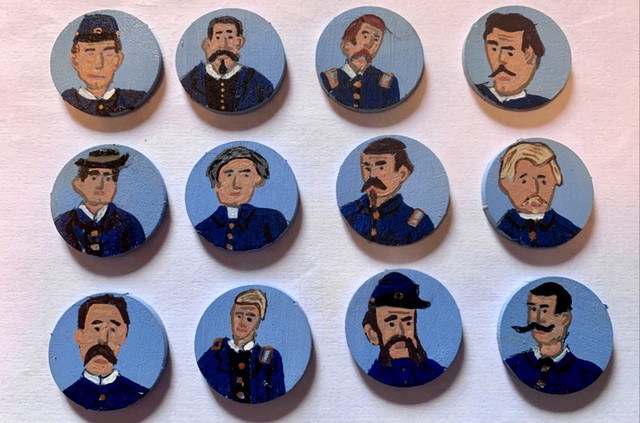
Recently I sketched some Union ADCs/SOs for Pickett’s Charge and finished them the other day.


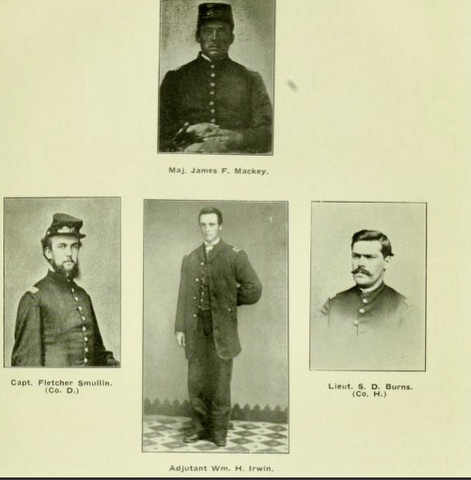
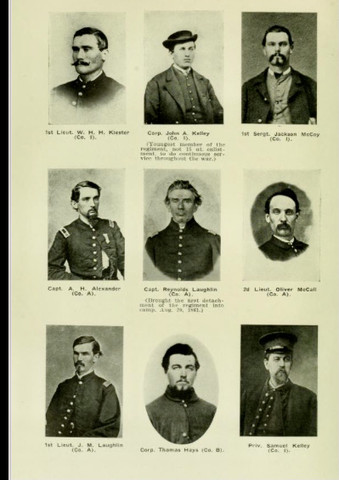
 My inspiration came from these photos of personnel from the 103rd Pennsylvania Regiment, from a digital copy of their regimental history.   The 103rd PA was roughy handled in the Battle of Seven Pines in 1862 as described here a while ago.  It gives me some pleasure to think that these old boys might approve of they likenesses and how they are being used.  Hopefully you can spot some of the inspirations for my tokens!

Making these tokens is a pleasant side project, and next up will be French Napoleonic and Confederate ADC tokens, as I ge to them.

Cheers and blessings to your gaming.

MP+


Blog Archive

Followers