Showing posts with label American Civil War Campaign. Show all posts

Monday, July 26, 2021

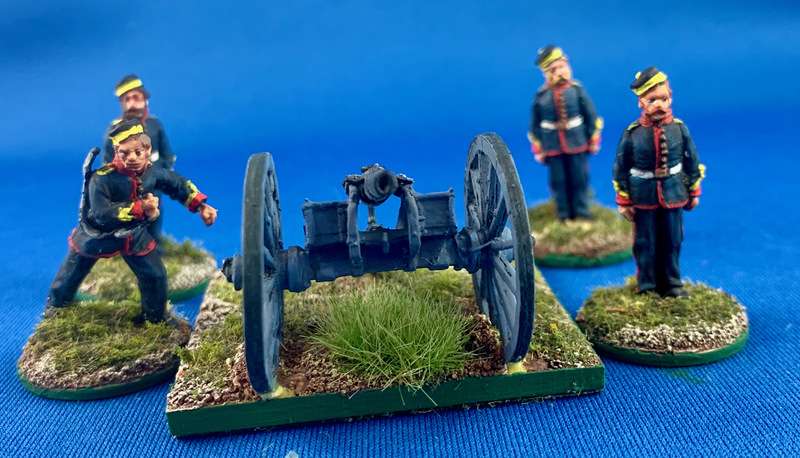
Perry Brothers Command and Artillery Figures for Upper Canada/Alt-ACW

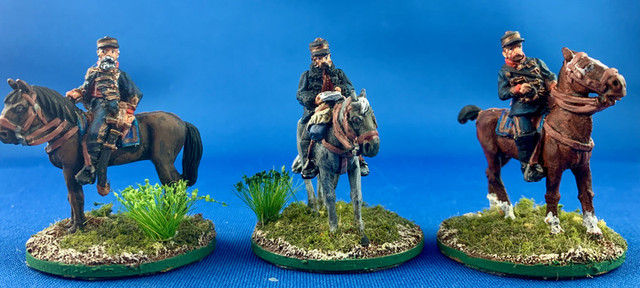
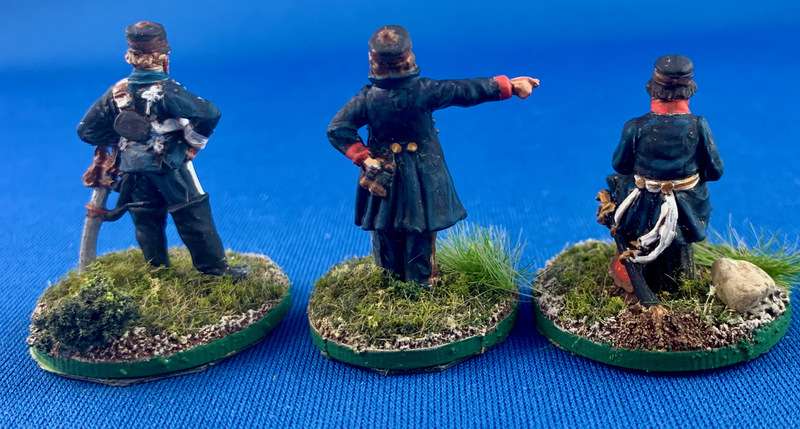
I’m happy to have finished another batch of figures for my alt-ACW project, all from the Perry 1860s British Intervention Force range.   

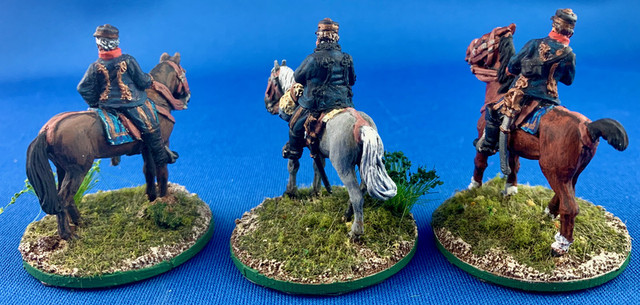
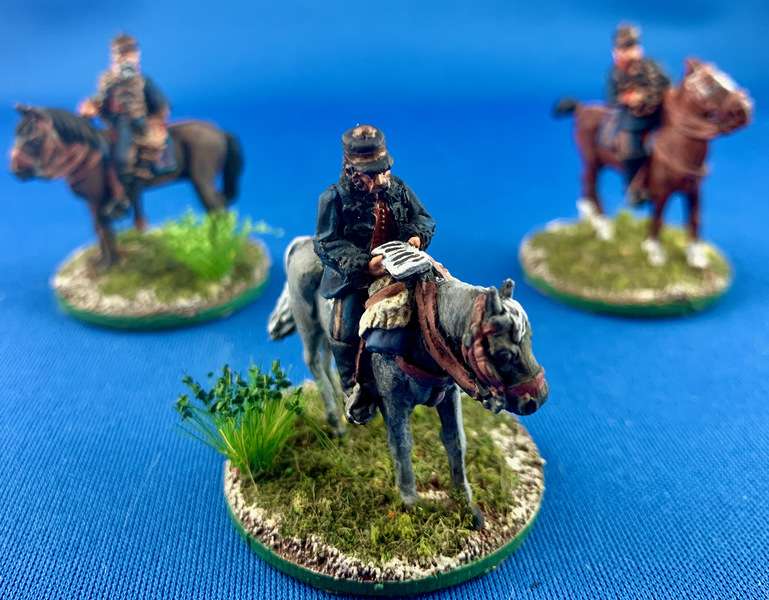
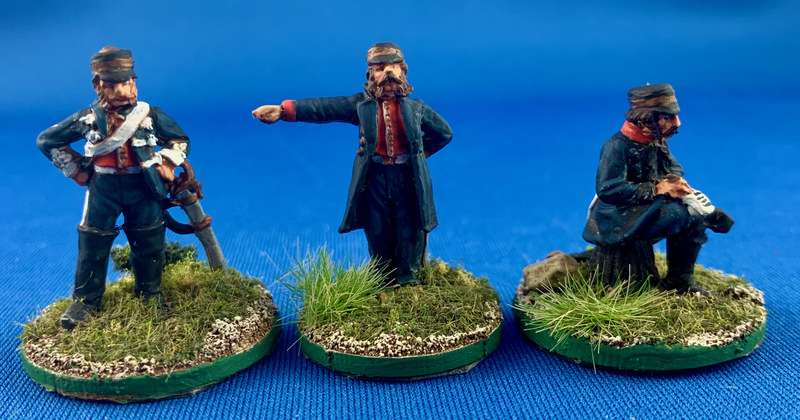
Command figures from set BIF 44, which are modelled on figures of the period such as Garnet Wolseley.  They’re painted using the Foundry tri-tone paint system, which I may slowly become a fan of.  The blue of the uniforms came out quite glossy, but the dullcote finish toned it down nicely.


“I say, chaps, it says here that we lost the Euro Cup to Italy!  Damn bad news, what?"

Bossy foot types.  Chap sitting on the stump is writing “Dearest mother, Canada is full of swamps and mosquitos.  Any chance Uncle Bertie can get me back to Horse Guards?"


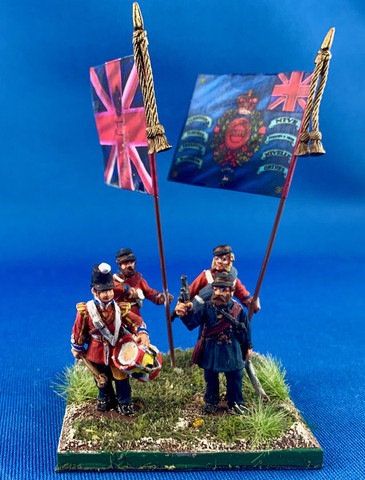
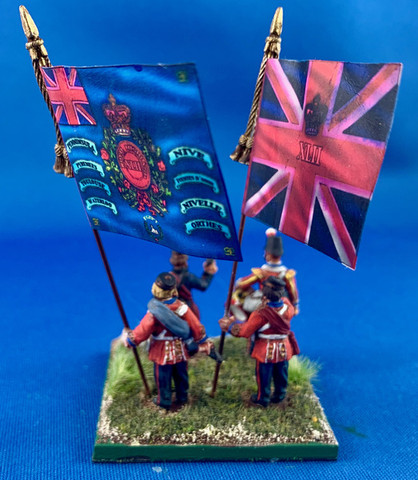
Command stand for a second unit of Canadian militia.   The flags are from Adolfo Ramos from his Crimean War range.  The battle honours might seem a bit spurious for a Canadian unit, but I can always say that this is a militia battalion affiliated with a famous British regiment and therefore entitled to carry its colours.  Or something to that effect.  At any rate, Adolfo’s flags are brilliant.


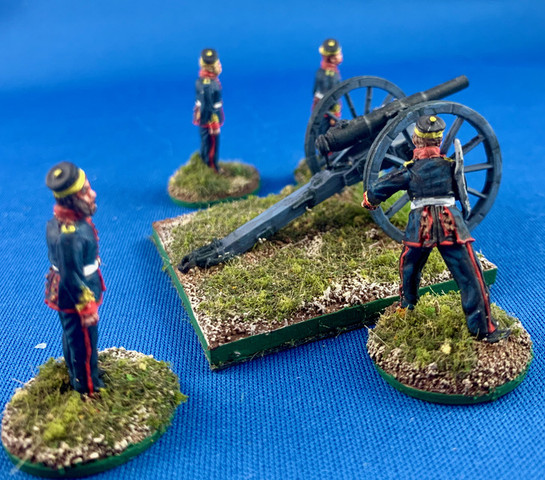
Finally, the Royal Artillery expand their presence in Upper Canada with a second Armstrong Whitworth gun and crew.   I think this uniform is incredibly smart, though the pillbox cap doesn’t look very useful for keeping the sun or rain off one’s hand, or for staying in place while operating a cannon.  Fun fact, Royal Military College of Canada cadets still wear this type of headdress as part of their ceremonial uniform.

The barrel looks a bit odd elevated off the carriage but I can’t figure out any other way to assemble it.


Hopefully I’ll get these chaps into action soon.   Thanks for looking and blessings to your brushes!

Tuesday, April 26, 2016

An Epic Night of Longstreet

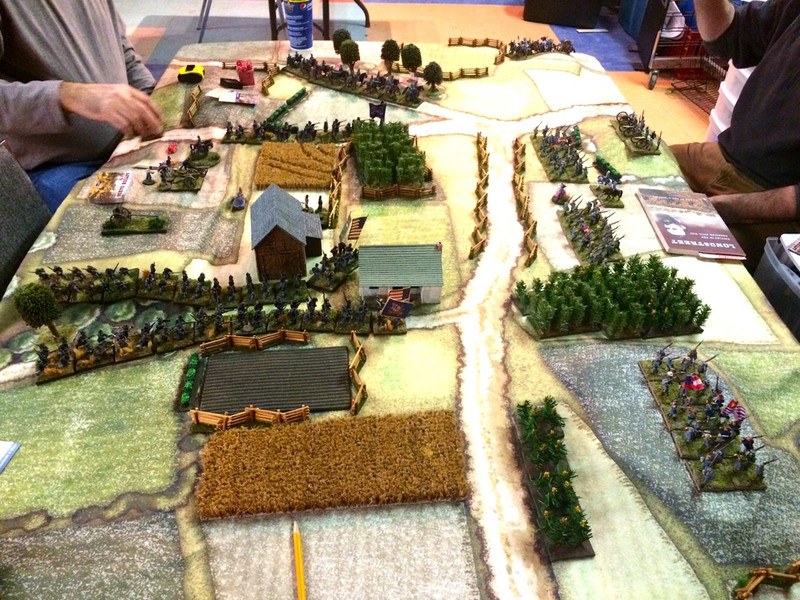
Four of us played a game of Longstreet at the wargames club last night.  It is quite a dark space, so I had to play with the exposure on these photos.

We used Len’s Cigar Box Battle Mat, which looked quite spiffy.  We put some styrofoam hills under the mat to create some elevations.    Stephen and I took the Union, while Len and Bruce took the Corn Fed Rats. We were both using the starting forces for a Longstreet Grand Campaign set in 1861

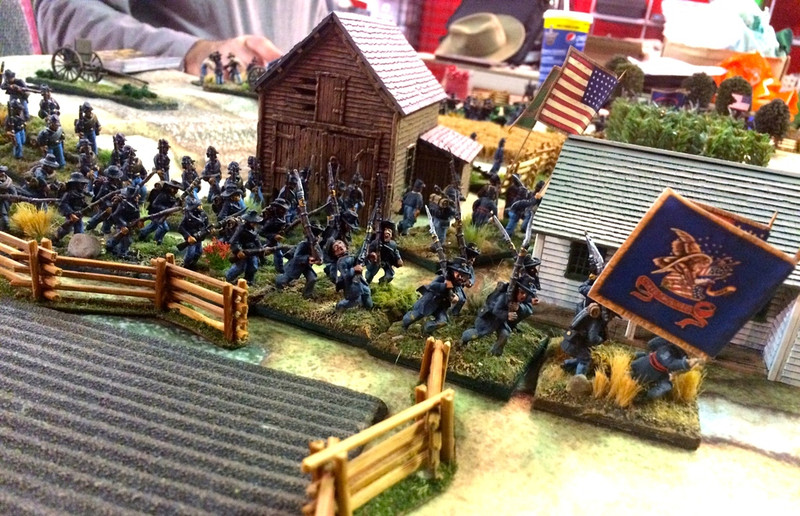
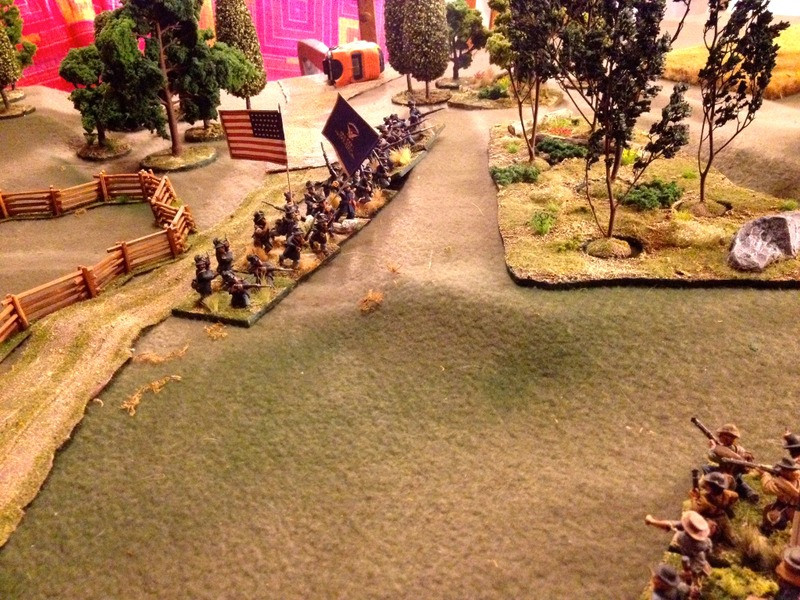
We are the attackers.  Our Union regiments go forward in column.   At the start of a Longstreet campaign, 10 stand units look quite impressive.

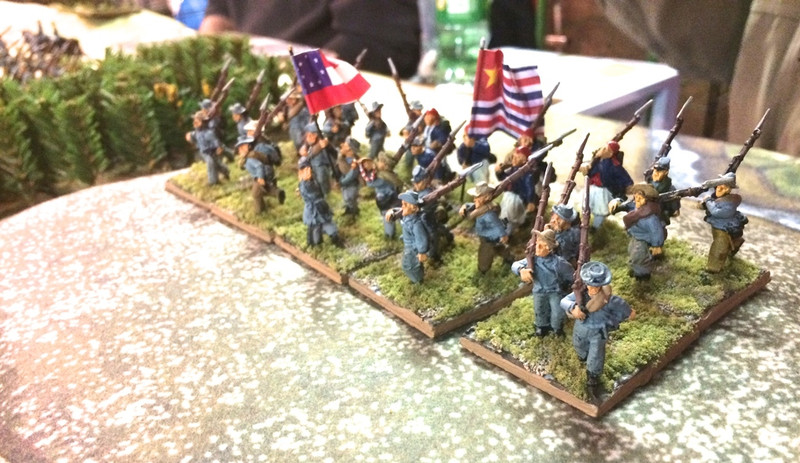
One of Len’s regiments awaits the onslaught.   All of Len’s units are Sash and Sabre figures, and looked quite fine.

The view from my position.  Two young ladies watch the battle in the foreground, obligingly serving as Objective Markers.   Both sides had artillery mounted on hills, but we found that the rule about Shooting Over Friendlies (Longstreet p. 41), which requires that there be 6BW or more between the artillery and the friendlies, and at least another 6BW between the friendlies and the target, meant that it was very for the artillery to support the infantry.  

The building in the foreground is one of Len’s - it looks very good.  Not sure what make it is.

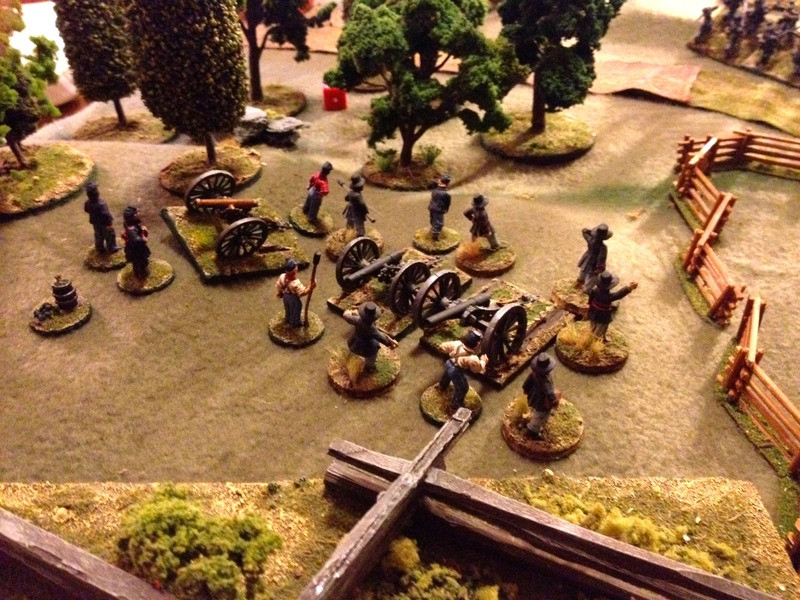
In the centre you can see that I pushed one of my artillery bases forward to engage the enemy with canister, but they were shot down before they could get off a round.  I didn’t regret the move, as it took some pressure off the Irish moving up in column to the right of the gun section.  in retrospect, though it’s not clear in the rule (Longstreet p. 20) on artillery formations, this may have been an illegal move, as I am not aure that one can break up artillery formations.

It all comes down to the big face-off.   I moved my two surviving guns to the right, where they could engage Len’s infantry on the hill on his left wing.  He saw my clever move, and brought his fellows down to shelter from the guns behind my black hats.

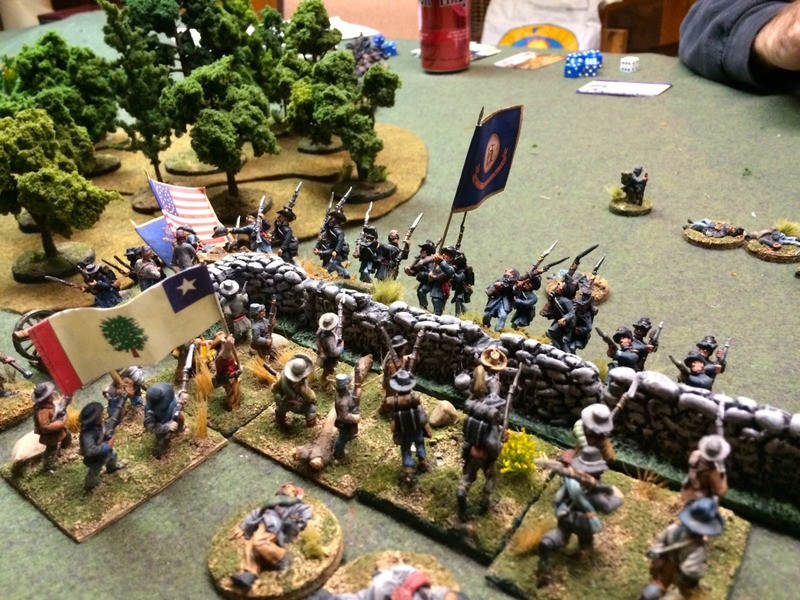
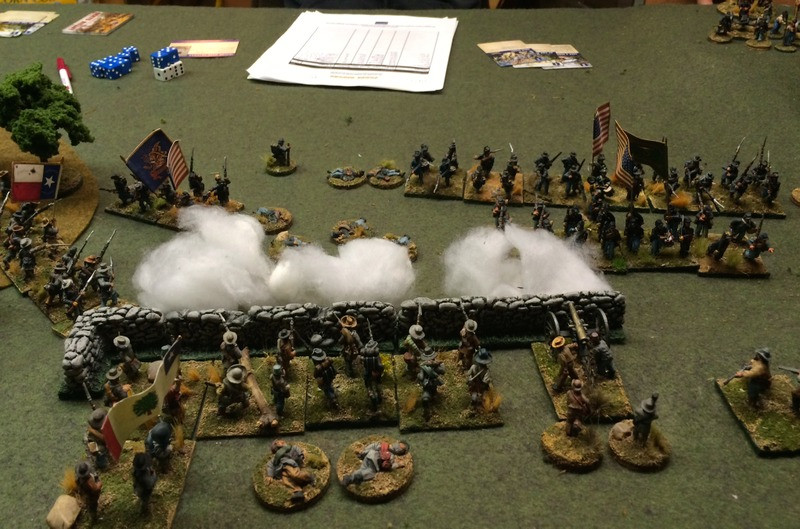
The big climax.   Stephen and I played the Charge Bayonets card (I think that’s what it was called) which allows units to shoot and then charge in the same turn.    


All four of our units charged, even the dismounted cavalry which don’t do as well in Combat as infantry do.  We split the honours, winning two of the battles on our right and losing two on the left.   We had an advantage, since all of the units started out as Eager, and Eager units do better on the attack than the defence.  However, with over thirty bases in total charging, that qualified us for three Epic Points, which means that we totally won the battle.  


We had time to run the post-battle process.  All four of our units kept their élan as Eager, while two of the rebel infantry units fell from Eager to Seasoned as a result of casualties.  It must have been because they got roughly handled in our Epic charge.  We were doing well until Stephen rolled for Reduction.  Out of nine dice for one of our nine-stand infantry regiments, Stephen rolled five “1”s, which meant that we lost five stands from disease.   Wow, the brigade shouldn’t have stopped at that IHop on the way home, the food poisoning was brutal.  Should have listened to the Adjutant, he thought that buffet looked dodgy.

We did ok one our Campaign cards, gaining 2 artillery stands (Light Rifles), a company of Sharpshooters for one infantry regiment, and raising our hardest hit infantry unit to Veteran status.

Here’s the Union force after the post-battle phase:

7 stands Cavalry, Eager Recruits

4 stands Infantry, Eager Veterans (w Sharpshooter company)

7 stand infantry, Eager Recruits

8 stands Infantry, Eager Recruits

1 artillery formation:  2 stands Light Rifles, 1 artillery formation

1 artillery formation: 1 stand howitzer, 1 stand 6 pdr smoothbore

Replacements: 6 stands infantry, Eager Recruits 

Hopefully next week this force can seek it’s next battle, in 1862.

Blessings to your die rolls!

MP

Monday, May 25, 2015

Another Longstreet Game: Holding the High Ground

On Saturday last, my chum James invited me over to an afternoon of ACW gaming and a delicious dinner of pulled pork courtesy of his lovely wife, Elizabeth.   A very pleasant day.  We revisited the brigades we had fought with in our previous game.   All figures are 28mm from my own collection.

James had two regiments of Seasoned Veteran infantry (4 and 6 stands strength), a regiment of Eager Recruits (5 stands) from his first fight, and a new regiment of Seasoned Veterans (6 stands) that he had gained between battles.   He also had 6 stands of Eager Recruit cavalry and two light (6pdr) cannon (he had lost a light howitzer in our previous fight).  You can read his account of the battle here, but I assure you that my account is more truthful.

My command, under Archibald Eustace Glossop, a renowned cavalry commander from the Mexican War, had two regiments of Eager Veteran infantry: the 21st Mississippi (6 stands), the 9th Texas (5 stands), and one of Eager Recruit infantry (14th Mississippi, 7 stands),  I also had 7 bases of Eager Recruit cavalry (the 9th Kentucky). I was well set with artillery.  Besides my three bases of light artillery from my first battle (2 cannon and 1 howitzer), I had also picked up another base after my first battle, a section of Napoleons.  One thing we had both forgotten to do after our first battle was to “top up” our brigades with green replacements to get us to the minimum strengths for brigades in the campaign game, so we could have had more figures on the table.  

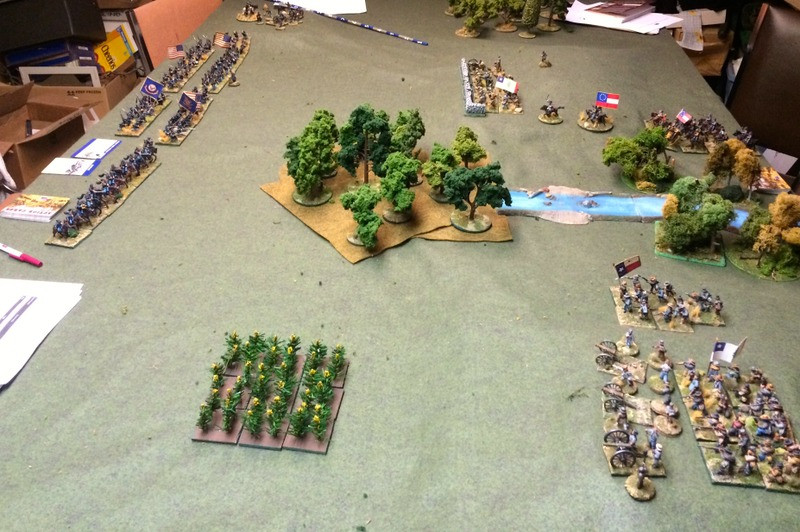
We rolled a random scenario, in which one side has to defend two hills separated by some nasty terrain.  Each hill was an objective marker.   Since James’ commanding persona is some kind of crafty Indian fighter, I was badly out scouted, and had to place my units in defence.  I had a few terrain choices, so I opted for a wall on the right hand hill, and a ford in the stream between the two hills, so I would have some sort of interior lines.

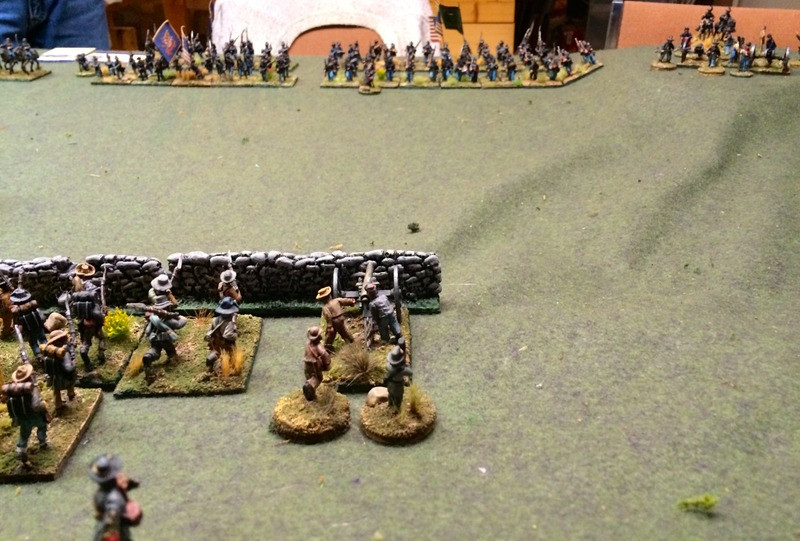
I placed all my light artillery on the left hand hill, with the 21st MS.  The 9th TX was in support, but also near enough to the ford that they could move to the right if James put his weight there.  On the right I gave my eager but still green boys from the 14th MS behind the stone wall, with the Napoleon, and assigned the 9th KY horse to support that flank. 

The 14th Mississippi and their supporting Napoleon watches the Yankee brigade massing in front of them.  James leaves his cavalry to threaten my left flank, and he’s evidently determined to mass his force to take my right.  

Trickiness!   James acquired this card in the post-battle stage of our last game, and plays it on me know.  I lose the top four cards from my action deck for all of this game, reducing my deck and potentially depriving me of some nasty tricks of my own.


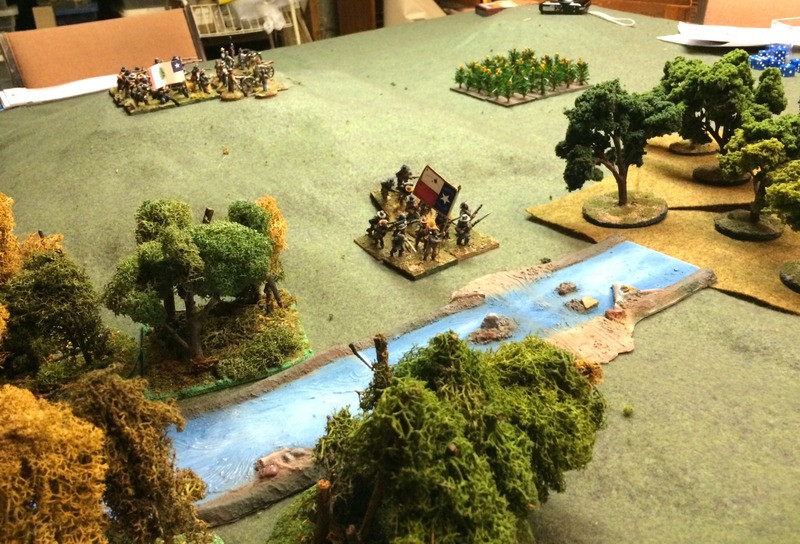
I immediately start to move my Texans to the ford to bolster the right flank, and have one my light guns on the left hill limber up to follow.   James plays a card which has the effect of halting the Texans for a turn, which was quite clever as it blocked up the ford and delayed the transfer of my artillery as well.

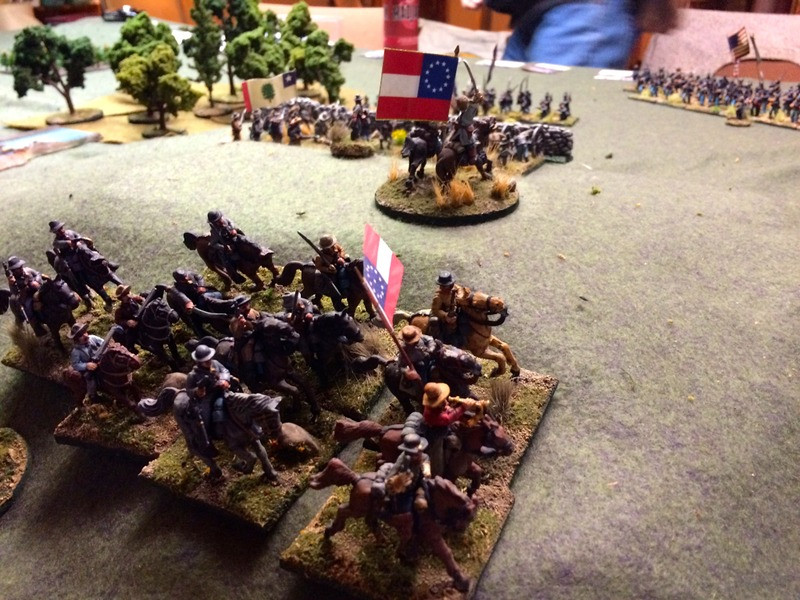
Fortunately the Kentucky cavalry aren’t likewise delayed, and they gallop behind the hill to take up position on the right of my line.  They will prove useful in the fight to come.

Artillery plays its part.   My Napoleon crew pours canister fire into the advancing bluecoats, while James bombards the Mississipians behind their stone well.  The cover advantage helps them enormously (James could only hit the on a 6 on a d6) and while they would lose two stands, the Mississippians hold firm.

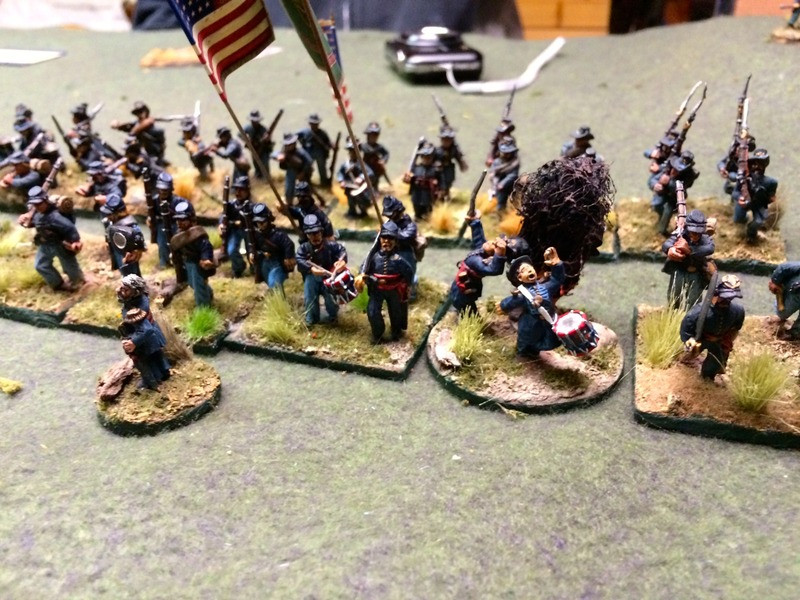
Cannister fire from the Napoleon tears gaps in the Irish line, but they still advance.

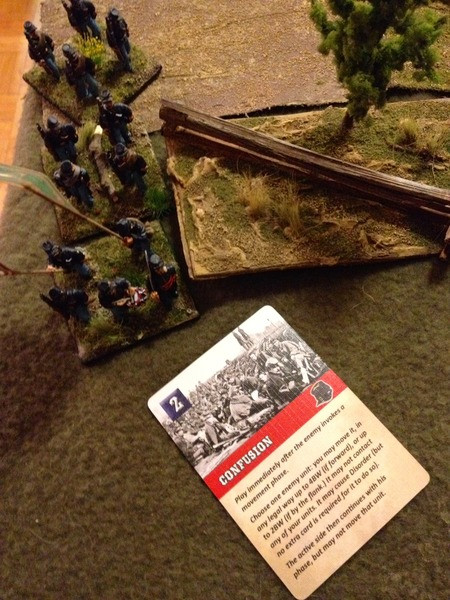
The reinforcement of my Texans on the right was further delayed when James played a Confusion card on them and they got mired in the swamp between the two hills.  My light artillery section did arrive and took up position on the left of the 14th MS, and frantically began to unlimber.  Meanwhile the 9th KY formed line and dismounted.  I had considered leaving them mounted, until realizing that Longstreet penalizes mounted cavalry in melee with formed infantry facing to their front, on the grounds that such engagements were rare in the ACW and usually ended badly for the cavalry.  Better to have the KY boys in a firing line, I thought, and their weight of fire would prove valuable.

James had a very sound plan of attack, which was to assault my position with as much strength as he could muster.  Alas for him, I played the Pinkerton Intelligence card, which invokes hesitation and prevents one unit from charging or attacking in a given turn.  I don’t think I get to play that card in scenarios after 1862, but it is helpful until then, and this meant that half of James’ brigade did not charge.  He had some success, capturing my light artillery before it could unlimber, but the 14th MS held firm and threw the Yanks back from the wall in confusion.

My boys pour it into the Yanks while the Texans finally emerge from the swamp and threaten the Yanks’ flanks.

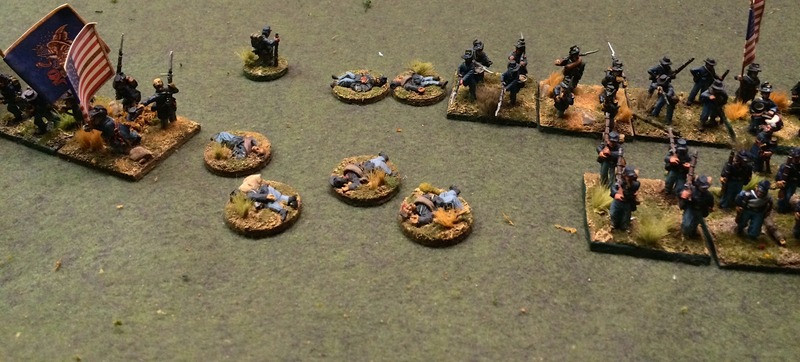
In a scene very reminiscent of Fredericksburg, the Yanks fall back from the deadly wall, leaving the field strewn with their dead and wounded.  James has had two of his four infantry regiments wrecked, and lost his chance to storm the objective.   He preserves his force for another day.

In the post-battle phase, I get my second victory of the campaign, (2 for 2) but neither James or I get promoted (nothing really but a Longstreet mechanism for bragging rights).  He picked up an Epic Point for capturing my gun, but I got two Eps for holding both the objectives.   In the after battle reckoning, none of my regiments lost any Elan for tacking casualties, so all four are still rated as Eager.  However, sadly, both my Eager Veteran infantry, both untouched during the battle, lost two stands each from disease.  Poor camp discipline, I fear.  On the positive side, I was able to raise the 14th MS to Veteran status and did receive a second Napleon to bring my artillery to four bases.  I also received two green units to bring me up to full strength for a CSA brigade in 1862 (less than the Union max strength).

Glossop’s Brigade now consists of:

Infantry:  21st Miss (Eager Veteran) 4 stands,  9th Texas (Eager Veteran) 4 stands, 14th Mississippi (Eager Veteran) 5 stands, 31 Tennessee (Eager Recruit) 7 stands, 25th Mississippi (Eager Recruit) 7 stands.

Cavalry: 9th Kentuck (Eager Recruit) 5 stands.

Artillery: 1 6pr smoothbore, 1 6pd Howitzer, 2 Napoleon smoothbores.

Our impressions of Longstreet continue to be positive.  We like the card system as a way of simulating friction and command and control, and enjoy the fun of putting a stick in the other’s spokes at a key moment in the fight.  We also like the way Longstreet plays to a fairly quick conclusion once we have the basics mastered.   The campaign game calls for two battles in 1862, so we look forward to another 1862 punch up with our regrouped and reinforced commands.

Blessings to your die rolls,

MP+

Sunday, January 11, 2015

First Time Playing Longstreet: Battle of MacGillicuddy's Corners 2`

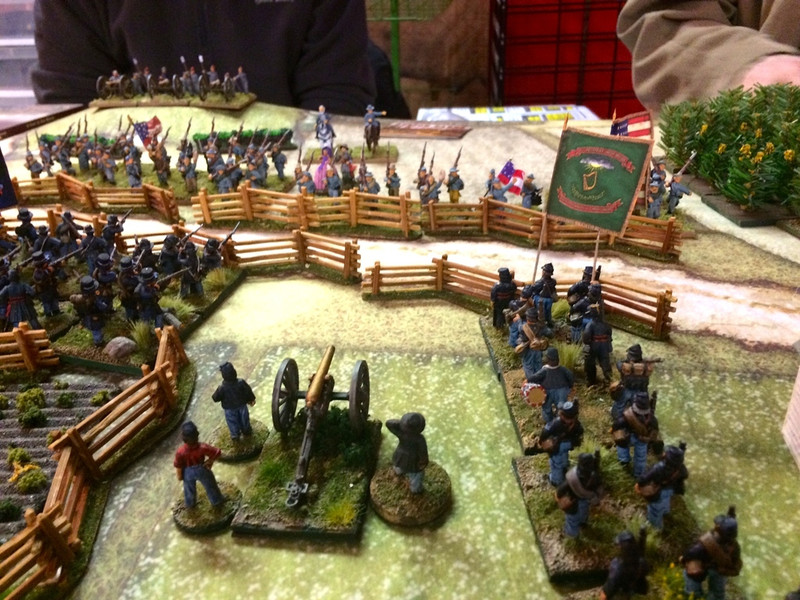
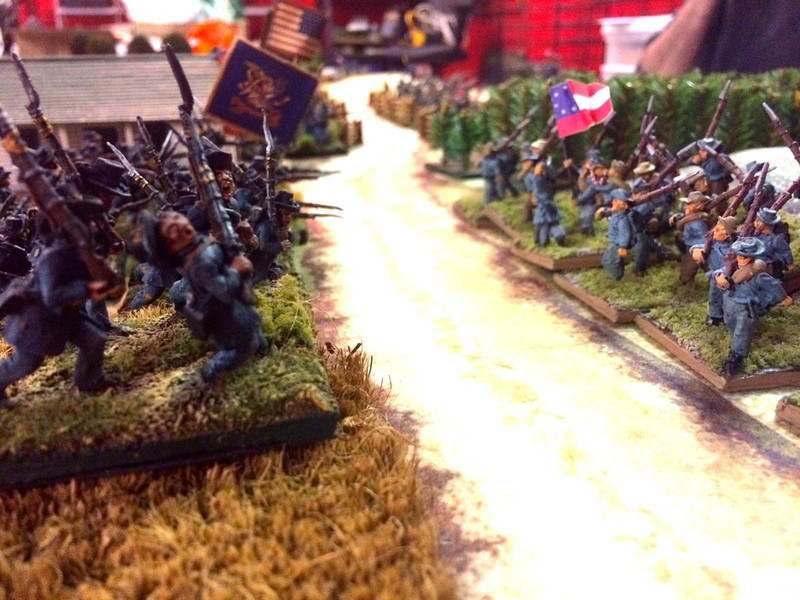
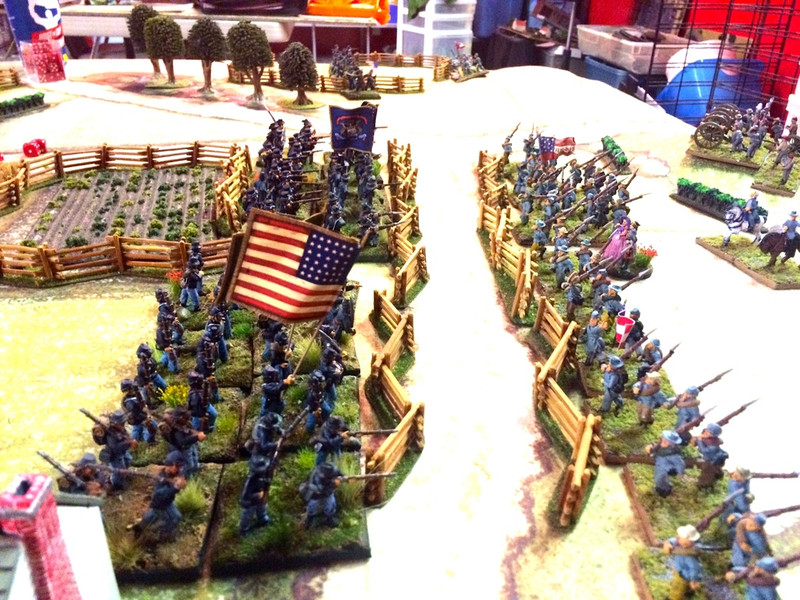
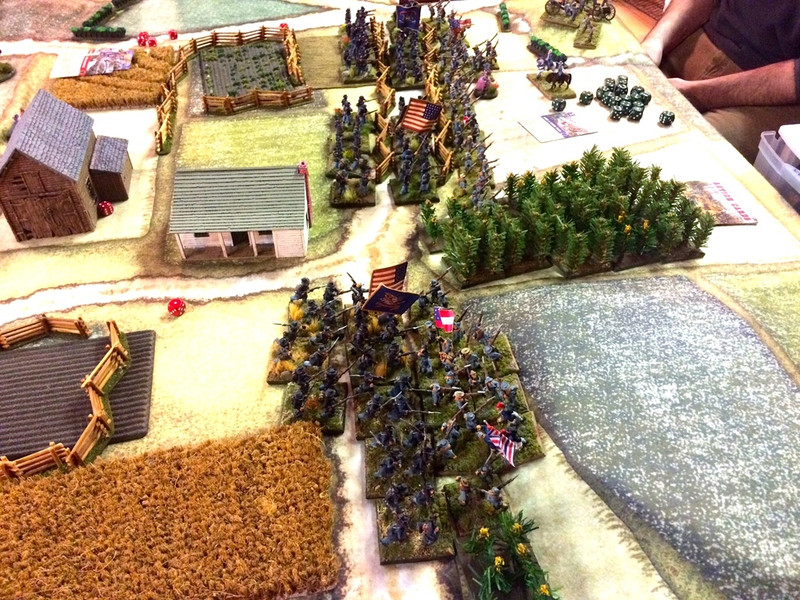
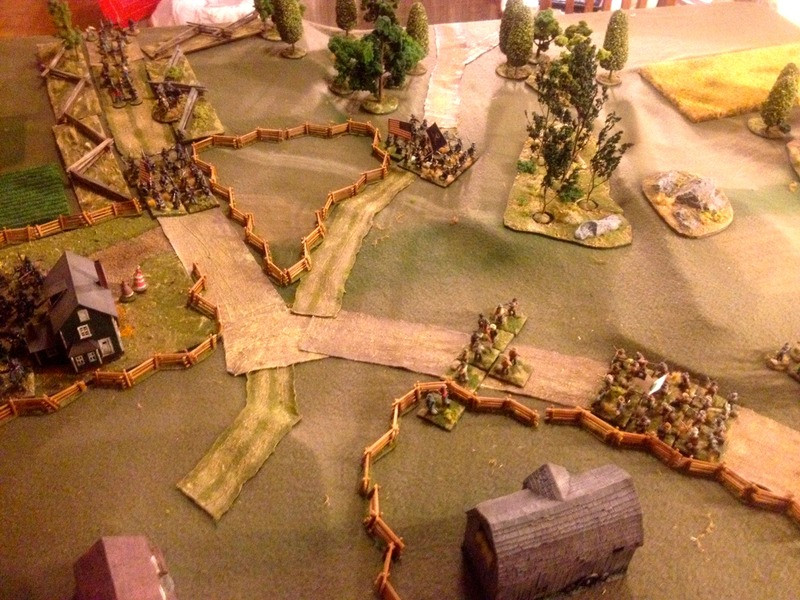
Just to recap on my first post, here’s the battlefield as the meeting engagement between Schotz’s brigade of Wisconsin volunteers and Crutch’s brigade of Zollicoffer’s division develops.  As Miss MacGillicuddy and her maid watch from the yard of their farmhouse, the rebs’ superior initiative has seem them win the crossroads.  In the Confederate centre, the Kentucky Rangers have dismounted and gone into line while the 31st MS hustles up behind them, and Snedden’s Battery, just visible bottom right, heads for the hill to the right of the 31st MS.  On the Union side, the Pabst Blue Rifles top centre head for the woods while the Schlitz Jaegers hustle down the road with Engel’s Milwaukee Brewers Battery behind them.  On the extreme left, the US cavalry, the Kansas Liberty Jayhawkers, ride around the side of the MacGillicuddy farmhouse.

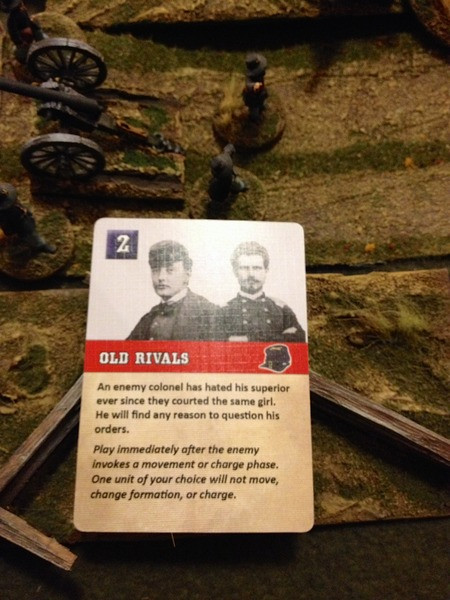
A sneaky card.  At the beginning of the US Movement Phase, the CSA plays the Old Rivals card, which halts the Brewers Battery for this turn.  Since they block the road which is the entrance space for the Union, the third US infantry regiment, McCleary’s Navvies, cannot enter this turn.   Presumably, given the bad blood between the two families, the battery commander, Ernst Engel, didn’t like Schotz’s order to pull off the road to his left and go into battery on the hill.  “Damn his eyes”, Engels tells his aid, “What does that Prussian pig know about how to site a battery.  Ride over there and check the position for yourself, and report back.  Schotz will have to wait."


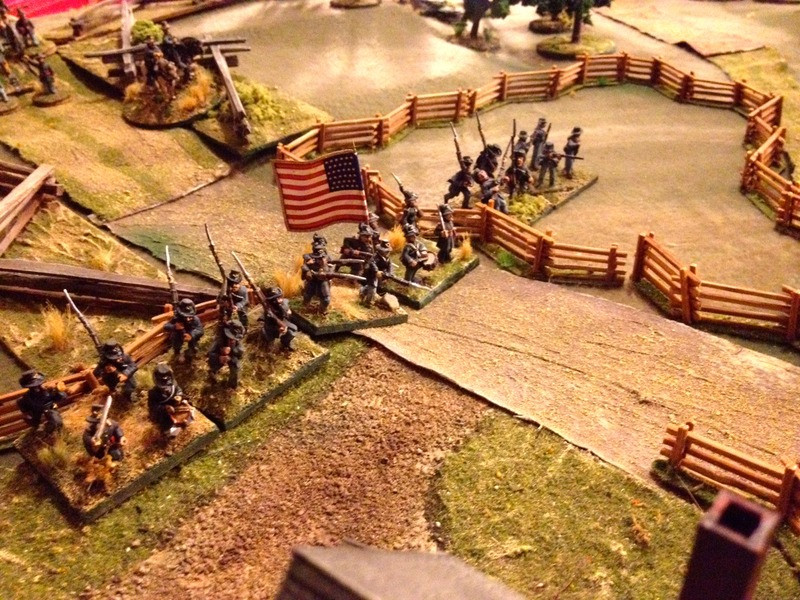
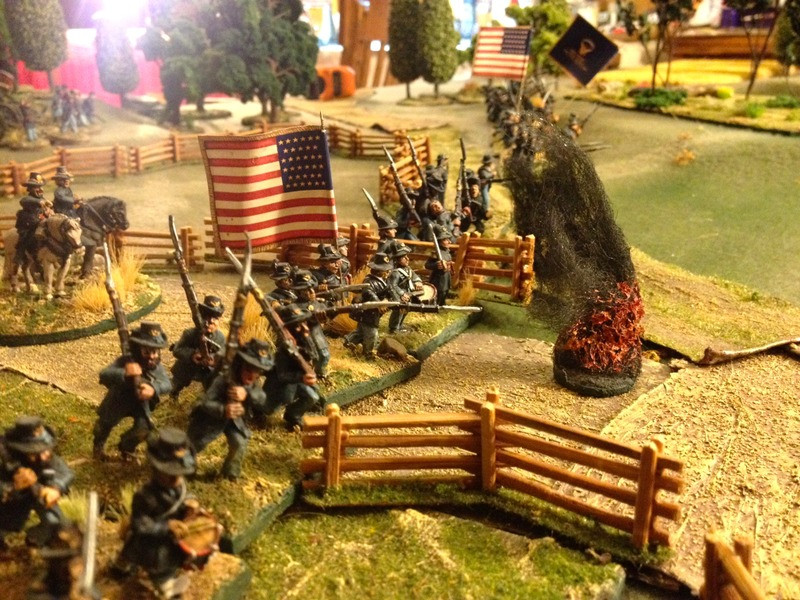
The Kansan cavalry don’t like the force stacking up in front of them and decide this fencerail will do just fine as a position to hold.  They dismount, safely out of range of the rebel horse, who are moving by their left flank to give the Mississippi infantry space to deploy.

The Schlitz Jaegers go into line.   In Longstreet during a movement phase a unit can either move or make a formation change, but not both, unless certain special cards are played.


Col. Schotz’s nephew Max rides over to the Pabst Blue Rifles and tells Major Vogelsang to have his regiment go into line and advance to the woods on the top of the hill.   The excited and greenhorn unit sorts itself out into line.


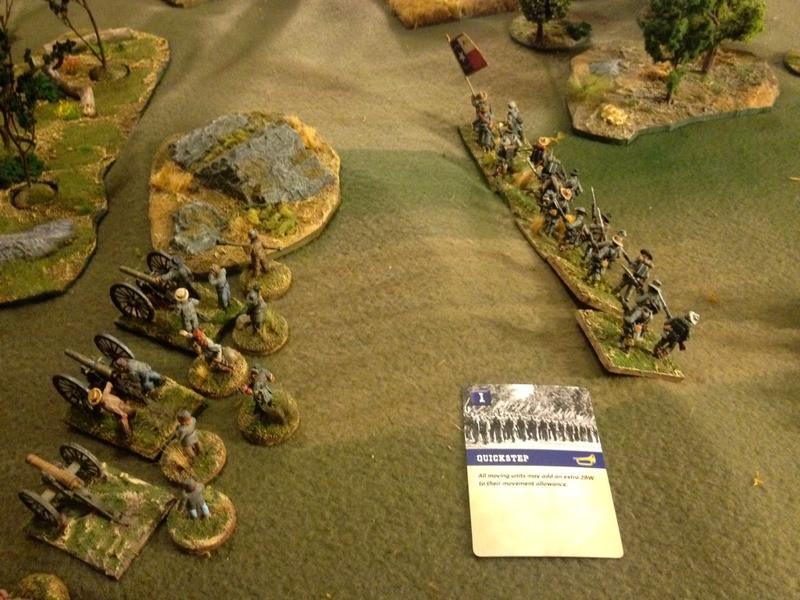
On the CSA turn, Snedden’s battery unlimbers on a two-level elevation hill, their view blocked by the woods to their right, but with a commanding view of the battlefield to the left of the hills.  Meanwhile, the 19th Texas (Galveston Rifles) are sent on a flanking move to the CS right.   The CS player (me, rather cleverly) uses the Quickstep Card (the bugle icon indicates that it modifies a movement) to give the column two extra Base Widths movement, for a title of 8 BWs, or 16”.  This was the point in the game where I realized that according to the rules, a column was a unit of bases in single file.  My previous formations, which I thought were columns, were actually two BW wide lines of three ranks.


The situation thus far.

On the CS side, the Kentucky Rangers have moved by their left flank into the barnyard and hold the fence, while the 31st MS are going into line with the 5th Kentucky (“The Lincoln Killers”) hustling up in column behind them.  Snedden’s battery is unlimbered on a prominent hill, while the 19th TX, the Galveston Rifles, marches by column to extend the Rebel line and protect Snedden’s guns should the Yankees get ideas.

By now the Schlitz Jaegers are in line and have come up, their right tied in with the dismounted Kansan troopers, their left not far from the Pabst Blue Rifles.  Col. Schotz has ridden forward and placed himself behind the Schlitz Jaegers, while Engel’s Brewers’ Battery finally gets to its assigned position after some frantic gesticulating by Col. Schotz, which Engels has politely ignored.   But where are the Irishmen of McCleary’s regiment?.  


McCleary’s regiment finally arrives now that the artillery isn’t blocking the road, but the CS plays the Confusion card, which allows the CS to pick one US unit and move it as long as the move is to the front or flank.  For some reason, McCleary things he has to leave the road and cross the fence line into the pasture on his right.   Schotz watches in dismay.  “Damn that fellow, what is he doing?”  When red banded cards are used in Longstreet to interrupt or sabotage the other player’s turn, they are removed from the deck for the rest of the game, they are not reshuffled.  Hopefully Schotz’s frustrations will abate, but the CS player has now been able to confuse the US deployment for two consecutive turns.
 

At least something is going right for Schotz.  Engel’s battery is now in position.  Next turn it can unlimber.


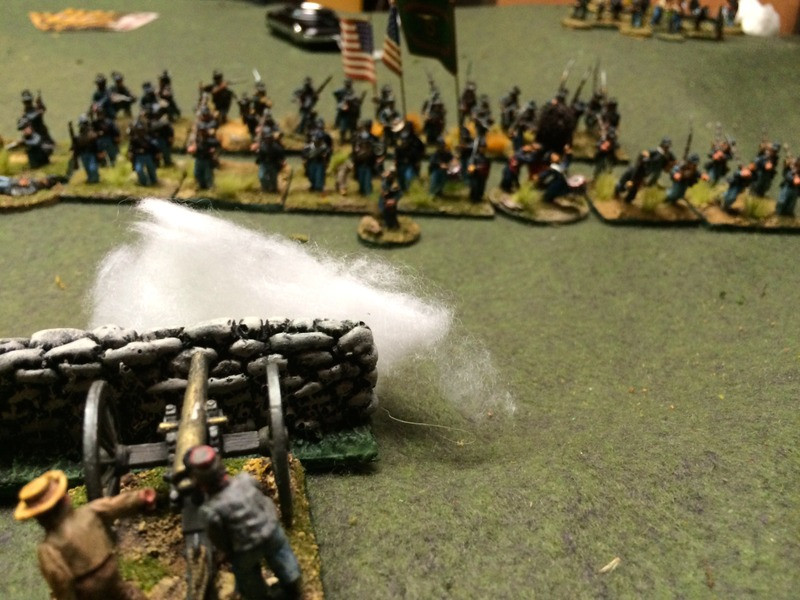
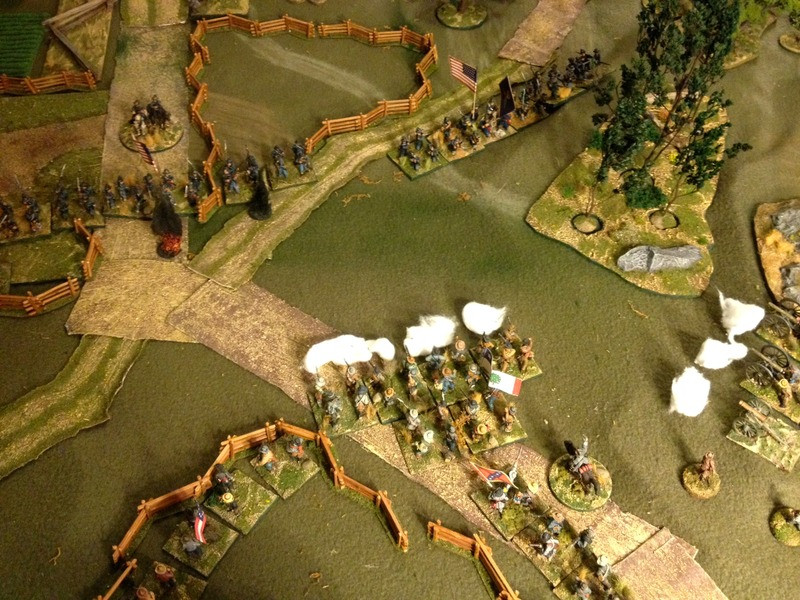
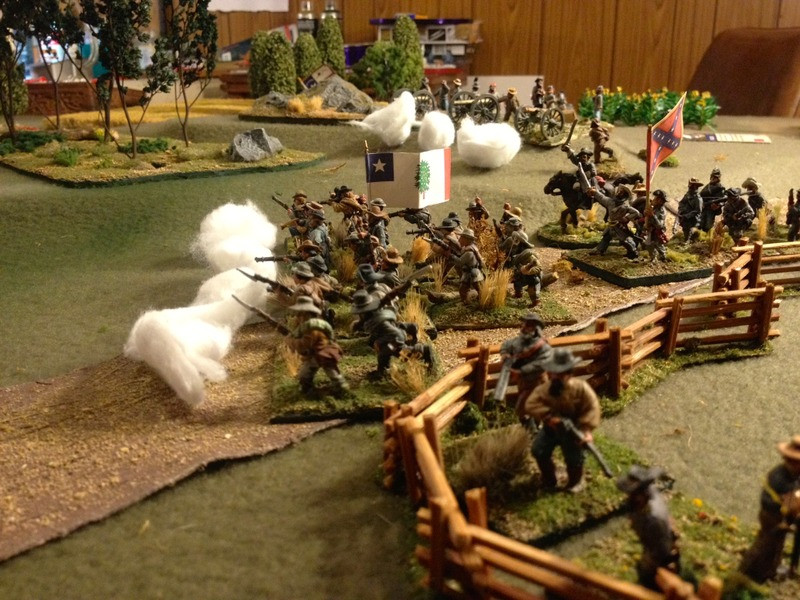
“Give ‘em hell, boys!”  Abner Crutch decides he isn’t going to wait until the blue bellies are all nice and positioned.  He’s going to do some shooting!  The CS opts to start their next turn with a fire phase.  Longstreet asks that cotton balls or some similar indicator be used to show firing units, which are ineligible to move that turn.  Four bases of the 21st MS and all three sections of Snedden’s battery have a line of sight to the Schlitz Jaegers in the centre.  Infantry range in Longstreet is 6 BWs maximum.  Artillery at ranges 6BWs or less fire canister, and at longer ranges do what’s called Bombardment fire, which is less deadly.

Artillery in Longstreet, if on an elevation, can fire over the heads of friendlies provided they are more than 6BWs from the guns and more than 6BWs away from the target.  In this case, while the 31st MS are slightly less than 6BWs away from Snedden’s battery, the rebel gunners are on a level two elevation, so I gave them the shot.

Mississippi boys fire their first shots of the war in anger.  The dismounted cavalry in the foreground have no targets within 6BWs


A bad few moments for the German boys from Milwaukee as the first Confederate shells crash around them.  Col. Schotz watches grimly just to their rear.  It looks like a deadly fire.  Will the Schlitz Jaegers be decimated?

More to follow.

Before I sign off, there was a comment in my first post about the fence rails and who made them and how.  The ones visible in this shot were made by hand by my friend Mike  I’m not sure how but he painstakingly glues them together and bases them on pieces of cardboard, which I flocked.  Since he’s retired and has a lot of time, Mike makes them in massive amounts and I buy them, rather cheaply, by the foot.  I just bought another four feet off him since a good ACW tabletop needs a lot of fences.  The much larger, chunkier fencerails were made by me, some years ago, when I was using a wood stove to heat my house at the time.  I bought a huge back of cedar shims from a hardware store and split with my axe and glued them together on MDF bases.  To my mind they now look crude and far too big compared to Mike’s fences, but maybe there is a place for both?  What do you think?

Blessngs to your die rolls!  MP+

Tuesday, January 6, 2015

First Time Playing Longstreet: Battle Of MacGillicuddy Corners, Part One

I’ve been meaning to give Sam Mustafa’s ACW Rules “Longstreet” a try for a while now, so this series of posts will be a kind of initial impressions / review / demo game.

First, it’s a bit of a mystery to me how I gravitate to some rules systems over others.  When I first started playing ACW miniatures in the late 1980s, the group I hooked up with was using John Hill’s Johnny Reb Two, which is what I started to build my own collection on, using JRII base sizes (still follow them today, for consistency’s sake).  I found Johnny Reb a little gamey and somewhat complicated, and didn’t really stick with it over the years, though I dutifully bought his Third Edition.  Too Fat Lardies seemed a logical next point, and I like their rules for larger battles, They Couldn’t Hit an Elephant, and their skirmish rules, Terrible Sharp Sword.   I’m also aware that there are a multitude of other rules out there, and it seems to me that Regimental Fire and Fury is a popular title.  I believe Hill has come out with a new title, Across a Deadly Field, which seems well supported with scenario books.  However, I ended up deciding on Sam Mustafa’s Longsteet. Other than the fact that I liked his SYW rules, Maurice, I have no explanation for why I ended up here.  

The first thing that might put some off Longstreet is that it is card driven.   I like card driven rules myself, and find them eminently suited for solo play, which I do a lot, but not everyone likes them.  The second thing that might deter people is that to play Longstreet, you need two decks of cards, one for each player, so it could be $60 before you can get started.   however, the cards are well produced, so some may feel that they have gotten their money’s worth.  About two thirds of the cards regulate play of the game, while the others provide a randomized system for terrain placement and for commander’s personalities.

Something else which may put players off the Mustafa way of wargaming is his decision to use Base Widths (BWs) rather than standard units of measurement such as inches.  One of the advantages of Sam’s systems is that he is agnostic about base sizes - provided that your bases are either squares or 3:2 rectangles, they should work fine. Since most of my infantry stands are on two inch square bases, I decided on two inches as the basis for a BW.  Since I found it a little annoying to mentally convert my tape measure into BWs, I spend a dollar at the DIY store on a four foot piece of dowel and after a little bit of work with some painter’s tape and paint, I had created this masterpiece.
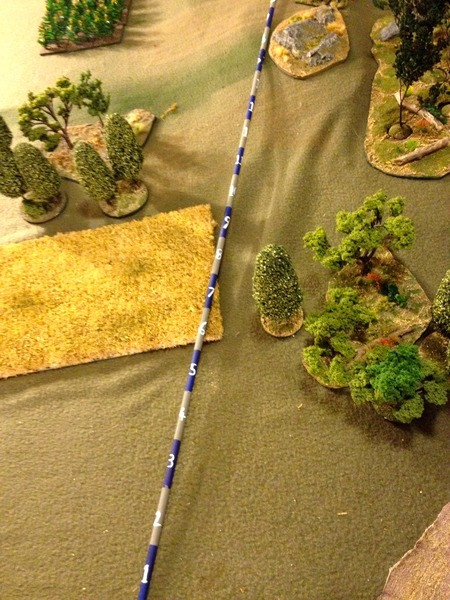
See what I did there?  Blue and grey?  Clever, huh?

Within the rule book the rules themselves take up about half the space, and the rest is dedicated to scenarios, army lists and a campaign setting.   Being me, I had to try the campaign system, starting in 1861, and drew a random general to represent me on the table.  I got a fellow with European service.
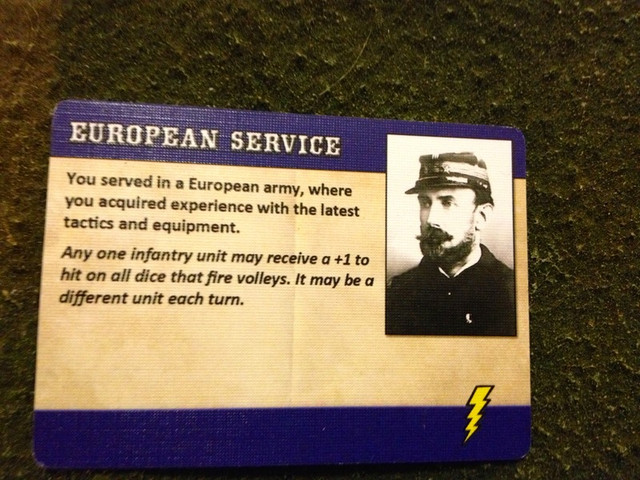
The little lightning bolt means that if a player uses the character’s ability in italics (the volley firing bit) there is a chance that the character can be wounded (Player Characters in Longstreet campaign games are never killed).  I’m sure Messrs Stuart, Jackson, Reno and Sedgewick all wished they had that ability.

So he became Hienrich Schotz, whose family had served for generations in armies of the Kings of Prussia.  Schotz had been a Major of Infantry, assigned to training recruits, but his career had come undone when he wanted to advocate for more humane ways of training.  His  brother Bruno had already immigrated to Milwaukee, where he had become a prominent sausage maker, so Heinrich moved to America in 1851 to join Bruno in business.  Their youngest brother Otto, an apprentice in a Munich brewery, soon joined them. Together they all went into business as “The Brat Brothers”  and opened an emporium that combined food, good German pilsner, buxom fraulein servers in traditional dress, and the latest sports news brought in over one of the first telegraphs in Wisconsin.  Historians of the sports bar see the Schotz Brothers as founders of an American way of life. When the war came, Bruno and Otto both landed fat contracts to supply Wisconsin regiments.  Heinrich, who had no appreciable business skills and was frankly a nuisance to them, was encouraged to offer his services to the state volunteers.  Thanks to his political connections in Milwaukee’s old German ward, Schotz soon found himself a Colonel commanding a brigade of mostly immigrant 90 day state volunteers.

Known to his men as “Hot Schotz” for his irascible manner and emphasis on musketry, Schotz’s brigade consists of:

An assigned regiment of Kansas cavalry, “The Liberty Jayhawkers”.  Not really a German speaking unit, there are some issues of communication.

Two German regiments from Milwaukee, the “Pabst Blue Rifles” and the “Schlitz Jaegers”.  Of these, the former is Roman Catholic and working class, while the latter is mostly Lutheran and recruited largely from shopkeepers, clerks and other businessmen, so there is some tension between the two, largely German speaking regiments.

A regiment of mostly Irish labourers and factory hands, named after their Major, “McCleary’s Navvies”, very few of whom understand any German.

A battery of three sections of artillery (2 of 6lber smoothbores and one howitzer), “The Mikwaukee Brewers”, commanded by Ernst Engel, son of a prominent immigrant beer maker, Max Engel. Unfortunately Heinrich’s brothers reneged on an exclusive contract to supply their tavern with Engel Lagerbier, and so relations between Schotz and his battery commander are a little frosty.  

All troops are rated as Eager Recruits, combining the worst of élan and inexperience.  The Longstreet campaign came calls for starting units at 10 bases strength.  Due to the limits of my collection and it’s size (25-28mm), I opted for six bases per unit.

Schotz’s Milwaukee Brigade was sent to Kentucky to work under the command of General George Thomas, serving alongside another western brigade commanded by Albin Schoepf, another European born officer who has served in the Austrian and Ottoman armies.  Thomas refers to Schoetz and Schoepf as “my two fighting Dutchmen” and the two brigadiers get along well.   In early fall of 1861, Schotz is ordered to advance towards the Tennessee border and hold the hamlet of MacGillicuddy Corners in case of a suspected CSA troop movement.   In fact a brigade under CS Colonel Abner Crutch of Zollicofer’s Division has orders to take the same crossroads.

A meeting engagement seemed the best way to learn the manoeuvre rules in Longstreet, and so I chose two mirror forces reflecting early war troops of both sides, keen but not well trained.

As is my usual practice, i laid out a table that I found both plausible and attractive.  This layout allowed me to use some recently competed terrain features, and some very spiffy fencerails that my friend Mike Barratt made for me, to replace the hideous older ones that I made some years back and which can be seen on the big bases at the Union entry area below.


Union force enters the table from the bottom of the picture.  The 6th Kansas “Liberty Jayhawkers” lead the way, followed by Colonel Schotz, followed by the Milwaukee Jaegers.  On the left, the Pabst Blue Rifles move off from their start positions towards the table centre.
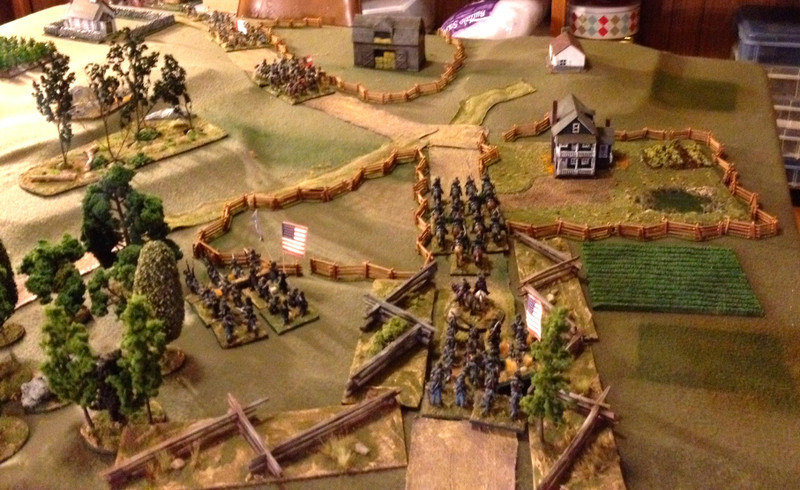
 

Col. Abner Crutch’s brigade enters from the other table edge.   A local unit, the 3rd Kentucky Rangers, a cavalry unit, leads the way, followed by the 31st Mississippi, followed by Snedden’s battery.
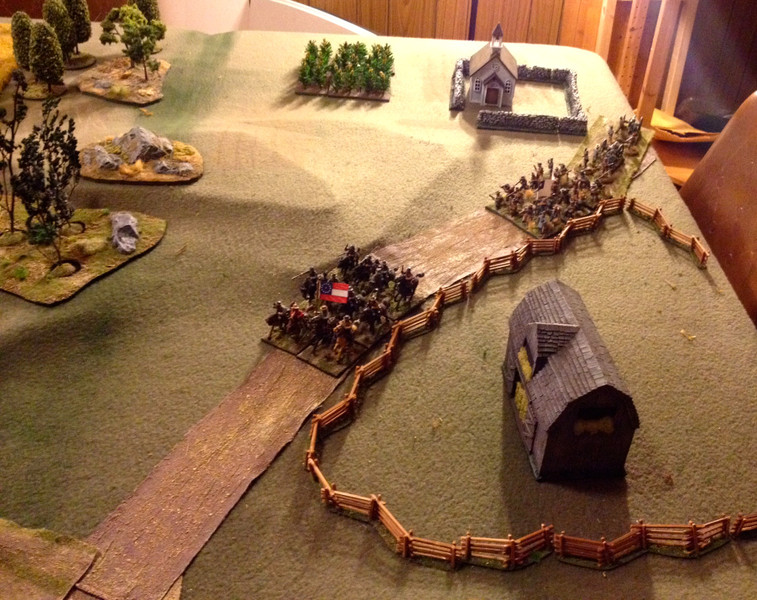
 

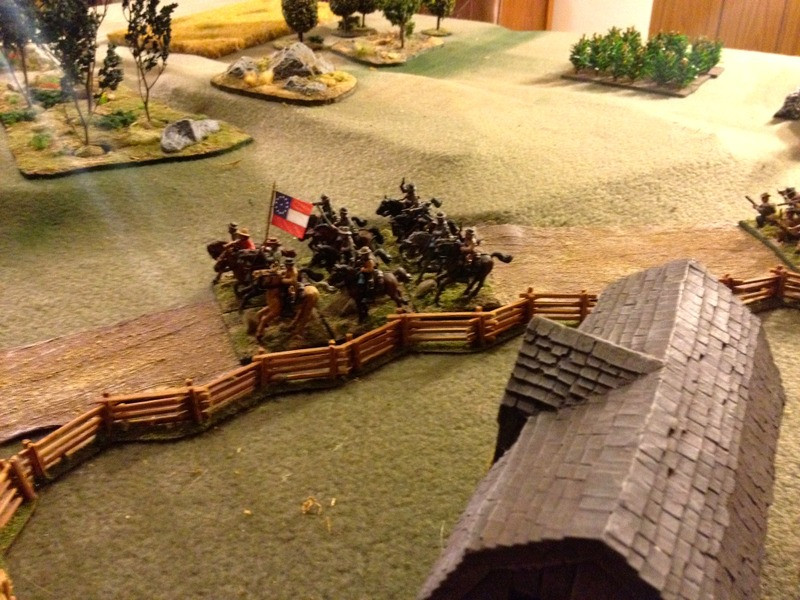
Kentucky Rangers and the other Confderate units benefit from the Quickstep Card which modifies the first CS movement phase, giving each unit an extra two BWs of movement.
 

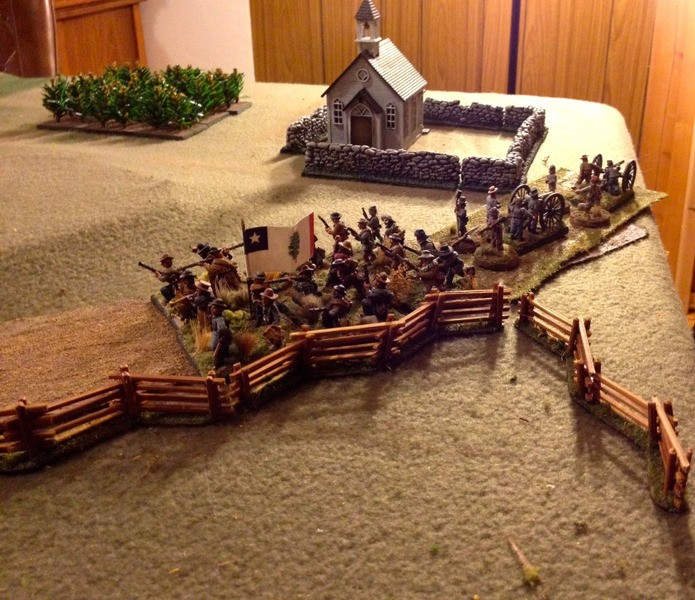
31st MS double-times past the Primitive Baptist Church.
An example of one of the cards in Longstreet that can wreck the other player’s day.   It seemed like a fun card to play as Miss Laetitia MacGillicuddy, protected by her house maid Dillsy, watch the Yankee cavalry invade their eace. As the card says, it allows the CS player to steal two cards from the Union hand that turn.   The dates at the bottom indicate that the CS player can have this card in any scenario set in the years 1861-64.  To simulate the initial advantages of the CS armies, Mustafa gives the CS player many such cards in the early years of the war, but mid to late war the US player starts getting cards that give an advantage, showing the gradual tipping of momentum to the US.

Union artillery, the “Milwaukee Brewers”, enter the table.  I really do need some limbers.
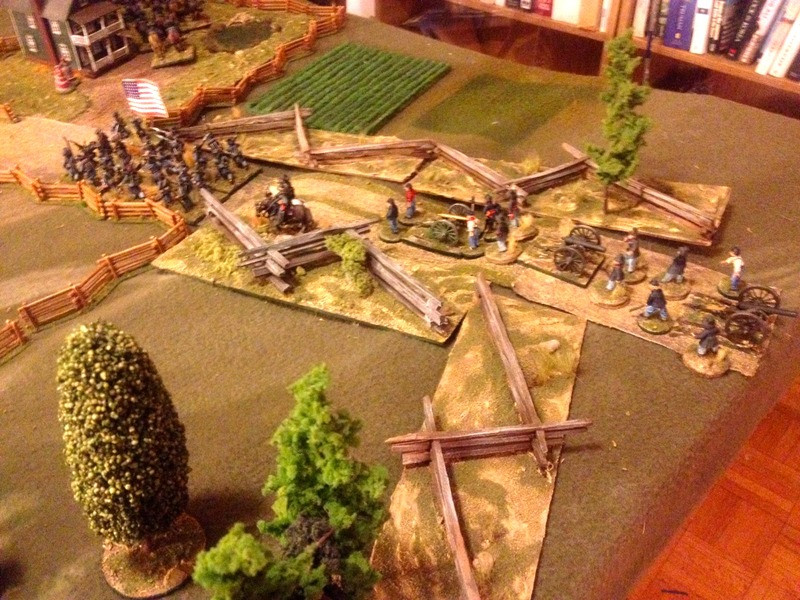
 

The Pabst Bliue Rifles head for the woods on the hill.  At the crossroads, the Kentucky Rangers have dismounted and formed line.
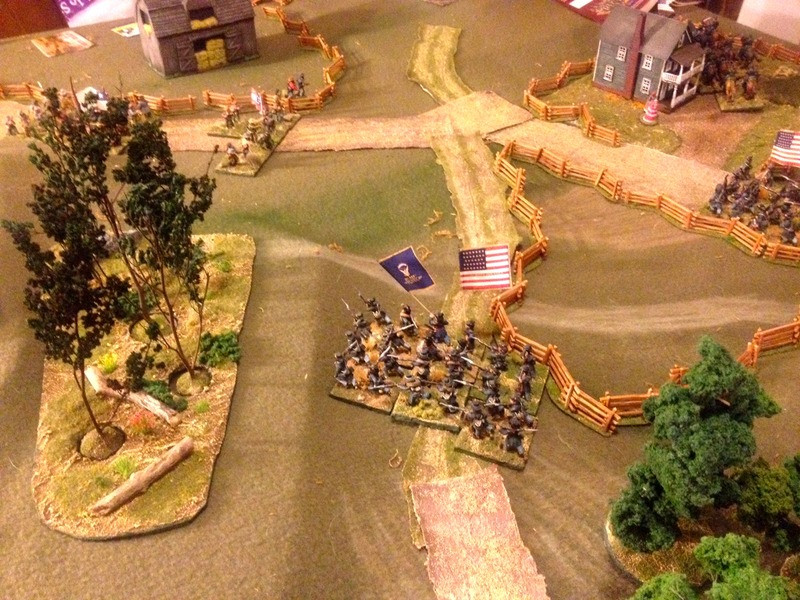
 

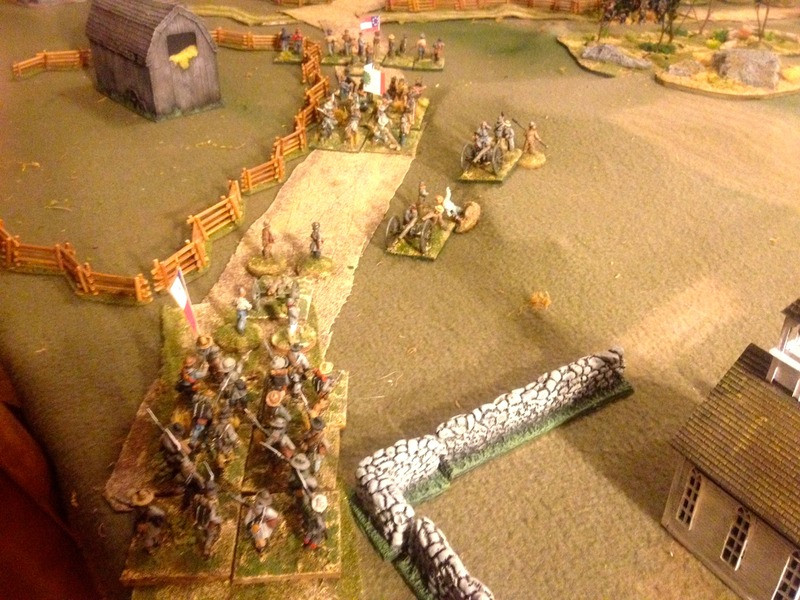
Snedden’s Battery heads for a hill near the Primitive Baptist Church, while the 31st MS move to support the Kentucky troopers.  A second CS infantry outfit, the 19 Texas (Galveston Rifles) enter the table.
 

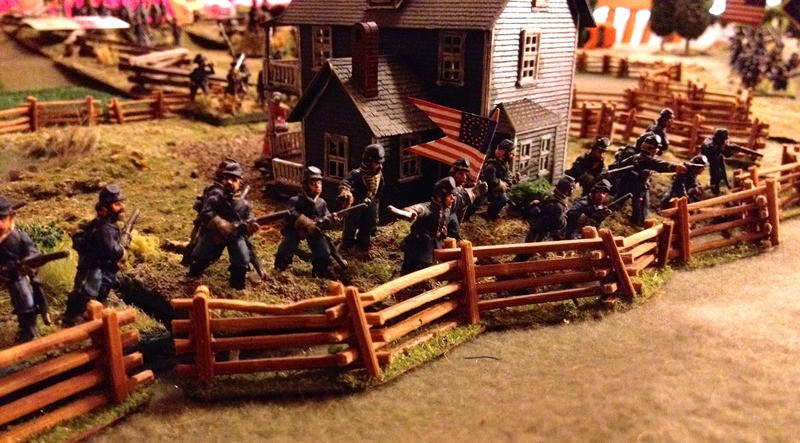
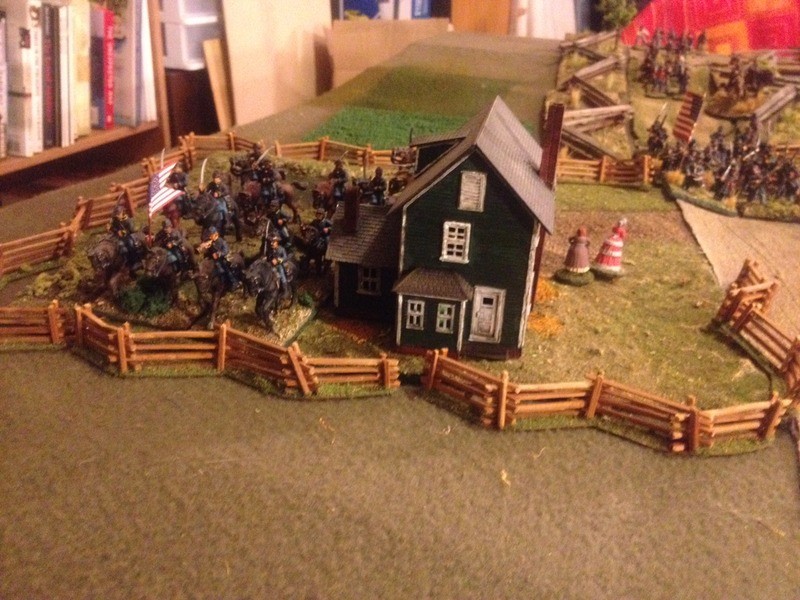
After saluting Miss MacGillicuddy, the Kansas troopers swing around her farmhouse with the intention of dismounting at the fencerails.   They aren’t keen to charge the dismounted rebs and face the carbine fire, not with those  feb infantry supports coming up behind. 
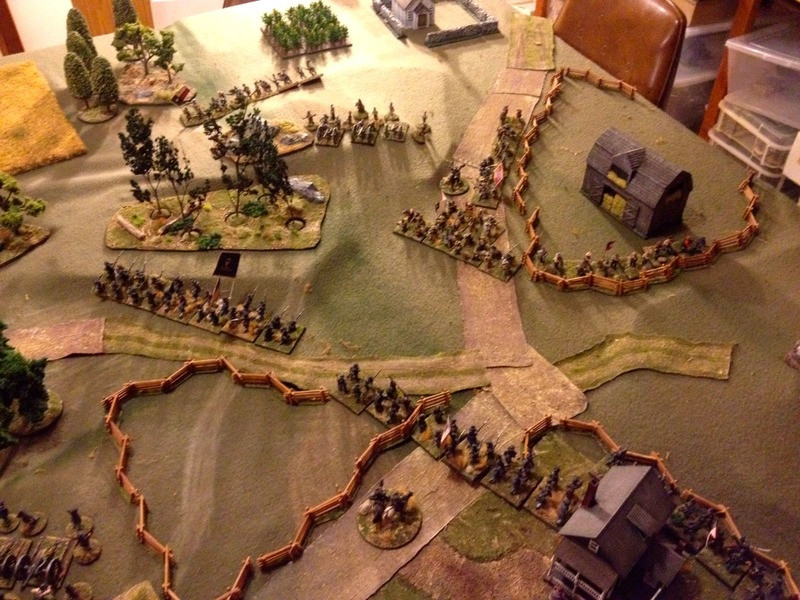
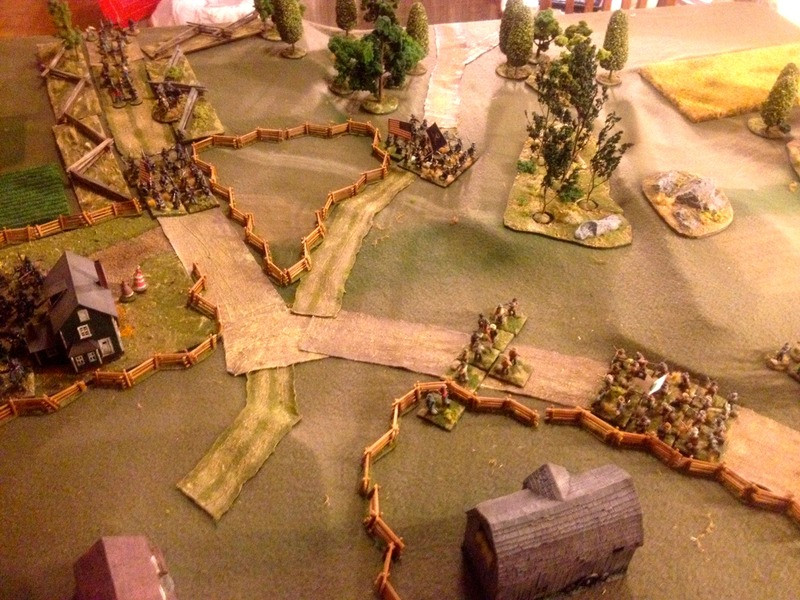
 Bird’s eye view of the situation thus far.   
More to follow.
Blog Archive

Followers