That rascal Vladimir, always stirring the pot. Back in 2016, when we worried more about Russia invading and annexing and less about Russia meddling in democracy, One Small Step Games published Putin’s War, a relatively small, operational-scale game about a conventional war in Eastern Europe. I bought it, because of a weakness for “next war war-games”, which used to be a big thing in my youthful gaming days; in the last decade of the Cold War, publishers like SPI and GDW made a lot of money off games imagining WW3, though that subject dried up in the optimistic years after the Berlin Wall fell. Interestingly, OSS’ website suggests that the bloom may be back on the next war rose, and big competitors like GMT Games have published a lot in this era as well, imagining future wars in Poland, Taiwan, and Korea. Perhaps, alas, a new war Iran game may not be too far off.
Putin Strikes is a Ty Bomba design - he has a long resume and an interest in hypothetical and alt-history designs. He’s also one of those designers that seem to inspire strong feelings in people. One writer on BGG called him “the reigning haiku poet of the wargaming world” and wrote that “Simple, fast, fun, elegant and reasonably historical war-games are Ty’s trademark”. Well, Putin Strikes is certainly simple and I played the full 8-game turns solitaire in one day, so it was reasonably fast. The rules are a quick read, though as I subsequently learned, the online errata would make for a different game.
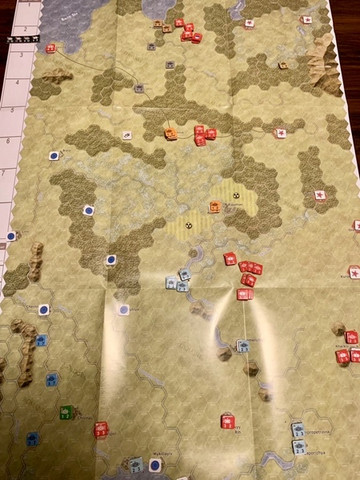
You get a fairly simple, bland map showing E. Europe from the Baltics down to the Black Sea. Starting forces are Russian, the three Baltic countries, Ukraine, Moldavia, Rumania, and Belarus. The NATO countries come on as random reinforcements. The Russians start with 12 cities in Russia, plus Kaliningrad, each worth 2 VPs, and have to capture 12 more cities to get a total of 36 VPs at the end of 8 tuns. They can just go for cities, as I did, or focus all their efforts on just capturing the Baltics and securing the rail line from Kaliningrad to the east, while holding all their initial cities.
Some things I immediately noticed and didn’t like. The game turn sequence is like Go - one side activates a unit stack, then the other can move or pass, and so on until all are done. Units can either Move or Attack, but NOT do both. This restriction makes little sense to me, given that many of the units in the game are air assault units which presumably specialize in rapid, surprise attacks. It also seems odd that no commanders in the game know how to execute a hasty attack. Also, there are no Zones of Control, so units can move past enemy units effortlessly, but there is no armoured or mechanized exploitation after combat, so presumably WW3 will go much slower than WW2 did.
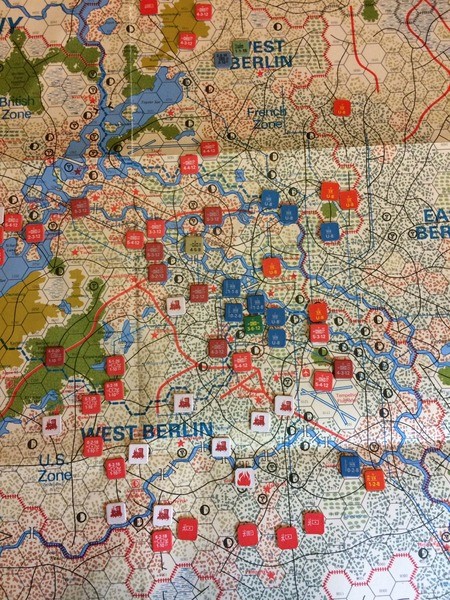
As many reviewers have noted, the game is all about cities. Each city has an inherent garrison of 6 strength points, and then can hold either six brigades or two divisions worth of steps. The garrison is always the last step to be removed. Defenders in cities get a 2 column shift in their favour on the Combat Results Table, which is simple and quite unforgiving to the attacker on low-odds attacks. Thus the game resolves into a series of sieges, like this one mounted against poor Kiev. The best choice for the defender is to mass as many units in cities as possible, since the allied units, like the blue Rumanian division below, are too weak (3 SP attack) to counterattack a Russian stack.
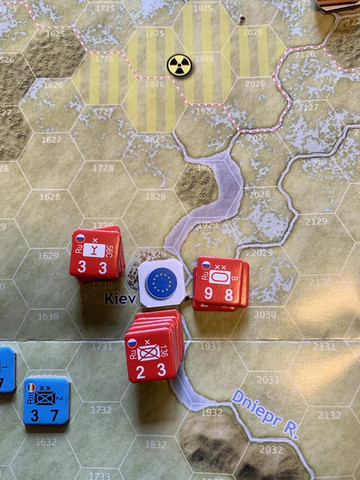
In the rules as printed, there is no restriction in bringing replacements into a siege, so if I had two Ukranian brigades come back to me as replacements, I could pop them into Kiev here and force the Russian to keep banging away at the siege. Since a lower odds attack is unlikely to kill more than 1 or 2 defending steps at the most, and since the identify maker/garrison with 6 SPs defence is always the last step to die, cities can hold out for a long time. In the game I player, the Russians did not capture Riga and Tallinin until turn 6, and never got the required 12 cities to win. Vilnius, for example, was proudly holding out at game’s end with the help of a German division. I understand that the online errata now forbid replacements to appear in hexes that are being attacked, so I guess that has been fixed, but the game feels far more like siege warfare than mobile warfare.
The other big problem with the game, I felt, was with the random NATO reinforcements. NATO has a variable strength unit, depending on the roll of 2d6, which could either be a 2-2 brigade or a mighty, awesome 12-12 division. However, due to the random die roll to determine reinforcements, the NATO High-Readiness force never appeared, while the two weak Slovakian brigades shown here in olive, plus the Swedes, Germans, Hungarians, and Czechs all appeared to lend a hand before NATO got its act together. Perhaps the US President kept questioning the value of NATO, who knows, but it felt wonky.
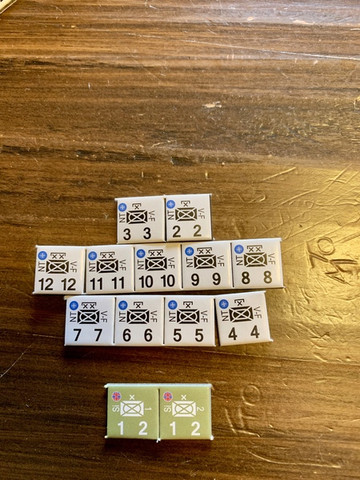
In general, the allied reinforcements do not have the power to do more than make a very few counterattacks against weak Russian stacks. Better to use them, especially the brigades, to hold cities, which accentuates the siege warfare feel of the game.
Airpower is very abstract, and depends on the differential between both sides rolling 2d6 as to how many air units one side or the other receives each turn. Each airpower counter can shift the CRT one column in the player’s favour, but they can also be used to interdict movement, or deny mobility to air assault units. Again, because of the random reinforcement roll, the NATO air reinforcements never arrived in the game. Perhaps all the F-35s were grounded for maintenance.
Other features about the game are quite simple. There are no supply rules, as the design assumes that in the first month of the war, the game’s timescale, all units would be prepared and well-supplied. Likewise all units, no matter their type, move 6 MPs per turn, with the usual costs for forest, swamp, rivers, etc.
There are some fixed ideas of the designer in the game - divisions are far more robust than brigades and can ignore CRT results of 1 or 2 steps lost, on the theory that western armies are wrong to get rid of divisions. That seems odd to me, as a big Russian Grad missile strike will kill you whether you are in a division or brigade, but anyway. There is also some nice chrome, such as the Russian Vostok unit, which has a variable strength in each attack. depending on how well Russian propaganda does with ethnic Russian minorities in certain regions. Curiously however the vaunted Russian Anti Access/Aerial Denial (A2/AD) missile defences in the north are not modelled, and there is no naval game or ability to assault from the sea.
In playing the game, I immediately ditched the sequence of play, instead allowing one side or the other to move all of its counters and attack in one turn, then the other, in the classic style. I allowed unengaged air assault units to add the SPs to the battle if they were within 6 MPs of the defender.
While some reviews were fairly positive, I confess that I was unimpressed, and would agree with the review entitled Putin Strikes Out. This was a disappointing game, and if I was going to return to this subject, it would be a via a game like this.
Blessings to your die-rolling defence of the free peoples!
MP+