Showing posts with label American Civil War Naval Gaming. Show all posts

Tuesday, July 27, 2021

#Terrain Tuesday: Barrage Miniatures Kickstarter Goodies Have Arrived!

 I'm not a big Kickstarter guy, but th offer from Madrid-based Barrage Miniatures seemed too good to pass up - modular resin/rubber terrain for the miniatures tabletop.   

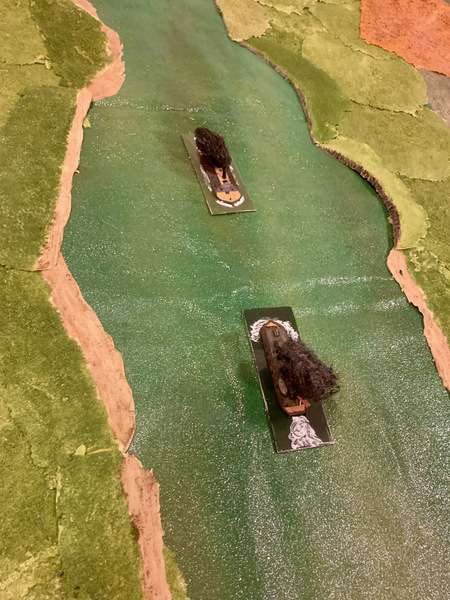
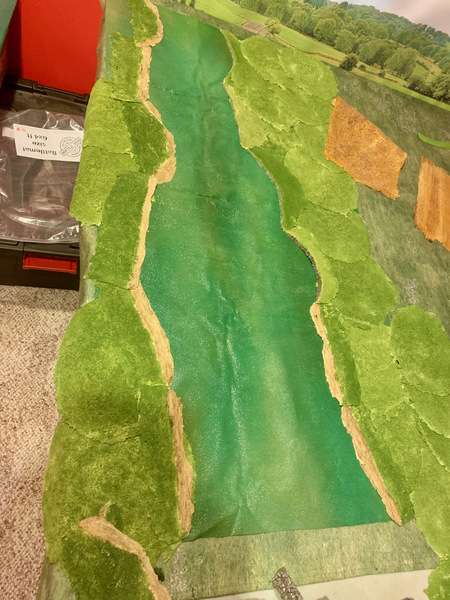
In backing the KS, I chose a green river, almost enough to cover the width of two of my tables, plus enough shore sections to line both banks.   


That river was just crying out for some boats, so I dug out my 1/600 Thoroughbred Miniatures ironclads and my instincts were correct, it all looks great together!


Hammerin' iron!  The nice thing about this system is that I could only line one side of the river mat with shore sections, creating a bay or shoreline, or I could use the modular bits to decrease the width of the river as needed by the scenario or scale - perhaps a 6mm version of Aspern Essling!


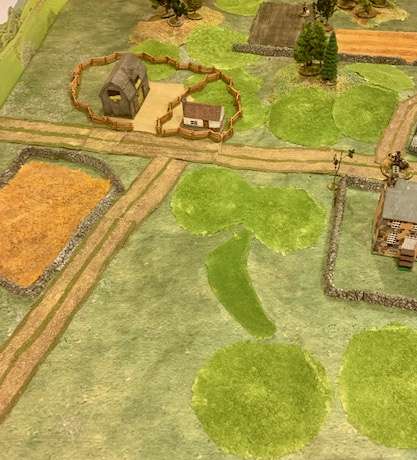
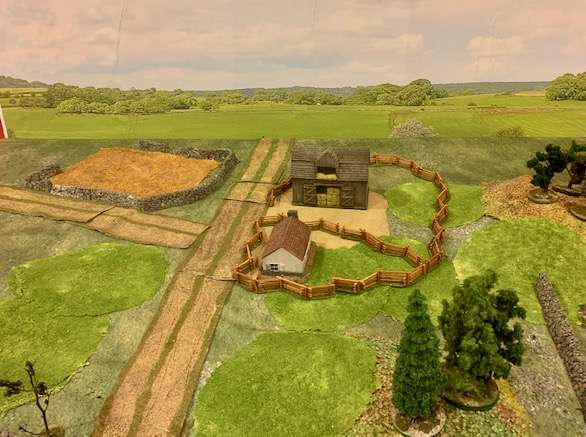
Here are some of the other pieces that came with the KS.  Cropped and plowed field, multicoloured sections to mark out woods and to depict fallen leaves, a desert mat for the farmyard, and stone wall sections.  Lots of round green grass sections that blend in nicely with my GeekVillain mat.


The elevations here are old T-shirts rolled up and placed under the Geek Villain mat.  Again, the green resin pieces are useful for hiding the creases in the mat where it falls over the t-shirt hills.


Of course, now that I've laid out this table, I need to get some troops on it.  It all looks Civil War-y, so ...

Cheers and blessings,

MP+

Thursday, December 18, 2014

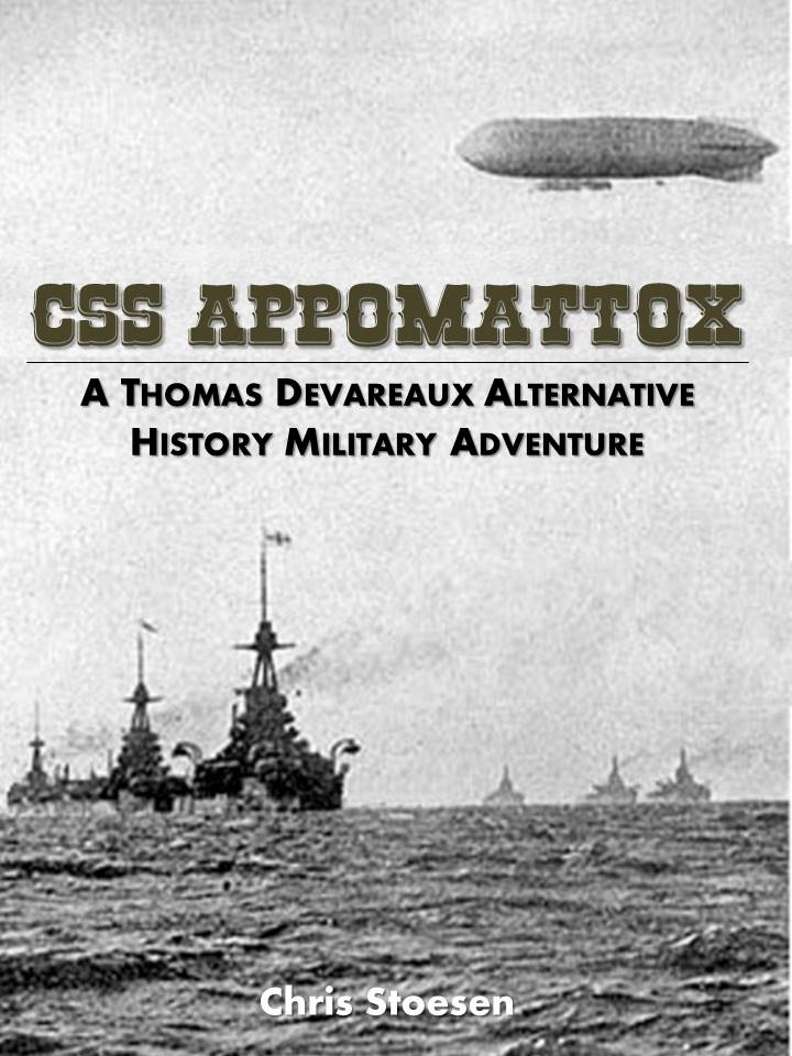
Book Review: Chris Stoesen's CSS Appomattox

One of my wargaming heroes is Chris Stoesen - blogger, historian, researcher, scenario writer and all around good egg can now add novelist to his resume.  


CSS Appomatox is an altnerate history novel set in a world where the Confederacy won the American Civil War.  In Chris’ carefully thought out and quite plausible version of events, the Confederacy has made its own peace with its past.  Slavery is abolished and blacks even serve in the CSA military.  The South has established an uneasy cold war peace with the North, and forged alliances with some of the European powers including Spain, except for Germany, a Northern ally.  This book begins as Germany picks a fight with Spain over her Caribbean holdings, Cuba and Puerto Rico.   The Confederacy commits her newest technology, an armed airship, to stop the German expeditionary forces. I need to be careful that I say airship and not balloon.  It is definitely not a balloon.

The hero of the novel is Thomas Devareaux, a tough and technologically minded naval officer who is luckier in war than he is in love.  He has a series of adventures in the air and on the land, and is supported by a crew of sailors, marines, technical wizards and shadowy intelligence operatives.  I won’t spoil the plot for you.

CSS Appomatox reminded me a little of the alt-history novels of Harry Turtledove, except with a much tighter focus on a small cast of characters.   I won’t flatter Chris by competing him further to the likes of a writer like Turtledove.  There are some rough edges to his style, and you definitely know that you aren’t reading the work of a professional writer.   However, how many of us can say that we’re written a novel?  Probably a lot fewer than the number of us who have wanted to write one.

CSS Appomatox is self-published and available on Amazon as an e-book.  It’s as cheap as chips so treat yourself to a copy in your e-stocking.

Reading Chris’ book makes me want to order the Avalanche Press title Zeppelin from its Great War at Sea series and put some warships against giant balloons … not balloons, Zeppelins!  Zeppelins!  AHHHHHHHHHH!!!!!!!!!

Wednesday, August 13, 2014

Rebel Raiders Recap


I hate this cruise company!  I’m never booking with them again!


I meant to report on this yesterday (the putative Tuesday Boardgame feature on this blog) but didn’t have time.   Last week I described the GMT game Rebel Raiders On The High Seas, a strategic-level game about the American Civil War at sea.

My solitaire game ended in a blowout, with the Confederacy achieving a Sudden Death Victory in the Summer 1863 turn.   By that point the Union had only captured four of twenty CSA Cities/Ports and had enjoyed a spell of terrible luck, losing several key battles to tied dice rolls.   While the Union successfully took Norfolk, VA using the Sea to Shining Sea card, which allows two extra Amphibious Assaults in a turn, and had a clear shot at an undefended Richmond, the CSA had the Longstreet card, giving an extra assault die which rolled a “6”.  The rebs win ties in Assaults, so old Pete saved Richmond and saved the Tredegar Ironworks, a key production centre for the CSA.  At Vicksburg a small CSN flotilla and battery gutted Porter’s ironclads, while Farragut, with a mighty armada, crapped out at Mobile.  A terrible turn and fairly typical of US dice luck.  With six Raiders active at sea (including one that SANK a USN screw sloop in the Whaling Area - the only time a sloop CAUGHT a raider and it gets promptly sunk!), and several good turns by Blockade Runners, and the CSA maxed out its VPs, forced the Union to Fail a Resolve roll, and ended the game.  

Half way through I realized I was doing a few things wrong.  I didn’t realize that Union Screw Sloops (the blue water navy) take 2 turns to build and not just 1, which gave a USA advantage, but I also didn’t realize that one could assault a CSA Port/Fort even if it was defended by a Battery.  Only CSN ships must be defeated first before an Assault.  The Battery may be present, but it gives the CS player an extra assault dice to roll.  That latter mistake was an advantage for the CSA, because the USN took heavy ship casualties trying to assault several positions with just batteries present.

After one complete play through, I have to say that I REALLY like this game.  The cards are a satisfying source of chrome and historical flavour, and the game is a real challenge for both sides.   For the Union, I think that the key to success in 1862 is to divert precious build points into buying extra assaults, since the USA MUST reduce the number of CS cities/ports early on if it is to have any chance.  The blockade is great, but taking ports is the best way to defeat the Blockade Runners.  

There will be a replay.  I just unboxed another GMT game, A Distant Plain, Brian Train’s treatment of contemporary Afghanistan, so hopefully I’ll have something to say about that next week.

Blessings to your dice rolls!  MP+

Wednesday, August 6, 2014

Tuesday Boardgame: GMT's Rebel Raiders On The High Seas

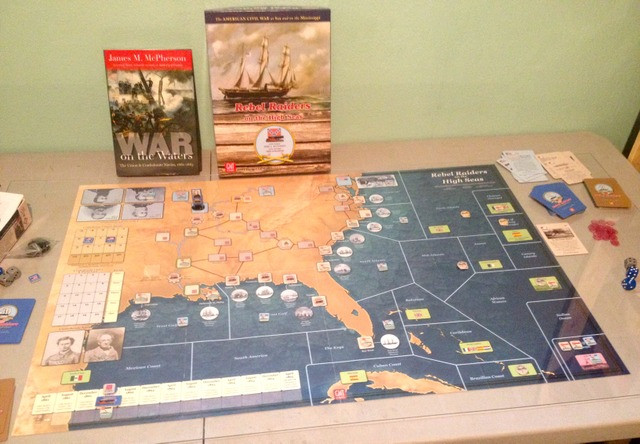
Rebel Raiders On The High Seas (I’m going to call it RR from now on) was released by GMT in 2013.  It’s a design by Mark McLaughlin, who is interviewed on the game’s development here if you’re interested.

i haven’t finished a complete game yet, but I can tell you that it’s a terrific design, that will appeal to any student of the American Civil War.

RR is a strategic game, using an area movement map and a simple combat mechanism that puts it in the lineage of classic games like Avalon Hill’s War at Sea (1976).  RR has all of the attractive art work and detailed rules that one expects of GMT.

The Union player wins by capturing the strategic Mississippi River, from Memphis down to New Orleans, by capturing ports and cities, and by establishing a blockade to choke off supplies to the Confederacy.  Units represent individual ships and squadrons, and there are three turns to a year.

The Confederacy wins by avoiding this fate, which means finding a balance between fortifying and defending key points, or by keeping the Union off balance through diverting resources to raider and blockade running ships.   Union resources spent blockading ports and chasing raiders are not available to steam into ports and duke it out with the defenders.

Combat and movement mechanisms are very simple.  The heart of the game is all about choices.   The Union player has a steadily increasing number of resources for building ships, but has to use them wisely.  Too much emphasis on capturing forts and ports leaves the raiders and blockade runners free to move and run up the score of Victory Points for the rebels towards the tipping point, while too much of an emphasis on chasing ships at sea means that a mostly undamaged Confederacy will almost certainly win the long game.

Key units for the Union are Screw Sloops (the blue water navy), and ironclads and gunboats, which are littoral/riverine capable only.   Screw sloops can hunt the sea lanes for raiders and establish an Outer Blockade, while gunboats and ironclads can maintain an inner blockade outside particular ports and fight the river war.  Confederate units include batteries for port and fort defense, gunboats and ironclads for river and coastal defence, and high seas raiders and blockade runners.  Most of these ships are generic, but cards can bring famous ships into play.  Land combat is abstract and other than batteries and a chrome rule for CSA militia, there are no land units represented.

While not a card driven game, the use of cards allows players to invoke key moments such as the Trent Affair, and key technologies, such as mines and submarines, to give the game a satisfying degree of chrome.  These cards would be a lot of fun in a two player game, but the game also works as a solitaire game.  As a two player game, I suspect it might get frustrating to the CSA player, who is restricted in his ability to strike back and mostly has to play a waiting game.

The Basic Game begins in 1861, and while there’s not a lot that either player can do until 1862, it’s a good way to learn the basics before the board starts getting crowded with ships.   The Union player has virtually no chance of successfully assaulting a port/fort until the 1862 turns begin, and even then has to choose carefully.   An unsuccessful assault on a port/fort is costly in terms of ships and VPs.  The number of assaults per turn is rationed, though later in the game the Union can be more aggressive on more fronts.  The CSA has a limited ability to counterattack, but doing so means diverting resources from shipbuilding.  Players who want to jump into the action should look at the 1862 scenario.

In the game I’m playing at the moment, it’s 1862 and things are slowly heating up.  The Union made a costly and unsuccessful assault on Louisville, which the CSA insolently seized at the start of the game, paying a small penalty to violate Kentucky neutrality.  This means that the top of the Mississippi will be a hard nut to crack, but that seems the best place to start.   The USN blockade is slowly building up, but is yielding mixed results.   In the Winter 1861 turn, 60% of the CSA blockade runners were captured, but in the Spring 1862 turn none were, and the CSA reaped quite a few VPs.   As the CSA I’ve been steadily building Raiders, and now have four operating at sea, forcing the USN to divert two precious Screw Sloops to the Pacific to defend the vital Whaling Grounds.   Raiders are tough to intercept and bring to battle, but they can’t be allowed to run around and drive up the CSA score unmolested.  However, the first US assaults on CSA ports and forts are ready to launch in the still unplayed Spring 1862 turn, so it’s still anyone’s game.

As an aside, you may remember that back in March I was musing here about what might have happened had the Trent Affair resulted in a British intervention in the ACW.   It occurs to me that with an extension of this map to include Canada and some extra counters and rules, RR would give you a way to model that what-if war.  Just a thought.

I’ll report back when my solitaire game is concluded, but I quite like this game and recommend it.  Another recommendation I’ll gladly make is the book visible in the photo, James McPherson’s War On The Waters, a cracking good book which gives you all the background you could want on this subject.


Friday, March 29, 2013

Toby Barrett Announces Ironclads For Ipad Kickstarter Project

I confess I am not yet convinced of the merits of Kickstarter, which is to say, truth by told, that I haven't found a project yet in our hobby that got me excited. That may have changed. I was very intrigued to read on the Ironclads Yahoo group this morning that Toby Barrett, proprietor of Thoroughbred Miniatures, has the rights to the old Yaquinto boardgame Ironclads and the expansions, and wants to port them over to the iPad platform.

This idea strikes me as eminently sensible because I have an American Civil War ironclads game on the table at present, and there are times when the ship models are obscured by a multitude of charts and tables, and if the ship models are visible, often the paper covers the little turning and arc of fire widgets I need. While the rules I am using, Smoke On The Water from Canis Publications, are perfectly fine, it's all a bit more cumbersome than I would like. I have an iPad and I have been slowly migrating .PDF copies of rules to it, and I would welcome a tablet-based solution for ACW naval gaming.

Here's a quote from Mr. Barrett's post on the Ironclads group:

Tonight on Kickstarter.com I launched a campaign in order to raise funds which will pay for the programming of an App to run on the Apple iPad. The App will contain everything from the original Ironclads game - all the rules, data cards, scenarios, and such for miniatures play, and will include a game referee and a combat resolution module to greatly help to speed up the operation and ease of the game. What happens on the table will still be key with the player more able to concentrate on movement, decisions and tactics. If you are not familiar with Kickstarter it is a web site whereby artists, creators and anyone with an idea can go in order to raise funds for projects in exchange for incentives. It is sort of like the show on TV Shark Tank but without the attitude and the millionaires. Several things came together – finally – to allow me to try this project for the Ironclads rules. First the amazing iPad system which I think will change a lot of things and greatly help gamers around the miniatures tabletop. Second I met a great programmer for the iPad, Jeremy Alessi, who is very skilled at the IOS programming skills required for creating apps for the system. (Jeremy has several apps already in operation, Airspin and Fat Rat. Check them out.)

The project URL for the Ironclads Kickstarter campaign is: http://www.kickstarter.com/projects/293087222/the-ironclads-app?ref=email and anyone on this group list can go there to read about the project and decide if they wish to become a backer at one of the several levels offered. Anyone familiar with the Thoroughbred 1/600 product line will know I stand by my products and am offering a whole slew of new models for the campaign. I promise my work and efforts to turn out an excellent Ironclads App will match the same quality of work shown in my miniatures over the years. And I will continue to maintain the level of excellent customer service I have always practiced in order to fulfill my promises for the campaign. Questions can be asked and given on the Kickstarter site, or I'm available on this group and by regular email to offer answers. Regular updates and video clips of our progression will be added to the Kickstarter site, so please plan to return for repeat looks. As Always, Thank you and Enjoy! Toby Barrett Thoroughbred Figures Portsmouth, Virginia

So I'm in. My first Kickstarter project, very exciting. If you are a fan of ACW naval gaming, I hope you'll consider it.

Sunday, January 20, 2013

Messing On The Mississippi

“Believe me, my young friend, there is nothing - absolutely nothing - half so much worth doing as simply messing about in boats.” Rat, The Wind and the Willows, Kenneth Grahame

p>Early on a rainy morning in late June, 1862, and a Union force of three warships is steaming downriver to capture Island No. 6, a Confederate fort blocking passage to Bluffsburg, the last rebel bastion on the Mississippi north of Vicksburg. Leading in line astern is the tinclad USS Chaffee, her sister ship USS Golconda, and the Cairo class casemate ironclad, USS Ironton. Behind them is an unarmed steamer carrying the troops tasked with seizing the island.

The Union commander aboard Ironton, Captain Holquist, is surprised to see two ships emerging from the mist in the middle of the river, heading upstream. He immediately assumes that they must be the Confederate ships guarding Bluffsburg, the scratchbuilt casemate ironclad Joshua and her consort, the cottonclad riverboat Maccabbee. As per his SOPs he signals the transport to turn about and retreat upstream while he moves to engage.

Aboard the Confederate ironclad Joshua, Captain O'Donnell unleashes his escort, the fast sidewheeler Maccabbe, with instructions to use her speed to work around the union flotilla and distract where possible. As the two Union escorts alter course to port to pursue, Joshua's forward gun, a heavy rifle, opens up and hits Chaffee as she turns and presents her unarmoured broadside. First blood to the rebs as the rifled shot knocks out one of the two medium smoothbores on Chaffee's starboard broadside.

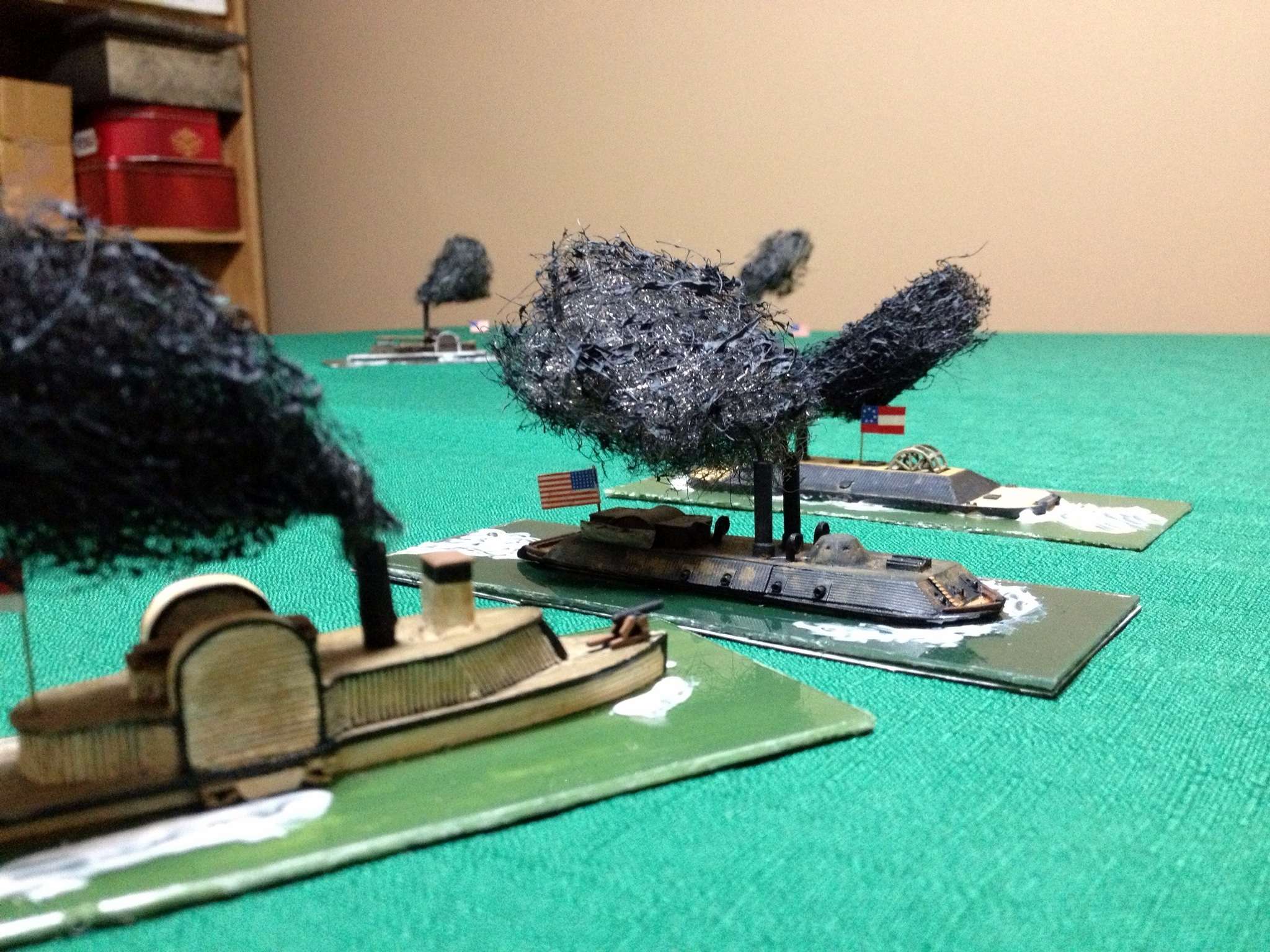
An unconvincing green tablecloth fills in to represent the Father of Waters as Maccabbee makes her run around the Union line, while Chaffee and Golconda try to catch her. Now that I've got the ships done I must think about scenery.

Ineffectual fire continues as the range closes. Maccabbee takes minor damage as her speed, far superior to anything else on the river, allows her to work her way behind the Union flotilla, and then come in hard and bows on Ironton's starboard side. Maccabbee's boilers are going flat out when she hits Ironton, causing both ships significant hull damage and locking them together. It is only the lack of a ram on Maccabbee's bow that spares the US ship from a fatal wound. At that moment Joshua passes alongside Ironton's port side, and the two ironclads unleash thunderous broadsides at one another.
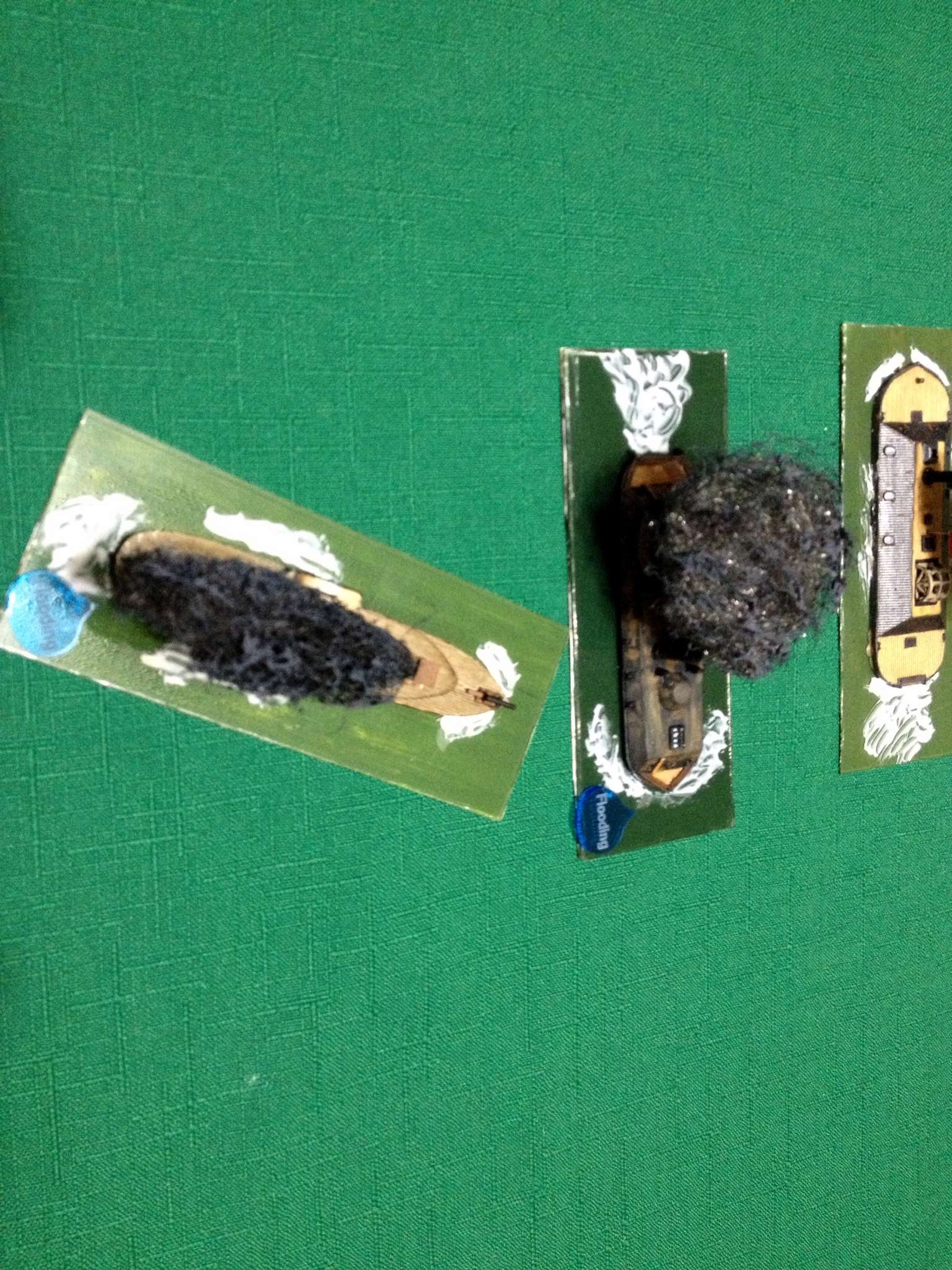
To Captain Holquist's dismay, point blank shot from his light rifles and medium smoothbores fails to penetrate the armour on Joshua's casemate, while a lucky shot from the rebel guns causes a critical hit, ripping a hole in Ironton's hull below the water line. The river begins to pour in. Meanwhile Ironton's starboard guns smash the hapless and fragile Maccabbee to bits and she begins to sink, still locked together. It is only the fact that Ironton is a larger vessel that keeps her from going under as well.

Joshua (top) steams by the unlucky Ironton, locked together with the sinking Maccabbee and herself taking on water. Note the very useful Litko "Flooding" markers.

The situation now goes downhill badly for the Union. Ironton and Maccabbee drift downstream and away from the fight. Ironton's critical hit is the worst possible result, a loss of three flotation points per turn (a 3 result on 1d3)and she fails three repair attempts in a row. While she frees herself from Maccabbee's sinking wreck, Ironton herself floods and sinks in middle of the the river, forcing Captain Holquist to watch the battle from a lifeboat. Golconda and Chaffee bravely engage the confederate monster, and Chaffee's captain desperately tries to ram Joshua, but causes no damage to her armoured stern and comes away much the worse, taking much hull damage.

To the right, Ironton and Maccabbee helplessly drift downstream, sinking. In the centre, Chaffee, with the blue paddlewheel housings, attempts to ram Joshua, and only gives herself a bloody nose in the process.

A circling duel follows, and while the Union medium smoothbores largely fail to penetrate, they do get lucky. At one point Joshua suffered three critical hits, having her two starboard gunports jammed and her rudder cable damager, restricting her to starboard turns. However the Confederate damage control is excellent, with Joshua making all her repair rolls. Joshua enjoys standoff advantage, as her rifled guns can hit the US tinclads at short range, while the Union ships' smoothbores fire less effectively at medium to long range. Soon Chaffee has lost three of her guns, one sidewheel is nearly crippled, and her hull integrity is below 50%. She exits the Union table edge. Joshua is now between the Union table edge and the Golconda, who gamely starts her escape run. Alas, it is not to be. The Joshua's bow rifle smashes what's left of Golconda's stacks, and the lack of updraught to the boilers reduces her speed to slow, giving Joshua ample time to keep broadside on and pummel the tinclad, whose return fire is ineffectual. Within a few more turns the Union skipper strikes his colours.

With one if its precious Cairo class ironclads sunk, with one tinclad lost and another facing many days of repair, Union control of this sector of the Mississippi is gravely weakened. General Moore's orders to move by land on Bluffsburg depend on cooperation from the Navy, but with that ironclad monster Joshua roaming the river, his whole operation is undermined. His boss, Old Brains Halleck, will not be happy. Meanwhile General Hatcher, whose division is slowly being pushed back on Bluffsburg, will find that with his river flank secure, he can concenttrate forces with a better chance of checking the Union advance. The battle is thus a major CS victory.

At least, it would have been if this was a real fight. This AAR describes my first attempt to get to know the Smoke on the Water rules from Canis Publications. The website for these rules claims that SOTW does not sacrifice realism for playability, and I have to agree. Other than a few head scratching moments with the collision rules (and things seem to collide a lot, even when playing solo and making probability rolls for individual ship moves), the mechanisms seemed easy enough, and the result seemed right.

What I need to work on here is play balance. I had historical ship stats for Ironton (a fictional member of the historical Cairo class), Chaffee and Golconda are based on the historical Fort Hindman class of tinclads, and Maccabbee used the stats for the CS Planter tinclad. Joshua however is a creature of my campaign, and I think I erred by giving it the stats for the CSS Tennessee, which was a pretty fearsome customer. Bluffsburg is supposed to be a minor town on the Mississippi, a mini-Vicksburg, and I doubt her workshops could produce such a monster. I need to reconsider her armament and armour before turning her loose for real, because as the above illustrated, a whole campaign can hang in the balance while people go messing about in boats.

Thanks for reading what has been a bit of a departure for this blog, namely its first naval AAR! AAARRRRRGGHHHH! Mike
Blog Archive

Followers