Showing posts with label Napoleonica. Show all posts

Sunday, January 24, 2021

Revisiting a Hex and Counter Classic: Napoleon's Last Battles

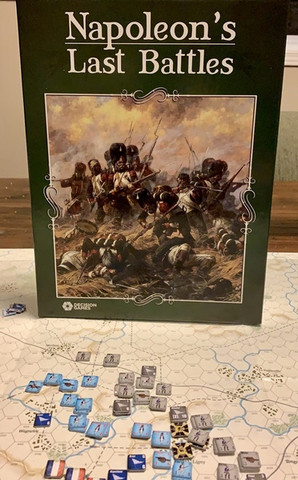
Back in 1976, in the heyday of disco, detente, high inflation, and my vain attempts to get Madeleine Bennett to notice me in Grade 6, Simulations Publications Inc.  published Napoleon’s Last Battles, one of the classic war-games systems.  It was designed by Kevin Zucker, one of the galaxy of talent that SPI’s Jim Dunnigan gathered around him like Napoleon and his marshals.    Kevin went on to found his own company, OSG, and is widely considered one of the authorities on Napoleonic board gaming today.

There is a great review of NLB, including photos of the original counter set, and a thoughtful appreciation of its impact on many subsequent titles, on the sadly inactive Map and Counters blog . on I bought the re-edition of NAB published by Decision Games, which picked up most of the old SPI titles after TSR acquired them.   NLB now comes in a shiny box with new artwork, and the original counters have been updated.  


The scale of NLB is operational, with individual counters representing brigades with combat and movement factors.   Optional rules allow for basic command and control; for example, Napoleon can only give orders to three divisional commanders in a turn if they are within his command range of five hexes, and the divisional commanders can only fully employ their units if they are within three hexes.  Combat is hex to hex, though artillery can add their combat factors if two hexes away.  Combat is a simple ratio worked out on a Results Table that only gets bloody if the odds are 4-1 or above, or 1-3 or below.   Otherwise units will safely retreat unless all possible retreat hexes are within the Zone of Control of an enemy unit.  Hex and counter gamers of a certain age will remember what being ZOCed is and why it is fatal.

NLB comes with four games (it was the original SPI Quadrigame) of the Hundred Days: Ligny, Quatre Bras, Wavre and La Belle Alliance.  There are of course rules to play all four games as a campaign game.  

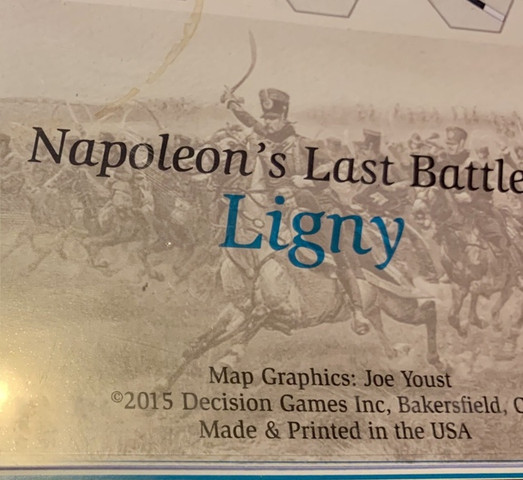
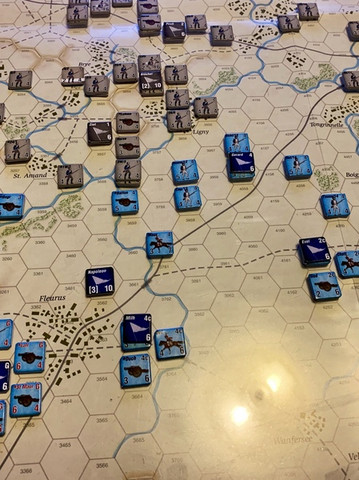
As time only permitted me to play one game, I chose Ligny. 

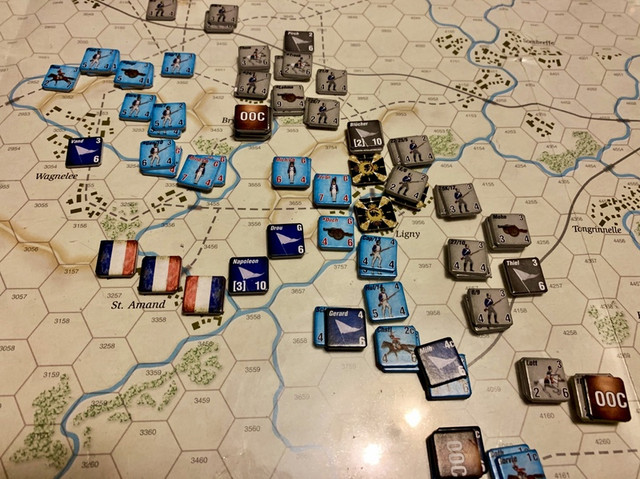
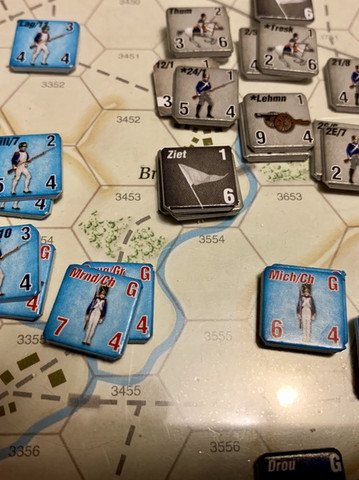
As in the battle, the French player only has six hours of daylight to inflict serious harm on Blucher’s three scattered corps.   The Prussian must hold with Zeiten’s and Pirch’s corps while bringing von Thielmann’s III corps to the rescue.

Alas for France, my first run-through did not go so well, as it took me too long to remember how to use ZOCs to my advantage.  At game’s end, Gerard’s Fourth Corps had suffered a mauling at the hands of Von Thielmann’s troops, while the Guard and Vandamme’s III Corps had taken Fleurus easily but were being forced out of Ligny proper.

Hero of the game:  Zieten, who held off Napoleon’s last big attack before twilight and who sent the Imperial Guard packing.  Prussian victory!

NLB is one of those simple game systems that remains fresh and interesting after fifty years, despite it’s new coat of paint in the Decision Games re-issue.  While it might seem dull because its woefully lacking in the chrome that we have since become accustomed to (although SPI’s monster Waterloo Game, Wellington’s Victory, also published in 1976, has all the complexity one could wish for), NAB does the job.  It presents an operational problem in sufficient detail to challenge the player, and delivers a clean result in a few hours, and works well enough as a solo game.  I would be delighted to play it against you on Vassal, if you care to.

 I’m very pleased to have it in my library and look forward to revisiting it again.

Blessings to your die rolls!

MP+

Thursday, September 3, 2015

"We Shall Go to Erfurt": In the Steps of Napoleon

  "We shall go to Erfurt. I want to come back with the freedom to do what I want in Spain; I want to be very precise with Russia regarding our involvement in the Levant. Prepare me an agreement which will satisfy the emperor Alexander, one which above all must be directed against England and in which I shall be at ease regarding the other points. I shall help; we shall not want for prestige.”  Napoleon to Talleyrand

 In my last post I promised a few photos of sites associated with the  1808 Congress of Erfurt, an event that we would describe today as a summit meeting.   Napoleon was looking for a free hand in Europe, and trying to impress Tsar Alexander.  It didn’t work out, because as you know, Napoleon and Alexander never exactly became BFFs.  There’s a good summary of the meeting here.

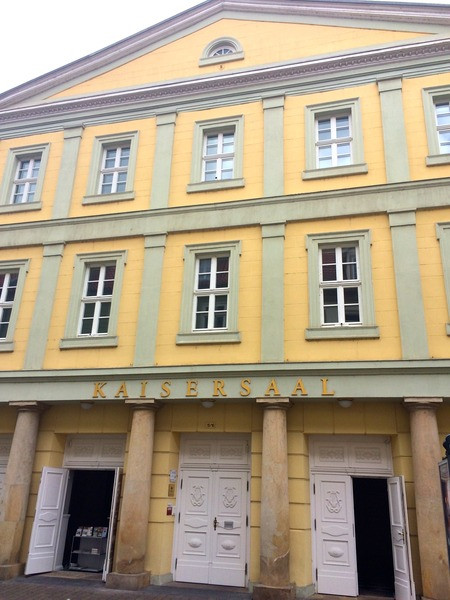
One of the venues we saw was the Kaiseraal, a concert venue which was used by Napoleon to impress his guests.   The Comedie Francaise was summoned from Paris to stage no less than sixteen plays and performances during the Congress (all series, the Emperor did not want trivial comedies and dramas).  Napoleon complained of the expense of this “mass levy of thespians”, but felt that it was worth it to awe the kings of Europe with France’s glory.  While I was able to sneak into the lobby, and mug with a mannequin of Napoleon in the lobby (fortunately that picture is still on Madame’s camera), I wasn’t able to see anything else.


In later years, Paganini and Liszt both performed here.  As you can see from this link, the Kaisersaal is still a pretty swish place today.

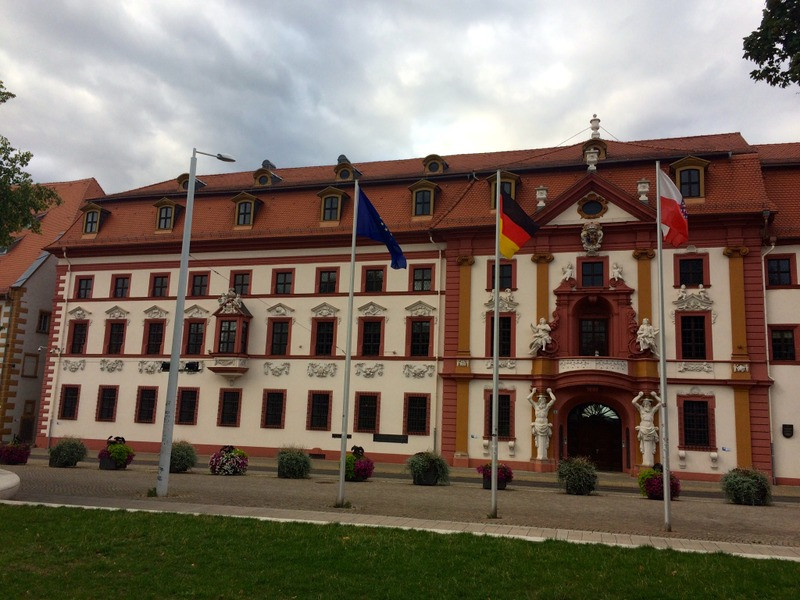
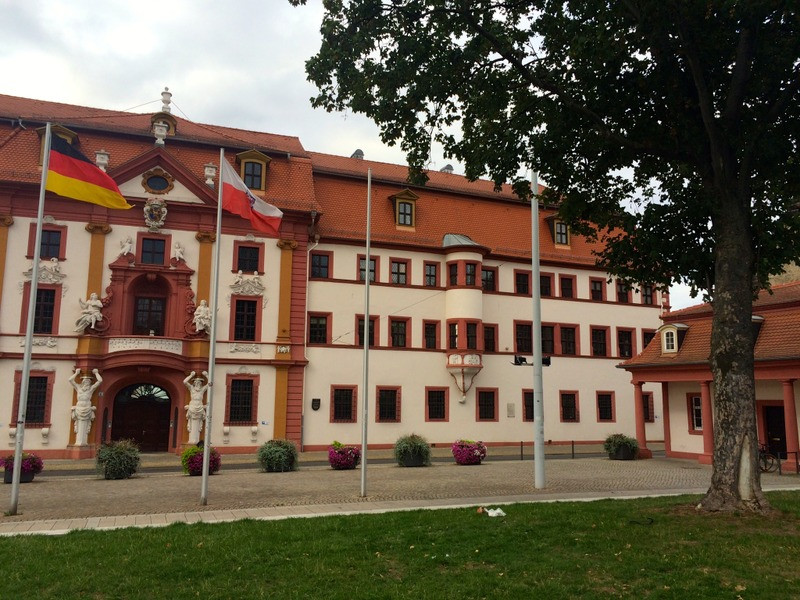
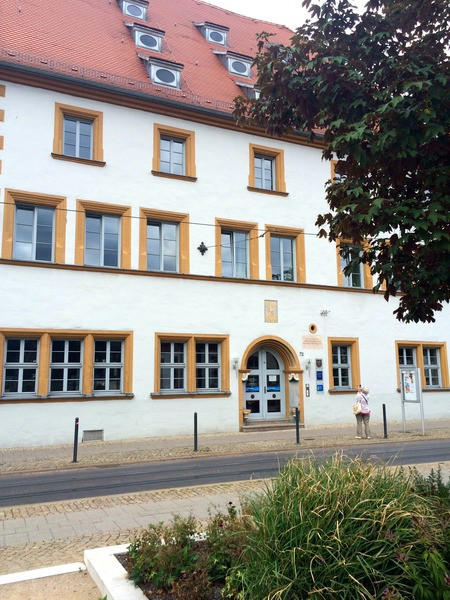
Much of the conference took place at the Governor’s Palace in Erfurt.   The building  is actually two, a Baroque-era building on the left and a Renaissance era building on the right (I hope I remembered that correctly), joined in the centre by a newer entrance hall.  Besides Tsar Alexander and the other VIPs of the day, Napoleon and his court would have passed in and out of here, including Soult, Lannes, Berthier, and Davout.  Today this building is used by the government of the German province of Thuringia, so the only people we saw passing in and out were youngish looking bureaucrats.

It was here that Napoleon had his famous meeting with Goethe, Germany’s secular saint of literature and culture.   It’s interesting to think that Napoleon wanted to impress Goethe.  It’s hard today to imagine any world leader going out of his or her way to impress, say, a Nobel prize winning novelist.  I guess cultural legitimacy was as important to Napoleon as political legitimacy was.   Napoleon also wanted to display military legitimacy, and some of his best regiments (6th Cuirassiers, 8th Hussars and of course the Old Guard) drilled and took part in reviews and inspections during the Congress.  A few years later, after the Battle of Nations, these once proud regiments would straggle through Erfurt on their way to the Rhine, little more than a gang of thieves, scandalizing Napoleon (and no doubt the locals) with their conduct.

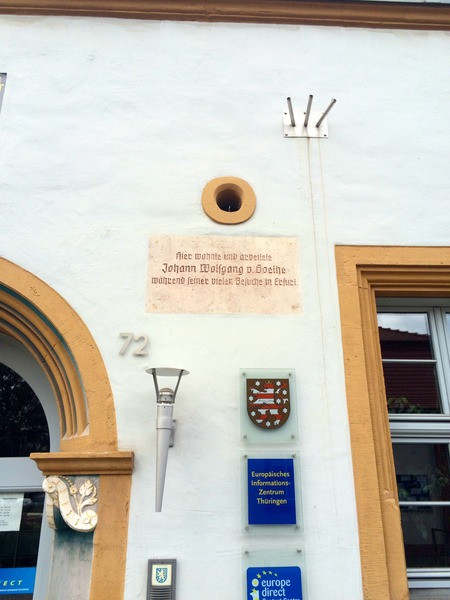
Speaking of Goethe (and who doesn’t speak of him?), the great man of letters was also a bureaucrat, responsible for managing the important east/west road that went through Erfurt.   He often stayed in this building next store to the Governor’s Palace.

As you can see, Germans still think of Goethe as kind of a big deal.

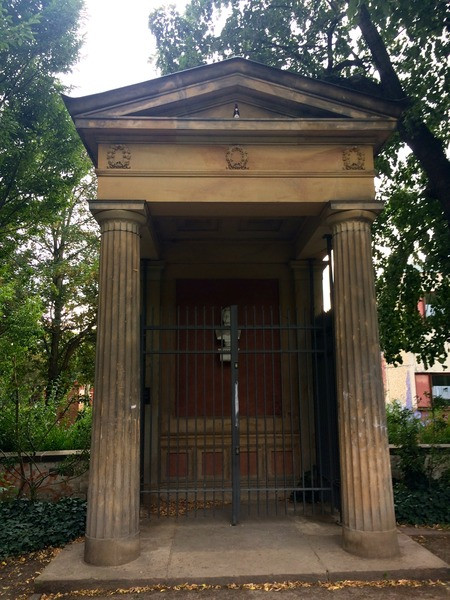
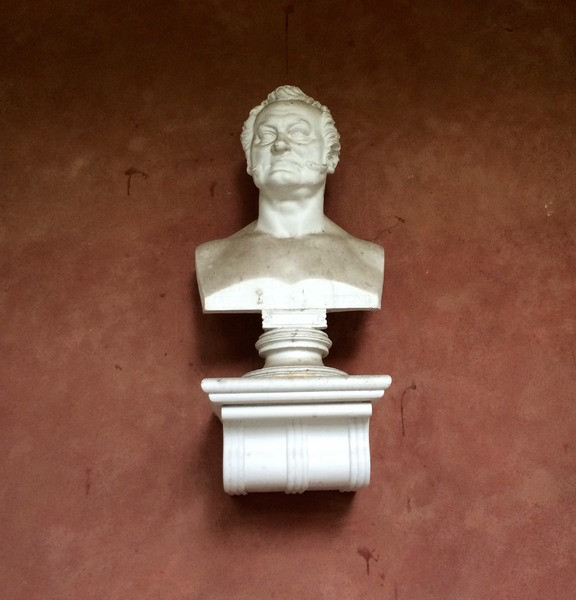
One more Napoleonic tidbit for you before we bid “Auf wiedersehen” to lovely old Erfurt.  Madame and I were strolling in a lovely park not far from our apartment, when I noticed my map showed something called the “Muffling denkmal” in the same park.   We found this little structure off in a corner.  Why here?   Wikipedia, always a good source for scholars, says that this hero of Waterloo died on his estates near Berlin, but the editor of an early translation of his memoirs reports that the estate was near Erfurt.

The great man, sporting some fine sideburns.   He looks like he was a pugnacious sort of fellow, making me think that the actor in the film Waterloo didn’t quite do him justice.


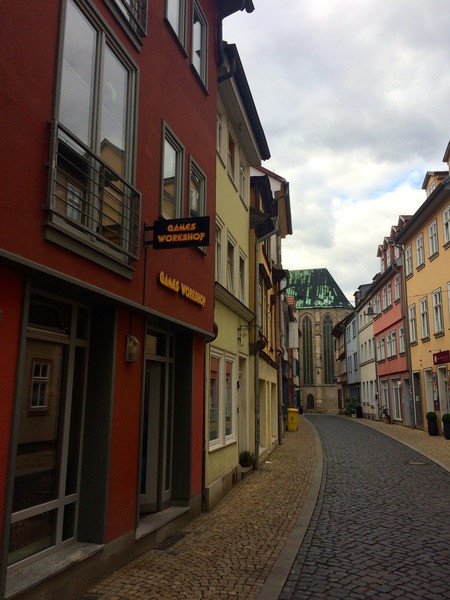
Finally, you may be asking, what were the hobby stores in Erfurt like?   I only saw one.  Didn’t go into it. But what a lovely street, with a ubiquitous church at the end of it.    In Canada we whine and moan about taxes, and consequently many streets in newer developments are built without sidewalks.   I gather the same is true of America.   The Germans don’t seem to have a problem paying for lovely, walkable streets.

Auf wiedersehen!

Wednesday, September 2, 2015

A Visit to the Citadel Petersberg, Erfurt, Germany

Madame Padre and I returned this weekend after ten all too brief days in Europe, where I was attending a conference.   We decided to make it into a holiday, despite Mdme having just received her first session of chemotherapy.  Her doc assured that she would have no problems,  despite having just had minor surgery to implant a shunt for the delivery of one of her drugs.   Go have fun while you can, doc said, and Mdme, always the feisty one, took up the challenge.  By and large she did beautifully, managing to do quite a bit of walking and sightseeing with plenty of rest periods where she sipped the excellent German coffee and I sipped beer.   A win win, I thought.

My conference was in the Thurnigian town of Erfurt, a medieval university town whose most famous alumnus was Martin Luther.   Erfurt was in the old DDR, and so most of the local residents over 30 speak little English. The town appears to be off the normally traveled tourist routes, which is a pity because Erfurt is a gem of a town  The old town centre survived the war largely intact, and after unification a ton of money was poured into the place. Today it looks clean and unspoilt.   We found lots to do for our week there.

Erfurt has a long association with the Napoleonic Wars.   Most well known is the Congress of Erfurt in 1808, when the Emperor tried to to charm Tsar Alexander into giving him a free hand in Europe.  I have some photos of sites associated with the Congress which I’ll save for a later post.  Today I thought I would offer some photos of our trip to the Citadel Petersberg, which is apparently the best-preserved Vauban-style fortress in an urban area of Europe.

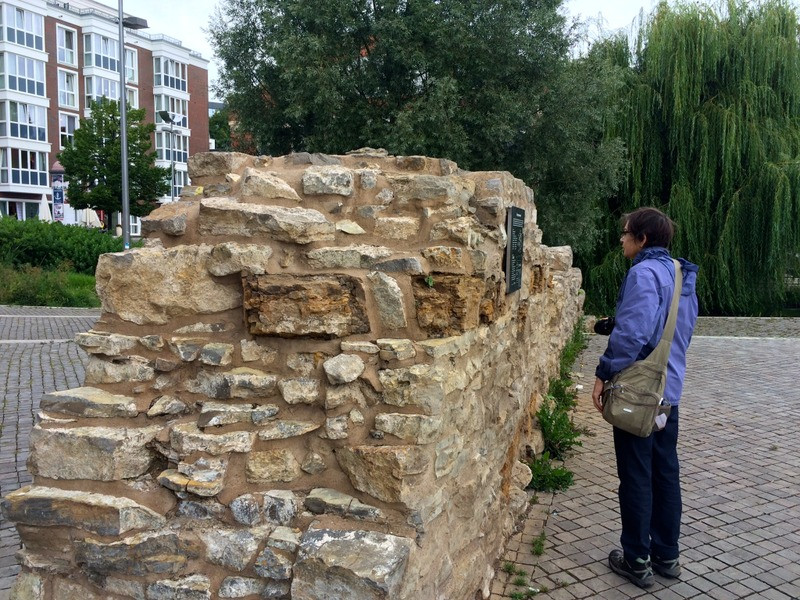
Erfurt’s medieval walls no longer survive, except for this specimen that Mdme. is examining on a disappointingly cold and overcast day.  
 

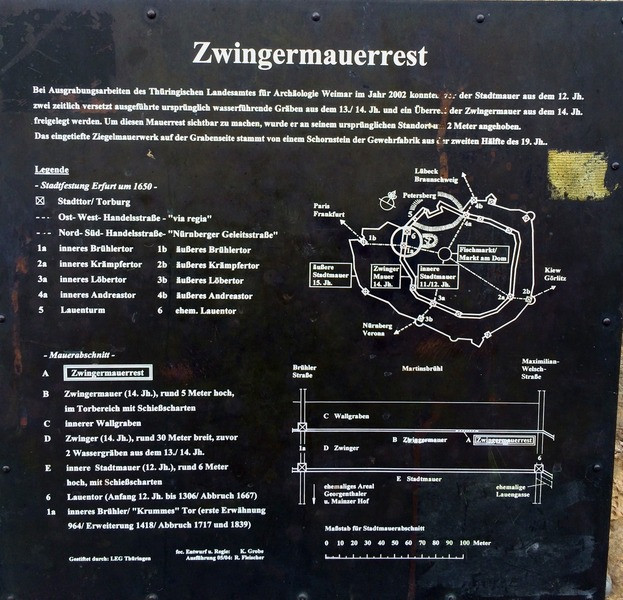
Map of the medieval walls showing the 17th century Citadel at the top left.  One doesn’t see much English in signs and museum placards in this part of Germany.
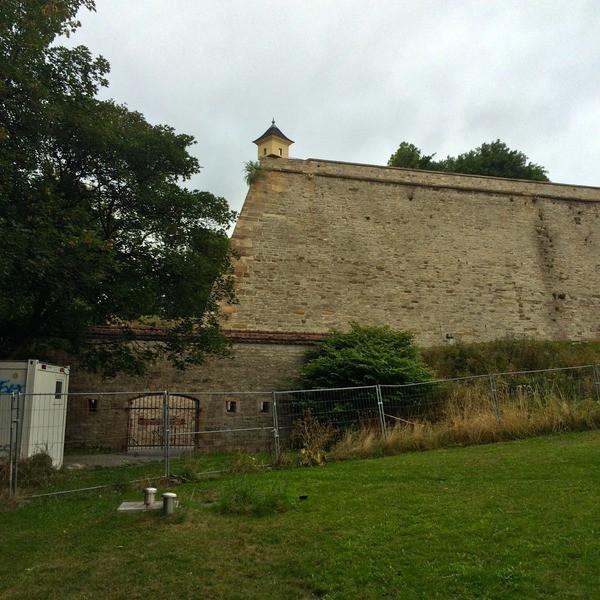
The Petersberg Citadel dates from the late 1600s.   It was built on a sizeable hill that dominates the town, and which was occupied by Benedictine monastery.   After the Treaty of Westphalia, Erfurt became subject to the Elector of Mainz, who was given permission to build the citadel.   The Elector employed an Italian architect, Antonio Petrini, and the fortress was finished by 1702.  So, it’s initial function wasn’t to protect Erfurt so much as to oppress the people of Erfurt.   I have all this from the Wikipedia entry thanks to Google Translate, or from history sites such as this one.  One can get tours of the Citadel thanks to Thurinigia Tourism, but they are only offered in German, so my visit was very much self-directed according to scraps gleaned over the internet.  Here’s a few of the Kiiian Bastion, one of the first works to be completed.
Approaching the main gate from the side.   The glass structure visible in this shot is a modern restaurant, which commands an excellent view of Erfurt and the surrounding countryside.
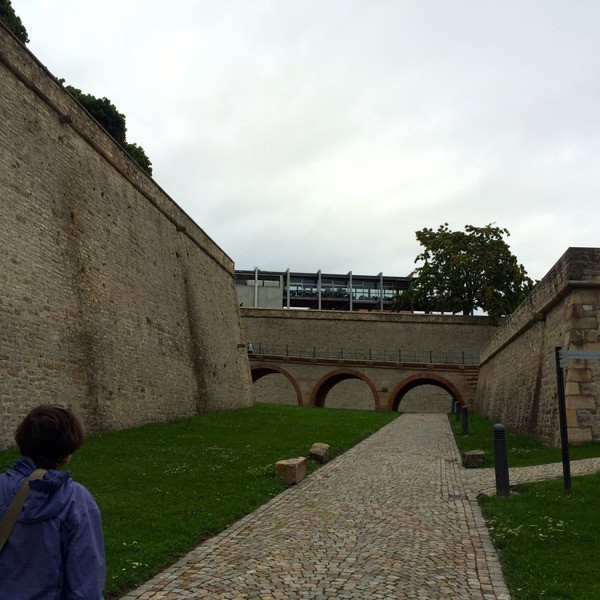
Mdme. Padre kindly demonstrates the height of the walls of one of the bastions.
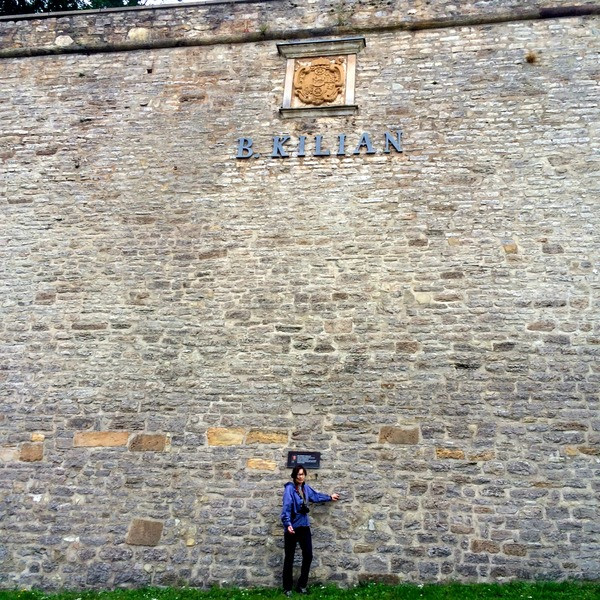
Just to rub the noses of the burghers of Erfurt in it, the arms of the Archbishop of Mainz are prominently displayed in many places. Erfurt became part of the Kingdom of Prussia in 1802.  The Citadel was slowly improved through the 18th century, and again by the Prussians.
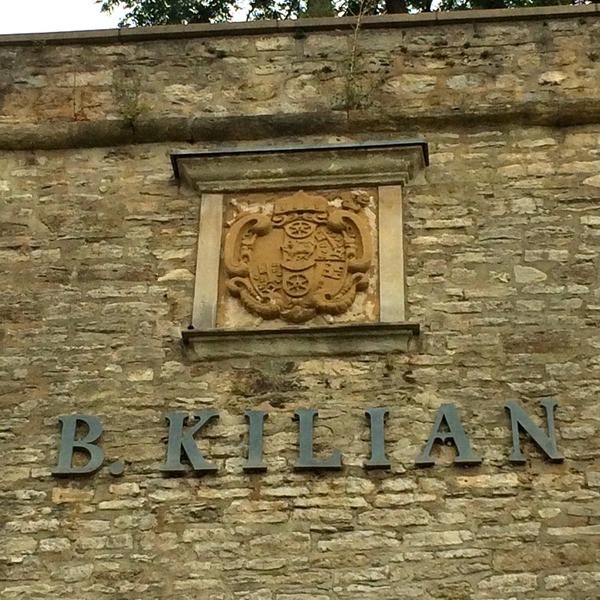
 

In 1806, following their defeat at Jena, a horde of demoralized Prussian soldiers sought shelter in Erfurt.   They were soon followed by Murat’s cavalry, which routed the Prussian rearguard.  Mollendorf, the hero of Leuthen and Torgau, had been wounded at Auerstadt and could not hold the Prussians together.  The Citadel’s commander surrendered to Murat, one of the few times surely when a fortress surrendered to a  force of cavalry.  A sad end to the career of this hero of Prussia.  Mollendorf was captured, and later this old soldier received the Legion of Honour from the Emperor.  

A view of the Peters Gate, the entrance to the Citadel.   The structure on top is modern, and as far as I could tell is used by a local youth group.  The Citadel has no military function today.  Some of the buildings are used as apartments, others for offices, and some are unused and in disrepair.  Sadly, there was no military museum or interpretive centre that we could see.
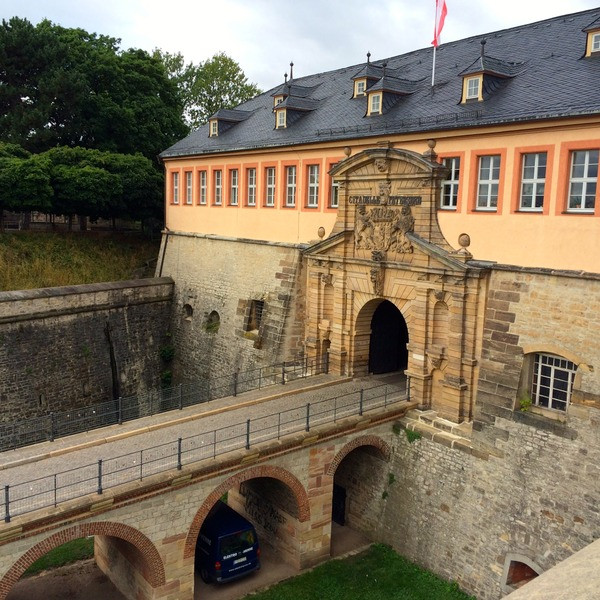
 

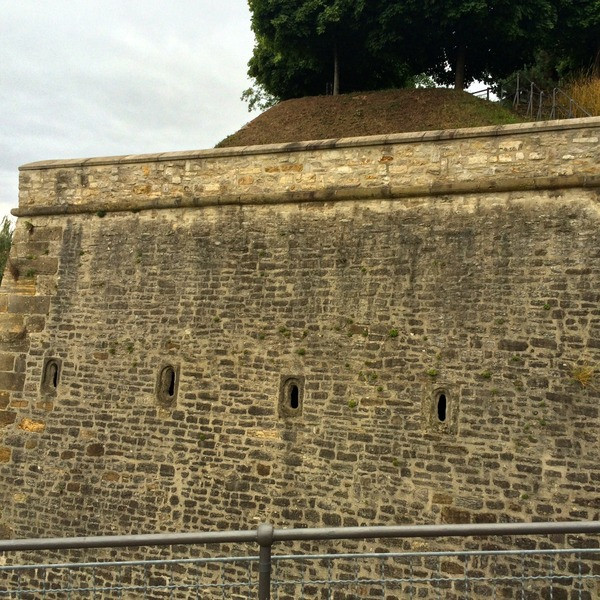
A view of the fortifications flanking the approach to the Peter’s Gate.  With determined troops holding this place and shooting out from these loopholes, storming the gate would have been a painful proposition.  I’m inclined to agree with the author of the Wikipedia article on the surrender of Erfurt:  “Historian Francis Loraine Petre remarked that Erfurt was the first of a series of ‘pusillanimous capitualtions’ by Prussian fortress commanders”.


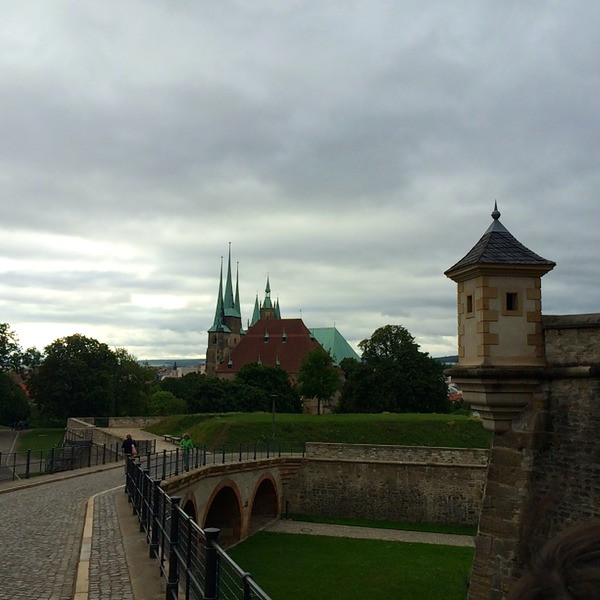
Standing in the Peter’s Gate looking out.  You can see the two churches on the lesser hill which dominate the Domplatz, the large square at the heart of Erfurt.  Both churches date from the 12th-13th centuries and are absolutely stunning inside.
 

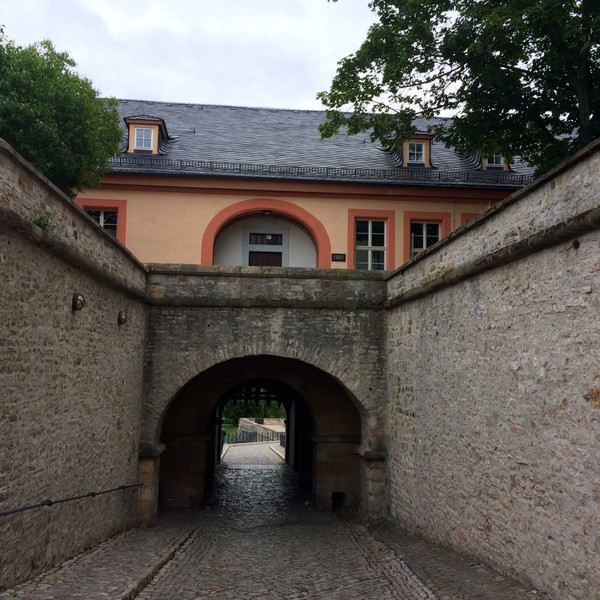
The Peter’s Gate from the inside, showing the portcullis still in place.
 

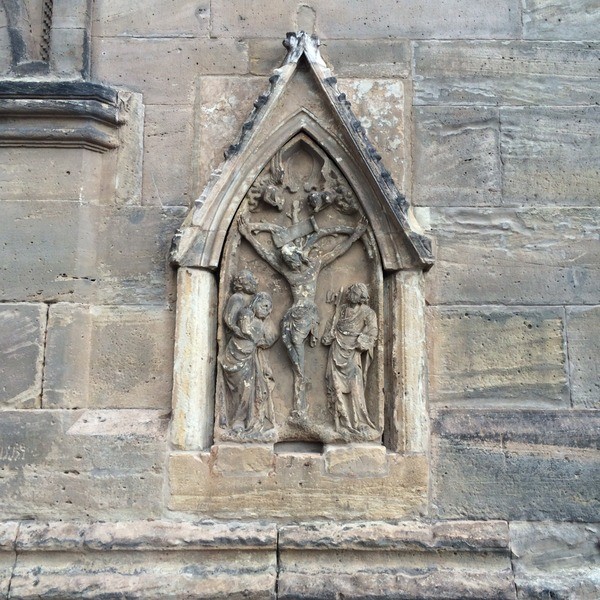
The Benedictines were kicked out in 1803, and their monastery of St. Peter and Paul became the garrison chapel, the Peterskirche.  It must have been a lovely church in its day, but sadly now is a hulk.  This sculpture survives from happier days - I am guessing it is at least 14th century.
 

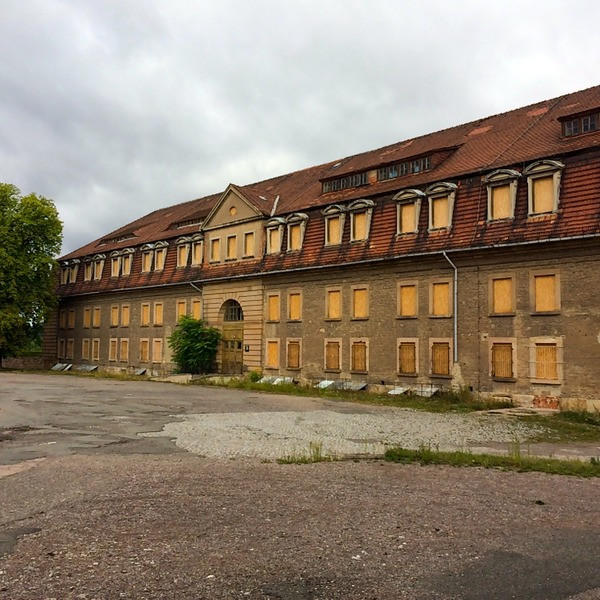
Some of the buildings inside the fortress have been restored since the unification of Germany, and some have not.   This is one of the barrack buildings they haven’t gotten around to yet.  It’s interesting to reflect on the troops that would have lived here and paraded in front of it.   Oudinot’s Old Guard would have gone through their paces here to impress Tsar Alexander during the Congress of Erfurt.   Since then, Prussians in the 1800s and Friekorps, Wehrmacht and DDR troops have all been based here.  Today the presence is all civilian.
 

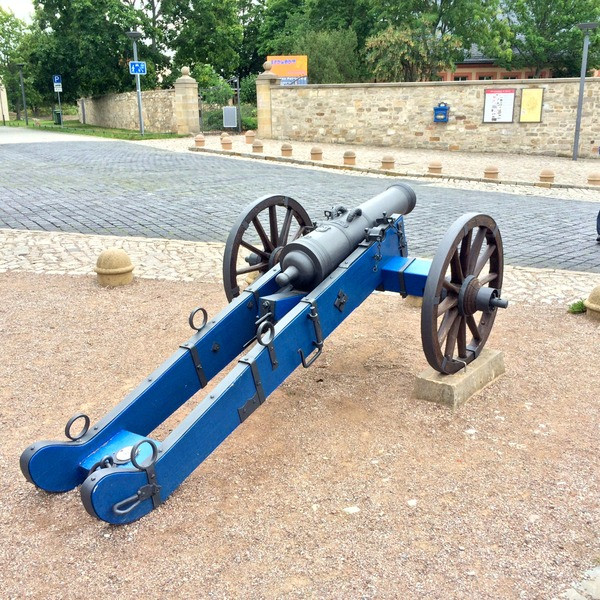
I’m not smart enough to judge the provenance of this artillery piece, but it looks Napoleonic at least.  It is parked in front of the Commandant’s residence, which today, from what I can tell, houses the Thuringian provincial government department that oversees monuments and historical sites.   During World War Two the commandant’s house was the site of a military court.   Political and military prisoners were detained in the Citadel, and today a monument exists to the unknown deserters of the Whermacht.   At least fifty of these were executed in the Citadel.  Another layer of history:  today the Citadel houses the state office responsible for administering the records of the the secret police, the Stasi, from the DDR days.
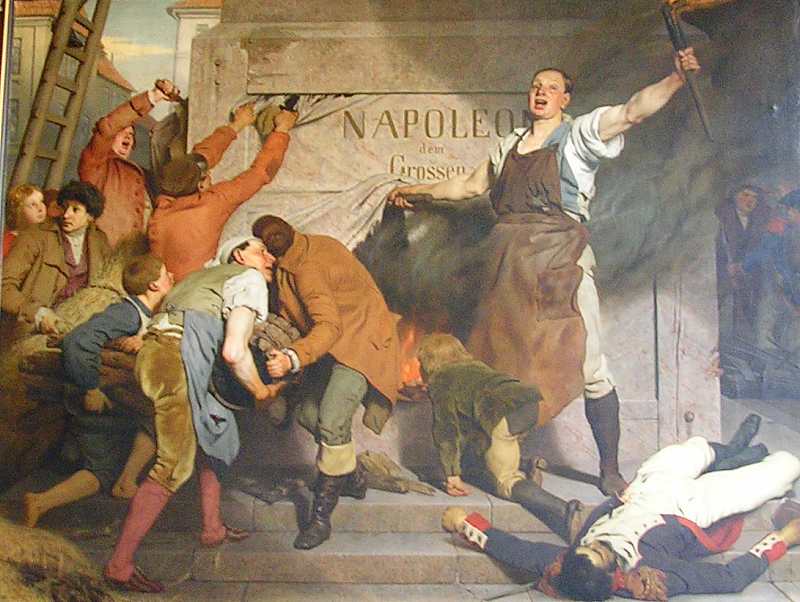
 By early 1813, Napoleon’s troops were fortifying the Citadel, which was a good idea, because Erfurt became a target after the Battle of the Nations, not too far to the east at Leipzig.  The Erfurt garrison commander was General de Brigade Alexandre Dalton, who refused a demand for surrender from an army of Austrians, Prussians and Russians under Nollendorf.  Dalton’s troops were evicted from the town of Erfurt, which caused much rejoicing among the burghers.   This painting by the mid 19th century historical painter Peter Janssen shows an actual episode, the locals destroying a wooden obelisk built in 1811 in Erfurt’s Angerplatz to honour Napoleon.   Judging from the painting, it wasn’t that sturdy an obelisk, not one of your quality stone jobs.
 

This postcard shows an initial scene of the siege, with the fortress and the heart of Erfurt under shellfire.   The obelisk in the centre right is your genuine stone version, and not the one in the previous image.  It is still there today.  The wooden buildings at the foot of the Citadel are gone now and the square, the Domplatz, is much more open today than it evidently was in 1813.   The two churches on the right, the Cathedral Beatae Virginis (left) and of St. Severis (right) are intact, but the spires on the Peterskirche in the Citadel (right) are gone.
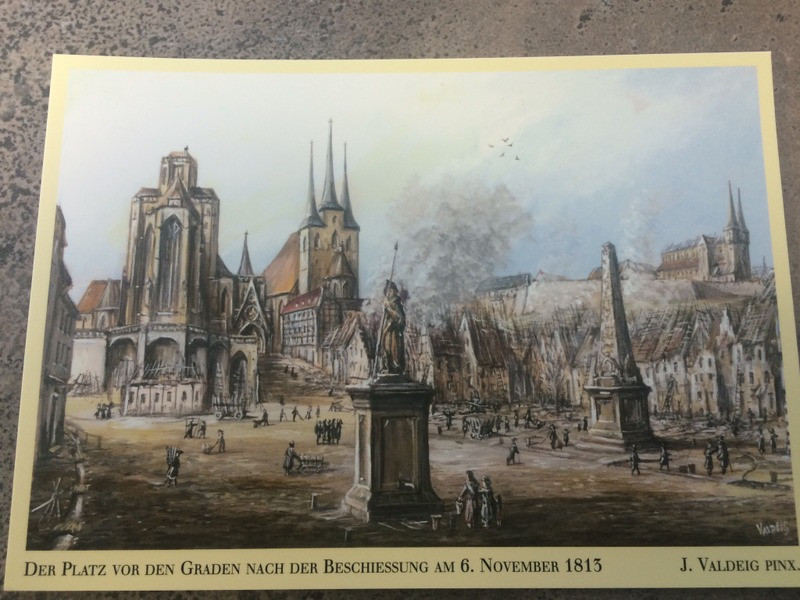
 

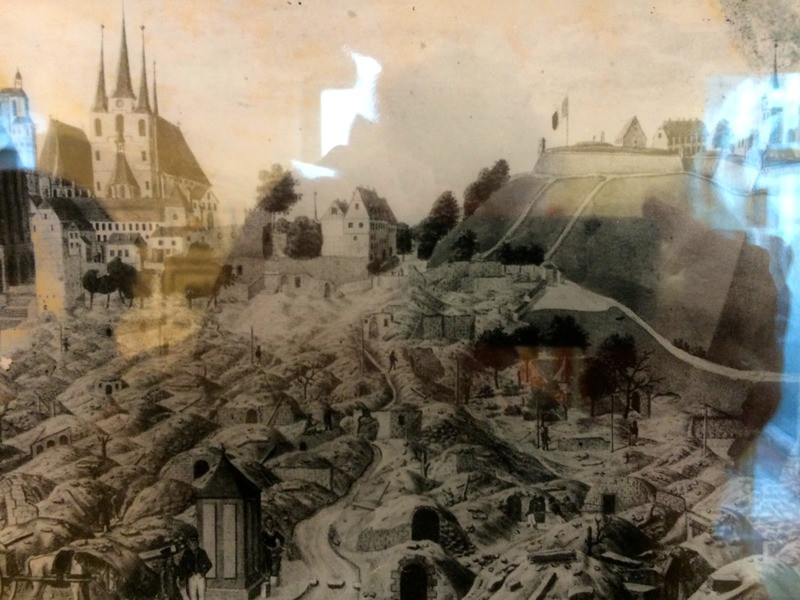
Dalton’s garrison abandoned the town and retreated into the Citadel, where they held out until May of 1814, when they were ordered to surrender by the French government.  Looking at the fortress, it’s easy to see why they held out.I saw this framed print on the wall of a cafe on the Domplatz and photographed it.   You can see what a protracted siege it was.  The ruined buildings in the postcard are gone, and have been replaced by extensive dugouts and bomb proofs once the siege lines were established.
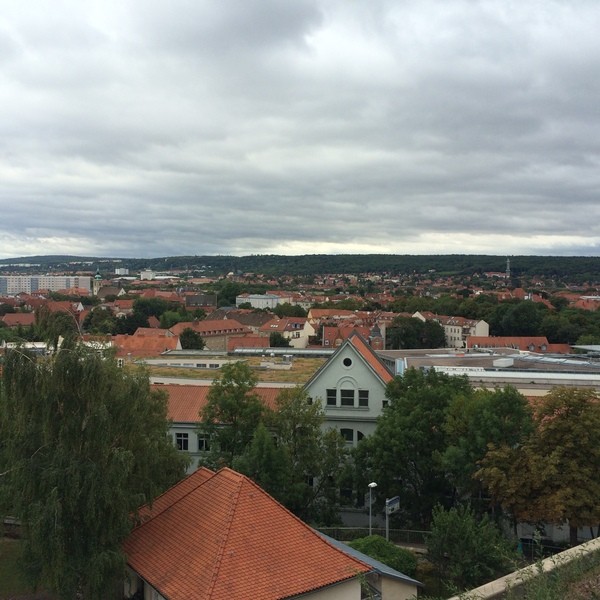
This picture from the walls of the Citadel shows what a commanding view the defenders enjoyed, and why all those dugouts were necessary.
 

There is a book on the 1813-1814 siege of the Citadel by a Frank Palmowski.  It is, unfortunately, only in German.  I picked it up in a bookstore in Erfurt, thought about whether the 20 euro price would be an incentive to learn German, and decided, sadly, to leave it behind.  Perhaps German readers may know more about this story, but I found it a fascinating piece of Napoleonica.   If you are ever in the part of Germany, I encourage you to visit this charming little town.

MP+
Friday, May 1, 2015

Worst Range Day Ever

I’ve been dropping off library books as I prepare to leave university and go back to work, and one of them was Charles Esdaille’s The Penninsular War (Palgrave 2003), which is a grand and detailed reference that I’d love to have in my collection.

I couldn’t drop it off without re-reading my favourite paragraph, in which Esdaille describes the particularly bad quality of the troops that Napoleon had on hand when he first invaded Spain in 1808.   Max Foy described the army as being thrown together of inexperienced men and bits and pieces of units.  “Unacquainted with each other, unknown to their officers, whose names, even, they knew not, taken little care of, badly subsisted and irregularly paid, [the soldier’s] existence as fluctuating and precarious, like that of the ephemeral corps of which they formed a part”. 

It was a dangerous army to lead, as Blaze (Memoires d’un Apothecaire sur le Guerre dEspagne) described.

“On the fifteenth of March, we held exercises on a plain outside the town [of Valladolid], and General Malher was killed by a ramrod that a soldier had foolishly left in the barrel of his musket.  An immediate inspection was carried out to discover the … culprit: eighteen ramrods were missing from the section of the line the shot had been fired from."

The unfortunate General Malher.

This story is especially tragicomic because Jean Pierre Firmin Malher was, by all accounts, a distinguished soldier. Here’s his bio from the Arc de Triomphe website.

 Jean-Pierre-Firmin Malher first enlisted in the army in 1777, and then two years later he served on the ship La Couronne. After the Revolution began, in October of 1789 Malher joined the National Guard of Paris. In 1792 he joined the 14th Battalion of Light Infantry, served with them in the Army of the North, and was commissioned as a sous-lieutenant. The next year he was promoted to lieutenant and became an aide-de-camp to General Queyssat. Malher continued to serve with the Army of the North and in 1794 he was promoted to chef de brigade and became the chief of staff to General Bonnaud's division.

Malher's next major command came in September of 1799 when he became Vandamme's chief of staff in the Army of Holland. The next month he served at Castricum, was promoted to général de brigade, and joined Boudet's division. In 1800 General Malher joined the Army of the Reserve in Watrin's division, and that May he seized Aoste and fought at Montestrutto, Ivrée, and Chiusella. In June he fought at Montebello and then was wounded at Marengo. That November Malher returned to Paris.

During the years of peace that followed , Malher was employed in the 24th military division and he received a promotion to général de division in 1803. In 1804 he went to the camp of Montreuil and took command of the 3rd Infantry Division that would become part of Marshal Ney's VI Corps the next year. Malher led his division throughout the campaign of 1805 and fought at Gunzbourg in October. On Christmas Day of 1805, Malher was made a Grand Officer of the Legion of Honor.

The next year, a few weeks into the campaign in Prussia, General Malher was replaced in his command by General Vandamme. In 1807 Malher was employed in the interior and then given command of the 13th military division at Rennes. That November he took command of the 3rd Division of Dupont's II Corps. Traveling with the army into Spain, Malher and his men were at Valladolid in March of 1808. Malher was participating in a training exercise when a soldier fired his gun but had left his ramrod in the barrel. The ramrod flew out of control and through Malher's skull, killing him.


Where’s your ramrod, son?  It’s in his head, innit?

 Poor man, he deserved better than a ramrod through the skull.   One wonders what happened to those eighteen soldats who had fired off their ramrods.

I might have caused a similar incident at a range day.  On my first field exercise as a padre to my first regiment, the troops were working in pairs firing live ammunition with the C7 (Canadian version of the M16 assault rifle) while working through a course with pop-up targets.  The Major in charge wanted me to take a rifle and go through the course with him.   As a chaplain, I am strictly required to be a non-combatant, and it had been many years since I had handled an FN rifle, the predecessor of the C7.   It would have been so easy for me to accidentally kill the Major or someone else, so I politely declined.  I also declined his suggestion that I serve as a Range Safety Officer, for similar reasons.   That Major was fortunate not to share the fate of poor General Malher!

Blog Archive

Followers