Showing posts with label GMT Games. Show all posts

Monday, September 11, 2023

Game On The Table: Burma The Forgotten War

Hello friends:

Just a quick proof of life blog post to show that I’m here and still interested in wargames, just terribly short of time.

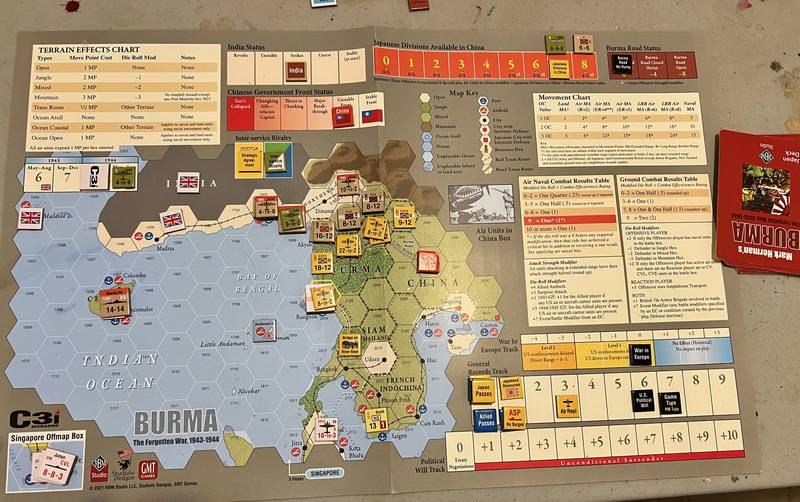
On the gaming table currently is a paper game, Burma 1943-44, The Forgotten War.   It’s a design by Mark Herman that shipped in the most recent C3i Magazine publication of Rodger McGowan which is essentially the GMT Games in-house magazine.

This is a strategic-level game that uses the same engine as Herman’s Empire of the Sun (2005) which covers all of WW2 in the Pacific.  I have EOS but thought that the Burma game would be a good way to learn the system, which is card-driven and focuses a turn on a series of possible military, political or economic events.   Cards can be played for specific effects as printed on the card (eg, the Japanese can use certain cards to make India more politically unstable for the British and cutting off key reinforcements and replacements needed to police the Raj instead of supporting the Burma offensive) or the like.

Or, cards can be played for their logistic and command and control values to allow certain units to act offensively, or to react defensively.   Thus, it’s not one of those games where every unit can do something during each turn.  It requires a lot of thought, and as it’s a card game, would doubtless be more fun as a two player game.

The puzzle for the Allies is to use their limited resources to punch a hole through the Japanese defences and push on Rangoon before the war ends.  The Japanese have a decent army and some air units, and can either play defensively or make their own attempts to reach India or knock the Chinese out of the game.

Not a simple game but it’s short (four turns) and halfway through my first try I’m enjoying it and feeling like I’m mastering the system.

Cheers and blessings to your die rolls,

MP+

Wednesday, March 29, 2023

Wednesday Boardgame: C&C Napoleonics Battle of Gunzburg

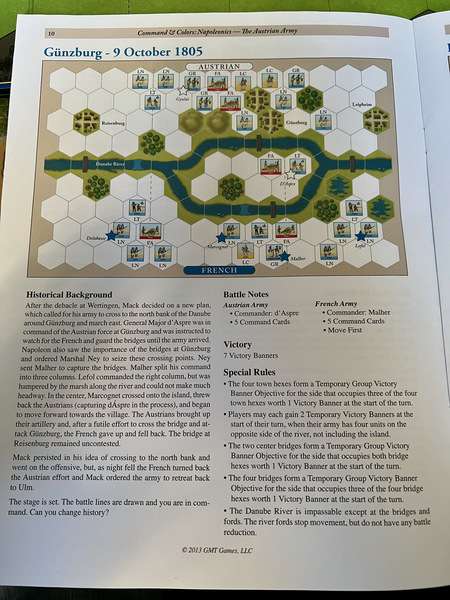
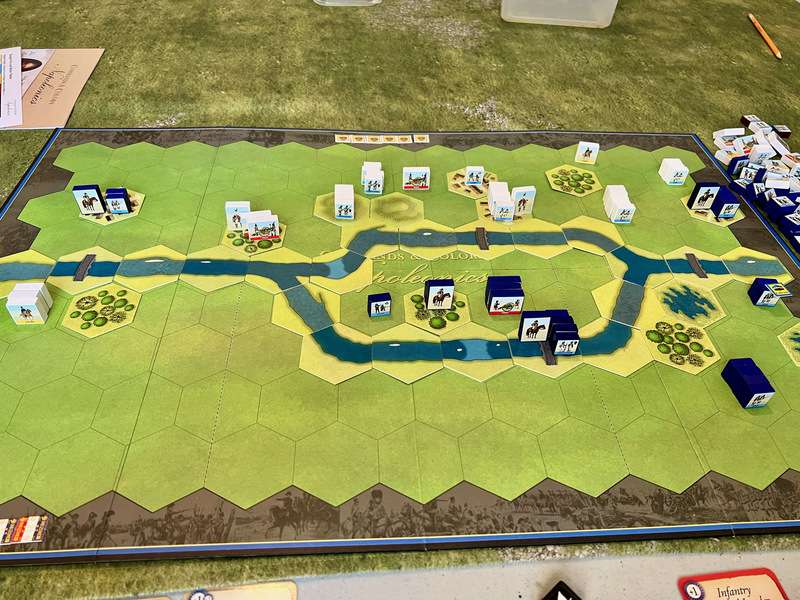
I decided to give my Command and Colours Napoleonics some love, as a fast way of getting acquainted with some of the more obscure battles of the period.  I chose the second scenario from the Austrian expansion, Gunzburg.  This was one of the actions of the Ulm campaign, when General Mack ordered General D'Aspre to find a way across the Danube so that Mack might extricate his forces from Ulm.  At the same time, Ney had ordered his Third Division under Malher to seize the bridges. The battle is brilliantly described by Jeff Berry on his Obscure Battles blog here.

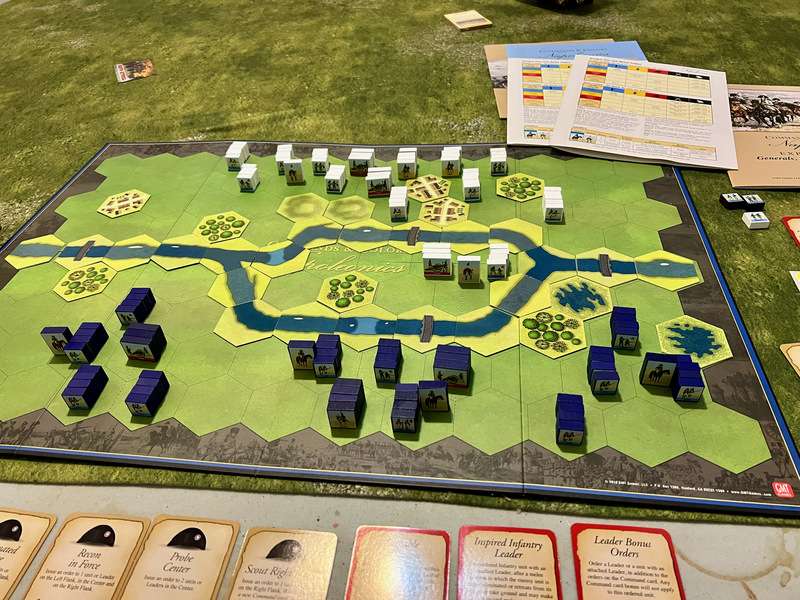
It’s an interesting battle because the two forces were evenly matched, about 7500 per side, and faced each other across a stretch of the Danube with four bridges, two of them leading on and off a small island in the centre.    There is also a ford near the left most bridge, though I just noticed that when I set up the board I mispositioned the ford tile closer to the centre, which may have disadvantaged the French.

Here’s the board set up.  As you can see, the ford should have been two hexes to the left, screened by the woods.  As it was, it was covered by Austrian troops on the hills, and the one attempt of the French to cross there was badly shot up.

It’s an interesting tactical problem for both sides.  The scenario gives the Austrians a temporary victory banner for holding three of the four towns, but both sides get temporary banners for holding bridges and for pushing troops across the Danube (not counting the island).  Either side can win the game if they choose to attack, though the more tempting approach is to let the other side try to cross and then punch them hard when they reach a bridge or ford.ave 

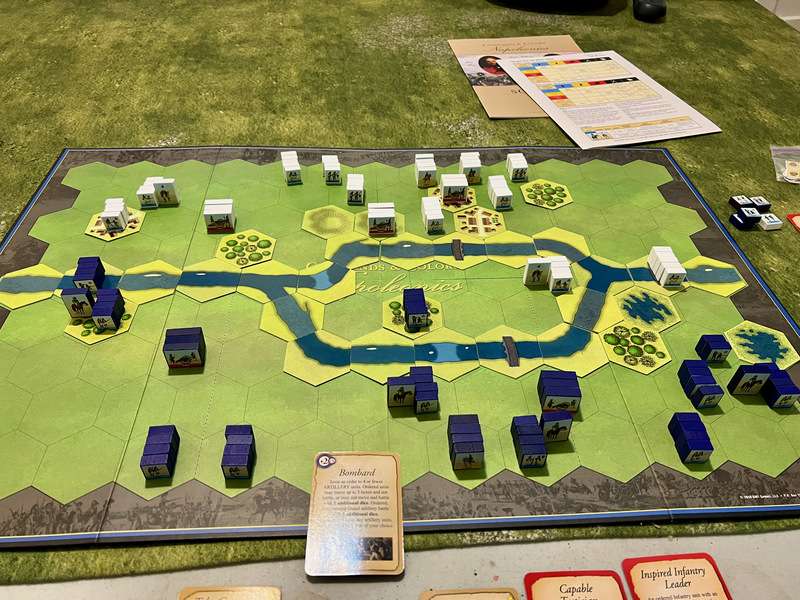
In the game I played solo, the French tried to advance, but a big (5 block!) Austrian line infantry unit smashed into the French light infantry on the right most bridge and threw them back.  That was pretty much how it went from then on as the battle became attritional.

The game ended with a 7-3 Austrian win and the French bled white after chasing an illusory success on the left wing.   In retrospect I should have tried to mass troops at several crossing points before committing to an assault.

Sharp-eyed CCN players will have noticed that I was using the Tacticians cards from Expansion 5, Generals, Marshals, and Tacticians.    I like extra opportunities that these cards provide, though I suppose some purists might complain that they make the game a little too “gamey”, like the cards in Sam Mustafa’s Longstreet.  Throwing down the “Break the Square” card when you charge with your cavalry might be gamey, but it is very satisfying.

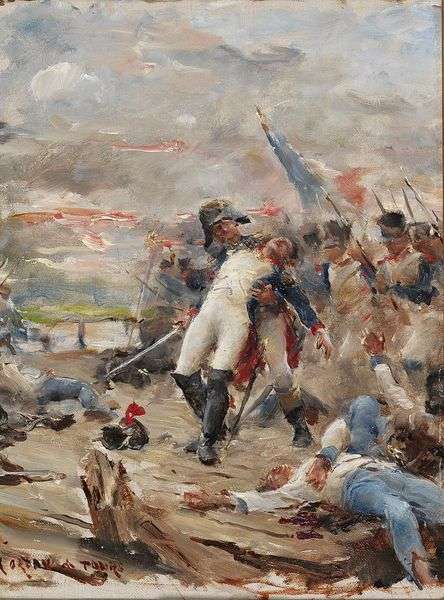
Death of Colonel Gérard Lacuée at the battle of Günzburg, on October 9, 1805. Oil painting by Georges Moreau de Tours.

“They rolled two sabres for Leader Kill!  Damn them!”

I knew nothing about this battle before playing the game, so I learned something, and would consider lifting the victory conditions from this scenario to apply to a 6mm miniatures version, since my collection is mostly French/Austrian, though I would need to improvise to get enough river sections.  It would be a fun project.  Visiting Gunzburg and seeing the Legoland there would also be a fun project.

Thanks for reading and blessings to your die rolls! MP+


Wednesday, January 23, 2019

First Look at GMT's Pendragon, The Fall of Roman Britain


Last fall as part of GMT Games' annual sale, I couldn't resist ordering their 2017 title Pendragon: The Fall of Roman Britain.   Designed by Mark Gouyon-Rety, it is one of the latest instalments in their series of COIN games, and is developed by Volko Ruhnke, the Prince of COIN.

GMT's COIN games are multiplayer simulations of political and military struggles other than traditional warfare.   Since they don't use the traditional war-games hex and counter format with historical orders of battle, and have a Eurogames look to them with their many multi-coloured blocks, they aren't for some grognards.   I confess I like them because of their complex and clever modelling of the historical processes - influence, population movement, and shifting allegiances - that mark many conflicts.  Some years ago I made some comments here about their Afghanistan COIN game, A Distant Plain.


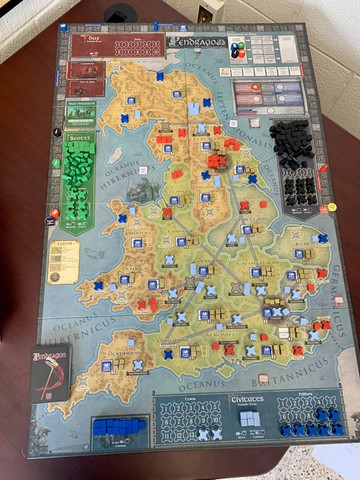
So here we are in the last days of Roman Britain.  The red counters are Dux, the Roman Army in the late 4th century. They have a lot of good troops and forts, and are at the start politically linked with the Civitates, the Romanized Britains (blue) who hold the towns and a variety of strongholds throughout the countryside.   On the left, the green counters are the Scoti, Celtic Irish and Scottish tribes, while the black counters are the Saxons.   Obviously the Scoti and Saxons want to carve up Britain between them.


As the photo shows, Pendragon is a beautiful game to look at, and is typical of GMT's high production values.  A quick  play by play of the first few moves follow to give you a sense of the game mechanics.

The turn sequence is card driven, as in other COIN games.   Each card shows the four factions' icons in different sequences.   Two factions can act on each card, starting from left to right.  The card on the left is in play, and the next card is placed face up on the deck, so players often face choices on whether to act on one card or pass and wait for the next, more optimal card.


The first faction allowed to move is the Civitates.   Since, while wearing my Civitates toga,  I know the barbarians are coming, I decide to use the Muster Command to pay resources to place an extra militia cube (the light blue cubes) in each of the provinces marked with a white pawn.  I also spend additional Resources to stockpile Wealth, which can be used for unit upgrades and the like.   Might as well get ready.   
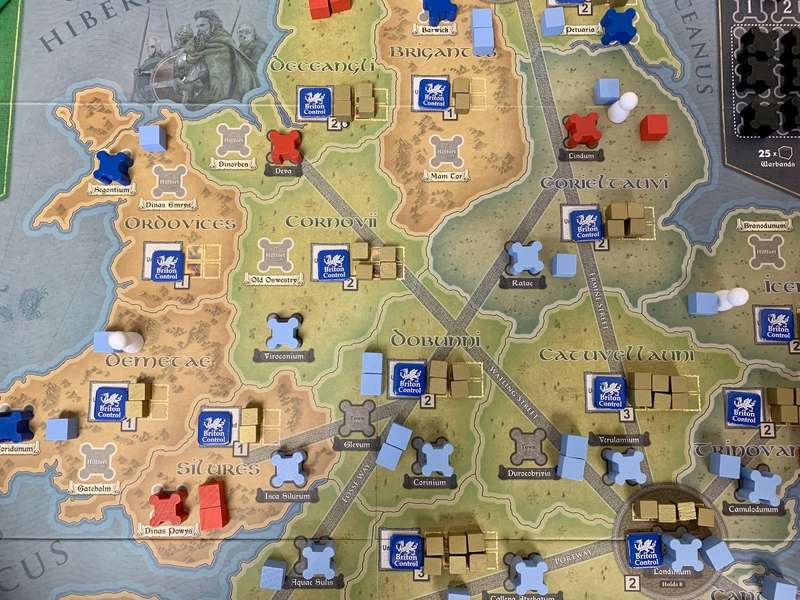

Next up on the St. Germanus card is the Dux faction, and since they are maxed out, with all their troops and forts already in play, they pass and accrue some Resource points for biding their time and harvesting their strength.   Because the Dux passed, the Scoti can act, bu since the Civitates have gone first, the Scoti only have a Limited Action, meaning they can only operate in one area.  They could play the shaded part of the St. Germanus event card, Papal Oversight, which would rob the Civitates of resources, but their game is all about raiding, and I want to see how the Raid mechanics work.

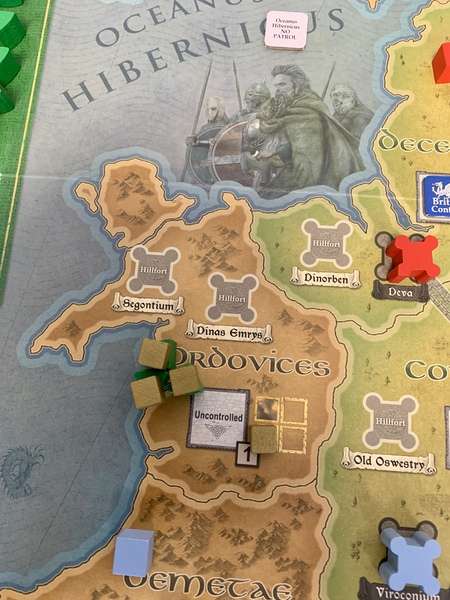
Each raid generates a random number of raider units, which are not as strong in battle as regular units, but are quite pesky.  The Scoti get to roll 1d4 for free, but chose to spend a Renown point (Renown points measure the success/failure of the two barbarian factions) to roll an extra dice.  Scoti rolls a 7, so seven raider parties descend on the region of Ordovices.   The Hibernian Sea is currently unpatroled, so the raiders are cross successfully.


Wealth in Pendragon is measured by gold Prosperity/Plunder cubes.  Ordovices has two, and the raiders can take a number equal to the population rating (Orodovices has pop 1) so the Scoti get a Plunder cube to try and take home - if successful they convert the Plunder to a Renown point, which the barbarian factions need to win.  The only Civitates militia cube in the region has wisely retreated into the hill fort at Segontium, but the Scoti can afford to throw all those raiders at the hill fort.  A multi-stage process (Escalade, painful for the attackers, then Storm, a straight exchange) follows.  At the end, the Scoti lose four raiders, but eliminate the hill fort and the militia, and acquire two more Plunder for a sacked stronghold.  They have three raider units left, so can carry all three Plunder.  Hopefully in the next Scoti turn, the raiders can return home and convert that Plunder into three Renown points.

Since two factions have moved, the St. Germanus card is finished and the Annona card is now in play.   Dux and the Saxons are the first eligible factions to move on this card.  The next card, now face up on the deck, is Groaning of the Britains.   Again, a faction can either chose the event on the card in play, (top version) good for them or (shaded version) bad for the others, or instead of an Event they can chose an Action, so there is always a choice on each card.
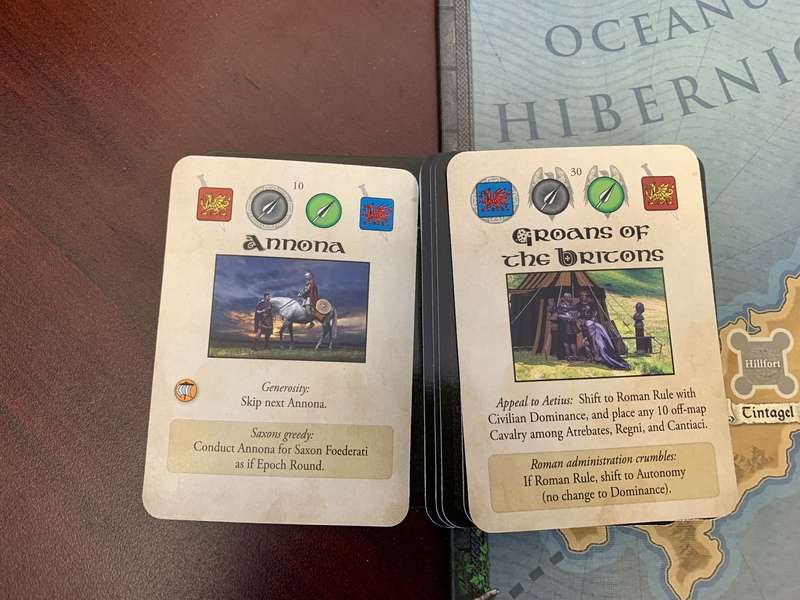

Situation at the beginning of the next card - Dux can go first.  The "Annona" event isn't relevant since there are no Feoderati (barbarian bands hired by the Dux/Civitates) in play yet that need to be paid for.   Dux therefore focuses on actions and could choose the Train option to reinforce,  but since all its allowable forces are already on the board, there is no sense in that.   Dux has two red cavalry units in neighbouring Deceangli which could use a Move action to reach Ordovices, but since the British have lost control of that region, the Dux cavalry could not bring the Scoti raiders to battle.  They could do this on an Intercept move, but only if the region was under Briton control (before Fragmentation, Dux and Civitates are both treated as Britons).  Getting Ordovices back under Briton control is a long-term project that Dux is willing to leave to the civilians, and besides, those two cavalry units in prosperous Deceangli are needed in case of further raids.  Dux passes and collects 3 Resource points.
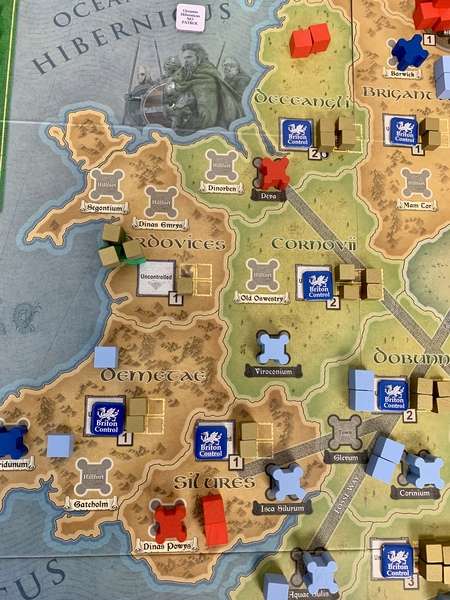


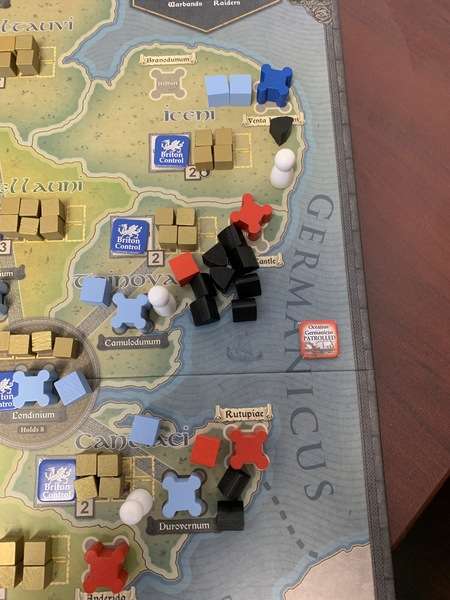
Saxons are next according to the Annona card and with my Saxon cap on, I decide to Raid in a big way.    The Saxons can Raid up to three regions or cities bordering the Oceanus Britannicus or Oceanus Germanicus.  They choose, from N to S, the three regions of Iceni, Trinovantes, and Cantiaci, spending 1 Renown each for Iceni and Cantiaci to roll 1d4 of Raiders and 2 Renown for Trinovanes to roll 3d4 of raiders.  The result looks grim for the people of Trinovantes, with 8 raiders descending on them!


Because the Oceanus Germanuicus is partrolled and is bordered by three red Dux forts, the residue of the Roman Navy does its job and three raiders are removed from each group, which means that the Britons only have to worry about Trinovantes.   The Saxons now grab Plunder equal to the population, so two Plunder cubes.


 The united Britons decide to stand and give Battle, and we go through the preBattle sequence, where the Saxons elect to try and Ambush (need a 5 or 6 on 1d6) but fail their die roll.  The hard hitting Dux cavalry charge first, killing two raiders, then in a  simultaneous round the raiders inflict 1 and 1/2 hits, killing both Briton units, while the Militia do 1/2 hits, enough to kill 1 raider.  That leaves two Saxon raiders loaded with loot, and that seems like a good if bloody day's work.  Trinovantes remains Britain but is now devoid of its garrison and the Saxons, like the Scoti before them, will try to take their loot home.   A dark pattern for Roman Britain is emerging.

So there are lots of things I am probably getting wrong, but that is the game so far, and I am enjoying it and the many decisions it forces on each faction.   As I continue, I may try and use the "bots", the decision trees for the non-player factions, if only to learn what the optimal strategies are for them, but for now the best COA for the barbarians seems to be raid, raid, and raid some more, until the Britons are weak enough that the remaining raiders can start to take up a permanent foothold.

Blessings to you gaming!
MP
Tuesday, October 9, 2018

A Game Too Far?

My son John was visiting me from BC this summer, and expressed a great interest in my board games collection.   John is a miniatures gamer, and knows W40K like the back of his hand, but he was intrigued by old school hex and counter games.    His birthday was coming up, so I gave him three websites, GMT Games, Compass Games, and Vassal, and told him to pick whatever game he liked that was still in print and had a Vassal module so we could play i by email.   More to follow on that.

I am not sure exactly how many Market Garden games a chap needs in my collection, and to be honest, my collection has a bit of a mind of its own and hasn’t been effectively curated over the years.  

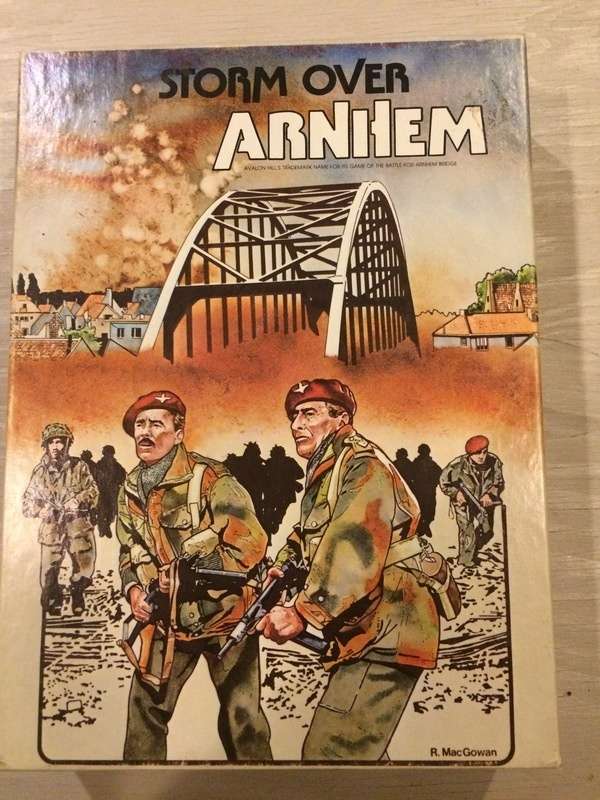
I have four MG games by my count.   One is an Avalon Hill classic, and is a sort of operational/tactical hybrid, focusing on the British defence of Arnham.   Designed by Courtney F. Allen and published in 1981, it featured an ingenious area impulse movement system for its day and spawned several other AH games using the same engine, one on Stalingrad and the other on Monte Cassino.  Breakout Normandy used the same basic engine but at a larger, more truly operational scale. SOA is the only Market Garden game I own that I’ve actually played head to head, and it is a much better played H2H than solitaire.

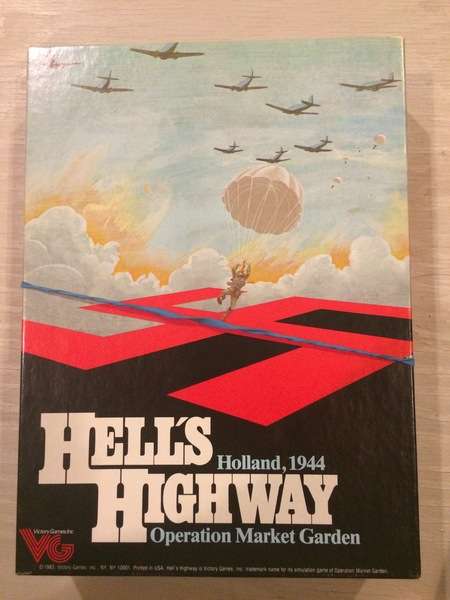
Hell’s Highway (published 1983) is a strategic level game by John Butterfield, who was one of the stable of SPI designers who went to Victory Games.  John is coming to a gaming convention in March 2019 in Toronto, which is kind of exciting.   Maybe by then I will have actually played this game, or at least peaked inside the box.

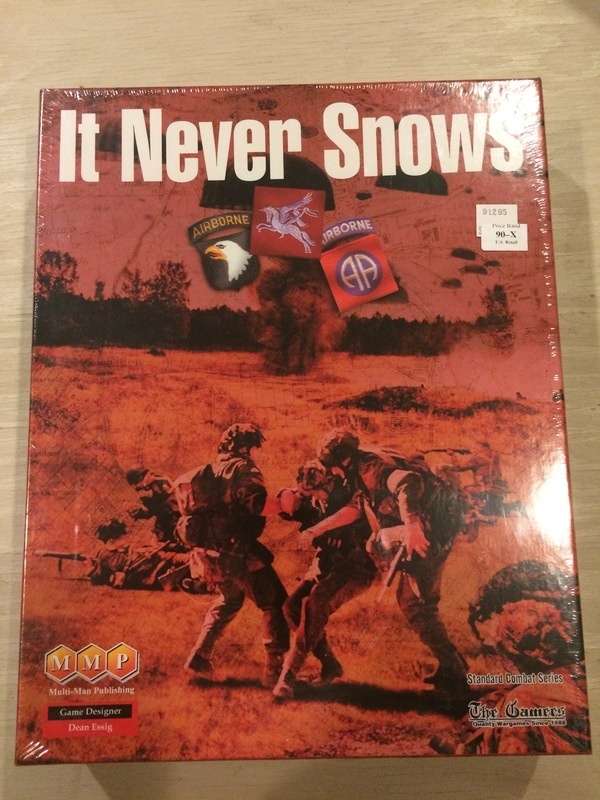
I bought It Never Snows shortly after MMP published it in 2012, partly from what I’d heard about it and partly on the strength of its designer, Dean Essig, who has won a hockey sack of awards and has a long and distinguished design resume.    Alas, it is still in the shrink wrap.    Hopefully when I retire I can get to grips with it.

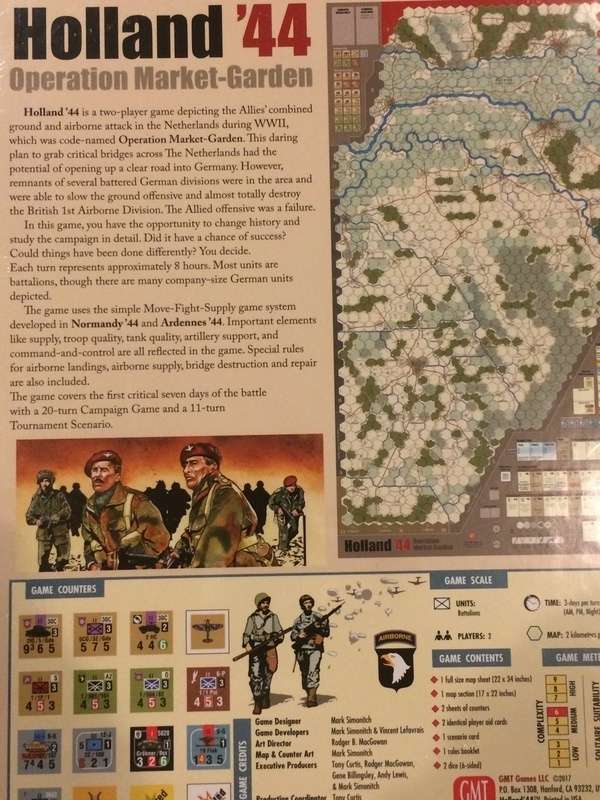
So, going back to my son John - what did he choose, but a Market Garden game?    Holland 44 is a 2017 GMT title, designed by Mark Simonitch, and is an operational, battalion-level game, starting with the airborne landings and ending on 23 September.  As with the other big titles (Hells Highway and It Never Snows), the game is a race to relieve or reduce the airborne bridgeheads before the Allied ground forces can get there.

Notice how GMT recycled some of Rodger MacGowan’s SoA artwork for the back of the box!

Well, that’s all I have to tell you for now.   I am waiting for John to tell me that he’s digested the rules (he is a demon for memorizing complex rule books) and then deciding what scenario and which side to play.   If you are interested in playing Holland 44 with me via Vassal, by all means let me know, I could use the practice.


Wednesday, May 30, 2018

Life Goes On

A dear friend of mine whose husband died of cancer a week before my own beloved Madame Padre passed away last November said something wise to me.   “You and I are still in the land of the living”, she told me, and I have tried to live by those words for the past five months.


 The support of my wargaming friends has been wonderful and I have leaned on several of you, as you know.  Thank you all.  I’m in a better place now, and do indeed want to dwell in the land of the living.  I’m eating well, working out regularly, have lost some of the weight I put on as Kay’s caregiver, and am fully engaged at work and as the volunteer honorary priest of my local parish.  A lovely lady, a cancer widow, has entered my life, and made it much richer.


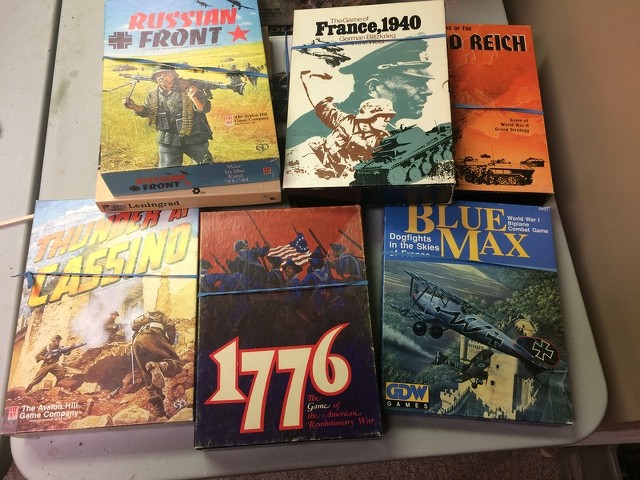
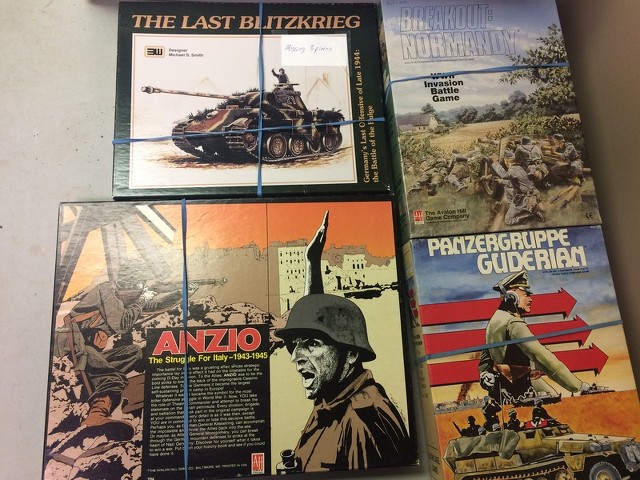
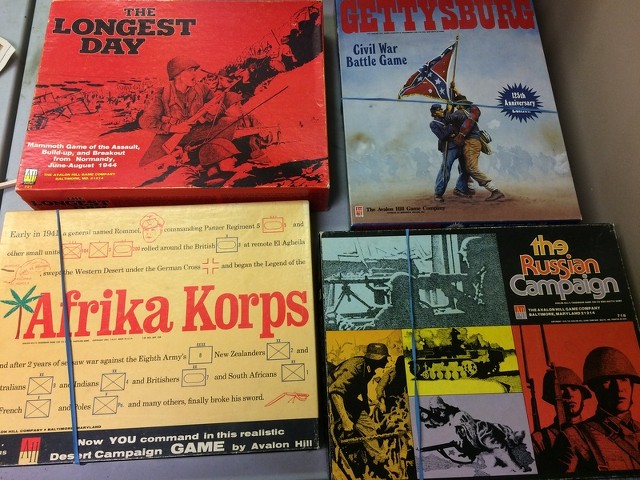
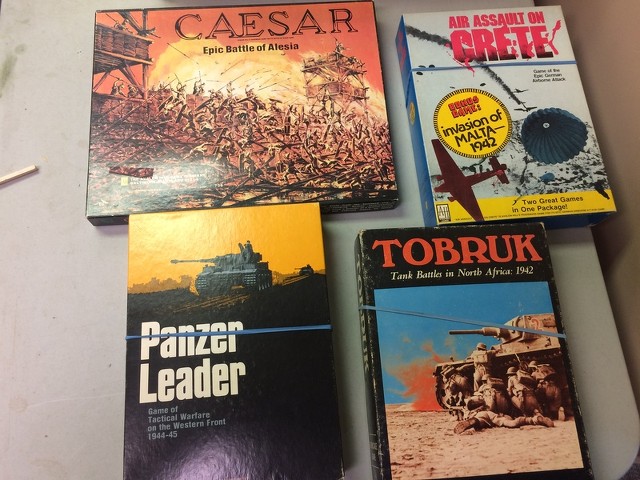
So my life has changed in many ways, but some constants remain.  I have only touched a paintbrush a few times since Kay’s death, and I have rolled dice a few times.   I am however slowly coming back to the wargaming hobby via my first love, boardgames.  A few months ago I had the opportunity to take a longish drive to buy five boxes of games from someone’s estate.  They almost went to the garbage dump, but someone had the sense to take them to a thrift store, and the thrift store owner knew someone who got the word out into the local gaming community, so that was a close run thing as someone once said.  Here are some of the games, mostly classic Avalon Hill titles.

It me, reading rules.

Besides the AH titles, there were some happy surprises, including seven of Avalanche Press’ Panzer Grenadier series, which looks like an interesting tactical game in the vein of AH’s Squad Leader.   I hope to explore PG in the near future.  

Currently on the gaming table is GMT’s game Churchill: The Struggle For Peace.   I’m playing i solo, as the Americans, and the other sides (USSR and Britain) are played by decision trees or “bots”.   The game is an interesting take on WW2, and certainly works as a history lesson, but not really sure yet whether it works as a game.   More to follow.    Also, my gaming friend James came by recently for a weekend of miniatures fun, in our ongoing OPERATION THUNDERING DICE series of irregular weekends, so I will have a report on that soon.

So it’s good to be back, I hope someone reads this, and I hope to be more active in the hobby again.

Blessings to your die rolls and paintbrushes,

MP+


Sunday, October 22, 2017

Quick Update On Madame Padre


A quick update and word of thanks to those of you on social media who continue to reach out and offer their support and encouragement.   As longtime readers of this blog will know, Madame Padre has been fighting cancer for two and a half years now, and has been giving ground grudgingly.   Unfortunately, her cancer has advanced and we and her oncologist are now hoping that we will have some good months remaining.  She continues to inspire me with her resilience and peacefulness, and with her total absence of self-pity.  Our parish friends sometimes speak of her as a living saint, which causes her to gently roll her eyes, but I see their point.


Friends and family are amazing with their support and kindness.  My brother Chris flow out from Vancouver, a five hour flight, just to spend the weekend with me and to help construct this wheelchair ramp which we hope will assist Madame when she comes home from the hospital.


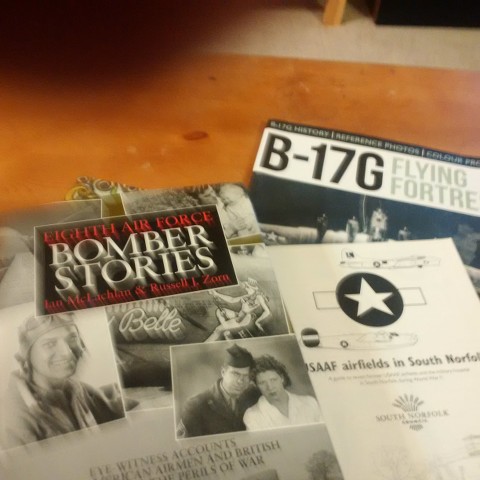
Knowing my interest in all things related to the B17 and to the airwar over Germany in WW2, the kind and eclectic Edwin King put together this B17 gift for me, which arrived in my mailbox last week.  It includes a guide to old USAAF airfields in Norwich, and I hope to tour them with Edwin one day.  


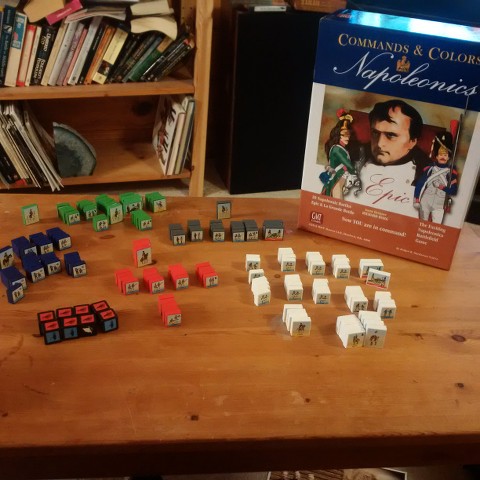
The wargaming hobby is pretty much on hold for me at present.   The only accomplishment I can point to is that I snickered the blocks for the Command and Colors Napoleonic Epic expansion.  Lord knows when I will play it.


I'll leave you with this photo of happier times last August, when Madame was well enough to come to work and be present at my promotion to Major.   We were joined by my ecclesiastical boss, the Anglican bishop ordinary to the Armed Forces.   He used to play Avalon Hill games as a boy, and I've encouraged him to visit this blog and see what a mad padre does.

Please keep Kay and I in your thoughts and prayers and accept my apologies for not visiting your own blogs and projects as they deserve.   Thank you for all your support and encouragement in this hard journey.

Blessings,

MP+


Wednesday, July 12, 2017

Tuesday Night Boardgame (On Wednesday): GMT'S Fields of Despair


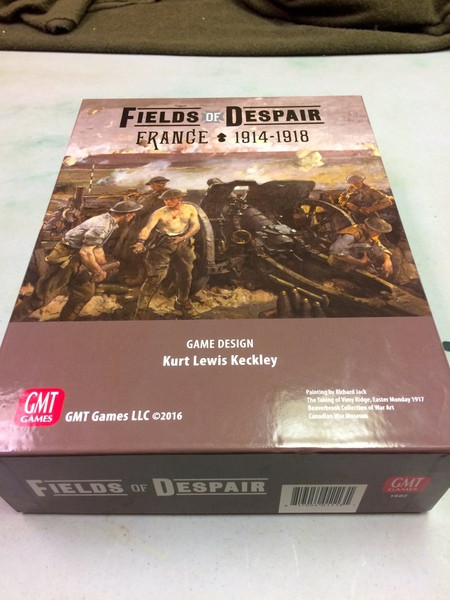
I couldn’t resist this title by GMT games - any World War One game generally goes to the head of my purchasing queue, and this one was no exception.    Fields of Despair (FOD) is a strategic scale block game designed by Kurt Lewis Keckley - you can find his blog here and follow him on Twitter at @PhotoAvalanche .  It comes with an attractive hardback folding map, several hundred counters and blocks which need to be stickered (thankfully, for Command and Colours fans, only on one side).  

I’ve only played FoD solo which is a pity because that is rather like driving a Ferrari in stop and go traffic and never getting out of second gear.  This is a game designed for two players, and the one-sided blocks mean that you never know exactly what is waiting for you when you launch an attack.   I can’t wait to try this game head to head because the suspense would be epic.   The blocks themselves are the heart of the game, reminiscent of the four-sided blocks used in well-known Columbia games such as Quebec 1759 and Waterloo.   Blocks range from 1 to 4 up to 17 - 20 Strength Points, with 20SP blocks representing a multi-corps army.   Most blocks represent infantry, with a few cavalry units given to each side.

In addition, players can commit artillery to key battles (representing strategic artillery assets) and can also commit aerial units in the hopes of forcing the other player to reveal some or all of his blocks before battle.   Aerial reconnaissance is not a sure thing, however, because the defending (or passive) player can throw in his/her air units as well to try and keep the observer planes from carrying out their missions.   Besides his/her own blocks, the defender can try to hold the line with a few key fortresses, such as Verdun, which are very hard nuts to crack.

Here is a shot of the game board in the early stages of the three-turn introductory scenario, set in 1914.  Infantry units move two hexes a turn, and cavalry three, but units have to stop when they enter an enemy controlled hex.  Unless all defending units are removed from a hex, it is considered contested and remains in the defender’s control, so the ownership counters seen here are quite important for deterring victory.

And the same game at the end.  The Germans have taken heavy losses, but have done worse damage to the French, and have come within an ace of capturing Paris before the end of the game, which the Germans won 9-7 based on hexes control.  The British (tan counters) are slowly building up strength, but were separated from their French allies by the German advance.

In retrospect this game might have gone better for the French if played H2H, since playing it solo it was impossible as the stronger German side to hit the French where they were weakest.   There is a slightly intimidating solitaire system for one of the late war scenarios, which I hope to try at some point.  

WW1 fans will appreciate the fact that the game is highly attritional.  While breakthroughs are possible and  can be exploited, they are difficult to achieve and hard to exploit.  Manpower is a very finite quantity in the game.  The Germans have an initial advantage, and their army grows considerably in 1914, but like the other countries the manpower streams dry up later in the war, so every SP lost early in the game is one you won’t have later when you may need it.

There are several economics and technology R&D tracks, where players can put resources into developing new weapons (poison gas, gas masks, better aircraft, tanks, etc) and also put resources into maintaining the Allied blockade vs the German submarine campaign, ether of which can hurt the other side’s resources.    The German player must also think about the second front with Russia, which is represented in a very abstract but effective way.  Don’t put enough resources into the Russian front and you as the German can lose the game.   

While the game does not use a card system like Ted Raicer’s WW1 classic Paths of Glory, it does have a series of technology thresholds that introduces events like aerial combat, the start of trench warfare, as well as political events like the US entry to the war.  

FoD is a simple and highly playable game with enough chrome to give it a good feel for the strategic choices faced by the combatants in the Great War on the Western Front.   Fans of WW1 should check this out.  While it would be huge fun with an opponent, the solitaire mechanism looks promising and there is also Vassal.

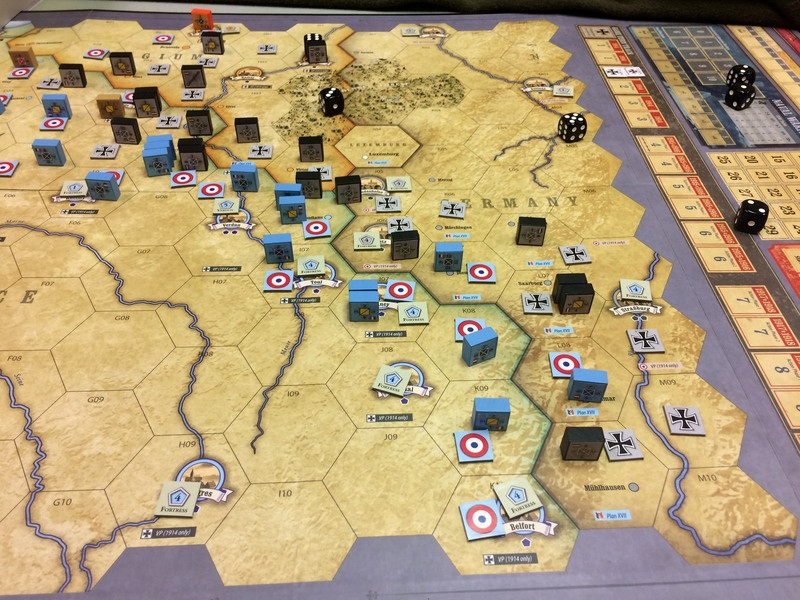
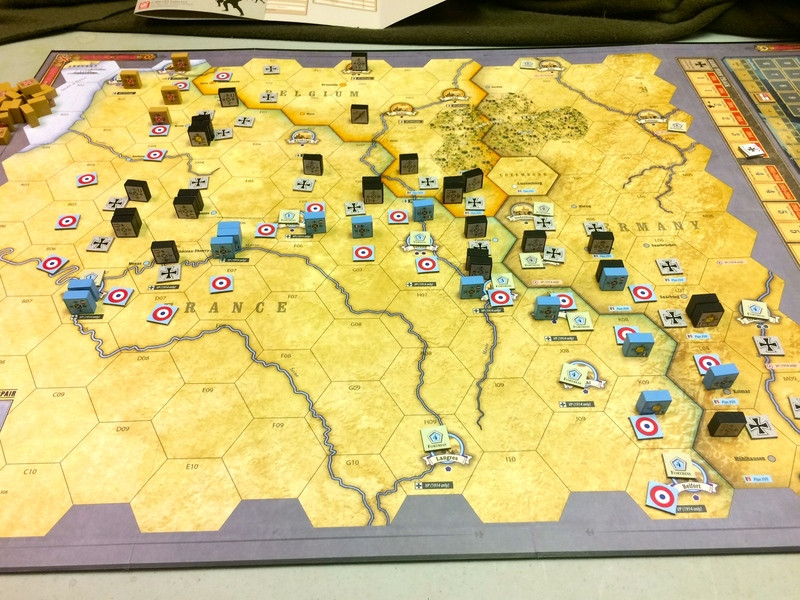
Speaking of Vassal, here is some bonus WW1 content.  This is a screen shot of a game that Jonathan Freitag and I are playing online - it is from the introductory scenario of GMT’s 1914: Offensive a outrance, from their operational monster game about the first months of WW1 in the West.  My French divisions begin the war by hurling themselves on the Boche to erase the infamy of 1870 and to recapture France’s provinces.   Latest communiques from French HQ confirm that all is going well.  

The cool thing about this game is that it is a 100% digital version of the real game, and while the going is slow, Jon and I are learning a lot about Vassal in the process.

Good luck to your die rolls, virtual or otherwise.

MP


Tuesday, April 4, 2017

Tuesday Night Boardgame: GMT's 1914: Attack A L'Outrance

Returning to an old and occasional custom here at Mad Padre Wargames, it's our Tuesday night boardgame feature, in which I spare some love for my first love, hex and counter wargames. 

Tonight's subject is the GMT Games Title, 1914: Offensive a Outrance, a modest monster game working on the operational level that recreates the first weeks of World War One on the western front. a 2013 title designed by Michael Resch. 

1914 features a fairly rigorous model of army organization and attachment, and forces the player to think carefully about each army's designated areas of operation and objectives.  It uses historical war plans that guide each army's movement and objectives, which is useful for solitaire play.   Plans can be suspended and armies can be relocated, but initially the game works according to the designs of the 1914 war planners.

Logistics is a big deal in this game, and there are detailed rules for fortresses, siege artillery, and rail movement that I haven't yet dived into.

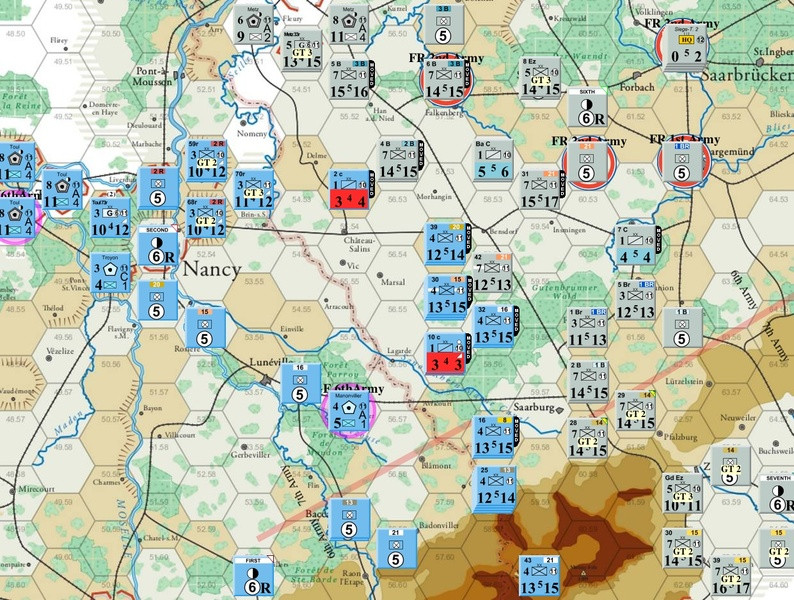
Because it's quite the big beast, I am only playing the tutorial scenario, which features the Lorraine offensive of France's First and Second armies in the first days of the war as part of the Republic's Plan XVII.   Here Second Army throws itself at the German lines in the true spirit of the bayonet, while the Germans do their best to improve their positions.  The black counters indicate Prepared Attacks, which cost movement points to execute, thus forcing the offensive to move fairly slowly, but which yield better odds of success.  Attacks can be moderated by the Attacker and then the Defender declaring if the battle is to be Intensive, which increases the chances of casualties.

Combat units are rated by attack and defence strength, the two large numbers at the bottom of each counter.  The smaller number between them indicates combat proficiency, and the small number to the side of the unit symbol indicates organic artillery.   Besides the usual retreat/advance/step loss results, the CRT gives a modifier that each side must use in what is basically a morale check after each fight,  which may result in a unit's combat effectiveness being degraded.


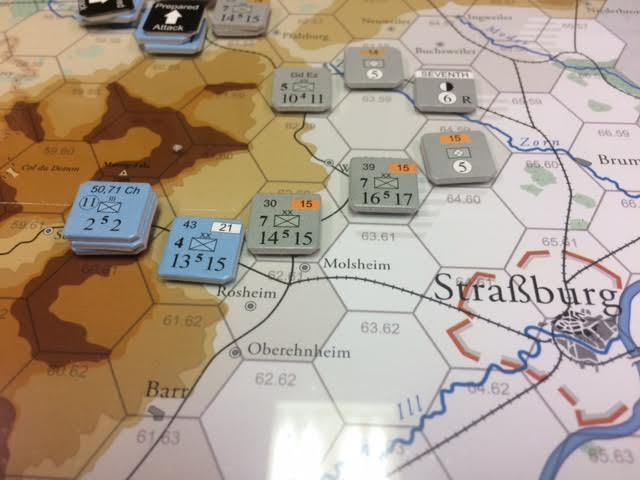
Turns allow the defender a limited move after the attacker or phasing player completes his/her movement.  Here below the French 21st XXX was trying to sneak through the Vosges to pressure Strasbourg.   In the German reaction face, elements of 15 XXX have moved far enough south to check the advance, showing that the game has some potential for solitaire play, as one can think through all options for both sides each turn.  

Here the 30th XX has moved into a fortress hex (as in the red lines around Strasbourg.  I did some checking and concluded that this hex must represent the Fort de Mutzig, which I was delighted to find has a website and looks well worth visiting.  in fact, the whole Alsace region looks like a beautiful destination, perhaps a cycling holiday.


I am only half way through a four-turn game, but the tutorial is doing its job and teaching me the basic mechanics.    I am working up the nerve to try the big game this summer, but am liking it so far.  Following the spirit of the French generals, I shall throw myself on the German lines like a tiger and reap the certain victory.  Faith in the bayonet and the spirit of the attack shall prevail!

Marshall Luigi watched the fighting for a while, but could not bear to witness the casualties.


Friday, February 17, 2017

What Monster Have I Created?

My learning this week is that I shouldn’t have offered to give this game away.

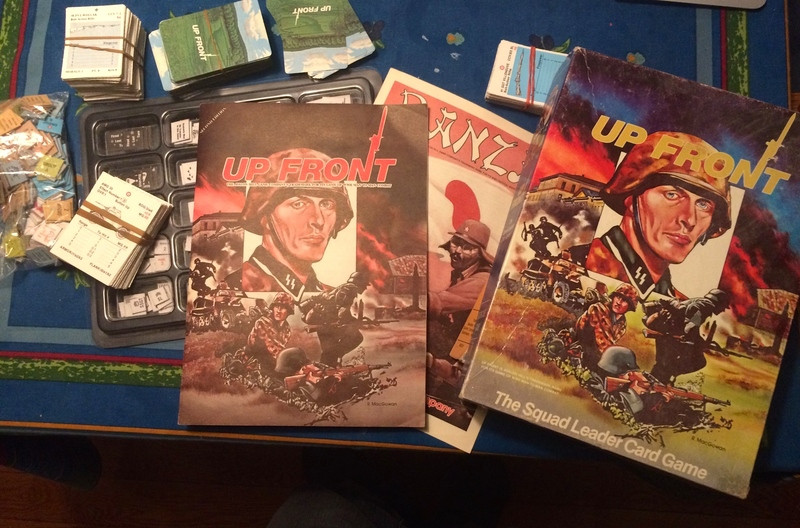
If you are an old school board war gamer, you will remember that Avalon Hill did a card game based on its popular WW2 game of infantry combat, Squad Leader.   It was notorious for the ridiculously handsome, almost angelic SS guy on the cover.  I’m surprised that image has not been resurrected by the Alt-RIght.    The bits below, including AH’s Pacific War expansion, Banzai!, was gifted to me by an Army friend of mine.  I tried playing it a few times solitaire, and it didn’t really seem that much fun.

This week I offered the game up on a Facebook group called Wargamer Pay It Forward.  The deal is that members can place dibs on games they want, and if they win one, they have to offer a game in return.  It’s a great system.  I had won a copy of GMT’s Labyrinth, a game on the US War on Terror against international jihadism in the wake of the 9/11 attacks.   It seems like a good trade to me, as I like contemporary games and am a fan of the thoughtful work done by Ruhnke and his sometime collaborator,  Brian Train.

However, I wasn’t prepared for the 90+ claimants that have put in their dibs for Upfront!  I am fully expecting the number of entrants will top one hundred by the deadline of noon tomorrow.  Yikes.  I think I’ve found a robust random number generator that will do the job, but it will be a big job.  I suppose I could write the names on slips of papers and let Stanley the Cat draw one.  I’ve done it here before.

Blessings!

MP+


Tuesday, September 27, 2016

Tuesday Night Boardgame: GMT's Talon (at the Cottage)

Madame Padre and I are on holiday this week, in the part of Ontario known as the Muskokas, or cottage country, near fabled Algonquin Park.  It’s sweater weather, but the days are mostly sunny and the leaves are turning, it’s magical.

Madame Padre is out with her camera when we’re not in the canoe.


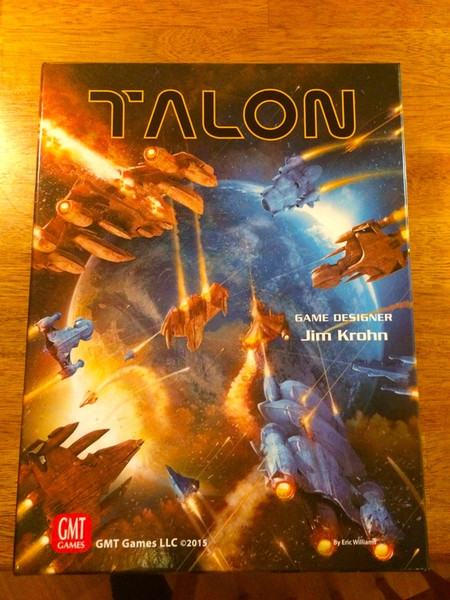
While I didn’t bring any figures to paint, I did bring a game:   GMT’s 2015 space battles game, Talon.  


Talon is designed by Jim Krohn - I was pleased to find that he is a pastor as well as a game designer.   Krohn is best known for his 2011 GMT title, Space Empires 4X (the 4X meaning eXplore, expand, eXploit and eXterminate).   Whereas Space Empires is a big game of building empires, Talon is game of individual ships clashing in space.  Talon is designed to be bolted on to Space Empires if one wanted to fight the SE battles tactically, though that seems like a lot of work.   With Talon as it is, you can fight battles following the supplied scenarios, or using a points system.  
There are a lot of reviews of Talon out there, including this one, which says much more, more preceptively, than I can say here.  Like the review, I had a strong first impression of the game.   It’s a little challenging to figure out from the rule book at first, but by following the tutorial scenario it started to come together.
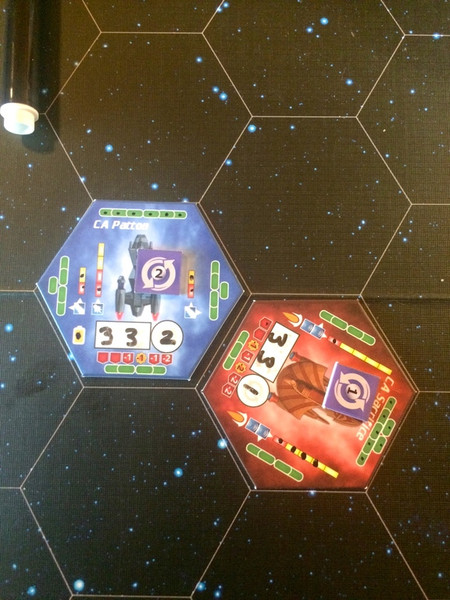
The first decision you have to make with Talon is to trust the recommendation to do the bookkeeping on the laminated counters, using the supplied dry-erase makers, rather than the printed ship roster sheets which are also supplied.   I resisted for a bit, but then unwrapped the dry erase makers and found it quite easy to use.   Here you can see a Terran heavy cruiser in blue and the alien (Talon) heavy cruiser in red.  The most important data are the lines of numbers, 3-3-2 for the Terran and 3-3-1 for the Talon ship.  These numbers are the Power Curves.  The first number is the AP (Available Power) generated by the ship’s plant, and the second is the speed (the higher the number, the faster).   The third number is the turn radius: the lower the number, the more nimble the ship.  
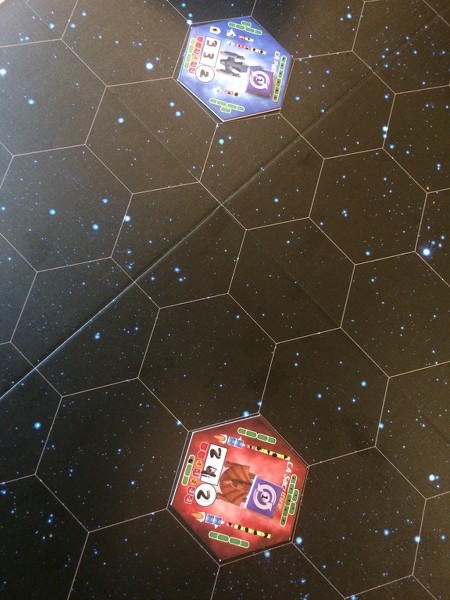


A game turn lasts six impulses.  During each impulse, ships can do different things depending on their Power Curve settings.  Power is useful for many reasons; it can reinforce shields as long as they are still up, it can be used to defend or to try and steal the initiative (very useful when one could shot can kill a weakened ship), or ti temporarily decrease a ship's turn radius when trying to attack or evade.  Most importantly, it can be used to recharge weapons.  The Power Curve can be adjusted up or down after every six impulses, during the Power Phase.

On these two counters, you can see that both ships have marks to indicate that their front shields (the green boxes) are knocked down and out of action.   Once a shield is down, hits go to the hull (the red boxes below the Power Curve number).  As hull boxes get marked off, critical hits can occur and the amount of available power decreases until the ship blows up.
In the two games I’ve played thus far, I’ve found that after an initial exchange of fire, which usually knocks down the front shields, ships tend to manoeuvre around each other, recharging their weapons while trying to keep their intact shields facing the enemy.  Small actions thus have the feel of frigates from the age of sail, looking for a moment of advantage while trying to keep out of the enemy’s broadside.  Because the weapons ranges are between 1 and 3 hexes, you need to be careful about losing the initiative and having an enemy ship turn and fire on a weak or missing shield This can happen when the enemy steals the initiative, or when a ship moves out of initiative (the Terrans and Talon both have special tech that allows them to do this on a limited basis).
 
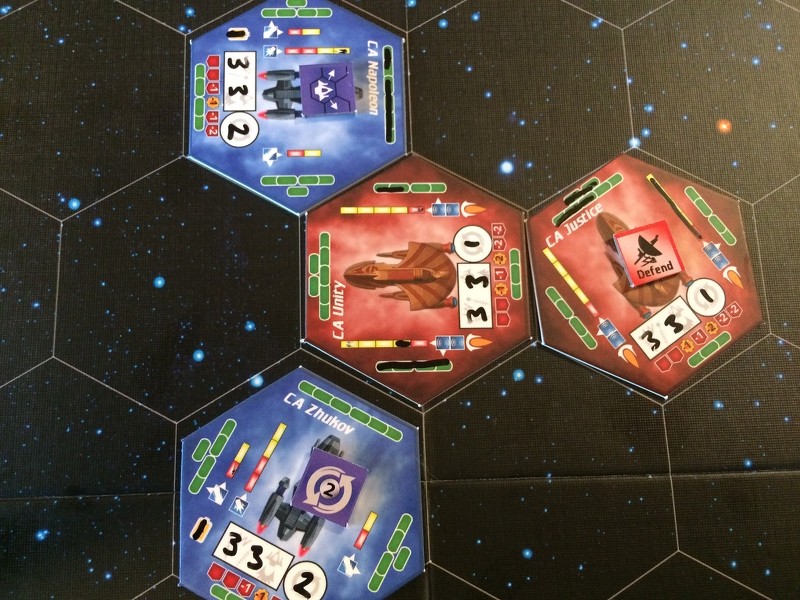
In the first scenario, two Terran and two Talon heavy cruisers mix it up.  After the first exchange, the Napoleon has lost its front shields, the Unity has lost its port shield, and the Justice has lost most of its front shield.  The yellow and red bars represent weapons and their charges.  Ships start a scenario with charged weapons, indicated by marking black on the laminated counters.   Once the weapon is fired, the black line is erased, and must slowly be charged up again.   Here, of all the four ships, only the Justice still has a charged weapon - the starboard disruptors.  The Justice also has a Defend counter on it, indicating that the Talon ship is using its Available Power this impulse to protect the initiative.  At the end of an impulse, if one side has spent more Power to take the initiative than the other side has spent Power defending it, the initiative passes to the other side.  As the game goes on, with multiple ships, there are a lot of decisions about how to use Power as it comes available - recharge the weapons, or try to gain/defend the initiative.

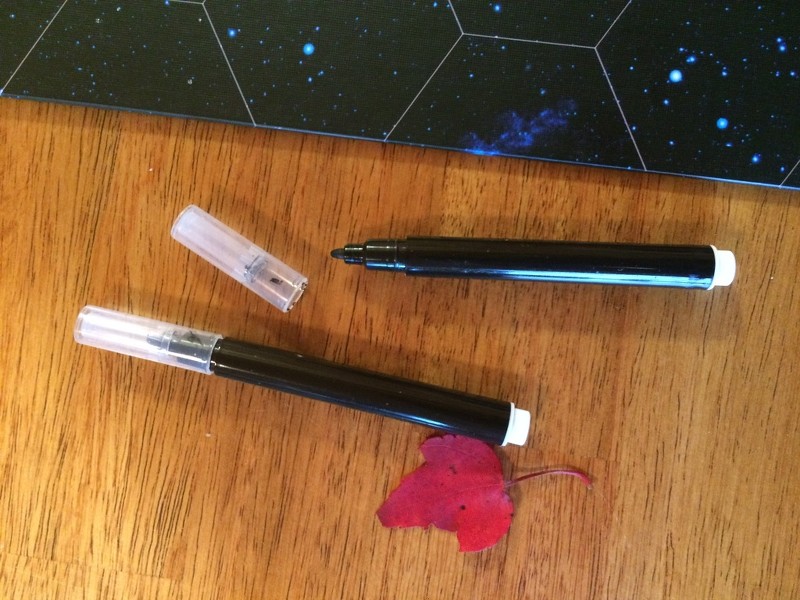
As I said, trusting the design intention and using the dry-erase markers on the laminated counters is a bit of a leap of faith.   The system does work, though I found that after two games, one of the two markers wasn’t working that well.   Hopefully I can find more markers this size at the local office supply store.   One thing I didn’t have was the Q-tips that are recommended for erasing the counters.  Otherwise, using a bit of wadded up tissue as I was, it’s easy to remove the wrong information from a counter.

Some of the complaints about Talon that I’ve read online are that players spend a lot of time dancing around one another, recharging weapons while trying to stay out of harm’s way.  This may be true of the small scale battles I’ve fought so far, while other reviewers mention that the game really shines with large fleets on each side.  These comments also mention that Talon as a game is much more forgiving to players than earlier games such as Star Fleet Battles, which was legendary in its complexity.    There are more advanced rules in Talon that I haven’t tried yet, including missiles, fighter wings, carriers, super-heavy battleships and exotic weapons.   I’m looking forward to trying these rules in future games.
Some might find that the universe of Talon is a little unimaginative.  You have the Terrans, and then a fairly faceless enemy, the Talon, who are sort of a generic, warlike race that comes along to make Terra’s life miserable.  Are they like Klingons?  Romulans?  Does anyone really care?   In defence of Krohn, he has written a player’s guide which is considerably longer than the rule book, full of fluff and backstory to explain the conflict, but all from the Terran point of view.  Another possible objection is the symmetry between the two sides.  While there are minor differences between the Terran and Talon ships, they both have the same ship classes: Scouts, Destroyers, Light and Heavy Cruisers, etc.   Does this make sense?  Can one imagine an alien race that only has one or two types of ships?  I can imagine an SF writer like Brian Aldiss thinking out of the box about an alien culture and its technology. However, in a game that includes a point system for building battles, perhaps one needs symmetry.
Finally, one could ask how a game like this is different from, say, a WW2 or modern naval war-game.   Perhaps a space game is just a naval game by another name, in that you have hulls, ranged weapons, speed and armour (shields by another name).  I would say the difference is the novel impulse mechanic and the inherent logic of the Power Curve system which Krohn as thought up, plus the copious amounts of chrome layered onto the game.
So, my first impressions of Talon are very favourable.  The first small battles I fought took about 90 minutes to resolve, the second game going much faster after I figured out the mechanics.   In fact, I like it so much, I’ve put my name in for GMT’s P500 club for the Talon expansion that is planned.
Blessings to your space ships!
MP+

Tuesday, August 16, 2016

We're Back ..With A Small Trove of ACW Boardgames

Hello and welcome back to this sadly neglected blog, which I am tempted to rename Dragon Dormant.  Since I returned from La Belle Province de Poutine, all has been well, but busy.  Madame Padre celebrated her third post-chemotherapy bloodtest with very good results, and has decided to celebrate with a new bicycle and a more active lifestyle, so bravo to her.   

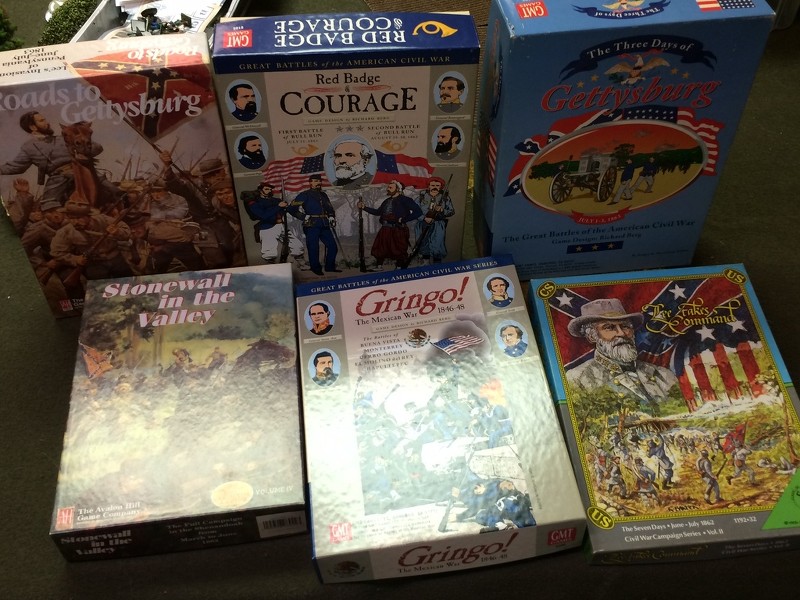
There has been a little painting and a little gaming, so some updates coming.  One of the most exciting things to happen lately was this small pile of out of print American Civil War (with one Mexican War title thrown in) cardboard counter type boardgames that came my way.   A friend at the local club was helping to sell off the collection of a gamer friend who had passed away.  I am sorry I didn’t know this fellow, as I think we would have gotten along well.

Three of these titles are from the GMT Games series, Richard Berg’s Great Battles of the American Civil War.  Red Badge of Courage covers First and Second Bull Run, Three Days of Gettysburg was GMT”s answer to Terrible Swift Sword, and Gringo used the GBACW system to treat some Mexican War battles.   I am very fond of the GBACW system, it lives at that Grand Tactical sweet spot for me.   The two titles on the left came from late in Avalon Hill’s existence, from their Great Campaigns of the ACW series, designed by Joe Balkoski, and offer a more operational/strategic scale of treatment.    Finally, at the right is a Clash of Arms game on the Seven Days - I haven’t yet opened the box so know nothing about it.

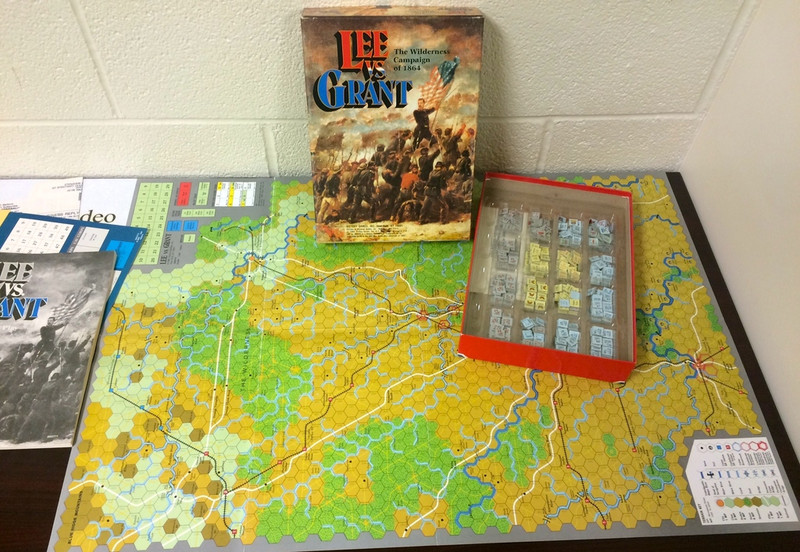
Below is the seventh game, Lee Vs Grant, another Balkoski GCAWC design, on one of my favourite campaigns, the 1864 Wilderness campaign.   It is currently set up in a quiet corner of the chaplain school library at work, and I am slowly figuring it out on my lunch breaks.


I know that these games will cut into my painting time, but it can’t be helped, hex and counter games have a large claim on my heart.  If you have played any of these titles, please let me know what you thought of them - your comments may influence which one I take on first.

Finally, because it’s too amazing to pass up without comment, here’s a What If article imagining WW2 German and Japanese battleships at war, because …. battleships. 

Blessings to your die rolls!

MP+

Wednesday, January 6, 2016

Tuesday Night Boardgame: Battle of Ligny, 15:00hrs

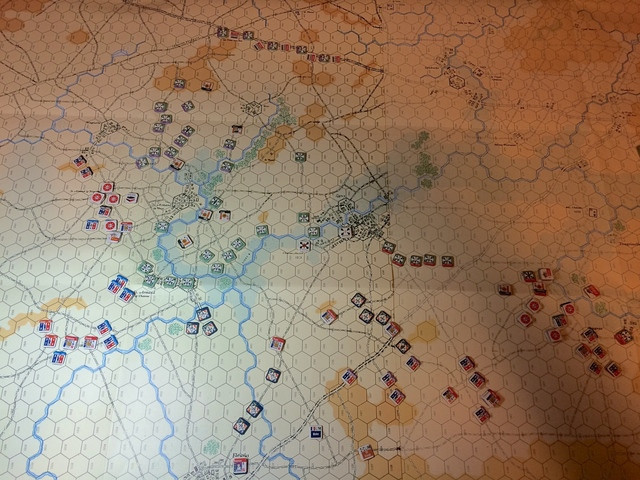
I thought it was time to pull the dustcover off a game I’ve had sitting in a cat proof room for many months.  It’s Lighy from GMT’s now OOP quad game, Battles of Waterloo, a 1995 Richard Berg design.  I’m embarrassed that this game has been sitting still since August.  Life happened, and I had to force myself to sit down and figure out the rules, which seemed a little opaque to me at first, but I think I understand the major mechanics now.  

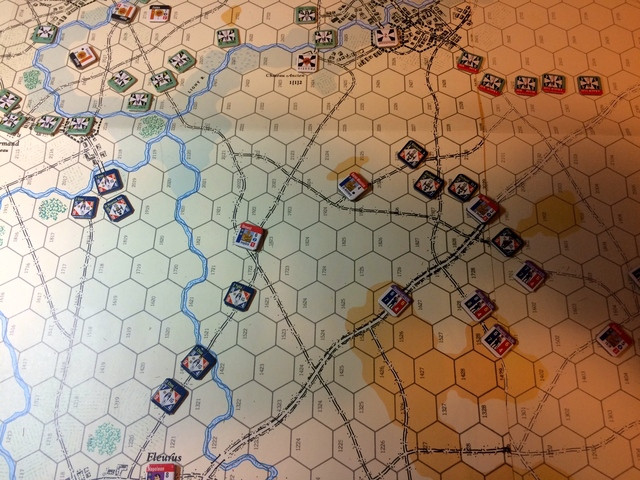
Now, in the middle of Turn 5, Thielman’s III Corps is now engaged to the east, while Zeiten’s 1 Corps has yet to be challenged for Ligny.  The fighting is on the outskirts so far.  This turn Pajol’s division of the Cavalry Reserve has been bumping heads with. Hobe’s III Corps Cavalry, while Milhaud’s cuirassiers have been battering the Prussians to the west.  Elements of Pirch’s II Corps are coming to the rescue.  Because the activation of units is random, the Prussian I and II Corps and the Imperial Guard, Gerard’s IV and Vandamme’s III Corps have yet to move.

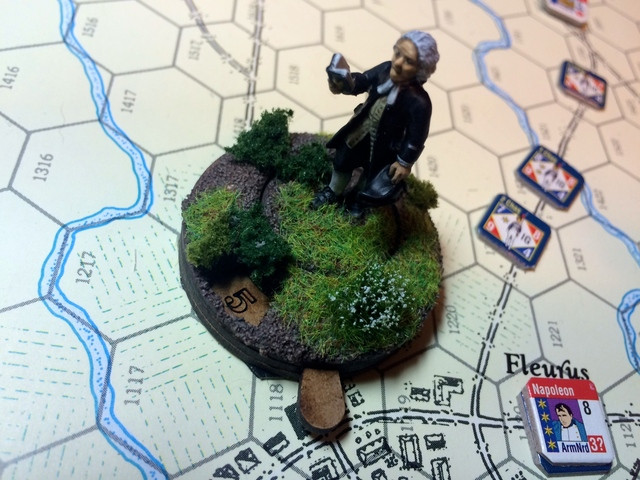
This pious fellow is helping me keep track of the turns.  He’s my lovely Santa Clause 2014 gift from Stefan of Monty’s Caravan fame.


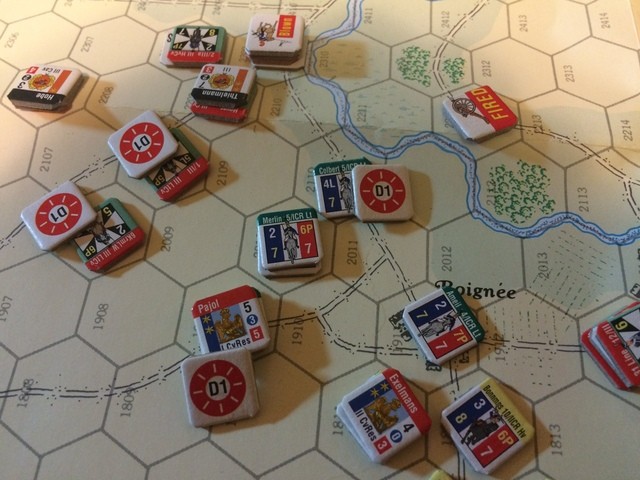
Here’s a close up look at the Pajol vs Hobe punch up on the French right.   Each of the units is a cavalry brigade and most have been in action this turn, hence the counters marked D1, showing disruption.  Disruption can be as a result of combat, but it also happens automatically to all cavalry at the end of the turn in which they Charge and Shock an enemy, so cavalry formations can quickly be used up.  As you can see here, Hobe’s cavalry are pretty much battered, but the fresh division of Exelmans is behind Pajol and could make life difficult for the Prussians on Turn 6 if Exelmans and the Cav Res activates before III Corps. If you’re curious about the size of the stacks, mostly the height is because of bookkeeping markers and leaders.   The rule is only one cavalry or infantry unit per hex, though a battery can stack with each or with another battery.  There are limits (9 I think) to the number of strength points that can fire out of a hex.

Meanwhile the Imperial Guard, with the fearsome Guard artillery to the fore facing five brigades of III Corps at the top right as they move to link up with I Corps at Ligny, and Gerard’s Corps at the bottom right, still have not moved this turn.  Ligny Chateau is probably safe for now, but the threat is building.

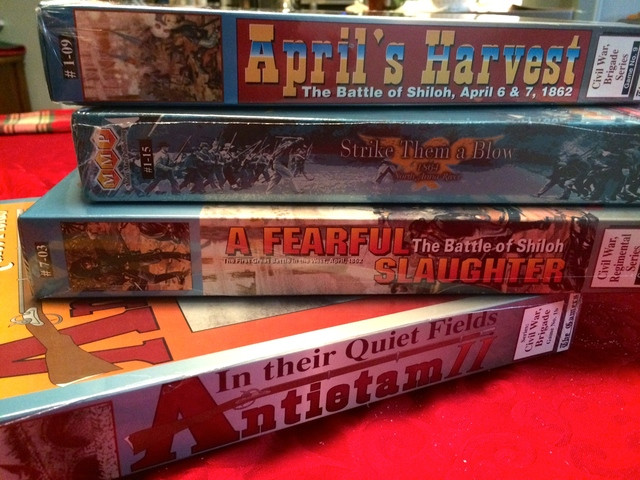
We’ll see how far I can get with this before next Tuesday.  I’d best get a move on because my stack of games to be played got bigger after these fellows arrived just before Christmas.  I blame Jon Freitag for putting me on to a sae by Multi-Man Publishing.  I elected to get four of their Brigade Series ACW games, including two different treatments of the Battle of Shilo, a battle I’ve always felt was under-treated by boardgame publishers.

Blessings to your die rolls!

MP+

Speaking of games, only three seats left in the Diplomacy Game starting soon.


Blog Archive

Followers