
Sunday, May 31, 2015
Alas, Poor Hobby Store!
Alas, poor Yorick! I knew him, Horatio: a fellow
of infinite jest, of most excellent fancy: he hath
borne me on his back a thousand times; and now, how
abhorred in my imagination it is! my gorge rims at
it. Here hung those lips that I have kissed I know
not how oft. Where be your gibes now? your
gambols? your songs? your flashes of merriment,
that were wont to set the table on a roar? Not one
now, to mock your own grinning? quite chap-fallen?
Now get you to my lady's chamber, and tell her, let
her paint an inch thick, to this favour she must
come; make her laugh at that.
It's been a tough time for hobby stores around here, and I've felt a bit like the Melancholy Dane, wandering around examining their remains.
Last week, during our House Hunting Trip to Barrie, I revisited some I knew. One was called The Dragoon, in a small village called Cookstown. A friend took me there in 2010. It was a in a small cottage, run by an older fellow, and it was full of nice stuff, a lot of larger scale pre-painted models from companies like King and Country and Forces of Valour. He had some nice dioramas, and a lot of model kits, ESCI and the like. It was a brilliant little place. Drove around Cookstown for ten minutes, couldn't see it. Finally found the building I thought it was in, and it was a business for people who want to learn to really communicate with their pets. The Dragoon still has a ghostly presence on Facebook, but it seems to have gone under around 2014. Here is the only tangible sign of it I have left, a fridge magnet.
Alas, poor Dragoon!
Mme. Padre was very kind about letting me search for The Dragoon, and allowed me to look for another store I remembered. Gamers' Lair was in a storefront in a small retail plaza at the south end of Barrie. I recalled it well because the last time I was there, also around 2010, I bought a few items and before I started my car to drive off, I realized that the owner had undercharged me. Went back in, paid the difference, and he very kindly gave me a box of micro dice as a sign of thanks. I always think of him as I use those dice. It was a pretty mainstream store, stocking GW, Flames of War, and the like, with a gaming space in the back of the shop. I wasn't expecting much, but I thought it would be a useful place to buy paint and such. Gone. Empty. Sign still there, but darkness and emptiness in the windows. Alas, poor Gamers Lair!
The next one isn't quite a skull scene, but it's close. My chum James announced last week that he was getting out of the miniatures business as well. J&M Miniatures was a joint venture between James and his friend Martin, and I've plugged it several times here in the past. J&M was a webstore and a mail-order business, but in a way it was also a storefront. James maintained the business' stock in his house, and it was not unknown for his friends to drop over and "fondle the toys". I have gone over to his place for a game several times with some money in my pocket, knowing that I would come home with something. James and Martin wanted to take the business in different directions, and so James graciously bowed out and let Martin, who had made the initial capital investment, take over. I wish Martin luck and will no doubt be a customer in future.
James and I have talked many times about the frustrations of running a wargaming hobby business. In North America the hobby market is dominated by one major distributor, and so there wasn't a lot of room or margin to make a go of things, even without a bricks and mortar and payroll costs to maintain. It was difficult to anticipate demand for new product launches, or to anticipate the trends that rapidly blow through the hobby. Would the WW2 market be sufficient to stock a lot of Plastic Soldier Co and Warlord stock? Would he have enough Perry Brothers product, and the right mix of that product, to satisfy the Napoleonics gamers? And what about stocking enough product to catch the latest trends? Pirates? Zombies? Wild West? Samurai? Laser cut MDF buildings? What happens when those trends have done and people have moved on to the next one? I didn't envy James and Martin having their money tied up in products that weren't moving as quickly as they needed it to move. James also remarked on the difficult customers, people who would demand discounts or home delivery of product since James lived a few towns over.
Perhaps the day of the bricks and mortar hobby store is done, like the video store. In nearby London, Ontario, a family-run model store is closing after decades in the business. McCormick's Hobbies stocked a wide variety of paints, particularly Vallejo, and mostly catered to larger scale modellers rather than wargames, but for years it was my paint shop of choice. I'm hoping that the one gaming store still operating in Barrie will carry paints, otherwise I'll have to order them online. Which, I suppose, is the reason that the hobby store seems to be dying, because of online ordering.
When I think about it, other than buying consumables like paint, flock, and the like, very few of my hobby purchases (other than the stuff I bought from James when visiting his house) have been from physically located stores. Almost all of my miniatures purchases (figures, rules, model buildings) have been made via online purchases direct from manufacturers. Very few of my miniatures purchases are spontaneous. I know what I want, I know who makes it, and the manufacturers all accept orders over the internet. Shipping prices to Canada are seldom cheap. since most of the manufacturers are in the UK, but I accept that as the cost of a hobby. Disposable income is disposable income, and I'm usually willing to pay the shipping to get what I want.
I can think of a few stores that will likely survive. When I lived in Alberta, Sentry Box West in Calgary was always worth a visit while in the big city. I recall the owner telling me that he owned the building free and clear, and that the bulk of the business from teen gamers (RPG, GW, and the like) underwrote a fine selection of historical miniatures and boardgames for people like me. Sentry Box was also in a large metropolitan market, and augments that market with sales over the internet. Even so, it's a small market, and being in an urban centre (Chicago) didn't save Emperor's Headquarters, which I recall fondly from one visit in the late 1990s. Alas, poor Emperor's Headquarters!
I am sure it is different in smaller geographies, like the UK. A lot of the blog posts I see from visits to Salute, Triples, and the like seem to mention the shopping as much as the gaming. In a larger country, like Canada or the US, there are fewer shows and smaller customer bases. I don't attend many shows, but the one I attend regularly in my region, Hot Lead in Stratford, isn't really a shopping destination for me. For the last few years I've gone, the number of vendors seems to be shrinking and what's offered is very trendy, so if one isn't into Steampunk, for example ....
Perhaps the owner of The Dragoon didn't go out of business. He may have gotten sick, or decided he was too old and wanted to go on cruises instead of minding the store, but the fact that his Facebook feed ends abruptly doesn't sound like a planned exit. I once wanted to do something similar in retirement. I had a daydream of going to a tourist town somewhere, one popular with older couples, and set up a wargames/militaria store with a license to serve alcohol. Chaps could drop in for a pint and a look at the toy soldiers, even learn to war-game while their wives looked at antiques and yearn stores. However, that was just a fantasy. In real life, I couldn't think of anything more dangerous to do with my retirement nest egg. Betting it all on the horses would seem sane by comparison. I hope it's not premature to sound the death knell for the wargaming hobby store, but these days, it sure seems like it.
Blessings,
MP+
Thursday, April 25, 2013
On The Shoulders Of Giants 2: Jim Dunnigan On SPI And Wargaming
A few months back I posted here on an interview with Don Greenwood, formerly of Avalon Hill, as run by David Dockter on his excellent Guns Dice And Butter blog. While on David's site I noticed that he had also recorded an interviewwith wargaming legend Jim Dunnigan, the founder of Simulations Publications, Inc (SPI), and resolved to go back and listen to that interview when time permitted. I've now done so, and the interview unleashed a horde of gaming memories and thoughts which I'd like to share with you. Hopefully I'll say something interesting.
A small(ish) preamble is necessary here. When I was a kid in a small town in Western Canada in the mid 1970s, my older brother Alex introduced me to a copy of The Courier, a small mimeographed newsletter in a construction paper cover that introduced me to the world of toy soldiers. God alone knows how The Courier found its way to our little town in the Rockies. I saw photos of grown men playing battles with stiff toy soldiers of Scruby/early Minifigs vintage on tables adorned with wooden hills and model trees, and I wanted so much to do that. But I was a kid and my allowance and paper route money wouldn't go allow for armies of toy soldiers, so that dream got deferred for the day when I would one day be a grown up.
That kid grew up and now owns more toy soldiers than he could possibly imagine back then, so the story ends happily, but it wasn't so sad in the middle, either, because that little kid discovered paper wargames thanks to two people: David Lewis and Jim Dunnigan. David Lewis was the son of friends of my parents, and he was living at home while pursuing a summer job. David became my hero. He had just finished a degree in history down island at the University of Victoria. He was worldly and listened to Boz Scaggs and Fleetwood Mac, which opened my ears to adult music, and he introduced me to paper wargames, starting with a great SPI Waterloo monster game called Wellington's Victory, a Frank Davis design that had just been published (1976). With the abundant patience of a surrogate big brother, David introduced me to the world of adult wargaming that Jim Dunnigan had opened up to us with SPI. I still have a treasured copy of this game that David gave me as a gift.
That year, 1977, I persuaded my parents to get me a copy of the SPI house magazine, Strategy and Tactics, which came with a game in every issue, and a lot of the S&T games I got were Dunnigan titles - Berlin '85 was a special favourite of mine because it was scary cool at the time to think about World War Three and it had some innovative mechanics, including unknown unit strengths, so that when you moved a unit into contact you flipped it to the revealed strength side to find out how good it was. That same mechanic featued in a bonus game that came with my S&T subscription, Panzergruppe Guderiananother Dunnigan title.
While the artwork in the SPI maps and counters of that era was primitive compared to those published today by the likes of GMT and Victory Point, there was a cool modernist vibe about SPI that appealed to me. The sleek plastic boxes with their build in counter trays had a space age aesthetic that the Avalon Hill bookcase games didn't have (almost everything about AH was stodgy and slightly dull), while the SPI cover art and counters were minimalist but appealing.
When I was a high school senior I lost touch with David but remained connected to SPI. My proudest possession in those years was their monster game Atlantic Wall, a divisional level treatment of Normandy where the smallest unit was the company(!). Through most of Grade 12 I had all five maps spread out on my bedroom floor and tiptoed around them to and from bed. My parents were bemused. I had the sense that I was somehow touching history in a real sense, and even if I didn't really understand all the nuances of the Normandy campaign I felt I was doing something very important and grown up.
When I went to college in 1980 I fell in with role players who mostly played Dungeons and Dragons, and there never seemed to be the room or time to spread out a big game for any period of time. In the mid 80s came graduate school and a turn to miniatures gaming, so that decade wasn't very kind to my boardgaming, and in the 90s I alternated between computer games and miniatures. One of the computer games that consumed a lot of my time was an early MUD, a multiplayer online game, Hundred Years War, hosted on the GEnie network (anyone remember GEnie?) that was a Dunnigan design. Little did I realize then that the evolution of my gaming life in the 70s, 80s and 90s pretty much matched the rise and fall of SPI and paper gaming.
In the GDB interview, Dunnigan doesn't talk a lot about his own designs, but he does describe with broad strokes how SPI came on the scene in the 70s and took wargaming in a direction that the more conservative Avalon Hill wouldn't go in. You get a sense of how clever this guy was in seeing opportunities, such as the appetite for contemporary/Cold War games, particularly from US military gamers, that led to titles such as Red Star/White Star. My own personal favourite was Dunnigan's World War Three (1975), a grand strategic game based on his WW2 engine, where players had a limited number of nukes which could obliterate whole hexes and all the fleets and armies therein, but each time at the risk of triggering a global nuclear exchange which ended the game. My younger brother and I blew up the world quite a few times playing that game. An interesting moment in the GDB interview is hearing JD describe how interest in contemporary gaming declined precipitously ("it fell of a cliff" is JD's phrase) after the Cold War ended.
Another takeway from the interview is what a tech-savvy businessman JD was. SPI was brilliant at capturing user feedback and figuring out what gamers wanted. In a pre-Kickstarter era, each issue of S&T would float several design ideas and make production decisions accordingly. I remember poring over the stats and rankings at the back of each issue of S&T, numbers that Dunnigan himself crunched using the programmable computers of the day. The interview also shows that JD had a pretty shrewd idea of what games would sell, and of how SPI's SF and fantasy titles would merit larger print runs (maybe 10 to 12 thousand) than the historical titles did. Several non-Dunnigan titles of that era, War of the Ring (1977) and their thinly-disguised Star Wars ripoff, Freedom in the Galaxy (1979) were friends of mine in high school, as was their terrific little Creature That Ate Sheboygan a homage to the old Godzilla-type movies of the 1950s and 60s. I regret that I have parted with these titles over the years. I suspect that every kid like me who bought Freedom in the Galaxy subsidized SPI's clunky monster games like their legendary Campaign For North Africa.
The trajectory which led to SPI's demise in 1982 pretty much describes the evolution of my own gaming life in those years, which wandered away from paper wargames into roleplaying, computer gaming, and miniatures. AS JD describes it, paper wargaming flourished in the 1960s and 70s because a well educated generation came up that was ripe for the kind of mental and imaginative challenges that wargaming offered. The first crop of AH games offered the appeal of chess, two players locked in an intellectual battle, but SPI exploited the idea that any conflict or historical period in time could be presented as a simulation, which added an extra dimension to the basic appeal of the game. By the late 70s, however, a number of factors, including the rise of TSR and D&D, and the coming microcomputer revolution, spelled the doom of big wargaming companies that were built on the publishing business model. SPI lost customers like me because we had more hobby options in the 1980s.
In the middle part of the interview JD makes a few interesting comments about how miniatures gaming survived and grew as a hobby despite the decline of the paper wargame. He rightly notes that miniatures gaming was always a niche in the hobby, with a high cost of entry in terms of time and money to paint the "figurines" (sic) and to master what he calls the "arcane" rules, but the people who got into the hobby (as I wanted to do when I was a kid lookng at those Courier magazines) were always loyal and enthusiastic. In JD's opinion the limitation of miniatures gaming is that it only allows for tactical games, rather than the grand strategic games that make up so many of his 100+ published designs. While this comment may be true of many club and convention games, a quick survey of wargaming blogs shows many examples of tabletop games that are driven by rich and complex strategic designs.
Another advantage of tabletop gaming that JD doesn't necessarily realize is that his own comments in the interview about how good designs should allow for players tweaking and customizing games (variant and what if scenarios, for example) is eminently true of miniatures gaming. The only limits to how we as gamers can modify history, explore what-ifs, etc are our imaginations and the number and type of figures/models available to us.
At the end of the interview, JD makes some comments on the barriers to entry to wargaming that apply to all parts of our hobby. The idea that wargames are difficult to learn and play, the "I'm not smart enough to do that", certainly applied to an SPI monster game in its day, and applies equally to many tabletop games, though we've come a long way from the scary, brain-busting rules books of the WRG era. JD is a great believer in turnkey solutions, giving the new player everything he or she needs to get started and making entry to the hobby as painless as possible. Those of us who mock companies like Battlefront or Games Workshop might do well to remember that they understand how to get new people/customers into the hobby. The strategic alliances developing between Warlord Games and Osprey, or the Battlegroup rules affiliated with PSC, or moves that JD would approve of.
Hearing David and JD talk for almost ninety minutes is a great treat. Love him or hate him, Dunnigan was a key player in our hobby. He had a great, even modernist, belief that with enough data and a spreadsheet you could model pretty much anything. His best games had a few brilliant mechanics, and his strategic level games often included clever political and economic subsystems. Empires of the Middle Ages (1980), another SPI game I have sadly let go of over the years, is a brilliant example. Dunnigan also had a belief technology should be explored and exploited, and he knew that much of what the monster paper game tried to do could eventually be done better by a computer. Today companies like Matrix Games show his foresight. For miniatures gamers who still keep a foot in the paper gaming tradition (or are returning to it, as I am), he's someone we all owe much to. If you want a trip down memory lane, or want to see an annotated list of Dunnigan's 100+ designs, Dockter has one here.
Now, where's my copy of PG Guderian?
Friday, March 29, 2013
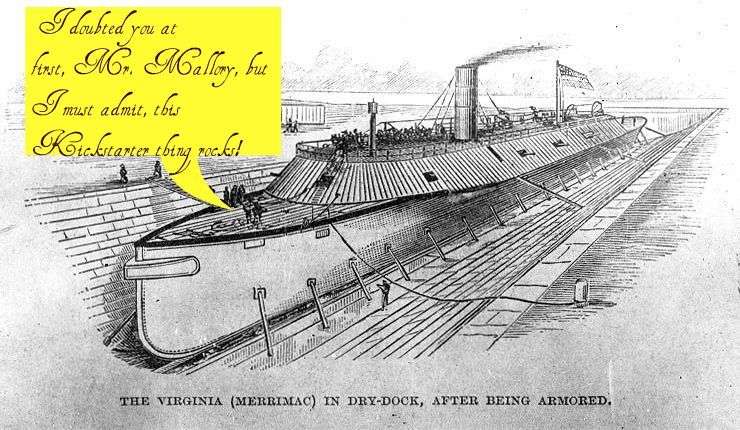
Toby Barrett Announces Ironclads For Ipad Kickstarter Project
I confess I am not yet convinced of the merits of Kickstarter, which is to say, truth by told, that I haven't found a project yet in our hobby that got me excited. That may have changed. I was very intrigued to read on the Ironclads Yahoo group this morning that Toby Barrett, proprietor of Thoroughbred Miniatures, has the rights to the old Yaquinto boardgame Ironclads and the expansions, and wants to port them over to the iPad platform.
This idea strikes me as eminently sensible because I have an American Civil War ironclads game on the table at present, and there are times when the ship models are obscured by a multitude of charts and tables, and if the ship models are visible, often the paper covers the little turning and arc of fire widgets I need. While the rules I am using, Smoke On The Water from Canis Publications, are perfectly fine, it's all a bit more cumbersome than I would like. I have an iPad and I have been slowly migrating .PDF copies of rules to it, and I would welcome a tablet-based solution for ACW naval gaming.
Here's a quote from Mr. Barrett's post on the Ironclads group:
Tonight on Kickstarter.com I launched a campaign in order to raise funds which will pay for the programming of an App to run on the Apple iPad. The App will contain everything from the original Ironclads game - all the rules, data cards, scenarios, and such for miniatures play, and will include a game referee and a combat resolution module to greatly help to speed up the operation and ease of the game. What happens on the table will still be key with the player more able to concentrate on movement, decisions and tactics. If you are not familiar with Kickstarter it is a web site whereby artists, creators and anyone with an idea can go in order to raise funds for projects in exchange for incentives. It is sort of like the show on TV Shark Tank but without the attitude and the millionaires. Several things came together – finally – to allow me to try this project for the Ironclads rules. First the amazing iPad system which I think will change a lot of things and greatly help gamers around the miniatures tabletop. Second I met a great programmer for the iPad, Jeremy Alessi, who is very skilled at the IOS programming skills required for creating apps for the system. (Jeremy has several apps already in operation, Airspin and Fat Rat. Check them out.)
The project URL for the Ironclads Kickstarter campaign is: http://www.kickstarter.com/projects/293087222/the-ironclads-app?ref=email and anyone on this group list can go there to read about the project and decide if they wish to become a backer at one of the several levels offered. Anyone familiar with the Thoroughbred 1/600 product line will know I stand by my products and am offering a whole slew of new models for the campaign. I promise my work and efforts to turn out an excellent Ironclads App will match the same quality of work shown in my miniatures over the years. And I will continue to maintain the level of excellent customer service I have always practiced in order to fulfill my promises for the campaign. Questions can be asked and given on the Kickstarter site, or I'm available on this group and by regular email to offer answers. Regular updates and video clips of our progression will be added to the Kickstarter site, so please plan to return for repeat looks. As Always, Thank you and Enjoy! Toby Barrett Thoroughbred Figures Portsmouth, VirginiaSo I'm in. My first Kickstarter project, very exciting. If you are a fan of ACW naval gaming, I hope you'll consider it.
Wednesday, February 6, 2013
On The Shoulders Of Giants: Don Greenwood On Avalon Hill And The History Of Wargaming
A big shout out to fellow blogger Itinerant Hobbyist for his post last week, noting an interview with Don Greenwood of Avalon Hill on the excellent Guns, Dice and Butter podcast. While the name may not be that familiar to those on the miniatures side of the wargaming hobby, he is an iconic figure to those of us who remember and/or are shaped by the revolution in board wargames that occurred in the 1970s. I hadn't thought much about Greenwood since I sold my original Squad Leader products in the early 90s and moved on to miniatures gaming, but now that I think about, his influence on my own gaming was huge, either through the games he designed or the games he influenced and produced when he was the driving force at Avalon Hill after its initial Charles Roberts days. For me, just hearing a pioneer of the hobby talking about its early days and casually dropping names to conjure with like Dunnigan and Nofi was amazing. For me the only thing more exciting would be a podcast where the Apostle Paul talks about his struggles with Corinthians, but I digress.
As the Intinerant Hobbyist noted, one of the most interesting (and saddest) parts of the interview was Greenwood saying that he regretted the two years of his life and energy he poured into Advanced Squad Leader. As he puts it, he didn't perceive that the hobby was going in a different direction at the time, and didn't need an even more complex rework of a game system that had grown into an ungainly mess since the initial Squad Leader came out in the mid 1970s (I still remember how excited I was when I got my hands on the original SL in 1978). You have to admire Greenwood's passion for the project, just as you have to regret that he was a victim of the technology on hand. It's mind-boggling to think that all the SL and early edition ASL rules were produced on paper and ribbon typewriters, so that if you made a change, as Greenwood recalls, you had to retype the whole page. The first edition of ASL came out in 1985, and I never touched a word processor until 1986 (how well I remember that airless graduate faculty computing centre with its tractor feed printers and amberchrome monitors, and loading Word Perfect off 5" disks). I wonder how much of Greenwood's decision to rewrite the whole system was based on the technology available to him.
As I was listening to this interview I was reminded of Rick Priestly's essay, "A Second Bite", in his "This Gaming Life" column in Wargames, Soldiers, and Strategy 63. As Priestly puts it, for the game designer, a second edition of a rules set "is a second bite of the cherry, a chance to correct, improve and perfect. The trouble is - second editions bite back!" Part of that bite back is that your most obvious target market for the second edition is the user base of the first edition, and of those users, perhaps half will be enthused and dedicated enough to welcome an improvement on their initial investment. But, because the "second bite" has to be made new enough to enthuse new users, a significant part of the first edition user base may well be alienated if the changes are so substantial that they see their investment in time, money, and figures to be invalidated. This is the "bite back" of the what Priestly calls the "design-led approach":
"Games designers like to innovate and change things: they just can't help themselves. Yet, the player base is fundamentally composed of customers who like the game the way it is. Thus a radical change, whilst presenting opportunities for publishers to re-market a game and designers to practise their craft, risks alienating a game's most loyal and appreciative supporters. A radical re-write of a popular wargames system will soon see the torch-bearing mob clamouring at the castle gates. Even today, the transition from the second version of Warhamer 40,000 to the third is enough to set grown men ranting uncontrollably on Internet forums."
As Priestly notes, GW is able to offset the loss of alienated existing customers by the recruitment of new ones, but not all publishers have this luxury. I was one of those SL players who walked away when I realized that ASL meant giving up everything but the game boards. I felt abandoned by Avalon Hill, and yet my experience of small-scale, tactical gaming led me to miniatures, while I continued to satisfy my taste for operational and strategic gaming through boardgames and later through a few computer games from publishers like Matrix. Had I been integrated into a community of SL players at the time, and had a better appreciation of what Greenwood was trying to do with SL, I might have seen a bigger picture and stayed loyal to the brand. To be sure, many many SL players stayed loyal, and I would not want to deny the validity of the ASL community, but that community seems to me a small cadre that revels in granularity and in a certain subculture status. Pray correct me if I have that wrong.
Technology is a factor here, surely. Greenwood says in the podcast that the internet came along too late to save Avalon Hill. He wasn't able to use the internet for playtesting until he was working on Breakout: Normandy. By contrast I think of my own experience as a very minor, mostly lurking member of the Too Fat Lardies internet community. A committed player of their signature WW2 rules, I Ain't Been Shot, Mum!, I was willing to buy the third edition of IABSM, and some extra bits and pieces, because I felt there was a consensus among the TFL comunity as to where the designer, Richard Clarke, was wanting to go with IABSM. It helped that the investment was limited to a rules set, vice the all-new counters and rules books that ASL required, but the fact that technology enabled the third edition of the rules to be an evolving process is a significant change from the SL/ASL transition, and one that Greenwood would envy, I suspect.
A final thought from the interview was Greenwood's comment that the fundamental difference between AH and its contemporary, Simulations Publications Inc, was that AH games were designed for replayability, and many to this day have fans who have played them hundreds of times. I think of the AH games I know and love, like Victory in the Pacific or Russian Campaign, and have trouble thinking of many SPI games that come close - Terrible Swift Sword, possibly, or my favourite SPI monster game, Wellington's Victory. Most SPI games are forgotten today, I think. It is interesting to ask the same question of miniatures rules sets. Which miniatures rules have attained a degree of replayability and affection comparable to certain Avalon Hill games? Which rules sets have been, or will be, played once or twice and then relegated to the shelf? It's an interesting question, especially at a time when the hobby enjoys a surfeit of new rules sets out or soon to be released. It will be interesting to see, when I am a very old man, if I look back on today as a golden age, as Greenwood remembers his best years at Avalon Hill as being. Time will tell.
In the meantime, thank you, Don, for all you've given the hobby. And now I'm all nostalgic. Does anyone have a copy of Breakout: Normandy they are interested in selling me?
Saturday, October 13, 2012
Volley Fire (Lights) Aimed At Your Wallet
This may be the most ridiculously clever piece of marketing fluff ever aimed at wargamers. Those Warlord chaps are brilliant. It's not a new idea, to be sure. I've seen people do similar things with dollar store lights and cotton balls to represent burning tanks, but this is marketing brilliance, because there are hordes of us afflicted with the "Ooooh, shiny" syndrome who will drool from the mouth while reaching for their wallets.
Or, it may go down in wargaming history as the silliest, most peculiar product offering since FOW came out with those little dust cloud thingies to put down behind moving tanks in desert war games. Perhaps time will tell. Thoughts?