Showing posts with label Multiman Publishing. Show all posts

Tuesday, April 21, 2026

First Time Playing Snorkers: Good Oh!

Just before I went on holiday this month (St Vincent in the Caribbean, quite nice) I had a chance to drive the two hours to Stratford (Ontario) and have a rare gaming day with old chum James.   Having both been bitten with the nautical bug, we wanted to play a game James has been quite obsessed with, Snorkers! (Good Oh!), which is billed as "an exciting, fast-paced WW2 naval wargames ruleset".  

James has a number of games under his life-vest and agreed to teach me the rules.  He pulled no punches!  For our first game we decided to use models from my 1/2400 collection and pitted two RN cruisers (Ajax and Achilles) and three Tribal class destroyers against two German CLs (Koln and Nurnberg) accompanied by three Karl Galster class DDs.  Here is the RN force steaming ahead out of a mistbank at full ahead.  The game tokens are 3D prints.  The ships are all metal models from GHQ.


The Kriegsmarine prepares to accept battle.   I put all that work into painting the ships and bases and none at all into preparing some nice labels.  Mea culpa.  At least the three GHQ Galster class ships look good.  The CL in the background is a rather old Panzerschiffe model, though still available for purchase!   The white cotton in the background represent mistbanks which obscure LOS and which can move randomly or dissipate.


One of the adjustments I had to make to these rules is the way they handle speed.  Ships can go from stationary to full speed in a single turn, whereas in other naval rules I'm accustomed to, there is usually a "throttle" rule where ships can only increase or decrease speed by so much per turn.  Not a criticism, just an adjustment I had to make.  And since lighter ships like DDs can move some 20" on the table, and then shoot, there's not a lot of time for fancy maneuvering.   An aggressive player can launch a devastating attack in one turn.  Here I managed to launch a torpedo at James' lead Tribal, but I don't recall it exploding.  German and USN torpedoes in the early war can be duds, which can be quite distressing.


Torpedoes in this game are wicked and deadly.   Launch and impact occur in the same turn, regardless of range.  Targets get a chance to evade, but if a ship is hit by one torpedo, its usually crippling for a bigger ship, and fatal for a smaller one.  Here a torpedo is about to find its mark and send some Nazis to the bottom.  One of the things I learned about torpedoes from this game is to use them before you lose them.  If you have a ship in range, its best to launch everything you have rather than to sink with fish in the tubes.

Of course gunfire is important, and I found the system fairly simple and workable.   Unlike crunchier games which require rolls to penetrate, Snorkers works in a fashion reminiscent of rules like Dan Mersey's Dragon Rampant.  Depending on the defence rating of a ship, you need so many hits to cause damage, and of course there is the possibility of exciting critical hits.   


After our Saturday night game had chased the Nazis away from Narvik, we decided to play a game set in the early Pacific.   For this game we used James' models, which are all 3D prints done in 1/1800 scale.  Even with the larger scale there is just not as much detail as there is in the GHQ models, but the overall look of the larger ships on the table is quite impressive. 

In this game I took the USN and put two CLs and a CA, with about ten Fletcher class DDs, up against James' similar IJN force.  We also gave ourselves an air wing so we could see how airstrikes and AA fire went.  Here the Japanese split their focus on the USS Quincy and some of its escorts, and did no damage to speak of.  I was a little luckier, getting a torpedo hit on one of James' CAs.


Once again, James showed me how deadly the torpedo can be in these rules.   I had been content to hold my main force back while sparring with James' most advanced DD squadron, and was getting the best of it, but in that time James brought the rest of his DDs up and raced them through a mistbank, at which point there were fish in the water everywhere.  An IJN DD can carry multiple centre-mounted launchers and can fire torps through wide port and starboard arcs, and so my three cruisers all blew up and sank before they could engage James' heavy cruisers.    We called it a game and it was a good learning experience.

So this isn't an exhaustive review of Snorkers, but I would say that it is true to it's billing in that it's true to its billing as "an exciting, fast-paced WW2 naval wargames ruleset".   It has a minimum of dice rolling, but when you do throw dice, you can be throwing a bucket's worth.   The maneuvre rules are simple (there is the obligatory template for turns) and things happen very quickly.  The turn sequence is somewhat randomized by card draws, which is arguably a more playable approach than simultaneous movement plotting, and thus makes Snorkers more suitable for solitaire play.

 The core rule book provides lists for most ship types that featured in the early war navies of Britain, Germany, Italy, the US and Japan, and it can be argued that for surface actions, WW2 naval gaming is really only interesting from 1939-43.  After that, most battles are just aerial massacres.  There is also an expansion for the French Navy and a new one that provides more focus on the early Pacific war.  In short, if you are looking to wet your feet in WW2 naval gaming, Snorkers would be a good place to start.

Finally, to end our gaming Saturday, I wheedled James into trying the MMP Siege of Jerusalem game I've touted in earlier blog posts.  James took the ruthless Romans, and benefitted from cards that allowed him to build siege ramps against the two key locations I had to defend to have a hope of winning the game.  Without my lovely wall defensive modifiers, it was a long struggle but late in the game the Romans achieved a sudden death win by capturing both Herod's palace and the Temple.   Kudos to James, he's not that interested in boardgames, but he is quick learner and an excellent tactician, as well as a great host and good friend.


You can read James' account of these games here.  Thanks mate, you're a grand friend.

Thanks for reading and blessings to your die rolls!

MP+

Tuesday, March 24, 2026

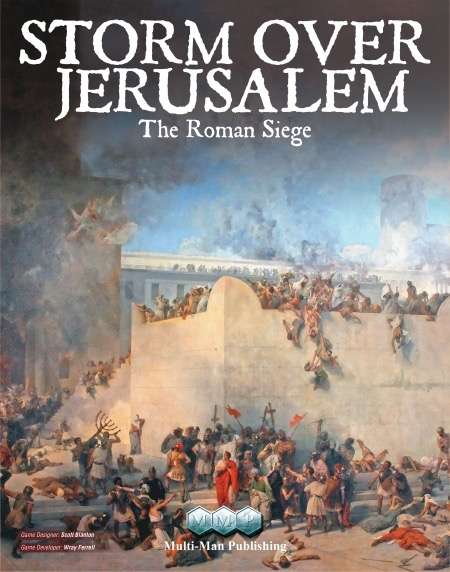
Quick Thoughts on MMP's Storm Over Jerusalem


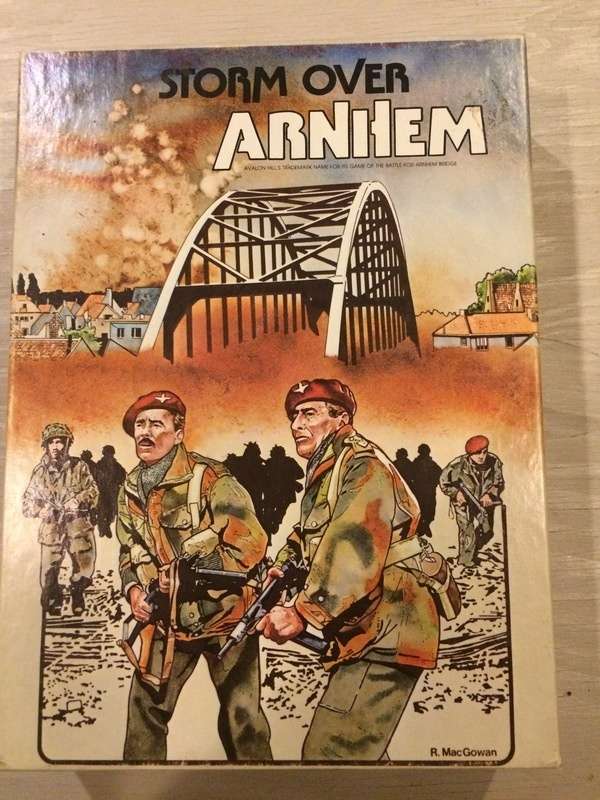
I've now finished two solo plays of Storm Over Jerusalem, MMP's game of Titus' siege of Jerusalem in AD 70.  It's a winner.   It has fairly simple mechanics (a very slim and well written rulebook) that are reminiscent of those old area movement games of the past, most famously Avalon Hill's Storm Over Arnhem.  

It's a fairly short game (eight turns) in which the Romans have a daunting task of getting over the walls of Jerusalem (so many walls!).  There are two vital areas, the Second Temple and Herod's Palace, and if the Romans can take both in the same turn they win automatically, but that's easier said than done.

The new town (top of the map) is easier to take because the defensive bonuses are slightly less than they are in the old town and the terrain around the new town areas is conducive to siege engines and siege towers which can partially negate the wall defensive bonuses.   So the Romans can make initial headway taking these areas but they aren't vital to the Jewish defenders and they can chew up valuable time.

The Romans have a lot of troops but they don't all start on the map oat once and can only be brought on from four specific reinforcement zones.  The Roman stacking limit is five units per zone, so the Roman player has to develop attacks carefully and plan to reinforce them.

The game is card driven, in that each player gets a hand of cards with fresh draws per turn and the cards convey certain bonuses and allow strategems, such as gradually cutting off Jewish supplies, upgrading Jewish units with captured Roman weapons, onager and ballista attacks, siege ramps, and such.   Some cards can negate others, so if the Roman plays the battering ram card and if the Jewish player has the flaming brand card, it cancels the battering rams.    If you like the flavour that cards bring, you'll like this game.

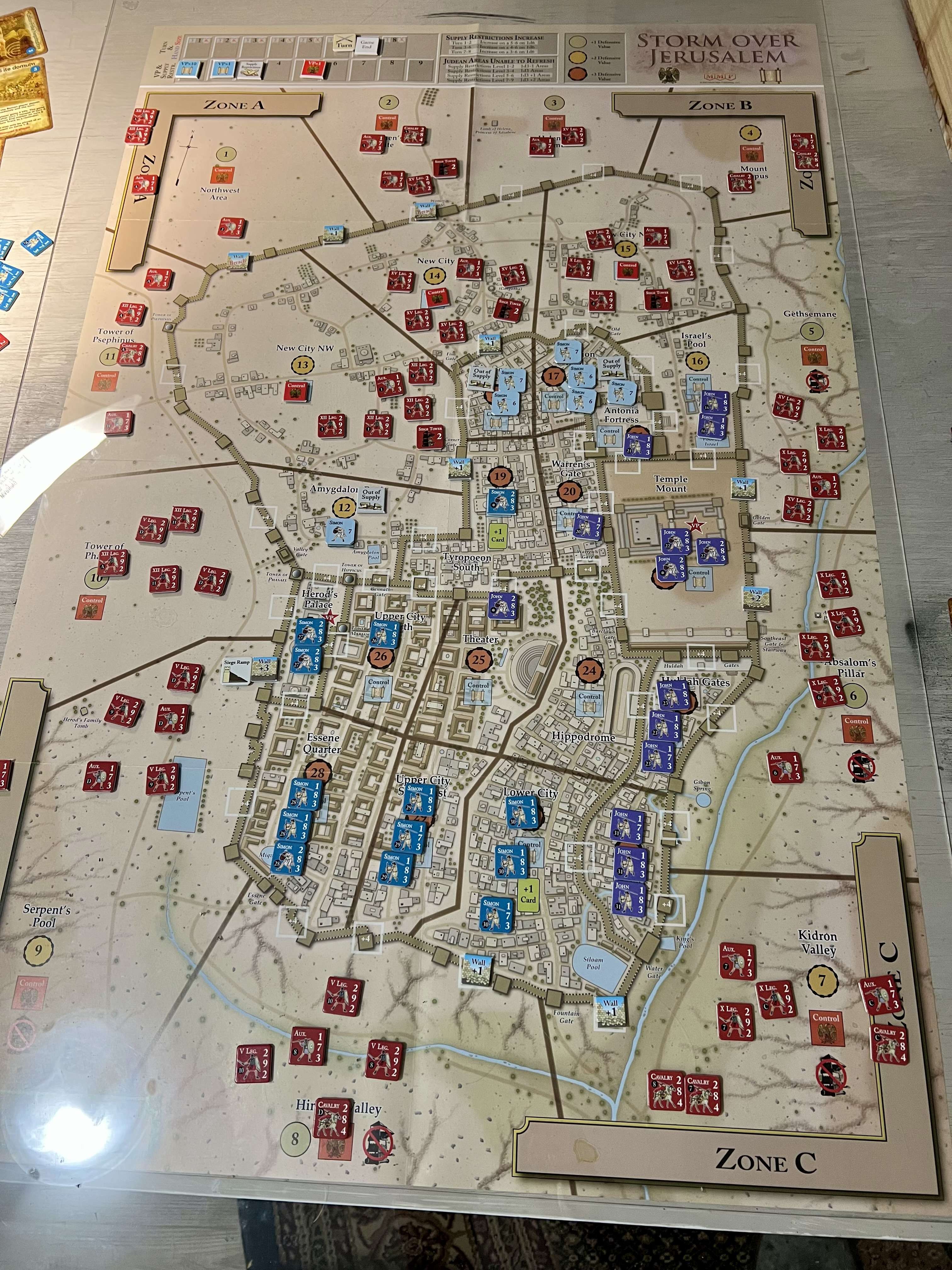
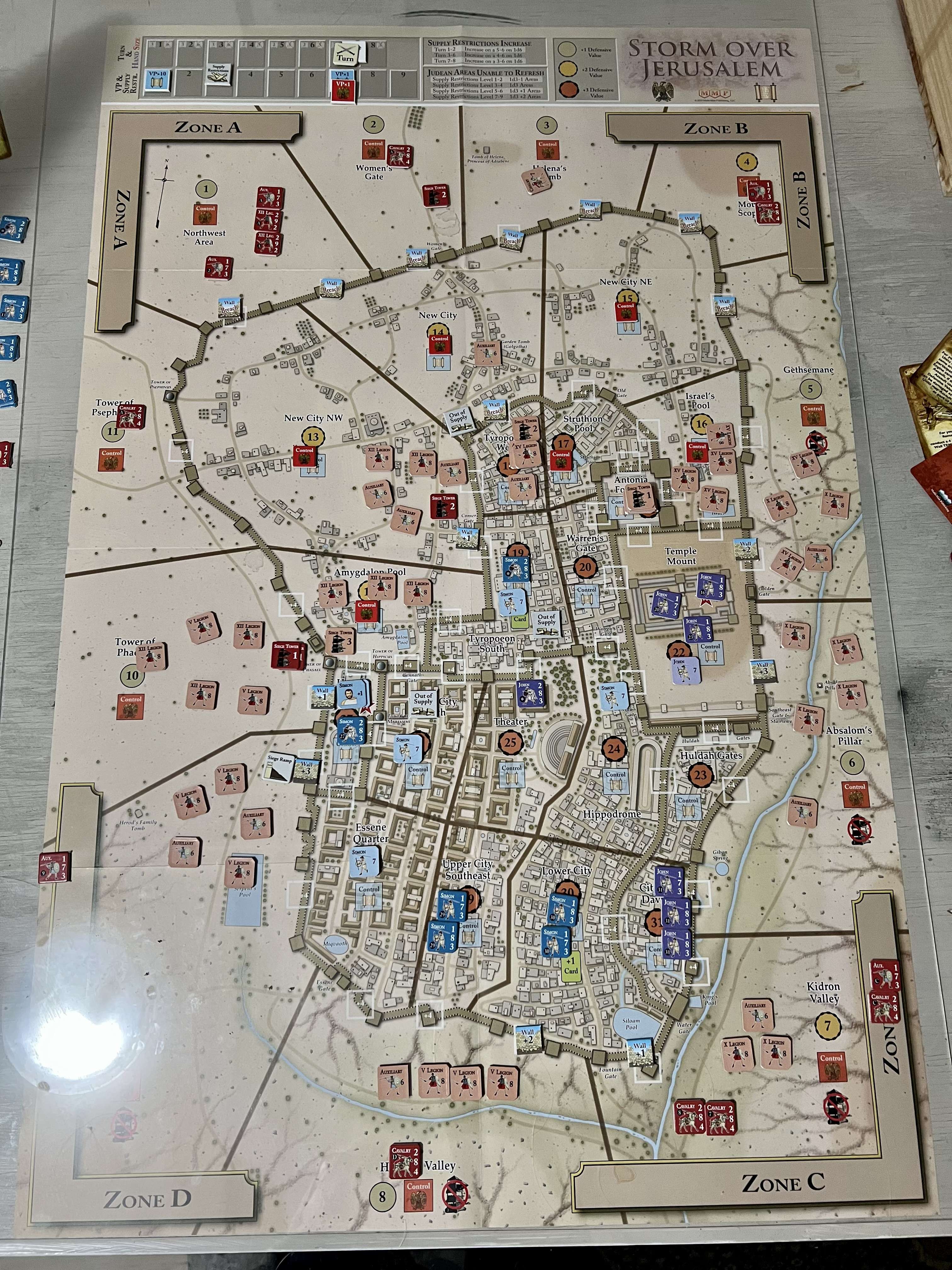
Here's the situation at the end of the second of two play throughs.    The Romans have thrown their full might at Herod's Palace (left) and the Temple (right) and in both case the Jewish defenders hung on grimly.  The game ended a turn early because of card play, and it was a tie simply because the Romans inflicted massive casualties on the Jewish garrison.


Siege games have a lot appeal for me.  For the attacker they can be interesting problems to solve, and for the defenders while there may not be lots of maneuvre choices, the tension of hanging on is always fun.   And the advantage of a paper game like this one is that I don't have to build a model of Jerusalem and to paint both armies, the game's all in the box.   

Physically the counters are oversize, colourful and well printed.  While mounted mapboards seem to be a thing of the past, it's a lovely and educational map and the cards are well done.  Full marks for the game's components.

This is a game I would definitely play again.

Cheers and blessings to your die rolls,

MP+


Tuesday, October 9, 2018

A Game Too Far?

My son John was visiting me from BC this summer, and expressed a great interest in my board games collection.   John is a miniatures gamer, and knows W40K like the back of his hand, but he was intrigued by old school hex and counter games.    His birthday was coming up, so I gave him three websites, GMT Games, Compass Games, and Vassal, and told him to pick whatever game he liked that was still in print and had a Vassal module so we could play i by email.   More to follow on that.

I am not sure exactly how many Market Garden games a chap needs in my collection, and to be honest, my collection has a bit of a mind of its own and hasn’t been effectively curated over the years.  

I have four MG games by my count.   One is an Avalon Hill classic, and is a sort of operational/tactical hybrid, focusing on the British defence of Arnham.   Designed by Courtney F. Allen and published in 1981, it featured an ingenious area impulse movement system for its day and spawned several other AH games using the same engine, one on Stalingrad and the other on Monte Cassino.  Breakout Normandy used the same basic engine but at a larger, more truly operational scale. SOA is the only Market Garden game I own that I’ve actually played head to head, and it is a much better played H2H than solitaire.

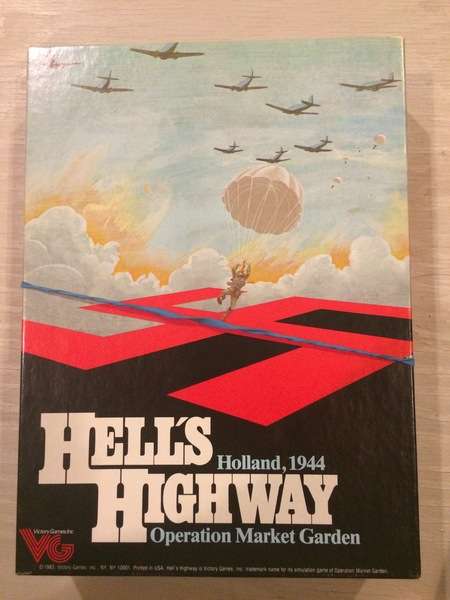
Hell’s Highway (published 1983) is a strategic level game by John Butterfield, who was one of the stable of SPI designers who went to Victory Games.  John is coming to a gaming convention in March 2019 in Toronto, which is kind of exciting.   Maybe by then I will have actually played this game, or at least peaked inside the box.

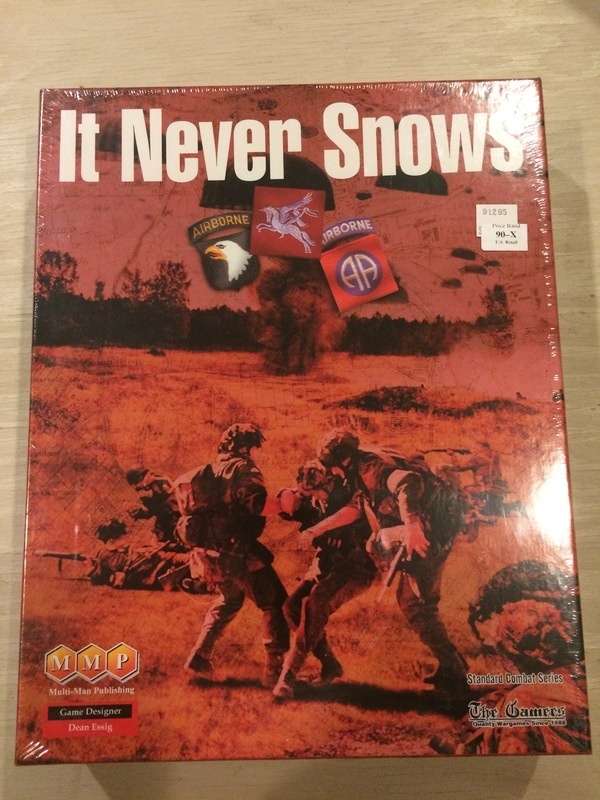
I bought It Never Snows shortly after MMP published it in 2012, partly from what I’d heard about it and partly on the strength of its designer, Dean Essig, who has won a hockey sack of awards and has a long and distinguished design resume.    Alas, it is still in the shrink wrap.    Hopefully when I retire I can get to grips with it.

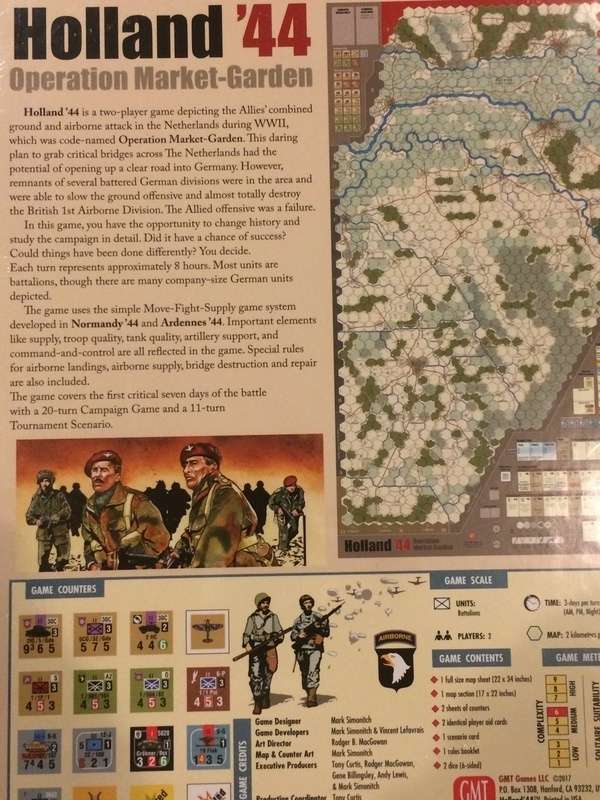
So, going back to my son John - what did he choose, but a Market Garden game?    Holland 44 is a 2017 GMT title, designed by Mark Simonitch, and is an operational, battalion-level game, starting with the airborne landings and ending on 23 September.  As with the other big titles (Hells Highway and It Never Snows), the game is a race to relieve or reduce the airborne bridgeheads before the Allied ground forces can get there.

Notice how GMT recycled some of Rodger MacGowan’s SoA artwork for the back of the box!

Well, that’s all I have to tell you for now.   I am waiting for John to tell me that he’s digested the rules (he is a demon for memorizing complex rule books) and then deciding what scenario and which side to play.   If you are interested in playing Holland 44 with me via Vassal, by all means let me know, I could use the practice.


Tuesday, April 11, 2017

Tuesday Night Boardgame: April's Harvest by the Gamers

A quiet week at the Mad Padre's wargaming chapel.   Spring is slowly coming, I've been doing some painting, including reorganizing my 15mm Red Army of the Great Patriotic War (more of that anon) and am generally being delighted that Madame Padre is doing so well.


While my GMT 1914 game is still raging at home, at work things are pleasantly quiet and I have found a space in the stockroom to set up a game to tinker with during my lunch hours.   Because it’s April and spring is gloriously here, II chose this 1995 title by The Gamers', April's Harvest, an ACW game on the battle of Shiloh.  It’s a design by Dean Essig, the well-known and distinguished designer behind The Gamers,  and Alan Wambold, part of the Civil War Brigade series now available from Multiman Publishing.  I blame Jon Frietag for telling me about an MMP sale a few years ago.


Most of the books in my ACW library are about the war in the East, and I don’t know much about Shiloh except the rollicking account in the first volume of Shelby Foote’s Civil War series, so it’s an opportunity for me to learn a little more about this battle that started the Confederacy’s long slow death spiral in the West.  

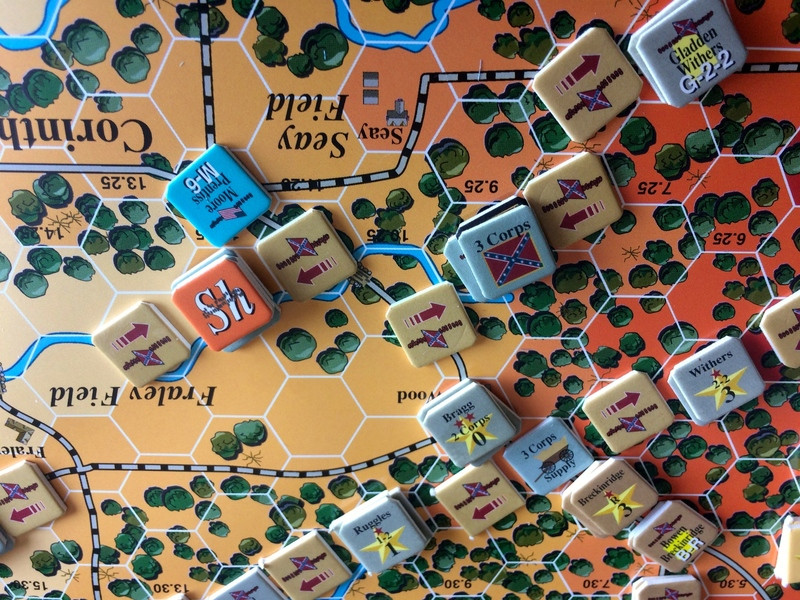
Here’s the game set up and ready to go.   The Confederate army is marching on in the top left corner, and the Union are the blue counters scattered around in the centre.  Because U.S. Grant let the Confederates assemble right next to his encampment at Pittsburg landing, without being too bothered by reports of trouble coming, most of the Union troops start immobile and off guard.  Each counter represents a brigade, a battery, a cavalry unit, a commander or a supply train.
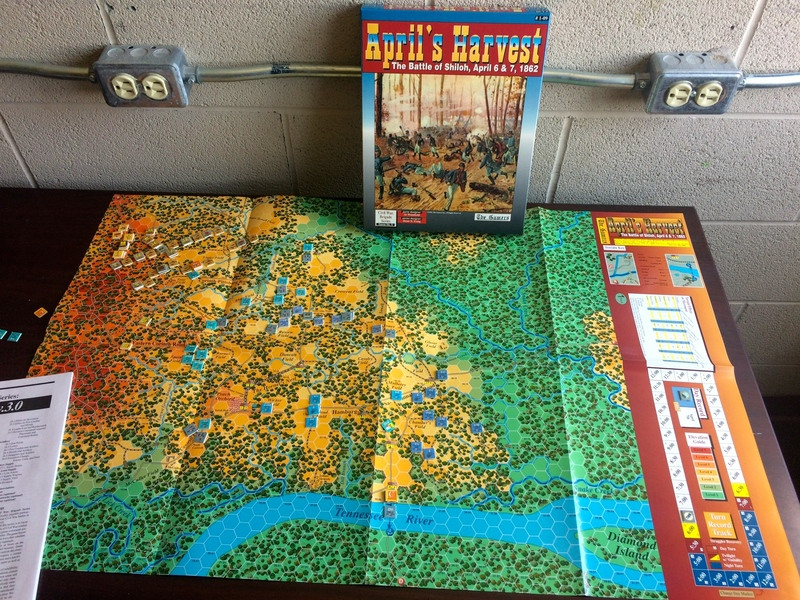
I am still working my way through the rules, which are generally well written and moderately complex.   One of the things that appeals to me as a miniatures gamer is the command and control dimension of the game.   As I understand it, divisions and corps need orders (seize this, defend that, go here, etc) that can need to be written in broad terms by the players.   It’s not at the micro detail of hex by hex movement, but broad strokes.  For example, the three CSA divisions that start on the board all have territorial objectives that they are ordered to capture.   If new orders need to be given, there is a mechanism that marks the time necessary for the orders to travel from commander to subordinate, and then a mechanism to see if they orders are accepted and understood.  

I’ve just had time to run the first turn (6:30am).  It wasn’t clear to me which side went first, so I let the Union go first and moved the two Union brigades that had orders.   Since then I have had access to the errata, and discovered that the rebs should go first.  Ooops.  Here Moore’s troops of Prentis’ Division have been ordered to scout for rebel tools.  They run right into Hardee’s third corps and are falling back.  Both sides have fired shots and taken casualties, with a rebel brigade pushing the Yanks back but becoming Shaken after a failed morale check.  Shaken is not a terrible thing, but it does stop troops from making Close Combat (shock) attacks.

The counters on either side of Confederate units showing red arrows indicate that the brigade has adopted an extended line formation.
More to follow as the Union camp starts to wake up.

Blessings to your hardtack and coffee!  

MP+
 

Blog Archive

Followers