Friday, May 7, 2021

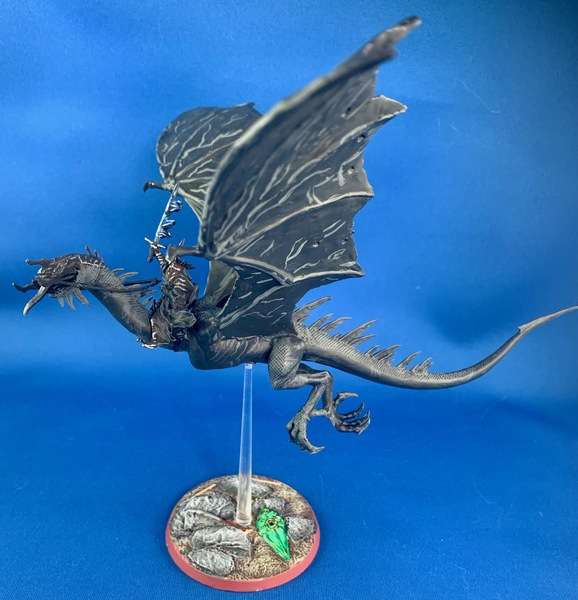
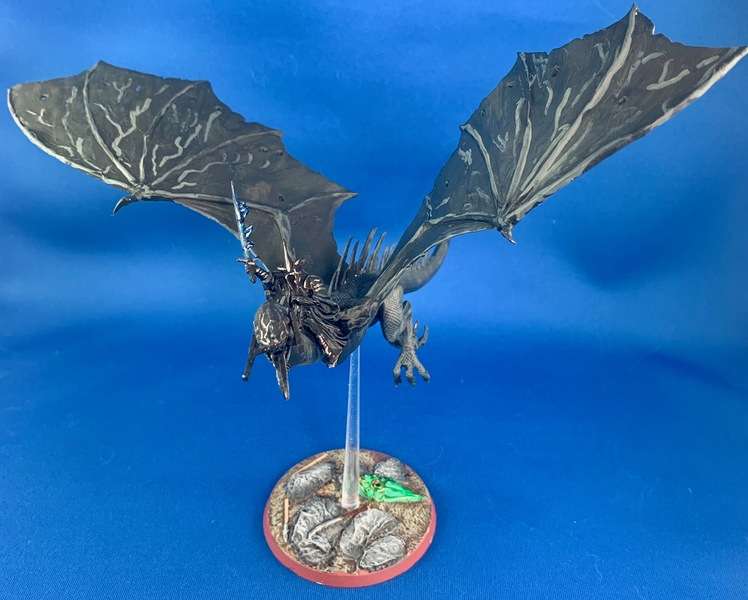
Friday Fantasy: GW Ringwraith on Fell Beast (or, Meanwhile, in Mordor)

As a rule I disapprove of super-monstrous units on the wargaming table.  My WW2 collection only has one 15mm and 1 20mm early-model Tiger tank, and you will search my collection in vain for a Maus, JSII, or King Tiger.   I confess I look askance at people who are all too ready to put such figures, or a French army consisting of just the Imperial Guard, on the table.  It’s just not right.   If you can’t eke out a win with PzIIIs, T34s or line infantry, then you aren’t really trying.   OK, I’ve confessed my prejudice, feel free to disagree.

However, if one is going to do the Lord of the Rings in a large way, then there are certain epic fights where you want a Nazgul lord on a horrid flappy mount, because if nothing else, you want to motivate your orc hordes to throw themselves onto the bright spears and swords of their noble foes.    When I found a Battle of the Pelennor Fields box set in my local games store at 50% off because, said the owner, no one wants this stuff anymore, I jumped at the opportunity, because it included a number of large models in plastic, including this guy.

I didn’t put a massive amount of work into the painting.  I started with an undercoat of Vallejo German Grey primer and then drybrushed with several lighter shades of grey craft store paint.  I picked out the veins in the wings with a medium grey.   The Ringwraith was black with successive shades of grey highlights on the folds of the robe, while his armour was Citadel Warplock Bronze, then a wash of Nuln Oil, then a dry brush of gunmetal.  I put the most work into the ringwraith’s sword.


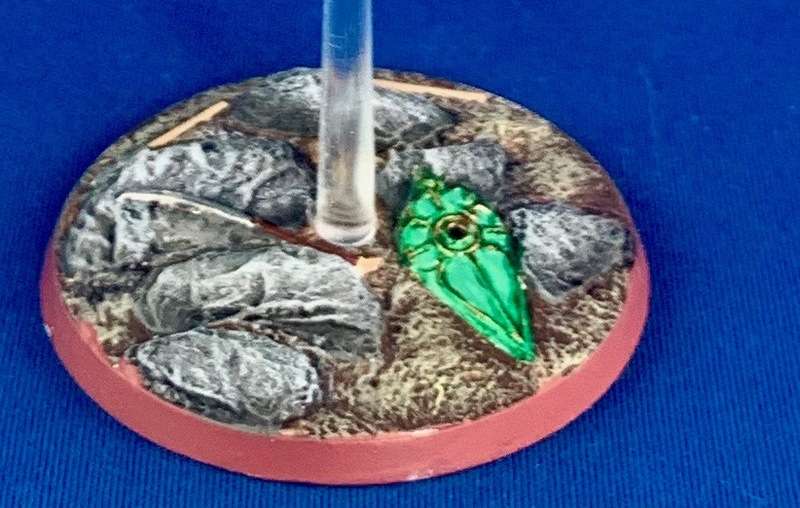
I think most of my effort went into the detail on the base, to be honest.

This figure will mostly sit in my display cabinet, but if it ever makes it onto to the table, it would only be for a very large scale battle.   If using Dragon Rampant (my friend James and I really haven’t found a better set of rules for big fantasy battles), I would give him the Goader ability to make the two closest units move automatically, as well as make Good units within a certain radius (at least a foot, I would think) check for Fear unless an equivalent hero like Gandalf was on the table.   

Thanks for looking and blessings to your brushes!

MP+

Wednesday, May 5, 2021

Thursday Napoleonics: Baccus 6mm Austrian Hussars and French Generals

Hello friends.

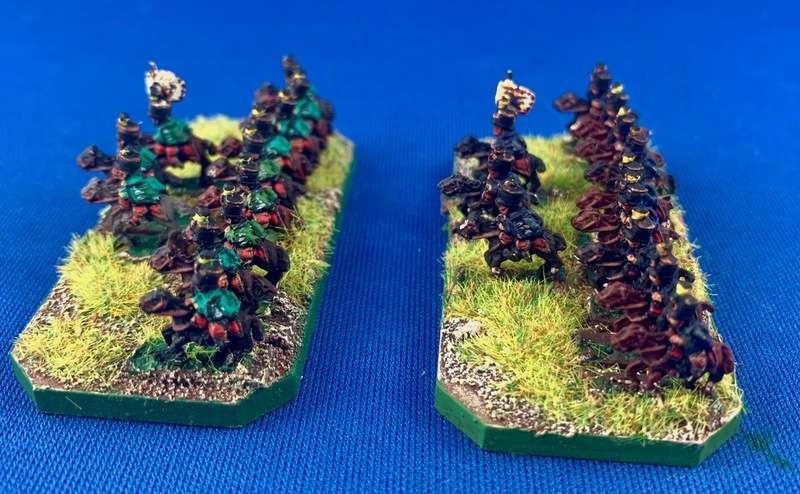
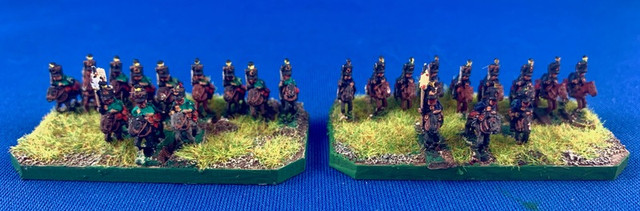
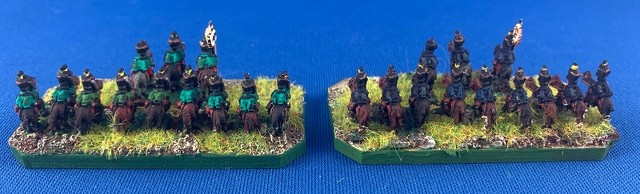
Solid progress on the Napoleonic front this week.  Two regiments of tiny Austrian hussars from Baccus (their code NAU08) were mustered into their Kaiser’s service.   While my painting style is somewhat generic in this scale, these are done to represent the No 8 (Wurmser) regiment in the green (left) and the No 11 (Szekler) regiment in the dark blue (right), though really, they’re just happy to portray any Austrian light cavalry as required.

Honestly I don’t know a lot about these Austrian regiments, but Haythornthwaite and Fosten, in their Osprey Book on the Austrian cavalry, note that the Szeklers were pretty tough customers who “enjoyed a reputation not only for elan but for an uncompromising attitude;  Marbot, for example, claimed with some disgust that the Szeklers were responsible for two attacks upon French flags of truce, assassinating the French plenipotentiaries at Rastatt in 1799, and cutting up the French delegation outside the gates of Vienna in 1809”.    Charming fellows.


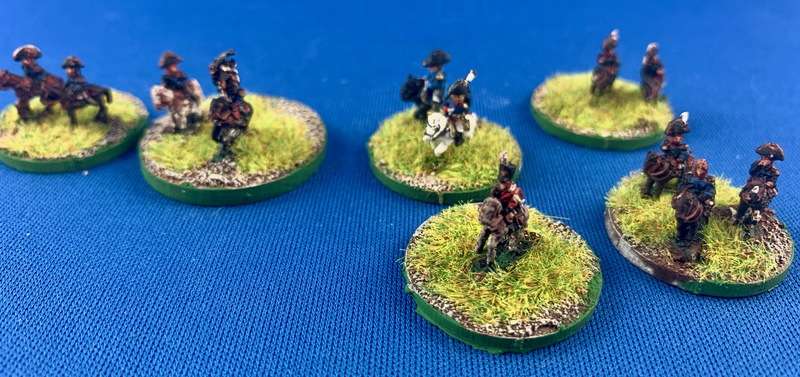
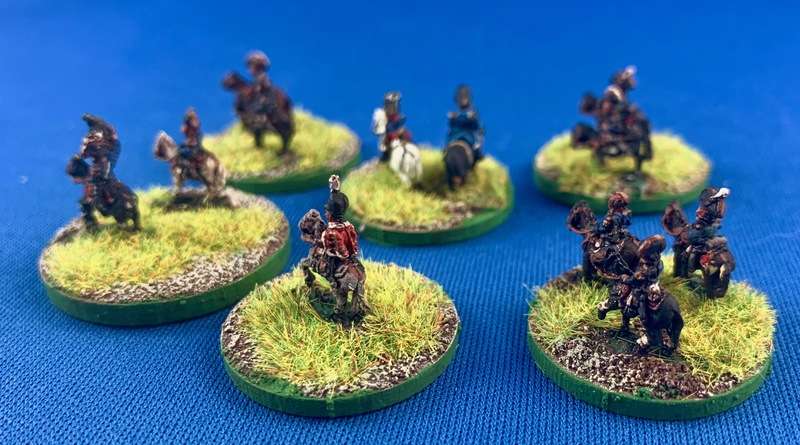
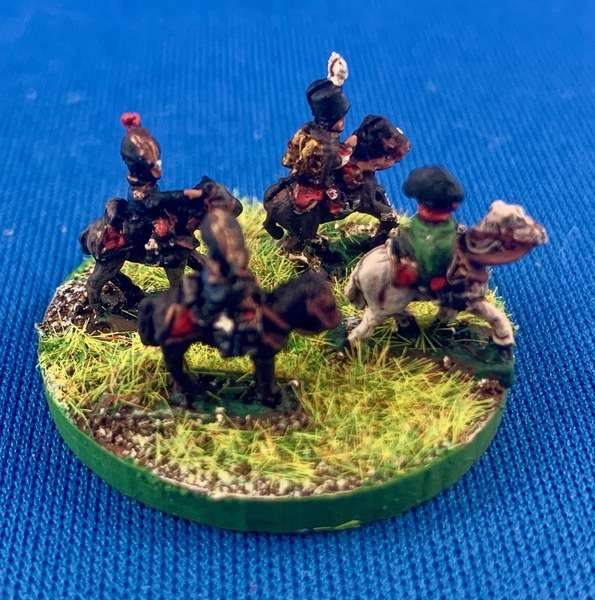
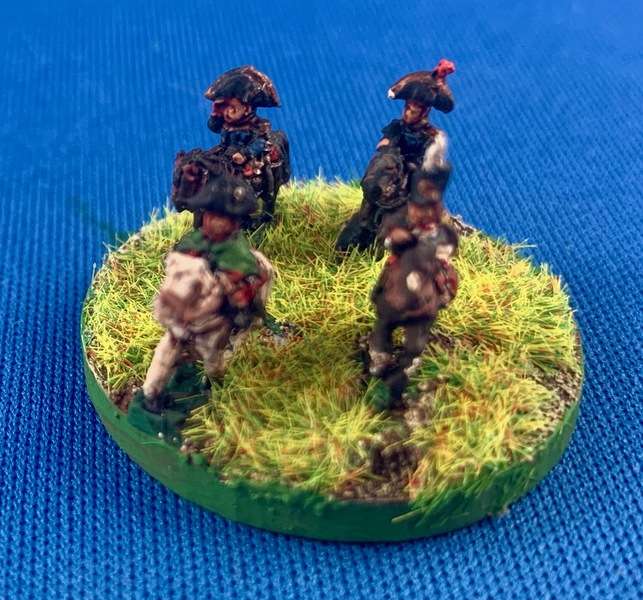
Also finished this week is this pack of Baccus French generals (Baccus code NFR 11).  I’ve based single figures as brigade commanders, two figures as divisional and three as corps commanders, including bald Marshal MacDonald bottom right.


Finally, as today is the 200th anniversary of the death of l’Empereur, here is Napoleon and his glittering staff, just in case the Great Thief of Europe is ever needed on the tabletop.


Thanks for looking.  Blessings to your brushes and Vive l’Empereur!

Tuesday, May 4, 2021

Terrain Tuesday: Winter Terrain for My Canadian Pulp Project 2

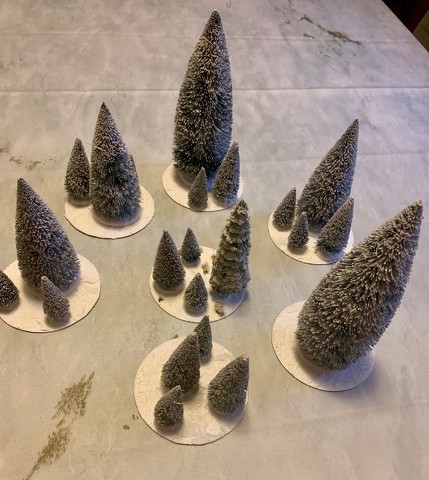
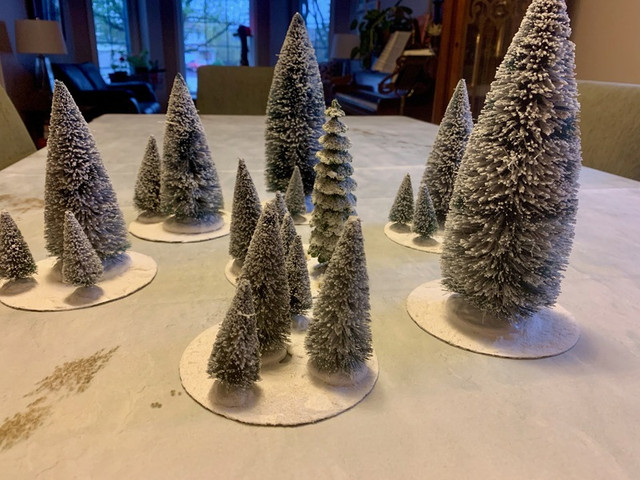
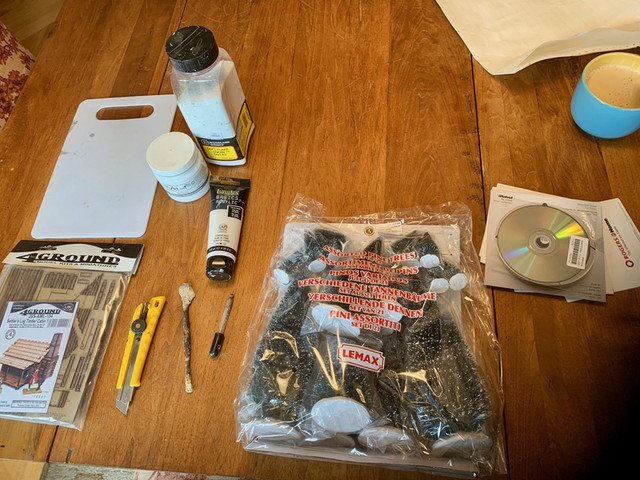
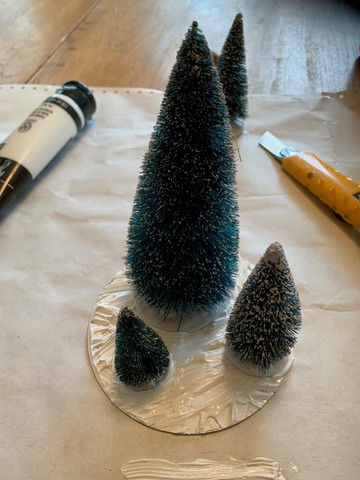
It’s Terrain Tuesday and I’m doing fairly well in making this a regular theme.    Here are the trees from that pack of craft store Christmas village trees, all based.   I wasn’t happy with the amount of snow on them so I mixed equal parts white acrylic artist’s paint with water, applied liberally to the trees (THAT was a mess of epic proportions, I’m still finding white paint dots on my glasses) and then drenched the wet tree in Woodland Scenics white snow powder.    Once dry I spray the whole base with artists’ workable fixative to help set the snow in place. 

Still adding some winter tufts to the bases and then they’ll be done.

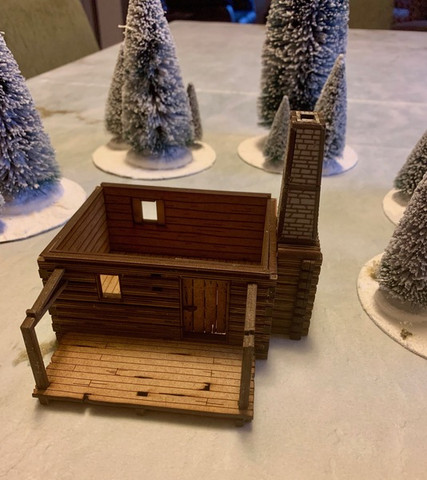
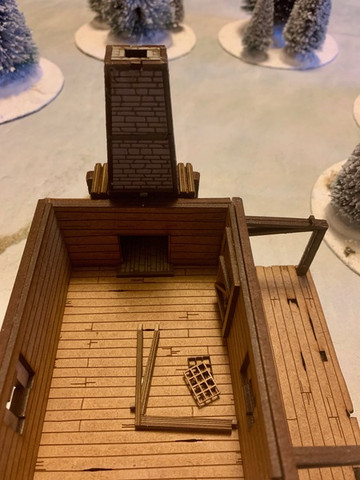
Also making progress on the Mad Trapper’s cabin, which is a 28mm 4Ground model, their Settler’s Log Timber Cabin 1.  I’ve purchased and build several 4Ground models and really like them, and this is no exception, very nice kit, though I did make a small mistake installing the fireplace insert.

 Some scatter terrain inside and outside (barrels, a wood stove, etc) would dress this up nicely, but it will do for now.    I may go hunting for twigs and build a woodpile, rather essential for the winter, I would think.  I should visit Annie’s Bad Squid store and see what she has in the way of scatter stuff.

Good progress made on this terrain project this week and should pronounce it finished by the next Terrain Tuesday.

Cheers and blessings,

MP+

Friday, April 30, 2021

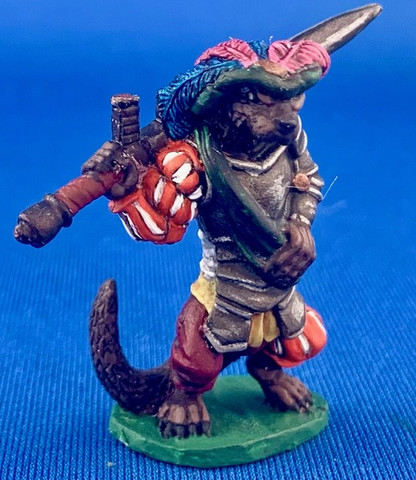
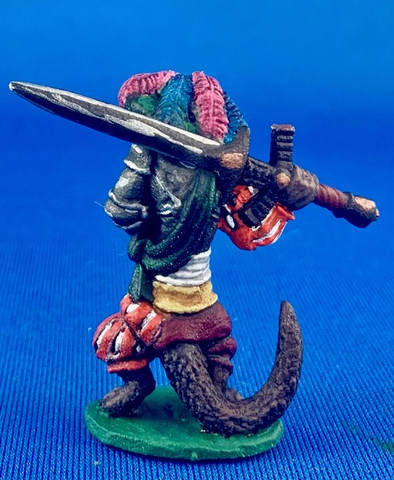
Fantasy Friday: Landsknecht Otter

I painted this 28mm Oathsworn figure at the request of my son, who is an RPG guy and is into Burrows and Badgers.  It was a heck of a lot of fun to paint, beautiful sculpt.   Very tempted to order some for my self, but I really don't need another gaming/painting interest!

If you follow me on Twitter (@marshalluigi), you’ll know that I have a pretty good GIF game that often features cute otters.   This fellow is definitely not cute or cuddly.  I texted these photos to John in BC and he wrote back “Full of bravado, full of himself”.

Thanks for looking.   I have a figure lined up for next week’s Fantasy Friday but it’s certainly not as cute.

Cheers and blessings to your brushes.  A happy bank holiday to my UK and Irish readers.

MP+

Wednesday, April 28, 2021

Battle of Seven Pines (ACW): Gaming the Battle, Piece by Piece (1)

 Hello friends:

Recently someone said on gaming Twitter that they preferred actual battles with stories and backstories to random X points per side battles, and I confess I've been leaning that way myself lately.   Since I wanted to return to Dave Brown's Pickett's Charge ACW rules and employ some newly painted figures, I opened Vol. 1 of my copy of The West Point Atlas of American Wars  at random and picked a corker of a battle, Seven Pines, the beginning of the end of the Peninsular Campaign of 1862.

Seven Pines was a terribly fought battle on both sides, and brings little credit to anyone except the ordinary soldiers who fought and died there.   McClellan's Army of Potomac had crawled its way slowly towards Richmond, giving the Confederates ample time to mass their forces.    At the end of May, 1862, McClellan was within a few miles of Richmond, but had inexplicably pushed two of his corps (Keyes' IVth and Heintzelan's  III corps) across the swollen Chickahominy River, making them a tempting target for CSA commander Joe Johnston.

The Union line was arranged in what has sometimes been described as a fishhook, with the most exposed Corps, Keyes', being the least trained.   Some accounts say that the regiments in the furthest forward Division, that of Brig. Gen. Silas Casey, were raw recruits, armed with inferior Austrian muskets.  As one historian put it, "Casey's division, the smallest and greenest of McClellan's vast arsenal, was inexplicably ordered to lead the army's advance on to Richmond".  These poor guys had been marching and working for days, exposed to torrential rains, often without their shelter halves and coats, so they were pretty used and abused going into the battle.
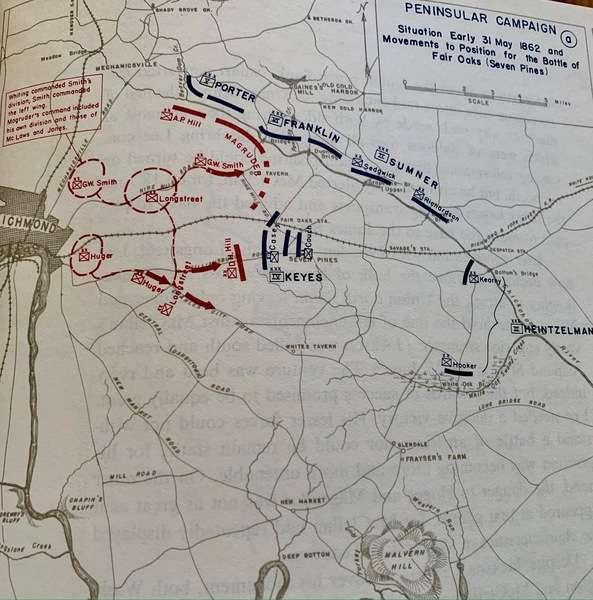

Johnston decided that Keyes' Corps was too tempting a target to pass up, even though by May 30 the CSA command knew that the Union IVCorps was digging in around Seven Pines.  Johnston's   plan was that D.H. Hill's division would attack it from the front, up the Williamsburg Stage Road, supported by Longstreet's division, while Huger's division would move south to hit the Union left and Whiting's division would move to hit the Union right.  

It was a good plan in theory, but there were several problems.  First, a heavy rain on the night of 30 May left the roads that the CSA divisions must use a wet soggy mess.   That would slow down the rebels, but it was hoped that the same rains would prevent the rest of the Union army from crossing the Chickahominy to help Keyes.   

The plan required far too much coordination for an army of the period, especially considering that the chain of the command of Johnston's army was complicated and inefficient and Longstreet basically got in Huger's way because he thought he knew best, while Huger's orders were unclear, leaving Hill to wait impatiently and finally launch the attack on his own.  Or something like that.  It was basically a big mess and many of the troops Johnston assigned to this movement never made it to the fight. If you have an hour to spare, there's a good lecture here on the leadup to the battle.

GAMING THE BATTLE

This would be an easy battle to recreate as a whole in the smaller scales, but since I do ACW in 28mm, the only way to recreate it is in sections.  Fortunately the timeline of the fighting meant that the battle on the first day unfolded as a series of episodes, which is how I intend to proceed.

EPISODE 1:  Garland Vs Keyes

I found this map from the US Civil War Preservation Trust to be most helpful.   It shows the initial dispositions of both sides as well as the Confederate plans.  Modern maps are no help, as the entire battlefield has been developed, including a substantial portion which is now covered by the Richmond airport.

The Confederates had done enough reconnaissance to know that Casey's division was deployed in an open space that had been cleared of the surrounding trees, and bisected by the Williamsburg Stage Road.   Roughly 800 yards east of the start of the clearing were two buildings known as the Twin Houses, about 135 yards south of the road, and in front of them Casey's troops had constructed a redoubt with a battery in the centre.


At the west end of the clearing, the Union had felled enough trees to form a substantial abatis on the north side of the road, and had posted a picket line of troops drawn from Casey's three brigades.     Just before 10:00 hrs, after abundant signs that an attack was coming,  Casey sent an additional regiment, the 103rd  PA, to support the picket line.  

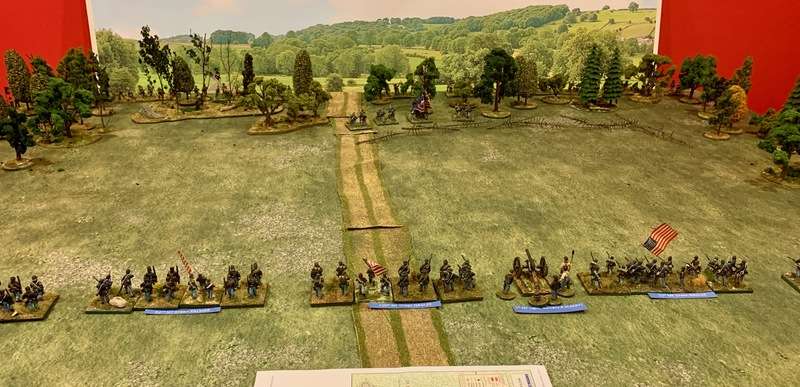
Working with the Pickett's Charge rules ground scale of 9" = 150 yards, with a 6' by 5' table, this is what I came up with.  The clearing is about 60" north to south, with Casey's first line, two regiments each from Naglee's and Palmer's brigades, about 27" back from the start of the clearing.   I've used model railroad pine trees to represent the abatis.  As I figure the ground scale, Casey's redoubt is about 36" back from the first line, so there is no room to represent them on the table in this first episode.  However, Casey's two batteries in the redoubt line (1 NY Co A, 7 NY) can fire from off the table if the rules permit.   From what I can read of the maps, this part of the battle was dead flat, so no need to model elevations.   Some of this clearing was planted, and possibly had snake rail fences, but I am guessing that after a few days camped here, Casey's men would have dismantled them and used the wood.


The first minutes of the fight in the woods doesn't need to be modelled, which is a good thing because it was absolutely terrible terrain.  In his report after the battle, Garland wrote that: 

The difficulties of the ground were almost insurmountable. The recent rains had formed ponds of water throughout the woods with mud at the bottom, through which the men waded forward knee-deep and occasionally sinking to the hips in boggy places almost beyond the point of extrication. The forest was so thick and the undergrowth so tangled that it was impracticable to see the heads of the several regiments as they moved forward, and the deploying intervals were in consequence very imperfectly preserved. 

The accounts agree that the Union pickets were driven in without much resistance.   Stephen W. Sears, in his book To the Gates of Richmond: The Peninsula Campaign, has an account by one Yankee skirmisher who hid himself when he saw the first of Garland's men:  "I [then] left the place and took a course to get away".   

Thus, Garland's brigade will activate on the first turn within inches of the hapless 103rd PA, while Rode's brigade will have to spend several turns moving through the woods (difficult terrain) before they can get into the fight, as per the battle.   


Troop ratings are easy to figure out for the Union - every regiment in Casey's division is rated Green, while Casey himself was a competent and brave commander (he was chosen for the job because he'd written an important drill manual before the war).   I don't know how to rate the three US brigade commanders - Palmer, Naglee, and Wessells - I'm assuming that they were competent.   Rating Hill's division is a little more difficult, but considering the relative quality of the ANV in 1862, I'd rate them as Veteran with a few regiments being Elite, just to reflect the qualitative difference between the two divisions.  I hope I'm not buying into rebel mythology here, but these same troops will be carried over to the next episode where they have to face the redoubt (which historically they did), so they will need some staying power.

I'd be happy to hear your thoughts/comments before I kick off the battle, hopefully tonight.  If this works, my plan is to work on a set of scenario notes for Seven Pines that might be publishable somewhere in our hobby.

In the meantime, blessings to your dice rolls!

MP+

Tuesday, April 27, 2021

Terrain Tuesday: Winter Terrain for My Canadian Pulp Project

I’m happy that I’ve posted on this subject three Tuesdays in a row!   

Yes, this is for my The Rockies Ablaze Project, which I am taking off the back burner for a while.    I need some more scenery and a cabin before I introduce a new character.

These craft store trees will need more snow than this!

Check in again next Tuesday to see the final result.  Check in again earlier than that for the start of a 28mm ACW project, The Battle of Seven Pines.

 In the meantime, blessings to your tiny landscapes.

MP+

Thursday, April 22, 2021

Napoleonic Thursday: Some Player Aides and Figures for General d'Armee

Good afternoon friends:

My first foray into General d’Armee by Too Fat Lardies/Reisswitz Press showed me that I needed some player aides to better manage some of the core mechanics, one of which is Aides de Camp.   When I served, an ADC was just a luckless very junior officer who got tasked with picking up a GOFO (General Officer/Flag Officer) at the airport, getting him to his guest quarters and turning his sheets down, and other sundry details, the indignity of which far outweighed the privilege of wearing the ADC’s aiguillette, the ceremonial length of braided cord worn on the shoulder of the dress uniform.   

n Napoleonic battlefields, ADCs were ambitious and dashing young men of good families who rode around with orders and goads from the General commanding, like the unfortunate Lord Hay at Waterloo.   In Dave Brown’s GdA, ADCs, as we’ve seen, are the limited resources of time and attention to detail that allow the player to try and exercise _some_ control over the battlefield.   So how to represent them in 6mm?

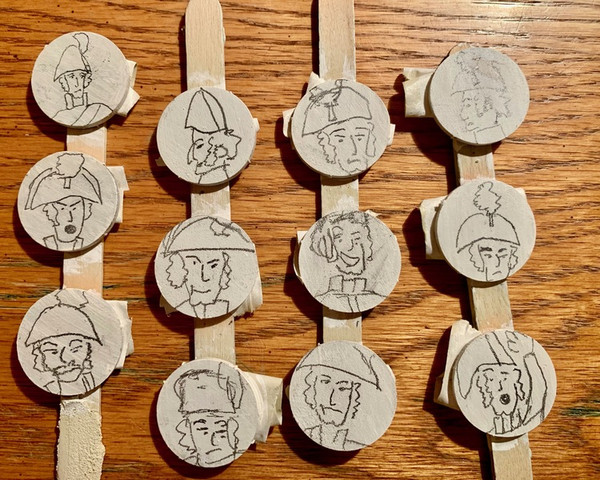
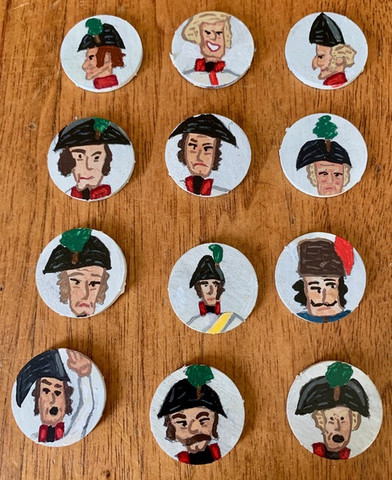
I thought of simply ordering some officer figures to single base as ADCs, but decided against it, as it would take a while to get them and paint them (Baccus is swamped with orders at present and I have no idea if other companies like Adler are any more responsive) and I already have single-based command figures in the pipeline to represent brigade level commanders.   I then hit on the idea of trying my dubious artistic skills to sketch some caricatures, starting with Austrians, so I painted some discard sabots from multi-bases in white and then went to work with an HB pencil.  I found as I went that I was remembering some officers from my military service as I went, like the fellow with the big hair and the easy smile.

 Final result.  Started colouring them with the grandkids’ pencil crayons, but the results were quite uneven and so I decided to revert to acrylic paints.   I’m quite happy with the final result.   Can’t wait to try them in my next game of GdA

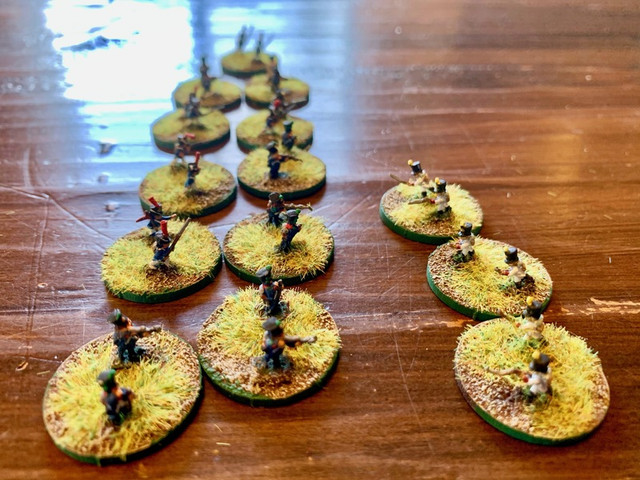
Also finished this week are some skirmish stands so I can try out the Skirmish rules in GdA.   I still need to do more Austrians, but I figure the French are more likely to deploy skirmishers than their opponents.  Some of the French figures (left) are by Baccus, painted by me, and some are from the collection I purchased.  The Austrians on the right were in that same purchased collection.

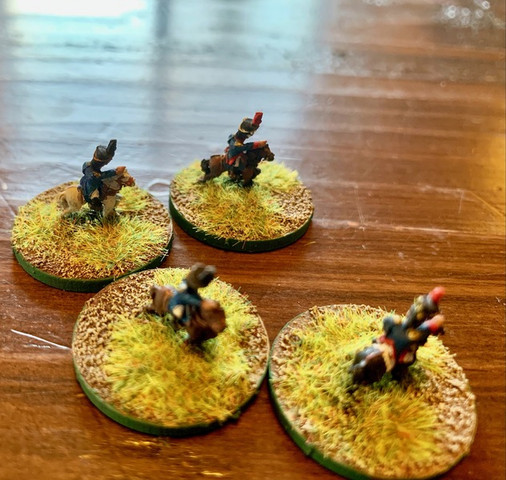
Finally, since I was on a basing jag, four brigade commanders for the French.   While I could also employ these figures as ADCs, I like my approach better.

Hopefully we’ll see all this kit in action soon.    Thanks for looking and blessings to your brushes!

MP+

Blog Archive

Followers