Tuesday, March 1, 2016

Diplomacy Game, Fall 1902 Results

A bunch of stuff has happened in the past few days.

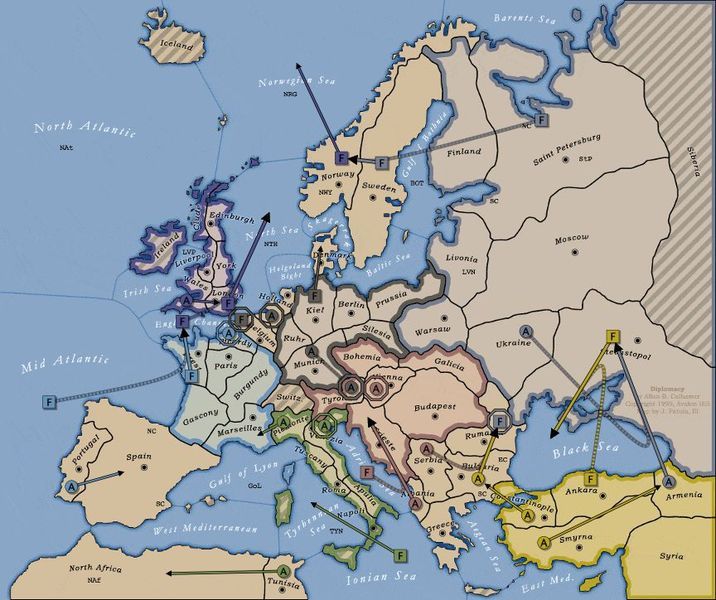
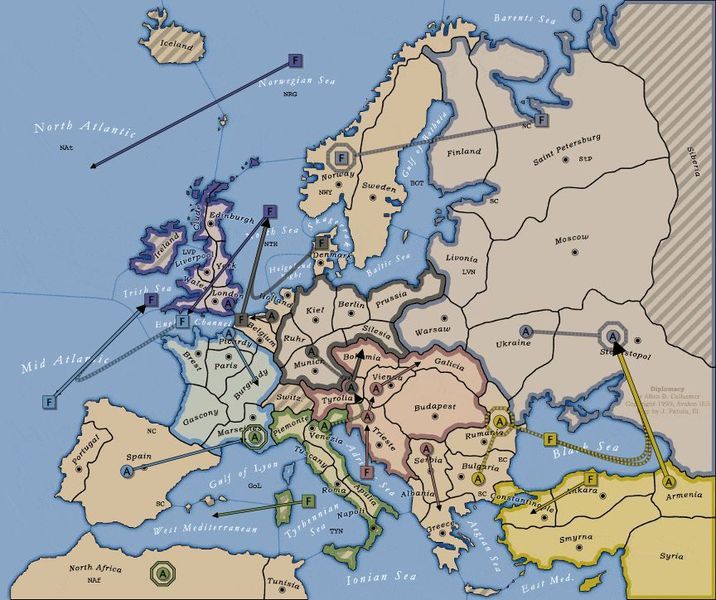
Moves for the Fall 1902 Turn (Turn 4).  Noteworthy actions:

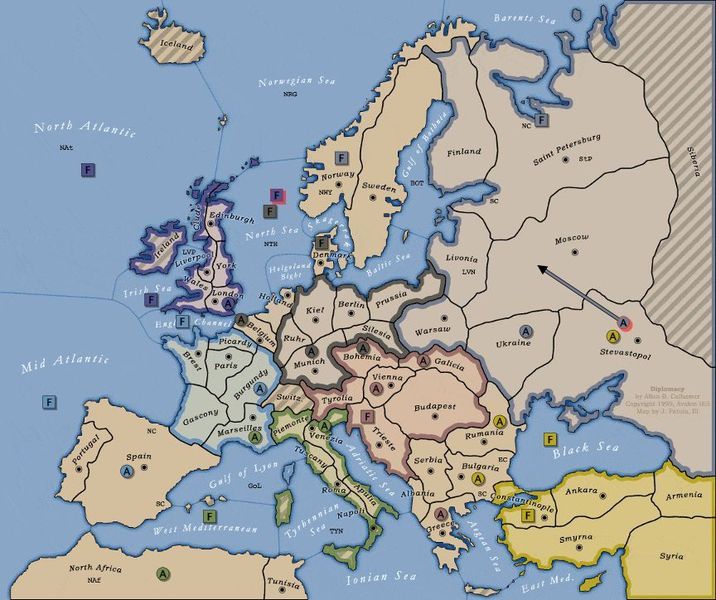
A concerted Turkish attack droves the Russians from Sevastapol.  

The German High Seas Fleet drives the Royal Navy from the North Sea, while the English hold the Irish Sea against the French MAO fleet.

Italy easily drives off a French attempt to retake Marseilles, while that Germany army in Tyrolia moves north to Bohemia, perhaps trying the patience of its Hapsburg guests.

The Retreats Phase.  The Russian army has no other route to retreat except Moscow.   The English fleet in the NorS has many options, though, and chooses the most vexing possible route for the German player by slipping into Holland and taking it from the Germans.  That deprives Germany of a build and saves England from removing a unit in the build phase.


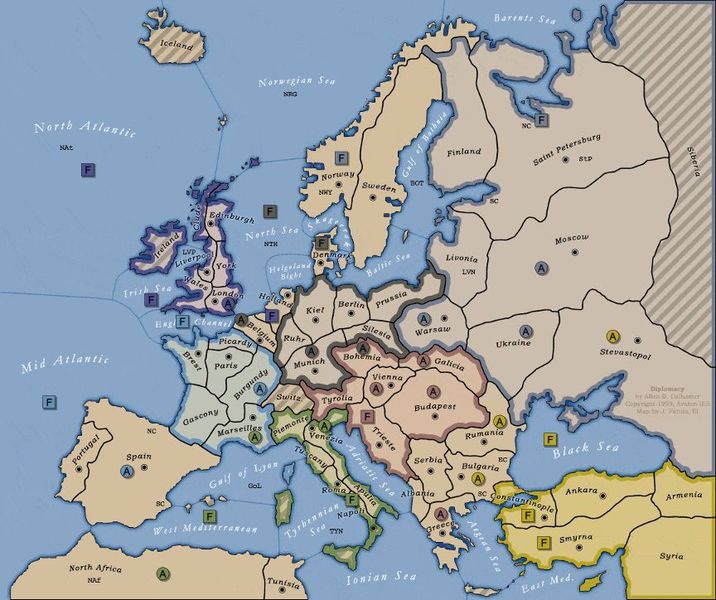
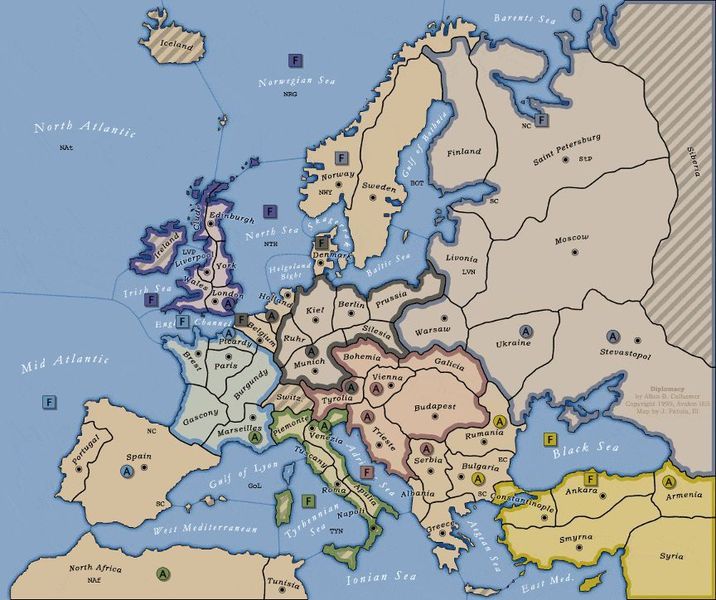
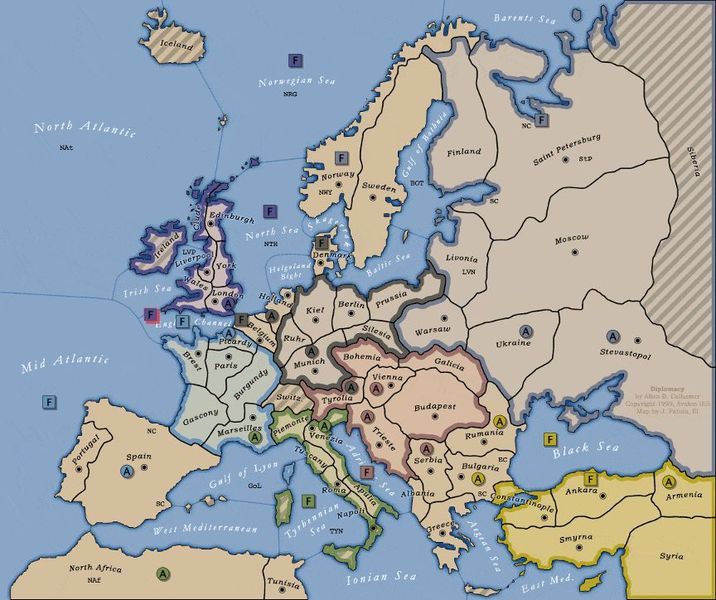
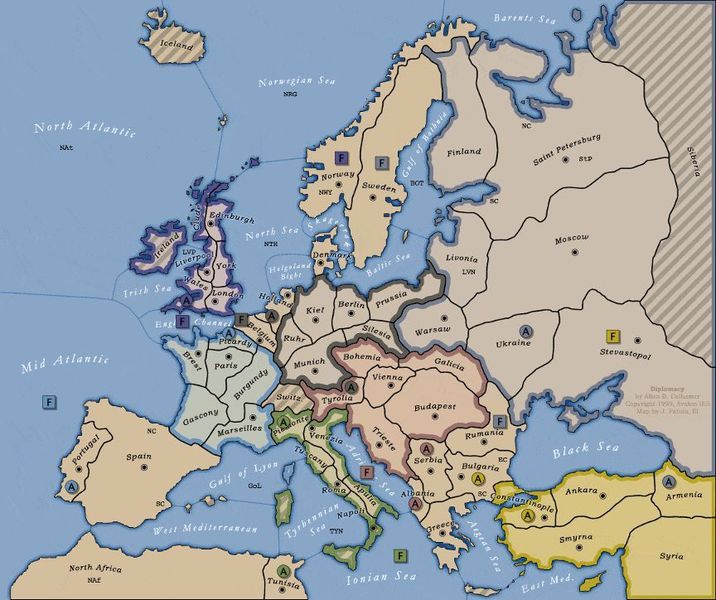
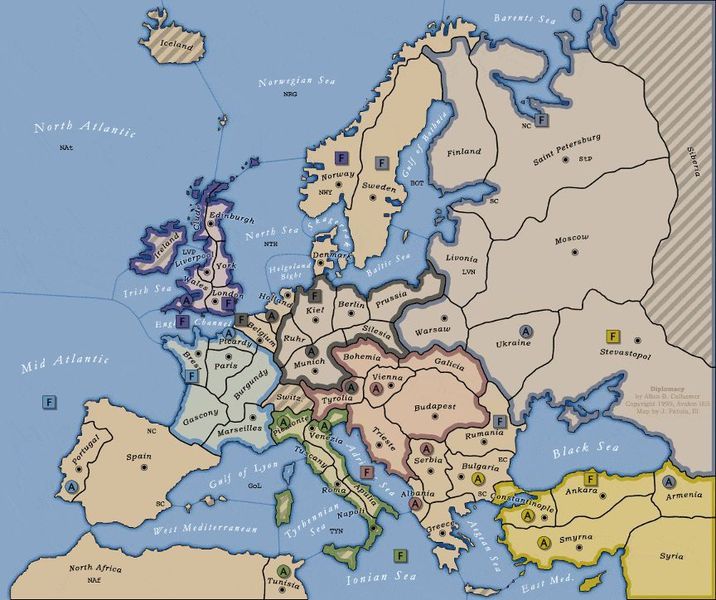
The situation at the start of Turn 5 / Spring 1903.

Austria builds an Army in Budapest, Turkey a Fleet in Smyrna, Italy a Fleet in Naples and Russia an Army in Warsaw.


Next turn is a week from today (Tuesday March 9).

Sunday, February 28, 2016

Daily Dissembler, Spring 1902 Extra Edition

This edition of the Daily Dissembler is dedicated to the memory of Robert Audin, who passed away recently at too young an age.  Robert was an avid war gamer, painter, and blogger.  He played Russia in the Diplomacy game I ran here in 2014, and I like to think he would have enjoyed the Dissembler's gentle silliness.   He was creative and clever, with many ideas and projects that sadly died with him.  Rest in peace, friend.  MP+


The Daily Dissembler, Special European Gazette Issue, June 15, 1902
 We make sense of a complicated world so you, dear reader, can enjoy the Gilded Age.


“A Turn-up for the Books!”  Our Expert Offers His Analysis


General Erasmus Blatt.

The editors are delighted that General Blatt, hero of the Empire’s campaign to subjugate the striking coal miners of Tiddleypool, has agreed to provide commentary on the unfolding events in Europe.  General Blatt’s column is syndicated by the Rioters News Agency.


A few surprising revelations have discovered themselves in the spring campaign season for 1902.  Though your correspondent was correct about some matters, he admits to have been somewhat mistaken about others.  Then there are one or two of my forecasts that have been proved right, but in unexpected ways.  

There is no four-way alliance against the Austria-Hungary Empire.  Not that this was really expected, but it seemed possible that the Asiatic Powers at least might be in cahoots, despite events around the Black Sea coasts.  That there could be a military alliance between Addul Hamid II and Franz Josef did cross my mind, but events gave no real indication that any such arrangement existed.  As it transpires, in the Great Game, a Statesman does well to play his cards close to his chest.

It is now clear that Turkey and Austria-Hungary are acting in concert.  Their combined forces have destroyed for good the Russian Black Sea Fleet – gone forever the Romanov dream of an untrammeled sea-going passage to the Mediterranean. Further, the purpose of Turkey’s raising the army in Smyrna has been revealed.  Pursuing the Russian Army counterattacking from Armenia and recapturing Sevastopol, it is now on the borders of that Tsarist province.  The three-pronged attack in the fall season  cannot fail to ensure that Sevastopol changes hands a third time.

I can perhaps excuse my assessment of a Hapsburg- Ottoman rapprochement as unlikely by the observation that Turkey seems so far to be garnering all the fruits.  Master of the entire Black Sea littoral by the end of 1902, the Ottoman Empire will have doubled its military resources (6 supply centres from 3), the Hapsburg having expanded by a third as much (4 from 3).

The attentive reader will understand by now why your columnist expected an army to be raised in Moscow in 1901.  An army there would have secured Russia’s southern flank, at a time when neither the northern, nor yet the centre, was under threat.  Russia’s stunning – and, I confess, beguiling – coup in Scandinavia will prove scant compensation, one imagines, as events have turned out.  At that, although I expected the Arctic Fleet to take Norway, it is probably as well for the Tsar that he chose the Baltic (in Sweden) for that honour.  That is, of course, providing Russia can rely on Germany leaving Sweden, lacking a garrison, inviolate.

That might not be so misplaced a trust.   Germany’s attention has been focused westward hitherto.  Its excursion into the Tyrol is explainable in terms of distracting Austria-Hungary, and hoping thereby to disarm the threat presented by a Austro-Turkish alliance.  It has not worked, and not helped much, withal, but this effort hasn’t harmed Germany very much – not in the short term anyhow.  In view of Russia’s plight, would Germany turn and take a bite out of the corpse of an ally that is dying?  Possibly – likely if the alternative were to cede the opportunity to England.  But that seems unlikely in the short term, as to do so would weaken Russia in the north and England is the more likely to gain.  Having said that, I have been proved wrong already so far! With nothing to fear from the West, Germany is free to decide ‘where to next’.  There, I refuse to speculate, so many are the possibilities.

For its part, the Austrian Foreign Minister seems to have persuaded King Victor-Emanuel to cast his eyes westward.  Greece has been left open – presumably for the Austrians to gather up in the autumn.  Did the Emperor apprehend an Italo-German descent upon Trieste?  That would explain his spring move to ensure the place had a garrison.  Otherwise, he might have moved the fleet thereto and the Albanian army into Greece during this past season.  A ‘bounce’ would have been as good as a repulse for the Austrian defence.  The opportunity to bring Greece under Hapsburg sway remains, however.  The Sultan is unlikely to oppose it – not so early in the game, when there is so much more to be gained from the partnership.  Italy obviously has no interest in Greece whatever.

That is understandable.  If the Italian is in any way in partnership with the Austrian and the Turk, it makes sense to forego Greece the more to concentrate on western conquests.  Marseilles has fallen, and France can not soon retrieve it.  The puzzle is the move into North Africa.  Why there?  It seems that the plan is to bring the Fleet into the Western Med, then to convoy the African Army into Spain with support from Marseilles.  There is not a great deal France can do about this if England continues the pressure from the Channel.  But as this army could equally well have embarked from Tunisia as North Africa, why ‘telegraph’ the punch?  To this writer it seems it would have been cagier to have kept the army in Tunisia.  More flexible, too, as were the sudden need arise in the autumn to bring that army quickly to the home country, it might have been accomplished at once, the army being convoyed across the Tyrrhenian Sea.  The King must really trust the Emperor!

Could France – can France – resist Italy’s planned tide of conquest into the Iberian Peninsula?  Possibly, if Germany stays (apparently) neutral, and England abandons its war with France.  That England might well patch up a peace with France, now, is not unlikely, given the loss of its Norwegian supply base, and French naval superiority in what we probably ought now to call ‘La Manche’.  France has been canny enough to send its newly raised fleet from Brest into the Channel, which leaves La Republique with resources sufficient, by the look, to retain possession of Spain and Portugal both – at least for the time being. 

Will England persist with its war against France, or try to retrieve its fortunes in Scandinavia?  No alternatives to these options suggest themselves, and neither of them seem especially promising of favourable outcomes.  The Spring battles in the Channel have left England’s naval resources somewhat dislocated.  Were the Channel Fleet now in London instead of the Army (which had gone to York, say) then England might well have reasserted its control of Norway.  Even that plan could not have been successfully concluded before mid-1903.  Can it be achieved at all?  One would have to hope that in the next eighteen months nothing would conspire to prevent it.  How likely is that?

Suppose England were instead to persist in its efforts to subjugate the Republic.  Something might be achieved with the former’s overall superiority at sea, but it would take at least half a year to bring it into concerted action, placing all three somewhere along the Irish Sea-Channel coast-North sea line. 

Whatever strategy is chosen,  the Ministry of the incoming PM, the Earl of Balfour, is placed in an unenviable and difficult position.  One imagines that the diplomatic channels between England and its nearest Continental neighbours, including Italy, will be carrying a deal of traffic in the second half of 1902!

It is true to say that the strategic situation of France is little better than England’s.  It is imperative that she hold Spain in the fall – even at the cost of giving up control of La Manche.  Even then, the loss of Marseille guarantees she can not expand her military. Italy can, and that spells the latter’s likely achieving mastery over the Mediterranean Sea west of the Ionian.  This is provided, of course, there remains no threat developing against Italy in the east.  No doubt Italy will be seeking dialogue with Austria and Turkey as well as with England… and Germany… At any rate, I should not be surprised if a spanking new Fleet sails out of Naples or Rome, come the Spring campaign in 1903.


Rioters Association 1 July 1902
 

Bonus Edition!  Turkey’s Leading Newspaper, Translated For Our Readers (courtesy of Mr. R. Pasha, the Turkish player)
(Click for a larger image)


Friday, February 26, 2016

Diplomacy Game: Spring 1902 (Turn 3) Results

I can vouch for the fact (because I pay the telegraph boys and lick the envelopes) that the cables and dispatches are flying between the European capitals after Turn 3 of our Diplomacy Game.  Here are the moves for S1902.

Note the first instance of international cooperation, as Austria’s Army in Serbia helps the Turks to take Rumania, destroying the Russian fleet there.  Germany plays it cautious this turn but plucks the low-hanging fruit of Denmark, while England’s situation worsens as, with Norway gone, she loses her only build thus far.    While France can feel confident in the north, the Italians marching into Marseilles must be an unpleasant shock.

Results for Spring, 1902 (Movement)


General Notices:


Order resolution completed on 26-Feb-2016 at 08:13:49 EST


Order Results:


Austria:

 F adr Supports A alb -tri; A alb - tri;   A ser Supports A bul -rum;  A vie Holds


England:

 F eng Supports F lon - nth  Support cut by Move from Brest. Dislodged from bre (2 against 1).

 F lon - nth;  F nwy - nwg;  A wal - lon


France:

France: F bre - eng;  mao Supports F bre - eng;  A pic Holds; A por - spa


Germany:

 F bel Holds;  A hol Holds; F kie -  den; A mun Supports A tyr; A tyr Holds


Italy:

 F ion - tys;  A pie - mar;  A tun - naf;   A ven Holds


Russia:

The Fleet in Rumania cannot retreat; unit destroyed.
A arm - sev; F rum Holds  Dislodged from bul (2 against 1). 

F stp/nc Supports F swe - nwy; F swe - nwy; A ukr Supports A arm - sev


Turkey:

Turkey: F ank Supports F sev - bla; A bul - rum;  A con - bul;  F sev - bla; A smy - arm


Here is the situation as of the Retreats Phase.   England’s fleet is driven out of the English Channel, and only has two retreats, the Irish Sea or Wales.   I await the English player’s decision.    Hard times at the Admiralty as the south coast now lie within range of French naval artillery.  


Expect the next turn this Sunday.   Subscribers to the Daily Dissembler may see an issue before then.   Your letters to the editor are encouraged.

Blessings to your intrigues!

MP+


Tuesday, February 23, 2016

Daily Dissembler, Spring 1902


The Daily Dissembler, Special European Gazette Issue, January 15, 1902

 We make sense of a complicated world so you, dear reader, can enjoy the Gilded Age.


WAR!!!  EUROPE ERUPTS!!!


Our Man on the Spot – Ernest Harrington – Reports
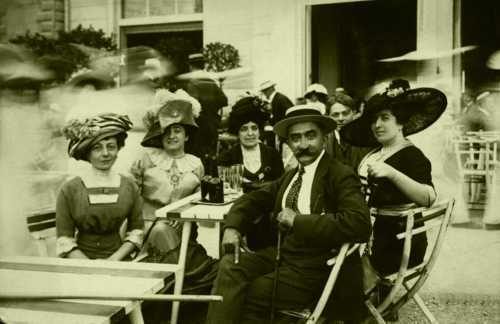


Mr. Harrington and his staff.


 As predicted in my last despatch, Europe has erupted into conflict.  Belgium and the Balkans have proved to be the main theatres of war.  

  The suggestion of less experienced, dilettante correspondents that a British force massing in Wales was poised to leap across the Channel proved far-fetched – that was a mere sideshow, easily rebuffed by the French.  The British fleet in the English Channel did have an effect though.  It resulted in the recall of the French fleet and prompted the Germans to march into Belgium ‘to keep the peace’.  Some will assume that England has worked hand-in-glove with the Germans or other powers.  Some will assume that those foolish reporters who trumpeted news of a cross-Channel invasion were victims of a clever bluff aimed at distracting the world’s eye from the Scandinavian Question.

 No less puzzling is what is happening in Southern Europe.  Russia and Turkey have long fought over the Crimea, but on this occasion they seemed to have missed each other completely!  Will either or both drive on into each other’s territory, or will they re-coup?  And what of Austria and Italy?  Either could prove to be the deciding ally in an Russo-Turkish War, but at what price?  Of the two, Austria may seems the weakest, but she is in the better position to wrest concessions from a suitor.

 Whatever happens, be assured that Your Man on the Spot – Ernest Harrington – will report!


KAISER DECLARES WAR!!! 


In a recent speech to the Weimar Women’s’ Guild His Imperial Majesty the Kaiser made the following declaration.


“It has long been the dearest wish of the German peoples – those within the current borders of our country, and our dear brothers and sisters living outside them – for a peaceful Europe.  We have a long martial history and we know, more than outsiders, what war brings to our doors.


“We will do all that will can to ensure peace!  Even now our trusted diplomats are working to forge lasting alliances.  But know this!  Woe betide those who take our hand in pretended friendship!  For those who betray us will feel the weight of our justified anger!


“As I speak, dear ladies, our troops – your husbands, your sons – have moved into Belgium to prevent that gallant country from being an arena for conflict between England and France.  But do not fear!  Those countries are our friends and We are sure that no such conflict will arise.  Our boys will be back before the autumn leaves fall!”


TERRIBLE NAVAL BATTLES IN CHANNEL, ADRIATIC!!! 
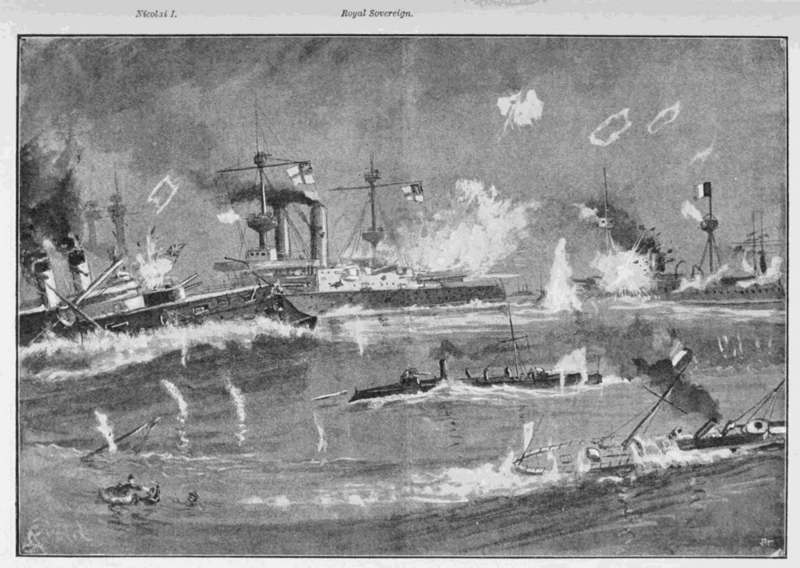


Our Artist’s Impression of the Battle of Brest


In a significant naval action in the English Channel, a British assault on the French port of Brest has been repulsed.  Following tensions raised by the movement of the British Expeditionary Force to Welsh ports, the British government declared war in all but name.   Ironclads of the Royal Navy exchanged broadsides with French coastal artillery, and succeeded in disembarking Marines and soldiers near the port of Brest.   Over the next week, however, France’s Army of Picardy and squadrons from the Middle Atlantic fought a sustained battle on land and sea before the British were forced to withdraw.  In the House of Commons, loud demands for the resignation of the government have paralyzed parliament, and the British media have criticized the government for a policy of “reckless adventurism”.


Meanwhile, Austrian and Italian spokesmen are being close-lipped about an incident in the Adriatic in November when the two countries’ navies clashed over several days off the Albanian coast.   While the engagement was considerable, it did not prevent the Reggia Marina from landing troops in North Africa.  Nevertheless, several light ships on both sides are said to be lost, and at least one capital ship is said to have returned to her home port of Naples with visible shell damage.     However, neither government has taken a hostile tone since the incident, and an unofficial source in the Austrian naval ministry blames an error in signalling.  “Our ships were ordered to fire a salute in honour of King Victor Emmanuel, and instead the order to Commence Firing was hoisted.  It was a terrible error, and we regret the loss of life.  The signalling ensign responsible has been tried arrested and sadly drowned in custody."
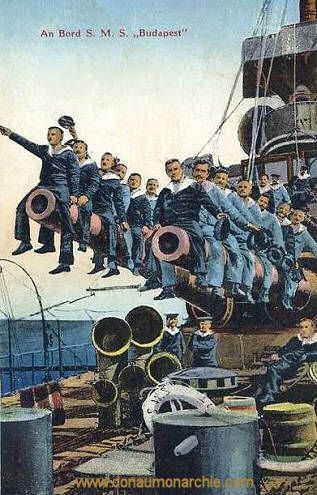


The Austrian Navy in happier days


Finally, naval experts are agog at the Turkish coup de main which seized the Russian Black Seas Fleet’s home port of Sevastapol.  Our in-house naval expert, Admiral Dred Knott, USN (Ret), told this paper that“We had no idea their ships were even seaworthy.  The Turks surprised us all just by getting up steam.  We really underrated them and it looks like the Rooskies did, too.”    According to one rumour, the bold stroke was made possible by an equally bold misinformation campaign by the Turks.   “The Fezzies seem to have spread the word that the Sultan’s harem was starting a European tour”, said Admiral Knott.  “Girls on boats.  Wouldn’t that be a sight, eh?  Heh heh heh.  Mmmmm  ...  hem hem.  But when the gangplank went down and a bunch of hairy bashi-bazouks poured off, that was quite a shock for ‘em.  Clever fellows, them Turks."


THE LAMPS HAVE GONE OUT, BUT THE FLAMES HAVE BEEN IGNITED: OUR EXPERT EXPLAINS
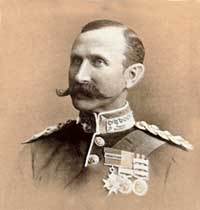
General Erasmus Blatt.

The editors are delighted that General Blatt, hero of the Empire’s campaign to subjugate the Midgets of M'bhutto, has agreed to provide commentary on the unfolding events in Europe.  General Blatt’s column is syndicated by the Rioters News Agency.
 

“The lamps have gone out, but the flames have been ignited!”

Commentary by General Sir Erasmus Blatt for Rioters Press.  January 1 1902.

The turmoil underlying the apparently serene opening to the European troubles as we entered the 20
th Century of Our Lord has broken out into a maelstrom so soon that even your correspondent is finding difficult to navigate.  

The Emperor’s plans have been sabotaged – whether or not with malice aforethought – by the Kaiser; Russia, after its apparently disastrous loss of Sevastopol might not be so poorly placed after all; France, without any loss to deplore, and a victory to its credit, might well be finding 1902 a more interesting year than is strictly desirable.  Turkey has made a solid beginning and pulled off a stunning coup de main as well, Austria-Hungary might feel some disappointment with its modest successes in 1901; Italy ends the year on a sound footing, and Germany?  Germany has confounded us all, with a brilliant seizure of the Low Countries in their entirety, but what is that Army doing in the Tyrol?

The Porte seems to be recovering some of the energy that fuelled the Ottomans’ former greatness.  To accompany a stolid slow absorption of Bulgaria, The Black Sea Fleet has seized Sevastopol, and left a Russian Army stranded in the mountains of Armenia. That guaranteed the Sultan two builds this winter: an Army recruited in Smyrna, and a reinforcement to the Black Sea Fleet.  Henceforth, the Russian Fleet will have its work cut out to maintain a presence in these waters.  Before turning to Russia’s position, this writer was a little surprised that an Army was raised in Smyrna, rather than a Fleet.  A Mediterranean Fleet (it seemed to me) would have offered the Porte a more flexible approach to the Balkans.  All the same, Turkey bids fair to become a major player in that part of the world.

Russia’s position is by no means as compromised as the loss of Sevastopol might suggest.  One begins indeed to wonder if there is a subtle and brilliant mind advising Russia affairs.  Matters have been so arranged in the south that Turkey cannot maintain its hold upon the Donbas and Crimea (i.e. “Sevastopol”).  Can Russia still hold Romania, then?  That remains to be seen.  If the Sultan and the Emperor are in cahoots, the Tsar will not long retain control in the south.  But it is clear that he will get Sevastopol back in the spring.  Turkey can not hold it.  Perhaps there was never any expectation that it could.

One observes the building of the Fleet at Murmansk (St Petersburg, North Coast) with considerable surprise, having expected an Army to be raised at Moscow.  To be sure, an Arctic Fleet makes sense, but unless he is planning to strike at once to seize Norway… Ah! There we have it.  There have been persistent rumours of a sage head upon young shoulders, a junior official in the Foreign Office, a certain Vladimir Putin, having the ear of the Tsar.  England is in no position to defend Norway in the spring, nor, in all likelihood, to recover it in the following autumn.  With such slender resources, Russia seems poised to strike England a mighty blow.

Now, with whom has Russia reached an accord?  If with Germany, a certain move by one of the Kaizer’s Armies begins to make sense.

In an earlier commentary, I remarked that what appeared to be differences of opinion between England and France were likely to redound the advantage of Germany.  So it has proved.  Distracted from carrying out its traditional plan of securing Belgium as well as the Iberian Peninsula, La Republique could manage but one build going into 1902.  Given its successful repulse there of the attempted invasion by a British Fleet, the raising of a second Fleet in Brest might not have been the wisest course.  An Army in Paris would have been the more flexible option – unless France has good reason to place the highest level of trust in Italy’s resistance to temptation.  There is some very low hanging fruit in Marseilles.  Italy has merely to stretch forth its hand, and Marseilles may be plucked.

England’s aggression against France has yielded the Island Nation few dividends.  Norway has fallen to her lot, as anticipated, but the fleet occupying that country is isolated, without hope of support until the second half of the year.  Russia is well placed to exploit that very circumstance.  Indeed, that the Tsar is planning the occupation of the whole of Scandinavia north of the Skaggerak is the sole explanation for his raising an Arctic Fleet.  Once in Norway, Russia’s Arctic and the Baltic Fleets will be mutual supporting, and not to be dislodged any time soon.

So much for the edges of the Pan-European strife.  Now for the Central Powers.  Germany has done very well for itself in conquering the whole of the Lowland  States.  Unoccupied as yet, Denmark will enter Germany’s growing hegemony during 1902.  But a large question mark raises itself over why a German Army entered the Tyrol.  Had it invaded Burgundy instead, then, together with Italy and possibly England, Germany might have been able to pick over France’s bones.  Closer investigation, however, suggests that Italy stood to gain most from such an alliance, and even England might have benefited more.  

But what lies behind the Tyrol invasion?  There was never much hope of seizing Vienna, nor yet Venice.  One feels that Germany has some, so far secret, deal with one of the Asiatic States: the Turk, or the Muscovite, most likely the latter.  The Army in Tyrol is intended as a distraction to the Hofkriegsrat Oesterreich, keeping Austria’s armed forces away from Russia’s borders.  

It is not altogether inconceivable that, if talks haven’t taken place already, the Eastern Powers might patch up their differences, end the Black Sea war, and divide between them the Balkans and the Austria-Hungary Empire.  Germany might be rewarded with Vienna. Italy, if it is part of this alliance might receive the long-coveted Trieste.  I don’t really think whatever agreement exists in the East extends quite so far west, but it is not impossible, nor even unlikely.  Be that as it may, it is clear  that more than one pair of hungry eyes are fixed upon the  Austria-Hungarian Empire.  

The Kingdom of Italy finds itself, without at all overextending its resources or straining towards the unachievable, in an immensely powerful and influential position.  Marseilles is there for the taking, and will be held through to the fall.  Furthermore, Italy has as much chance of seizing Greece as has Austria-Hungary, by, say convoying the Tunisia Army thereto.  But will Italy want to do that?  Italy might prefer, indeed, to support and Austrian Army there, leaving the Empire to form a bulwark against Turkish expansion, whilst Italy pursues a westward policy.  If England, and possibly Germany, can be induced to apply pressure from the north, there is no reason why Italy might not conquer the Iberian Peninsula and become Master of the Western Mediterranean.

The turbid surface of European affairs hides, I think, even more tangled webs of subterfuge lying beneath.  One suspects that behind England’s opening moves has been the Kaiser’s honeyed words and poisonous intent; that Germany and Russia have at least a covert ‘understanding’ if not a formal alliance of a aggression; that Turkey and Russia might possibly be playing a double game of deceit to mask their real policies.  It is not beyond the realms of possibility that Austria-Hungary has been marked out for dismemberment by the four surrounding powers.  Urgently needing friends are France and Austria-Hungary.  France won’t find one in Italy, and will have to look north. England is as parlously placed, and Austrian-Hungary will have to do some very fast talking with Italy and at least one other of the surrounding Powers.

1902 is shaping up to be a very interesting year


Sir Erasmus Blatt
 

AMERICA’S GIRL REPORTER ARRESTED IN PARIS!!
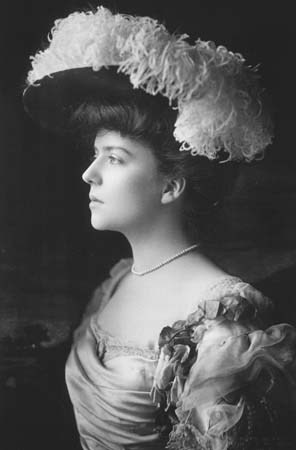

Miss Amelia Roosevelt.

Reports from Paris indicate that our reporter, Miss Amelia Roosevelt, and her governess, Mme. LaBonq, have been arrested in Paris.   French gendarmes confirm that the duo were taken into custody when the morality squad conducted a raid at a well known nightclub in the Moulin Rouge entertainment district.   The authorities gave no reason for the arrest, but noted that the two women were dressed as showgirls and could not verify their identities when the club was raided by police.  One source in Paris expressed surprise to us, saying that “I was shocked that the French have a morality squad!.


Le Chic Chat, the nightclub where Miss Roosevelt was arrested.  The editors deny that publishing this image is in any way gratuitous.

The editors are sure that Miss Roosevelt’s reputation and integrity, as a representative of both this fine journal and of American femininity, are intact and above reproach.   Our Parisian lawyers, Messrs. Chirac, LeHacque, and LaWacque, expect to file a demand for her immediate release and the dismissal of all charges, since Miss Roosevelt was in Paris for the sole reason of pursuing her journalistic duties.

LETTERS TO THE EDITOR
 
Dear Sir:
 
I think it is just marvellous that your staff includes Miss Amelia Roosevelt.   In this day and age, when women are coming into their own, it is high time.    All of my sorority at Radcliffe follow her exploits with the greatest admiration.  Why just the other day we were discussing her exploits last year, like, when she went in disguise to foil the White Slavers of Zanzibar and the foul Count Orloff - I mean, that guy was a disgusting creep!  So gross!   But, we think it a great shame that you use Miss Amelia to encourage the fairer sex to buy your paper, which, like, we totally do, but you have TOTALLY avoided the issue of our time, which is Votes for Women.   Come on, DD, do the right thing!  You know Miss Amelia would agree with us!
Sincerely, 
Sally Suffragette from Sewanee

Dear Sir:

I am quite livid at the shocking bias your paper shows to Germany.  It seems like every edition there is a favourable mention of that tinpot tyrant, the Kaiser, and his latest lurid pronouncement.   The Hun’s annexation of the Low Countries is a huge security threat.  If America does not support Britain, our most loyal and truest friends and cousins, then she will fall, and then what?  The Kaiser’s warships off Manhattan, goose steppers in Times Square, and mandatory Kraut lessons for our kids!  And where will your precious freedom of the press be then?  It’s time the DD stood for Britain and a sensible foreign policy and supported Donald Trumpett’s call to build a wall on the coast - an Atlantic Wall to keep out the Germans!
Yours,
Britlover in Boston
Monday, February 22, 2016

Solo Scharnhorst 3 - The Battle of Karseck-Kaltenbach Begins

On Day 2 of the campaign, Marshall Kurvi-Tasch, the Austrian CinC, had identified, with a high degree of probability, the presence of Napoleon and his Guard in the town of Karlseck.  With Groll’s report of a French corps some distance to the West, the Marshall felt that he could concentrate his forces and crush Napoleon, outfoxing the fox at his own game.

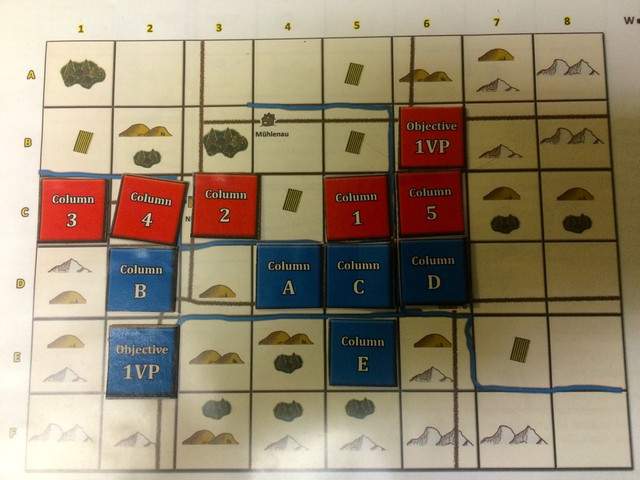
To that end, he gave orders that the light infantry division detached from his own force and shown below as Col 5, would remain in front of Karsleck while he shifted his own Corps (1 infantry and 1 cavalry division) W following the road to B5 and then south to C5, to allow Groll (Col 2) to link up with him.   The Austrians won the initiative on Day 3 and Col 1 executed these orders.  It discovered Col C (Napoleon with the Guard and a cav division) at D5 while the Grenzers of Col 5 reported that another French Corps was moving into Karseck.   That was all the information K-T needed.  Stroking his luxuriant whiskers with satisfaction, the Marshall declared a Battle, since he occupied the centre position at C5.  The squares for the battle, meaning the landscape of the tabletop, would be C4-6 and D4-6. Austrian Cols 1,5 and French Cols C,D will be frozen if Napoleon accepts the battle (he has one chance during the 5 days of Scharnhorst to refuse a battle, at a cost of Victory Points).  The Emperor accepts the battle.

All Columns not frozen now have a chance to reach the battle.   The French turn is next, and Col A (Moisan’s Corps, an infantry division) marches E from D3 to D4.  It has to pay one if its 6 movement points to disengage from the Zone of Control of Col 2, but that leaves it more than enough MPs to arrive on the battlefield and take up position on Napoleon’s left wing.

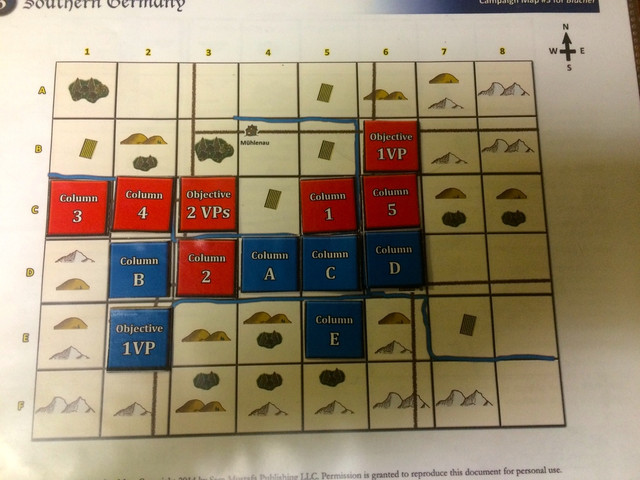
Now it’s the Austrian’s turn to move unfrozen columns.  Groll (Col 2) and his substantial Corps (2 infantry and 1 cavalry division) know that there is French cavalry (Col B) in D2.  He then orders his Corps to move one square south to D2.  This has two results.  First, Groll will be able to arrive, at some point, on the battlefield as a reinforcement.  However, it poses a problem for Col B.  In Scharnhorst, Columns may not move diagonally.  Col B, which is the best of the French cavalry units, four brigades of heavy cavalry under Marshall Noel, is now cut off from the battlefield.  It doesn’t have the MPs to disengage from the ZOCs of Cols 4 and 2 and reach square E4 to arrive as a reinforcement.  It is out of the battle.

The best French move now is to leave ColB in place.  Col 4, the light cavalry division under Sachsen, does have the MPs to disengage from Col B’s ZOC and march C3 C4 to reach the battlefield, across from Moisan (Col A).  However, the Austrian Col 3 (an infantry division of 4 brigades under Von Lunenburg) will also miss the battle because it doesn’t have the MPs to reach C3 as a possible reinforcement.  Being south of the minor river at C1 really hurts C3.

Here is one satisfying aspect of the Scharnhorst system, in that one can draw up two armies using a points system and, if the points are equal, one can expect an equal contest,  However, with this battle, of the 400 points allotted to both sides, not all of those troops are guaranteed to make it on to the table, so one has a good chance of an asymmetrical result, if one likes that sort of thing.


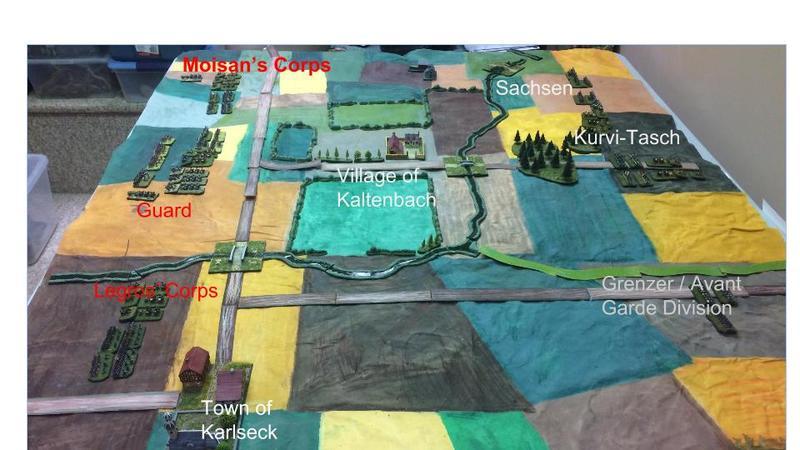
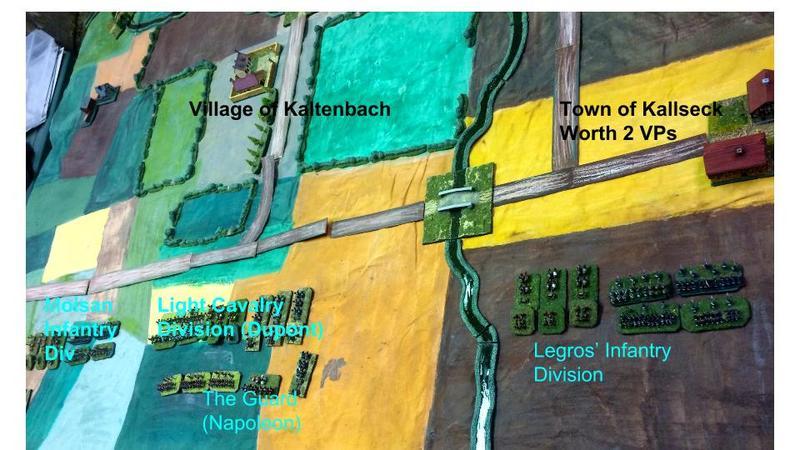
The battle commences on the dawn of day 4.  Here is the deadly field of Karlseck-Kaltenbach.  This battle marks the first official use of my groundsheet, a mix of acrylic craft store paint and artist’s pastel crayons, treated afterwards with artist’s fixative.  The roads are all handmade, using balsa or cardboard coloured with pastels.   At the bottom left is Karsleck, and the village of Kaltenbach is in the centre.   This battlefield corresponds to the six squares of the Scharnhorst map of S Germany mentioned above, with some randomized hills thrown in.

I need more trees.  As you can see, I had to quickly make some river sections (more cardboard coloured by pastel) to provide the rivers required by the Scharnhorst map.    The hedge sections are resin, from Timecast.

 A view of the French side.  Players of Blucher will notice that I am using my batteries to form units, despite the advice of some wise readers, such as Kaptain Kobolod, to fold them into individual brigades.  However, if I did that, I wouldn’t really be able to use my artillery and limber models, would I?  

I forgot to note that Kaltenbach is worth 1 VP.   It was a bit laborious labelling these photos on my Mac.  I had to use Google Slides to caption the photos, and then export them to my laptop so I could upload them to Imageshack.  I need to research better photo-editing tools for the Mac.


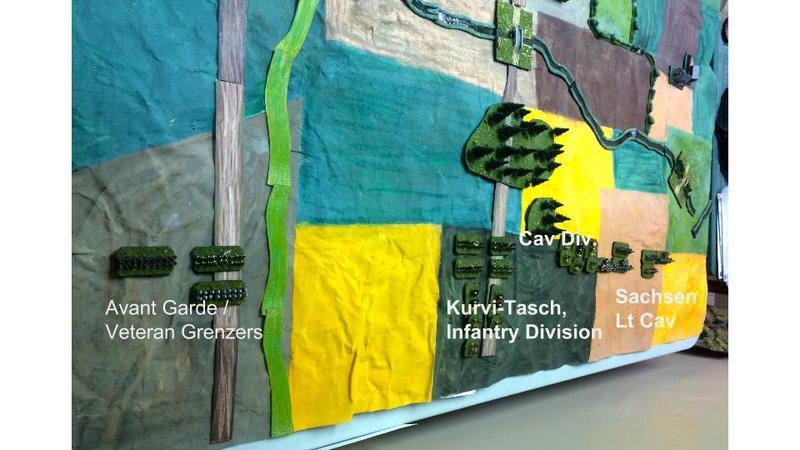
View from the Austrian side.   Kurvi-Tasch has lots of cavalry, and he has three more divisions that at some point will show up on Napoleon’s left flank, so he’s in a pretty good spot.   He doesn’t know yet what the French have in the way of reinforcements, or that Napoleon can only count on one infantry division possibly coming to his aid.  The Emperor has a very real chance of his flank being rolled up from left to right.

We shall see what transpires.  It may be a bad day for the French, if the Austrians get lucky and Groll’s II Corps enters the table early on. Will the Emperor try to refuse his left flank, or will he seek to savage Kurvi-Tasch’s I Korps before it can be reinforced? 

Sunday, February 21, 2016

Diplomacy Game: 1901 Builds Complete

Hello Diplomacy Fans!

At the end of two turns, with most of neutral SCs pocketed and the some players already nibbling on one another, here are the builds at the end of 1901.

France, Germany, England and Austria are launching warships as fast as they can.   The Royal Navy will need some the help of some agile diplomacy if it is going to fend off all the menaces it faces, while the Balkan situation is too complex to predict.


Results for Fall, 1901 (Adjustment)


General Notices:
Order resolution completed on 21-Feb-2016 at 09:09:48 EST


Order Results:

Austria:

Austria: Builds A vie


England:

England: Builds F lon


France:

France: Builds F bre


Germany:

Germany: Builds F kie

Germany: Builds A mun

Italy:

Italy: Builds A ven

Russia:

Russia: Builds F stp/nc


Turkey:

Turkey: Builds F ank

Turkey: Builds A smy

Wednesday, February 17, 2016

Diplomacy Game 2016 - Fall 1901 Turn Results

All hell broke loose this turn.   Some daring moves were rewarded (viz the Turkish fleet in Sevastapol), the German annexation of the Low Countries, and a very strong Austrian push south.

At the same time, England’s descent on Brest has been frustrated, though La Republique may be worried about the Italian army threatening Marseille, even as Italia looks worriedly at the Germany army in Tyrolia.  

An interesting end to the first year.


Results for Fall, 1901 (Movement)


General Notices:

No retreating units; retreat phase skipped.Order resolution
completed on 17-Feb-2016 at 12:29:11 EST


Order Results:


Austria:

Supply centers were gained. Units that may be built: 1.

Austria:

F adr - ion  Bounced with ion (1 against 1). ;  A bud -ser; A ser - alb


England:

Supply centers were gained. Units that may be built: 1.

England: F eng Convoys A wal - bre;   F nwg - nwy;  A wal - bre Bounced with pic (1 against 1).

Convoy path taken: wal - ;engc - ;bre. 


France:

Supply centers were gained. Units that may be built: 1.

France: F mao - bee Bounced with wal (1 against 1). 

France: A pic - bee Bounced with wal (1 against 1). 

France: A spa - por


Germany:

Supply centers were gained. Units that may be built: 2.

Germany: F hol - bel;  A kie - hol; A mun - tyr


Italy:

Supply centers were gained. Units that may be built: 1.

Italy: F ion Convoys A nap - tunI; A nap - tun Convoy path taken: nap- ion - tun.

Italy: A tus - pie


Russia:

Supply centers were gained. Units that may be built: 1.

Russia: F bot - swe; F rum Holds; A sev - arm;  A ukr Supports F rum


Turkey:

Supply centers were gained. Units that may be built: 2.

Turkey: F bla -  sev; A bul Holds; A con Supports A bul


Blog Archive

Followers