Friday, May 1, 2015

Worst Range Day Ever

I’ve been dropping off library books as I prepare to leave university and go back to work, and one of them was Charles Esdaille’s The Penninsular War (Palgrave 2003), which is a grand and detailed reference that I’d love to have in my collection.

I couldn’t drop it off without re-reading my favourite paragraph, in which Esdaille describes the particularly bad quality of the troops that Napoleon had on hand when he first invaded Spain in 1808.   Max Foy described the army as being thrown together of inexperienced men and bits and pieces of units.  “Unacquainted with each other, unknown to their officers, whose names, even, they knew not, taken little care of, badly subsisted and irregularly paid, [the soldier’s] existence as fluctuating and precarious, like that of the ephemeral corps of which they formed a part”. 

It was a dangerous army to lead, as Blaze (Memoires d’un Apothecaire sur le Guerre dEspagne) described.

“On the fifteenth of March, we held exercises on a plain outside the town [of Valladolid], and General Malher was killed by a ramrod that a soldier had foolishly left in the barrel of his musket.  An immediate inspection was carried out to discover the … culprit: eighteen ramrods were missing from the section of the line the shot had been fired from."

The unfortunate General Malher.

This story is especially tragicomic because Jean Pierre Firmin Malher was, by all accounts, a distinguished soldier. Here’s his bio from the Arc de Triomphe website.

 Jean-Pierre-Firmin Malher first enlisted in the army in 1777, and then two years later he served on the ship La Couronne. After the Revolution began, in October of 1789 Malher joined the National Guard of Paris. In 1792 he joined the 14th Battalion of Light Infantry, served with them in the Army of the North, and was commissioned as a sous-lieutenant. The next year he was promoted to lieutenant and became an aide-de-camp to General Queyssat. Malher continued to serve with the Army of the North and in 1794 he was promoted to chef de brigade and became the chief of staff to General Bonnaud's division.

Malher's next major command came in September of 1799 when he became Vandamme's chief of staff in the Army of Holland. The next month he served at Castricum, was promoted to général de brigade, and joined Boudet's division. In 1800 General Malher joined the Army of the Reserve in Watrin's division, and that May he seized Aoste and fought at Montestrutto, Ivrée, and Chiusella. In June he fought at Montebello and then was wounded at Marengo. That November Malher returned to Paris.

During the years of peace that followed , Malher was employed in the 24th military division and he received a promotion to général de division in 1803. In 1804 he went to the camp of Montreuil and took command of the 3rd Infantry Division that would become part of Marshal Ney's VI Corps the next year. Malher led his division throughout the campaign of 1805 and fought at Gunzbourg in October. On Christmas Day of 1805, Malher was made a Grand Officer of the Legion of Honor.

The next year, a few weeks into the campaign in Prussia, General Malher was replaced in his command by General Vandamme. In 1807 Malher was employed in the interior and then given command of the 13th military division at Rennes. That November he took command of the 3rd Division of Dupont's II Corps. Traveling with the army into Spain, Malher and his men were at Valladolid in March of 1808. Malher was participating in a training exercise when a soldier fired his gun but had left his ramrod in the barrel. The ramrod flew out of control and through Malher's skull, killing him.


Where’s your ramrod, son?  It’s in his head, innit?

 Poor man, he deserved better than a ramrod through the skull.   One wonders what happened to those eighteen soldats who had fired off their ramrods.

I might have caused a similar incident at a range day.  On my first field exercise as a padre to my first regiment, the troops were working in pairs firing live ammunition with the C7 (Canadian version of the M16 assault rifle) while working through a course with pop-up targets.  The Major in charge wanted me to take a rifle and go through the course with him.   As a chaplain, I am strictly required to be a non-combatant, and it had been many years since I had handled an FN rifle, the predecessor of the C7.   It would have been so easy for me to accidentally kill the Major or someone else, so I politely declined.  I also declined his suggestion that I serve as a Range Safety Officer, for similar reasons.   That Major was fortunate not to share the fate of poor General Malher!

Thursday, April 30, 2015

Problematic Political Games

Game designer Brian Train is a guy I have a lot of time for.  I’ve mentioned his epic board game on the contemporary war in Afghanistan, A Distant Plain (ADP), here previously.    Another of his titles, Fire in the Lake, on Vietnam, is on my shelf waiting for a chance to get into it.  Both titles were designed by Train and Volko Ruhnke, and the two bring a ton of real-world and gaming knowledge and experience to the table.

On his blog recently, Train points to an article in the UK newspaper The Guardian which includes ADP within the subject of political games.  Unfortunately the article gives about as much coverage to a complicated subject as one could expect from a mainstream media piece - too little.  The Guardian reporter, Matt Thrower, has an angle he wants to take on the subject, and it’s clear from his first paragraph, where he talks about playing a terrorist faction in another Ruhnke title, Labyrinth, the War on Terror (GMT 2010).  Thrower describes playing a card, “Martyrdom Operation”, and then realizing that the card’s “clinical euphemism” simulated the killing of “dozens of innocent people.  I felt so sick I had to walk away.  A physical reaction from a mind game”.  

It doesn’t help that the article begins with a stock photo of a game of Risk and a caption describing Risk as a game that “gives players a chance to affect world politics”.   The article goes on to shoehorn in another “game” designer, Brenda Romero, whose “Train”, about the logistics of transporting people to Auschwitz, is to my mind more a piece of performance art than it is a conflict simulation.  As Brian Train notes in his post, the Guardian article shows the limits of media in a soundbite culture, where the focus (and I find this especially maddening listening to radio interviews by BBC journalists especially) is on the reporter’s own gut reactions to something.

Interestingly, Richard Clarke of Too Fat Lardies posts some related observations on his blog after debuting his new Afghan miniatures rules, Fighting Season, at Salute.  As Clarke notes, one punter felt that Afghanistan was not a suitable subject for wargaming, whereas a senior British Army officer felt that the rules would be useful for training platoon leaders.   “Square that circle if you can”, Clarke says.  I recommend Clarke’s post as a thoughtful defence of why someone might want to game this aspect of modern warfare.   

Personally I find the idea absurd that gaming modern warfare is any more ethically questionable than gaming wars of past centuries.  I don’t see how simulating a roadside IED going off is any more horrific than simulating the effects of canister on formed infantry.   If the argument is that gaming modern warfare might offend living veterans (and I have yet to hear of a veteran being offended by an Afghan game), I think it’s odd that we don’t mind simulating the experience of dead veterans.  We don’t worry about the sensibilities of Roman legionnaires, since they aren’t around to register their offence.   It seems more than a little hypocritical to me.  For my own tastes, I would rather play Train’s A Distant Plain, since I find it has more to teach me about contemporary warfare than a skirmish game like Fighting Season where ISAF is dodging RPGs and hunting insurgents.   The former is interesting to me, the latter, not so much, but that’s just my mental wiring.   Horses for courses and all that.  For folks who want to play games like FS or Skirmish Sangin, like my friend Rabbitman, more power to their arms as long as they do it thoughtfully.

It seems to me that as war gamers, whatever the medium of gaming we favour, we have an opportunity to go deeper into our subjects and think about them from a variety of levels - tactics, strategy, history, politics, ethics.   All of those learning opportunities are there if we want to pursue them.  It’s a pity that the Guardian article missed this complexity.

MP+

Monday, April 27, 2015

A Kind Gift of Nasty Orcses

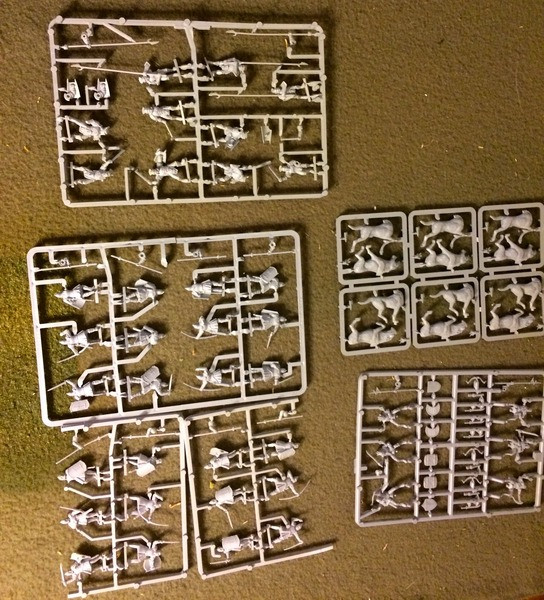
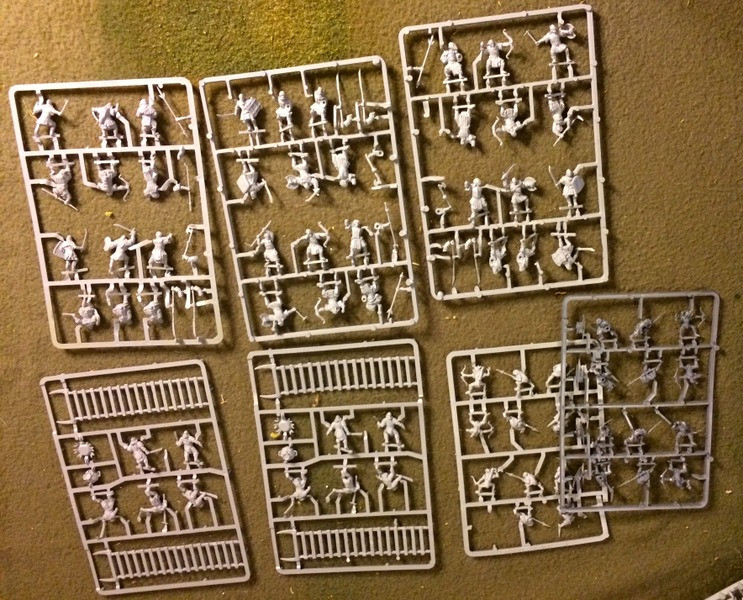
Chris Stoesen is a good chap.    He’s a talented historian and scenario designer, runs an eclectic and interesting blog. and a budding author.  He’s also a kind fellow.   A while ago I did Chris a very small favour, and he mentioned that he’d send me some surplus GW Lord of the Rings figures, since unlike me, Chris has wisely decided to limit himself to certain periods and scales.   I was expecting a sprue in the mail, and was quite surprised to get a box full of plastic goodness.

Some men of Gondor and warg riders.

 Some rather rare Uruk Hai siege and assault troops, as well as Mordor orcs and some goblins.

And three stalwart Rangers of Gondor.

Longtime readers of this blog know that I have a soft spot for the GW LOTR line and while I don’t care for the GW rules, have wanted to do the War of the Ring on a large scale.   Chris’ very kind gift gets me a long way towards doing that.      In a recent post, young Kinch described getting a similarly kind gift and used a phrase I quite like:  “The freemasonry of the hobby working its magic yet again”.   I have experienced many acts of kindness from war gamers and bloggers over the years, and continue to marvel at how kind we are to one another.   Thank you, Chris.

Blessings to your brushes and die rolls!

MP+

Saturday, April 25, 2015

First Game, First Thoughts on Blucher

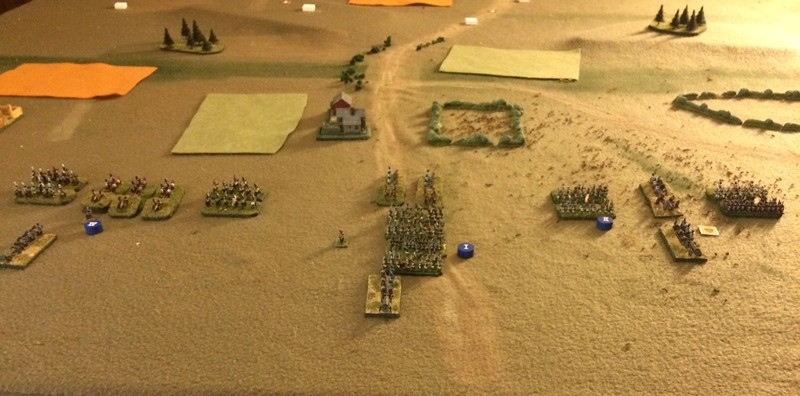
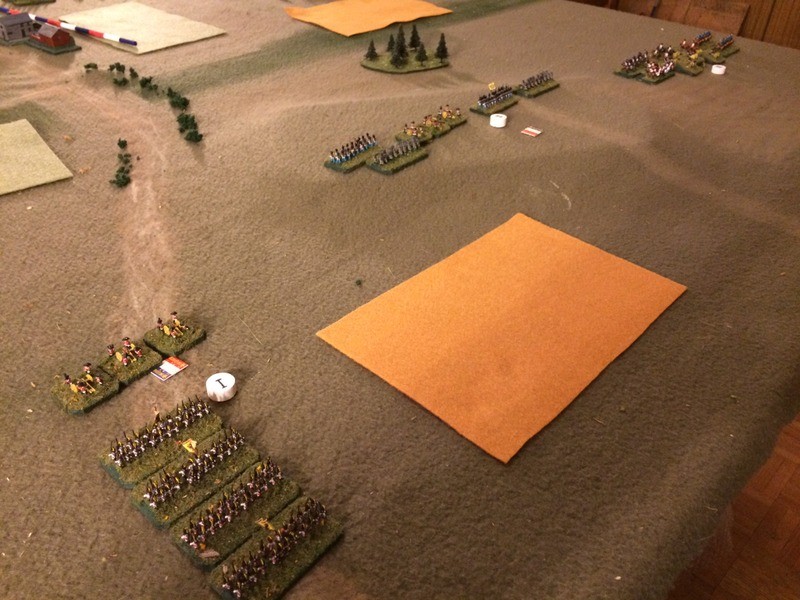
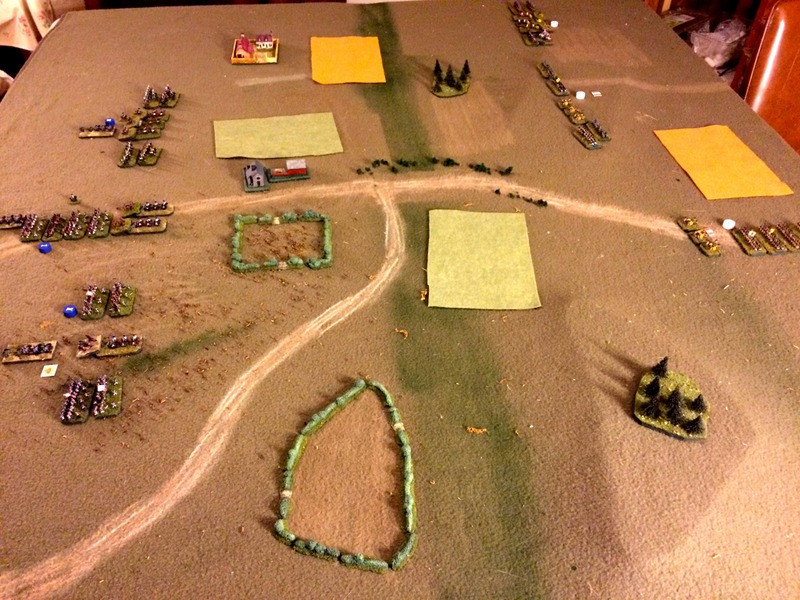
Last Tuesday I posted the start of my first game of Blucher, the Napoleonic rules from Sam Mustafa.   I had gotten as far as the initial setup, which is shown here in the first photo.  Two equal forces of 200 points, French on the left, Austrian on the right.  Both armies are organized into three corps each, two of infantry (four brigades plus an artillery unit) and one of cavalry (two light and two heavy brigades plus a horse artillery unit).  Both sides have one commander and one sub-commander.  The Austrians have to hold the road towards their table edge, plus the hill on the top of the picture.  The Austrians have one quality corps of four grenadier brigades (I Korps on the road) and one of two line brigades and two Grenz conscript brigades (II Korps on the hill).

 Both forces were generated from the Army Builder lists in the Blucher rulebook.   I could have created an historical battle but will save that for another day when I have more time for research.

I used the standard game clock of 30 turns.  Blucher is played in alternating turns, so each side gets 15 turns to achieve its goals.
And we’re off.   The French i Corps in the centre gets most of the initiatives for the first turn and marches at the Austrian centre.   What I quickly discovered is that even with a relatively small force, it’s hard to achieve your goals each turn.   Blucher uses a system of Momentums or MOs, which are generated by rolling 3d6 to generate the number of MOs a side gets per turn.  In a two player game, the passive player rolls the dice and keeps the total number of MOs secret from the active player.  The active player has to decide first which units in his Corps he will move (it costs one MO per unit in a Corps that wishes to move or fire), then decides if he will move or fire any units not part of a Corps (2 MOs per unit), then which units he will activate with his Army Commander, something you would only want to do if you had units from several Corps that were intermixed and you wanted to be sure of moving them in a single turn.  The problem for the active player is that he doesn’t know how many MOs he has at the start of a turn.  The passive player keeps track of the MOs being spent and then informs the active player when he’s done, which might come as a shock.  This means that in a two player game the phasing player can never be sure if he has enough MOs to achieve his goals for a turn, which could be quite suspenseful.

For a solitaire game, the problem is figuring out how to achieve a similar effect.  After a few turns of just rolling all the dice and the portioning out the total to my units as I wanted, I decided I was going to allocate dice to corps before rolling them.  For independent units (the French had one independent artillery unit) I would allocate the pips to that unit from whatever the total rolled would be.  This way, if I rolled a dice and had more pips than a corps needed, too bad, they were wasted for the rest of the army.  If I had less pips than the corps needed, also too bad.  If I wanted to be sure a corps got to act, I allocated it two dice knowing that that would sacrifice the actions of the other corps for that turn.
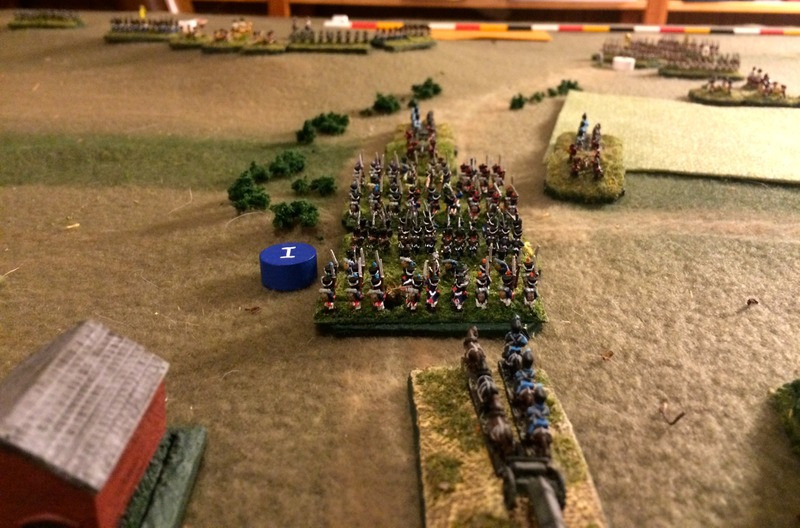
General Kurvi-Tasch watches from the II Korps position in the Austrian centre on the Plotzen Heights.    At this point I realized that I was using a table 6 foot wide by 5 foot deep, with 6mm figures.  Given that an infantry move using my base width system was 60mm a turn, that would take a long time to get into contact.   I decided that I would adapt the Blucher rule for Reserve Moves, which allows units that begin while Concealed to move 12 BW, provided that they do not come within 4BW or are observed by an enemy unit.  I decided I would borrow from other rules that allow for some sot of enhanced grand tactical move provided that they do not come within range of the enemy.  I allowed all units to use Reserve Movement provided that they did not come within artillery range (8 BWs) of the enemy.  Once units came within 8BWs of the enemy, they had to stop and used normal movement from then on.
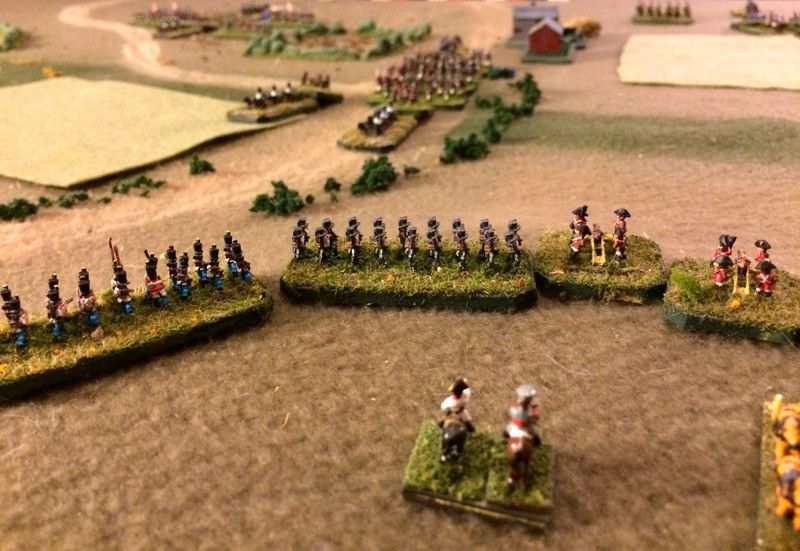
Guns of 1 Korps on the Austrian left open fire.  Here I quickly discovered that counter battery fire in Blucher is a vain hope.   The number of dice artillery get to fire depends on their ammo level.  Most artillery units (which are the same as grand batteries) start with 5 dice, then get two turns of 4 dice, then 1 of 3 dice, then 2 of 2 dice, at which point they are out of ammo and leave the table.  Artillery dice are halved firing against other artillery.  As with all fire combat, only sixes hit, though heavy artillery get to count one 5 as a hit.   It takes two hits to drive an artillery unit off the table, while only one hit forces artillery to retreat.   Here the 1 Korps guns waste their best dice shooting at the advancing French artillery, while the grenadier brigades deploy behind the guns.
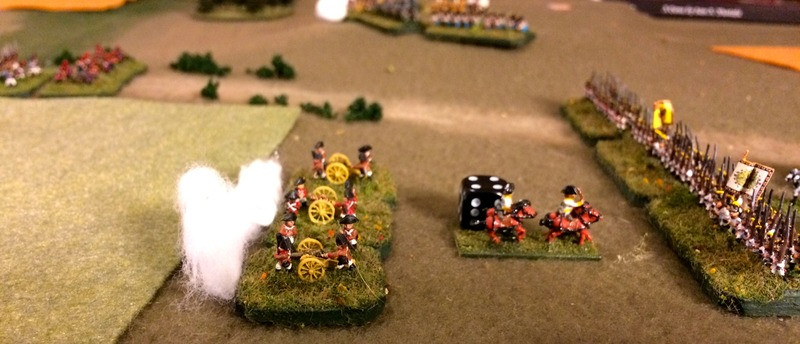
I Korps guns score a hit on the advancing French infantry of 1 Corps.   I used blue micro dice to indicate hits on infantry and cavalry units.   As Mustafa writes in the rules, casualties in Blucher are attritional.  Units are rated by élan, ranging from a starting score of 7 (elite) to 5 (conscript).  Once a unit falls to 0 élan, it breaks and is removed from the table.   Broken units count towards an army’s demoralization level, which is one third of the starting total of cavalry and artillery units.
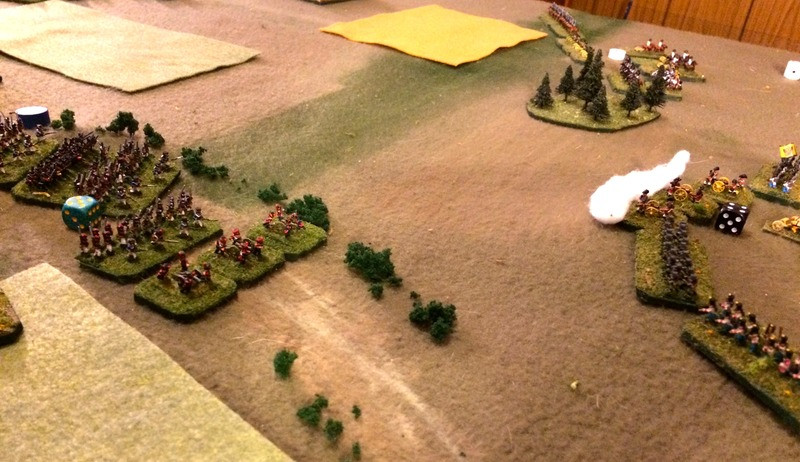
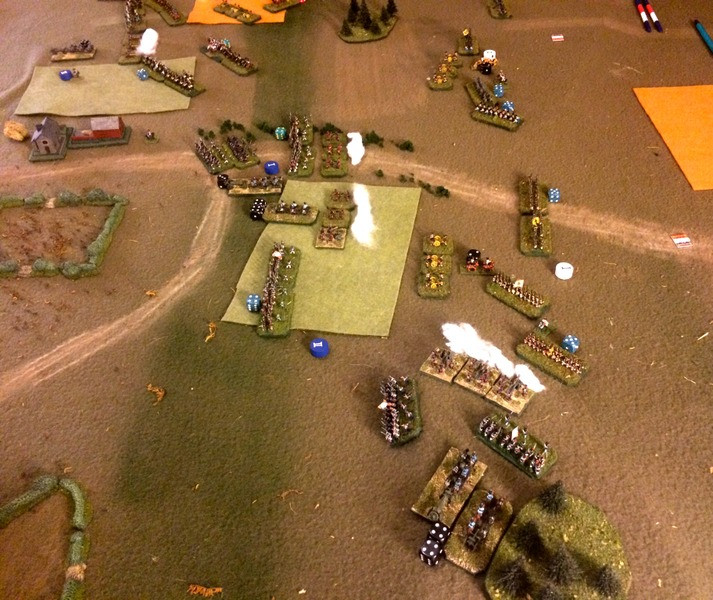
The situation at midmorning.  The French have had some very poor MO roles,  so the 1 Corps attack on the centre has not really advanced.   The two cavalry corps face each other at the top of the picture.  By leaving the southern hill of the Plotzen heights unoccupied, the Austrians may have given the French an opportunity.
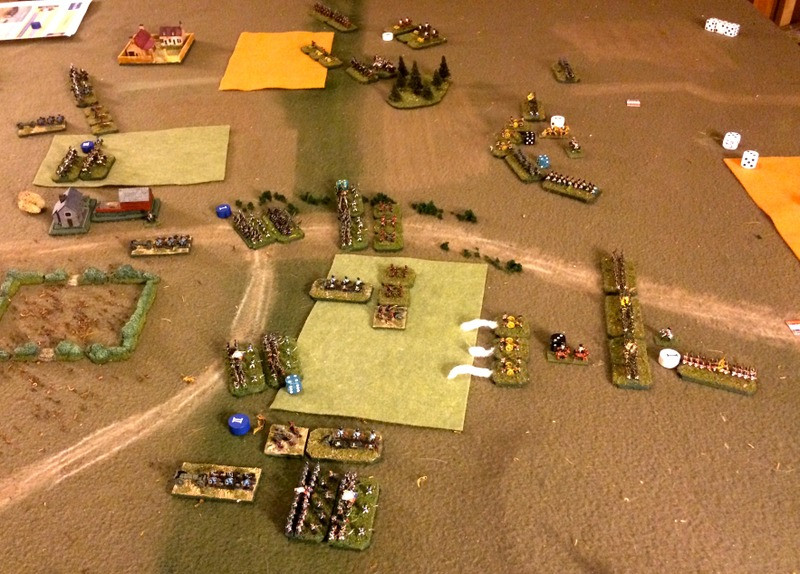
By noon the French attack is developing.   All four French artillery units fire in the same turn.  Two of the Austrian brigades holding the Plotzen Heights have been battered by artillery, and withdraw behind the crest   The French have gotten I Corp’s artillery onto the southern hill, before the Austrian grenadiers can get there, and fire a blast of canister into the oncoming Kaiserlichs.  Meanwhile, the Austrian cuirassiers advance and take some damage from the French horse artillery as they do.
Ouch.  Poor grenadiers have fallen to five élan and haven’t even gotten to the top of the hill.
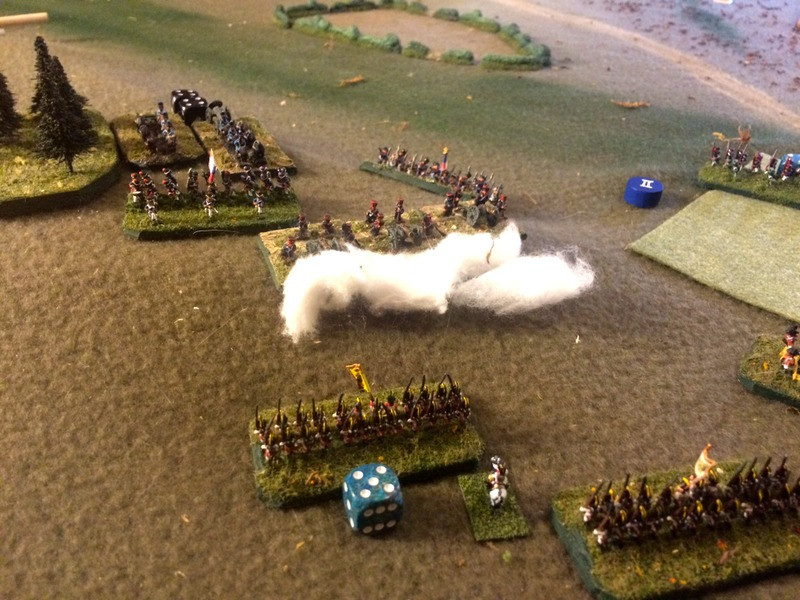
The grenadiers press forward for the melee combat.  Melee, like fire combat, depends on the élan level of the attacking and defending units, which determine how many dice they get to roll.   Since artillery units don’t have élan, their dice in combat depends on their ammo level.   Here the 1 Corps artillery has ammo level four, so they will get 4 dice in the coming melee.

A bad outcome for the Kaiserlichs.   Normally the Austrians would get an extra dice for being a shock unit as grenadiers, but since they are attacking uphill they lose a dice.  The result is a tie, which means they lose and will have to retreat.   All attacking units, win or lose, drop an élan level because they have attacked.  Defending artillery in melee combat lose an ammo level.
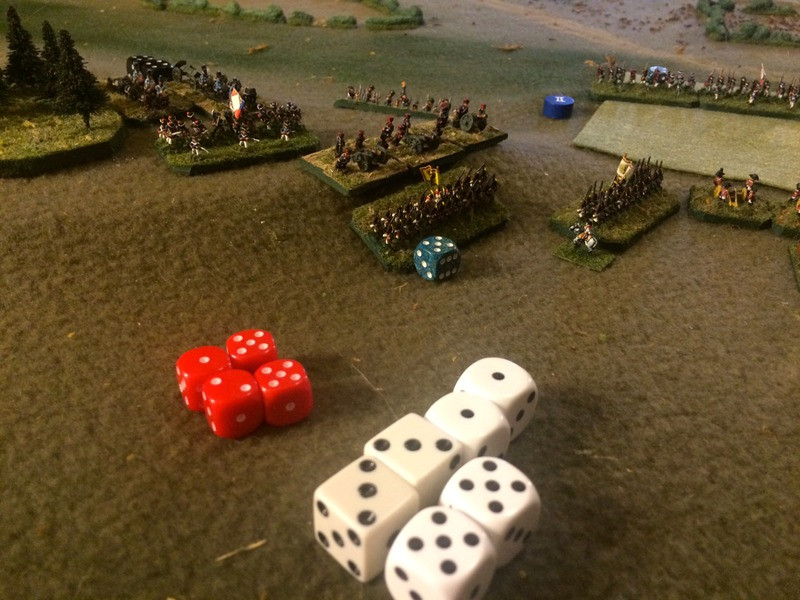
Another example of melee combat in the developing cavalry duel.  The Austrian hussars are rated as elite (7 dice) against the French hussars’ six, but the Austrian roll isn’t that great (only 4s, 5s and 6s count in melee combat).  Both sides lose en élan level (defenders lose élan levels equal to the difference between the attacker’s and defender’s score).
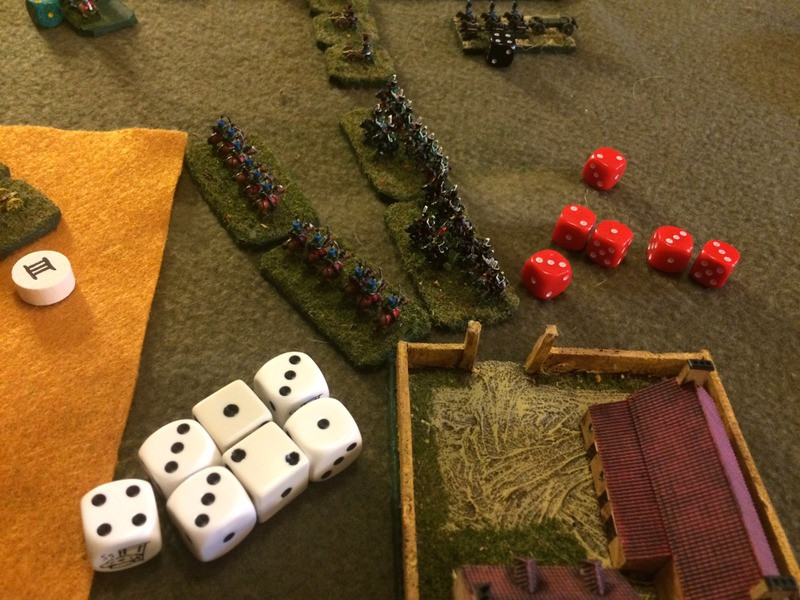
Cavalry battle develops.   It hasn’t gone well for the two brigades of Austrian cuirassiers, one of which (bottom left of photo) is down to 2 élan and is retreating in the hopes of retiring from the battle.   In Blucher units can be retired voluntarily from the table if they are more than 2 BWs from an enemy unit, which means that depleted troops can be removed from play before they break and count against your demoralization total.  The downside is that you lose if you have more voluntarily retired units than you have units left in play.  I hope you all go oohhh and errr at that incredibly sexy measuring stick in the top left of the photo!
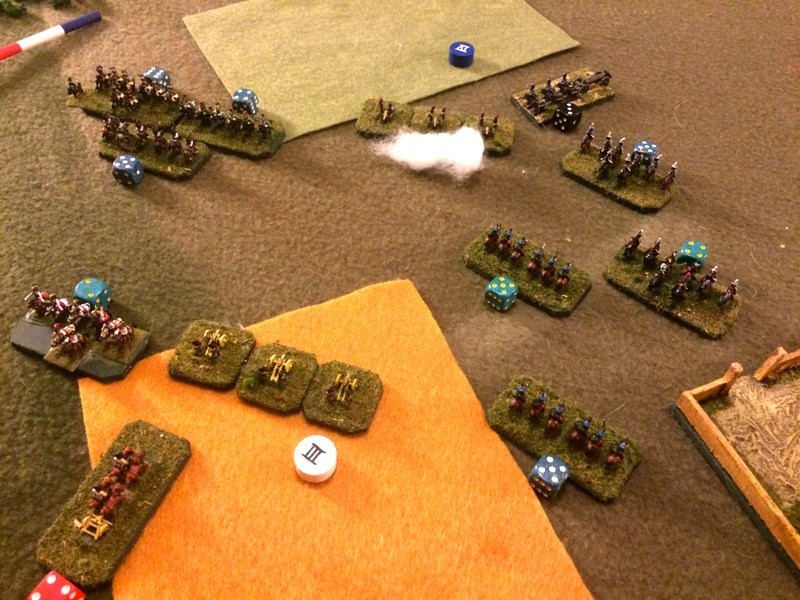
In Blucher horse artillery has the mobile quality, which means it can move and fire in the same turn at the cost of two MOs,  Horse artillery units can be quite lethal if protected, which doesn’t always happen if there aren’t sufficient MOs.  Here a depleted French dragoon unit (centre) charges the Austrian horse artillery, which loses the fight and is broken.  Meanwhile the French horse artillery torments the Austrian hussars.  At the bottom right I’ve used one of my cassion stands with a black micro dice to indicate the ammo level of the French guns.
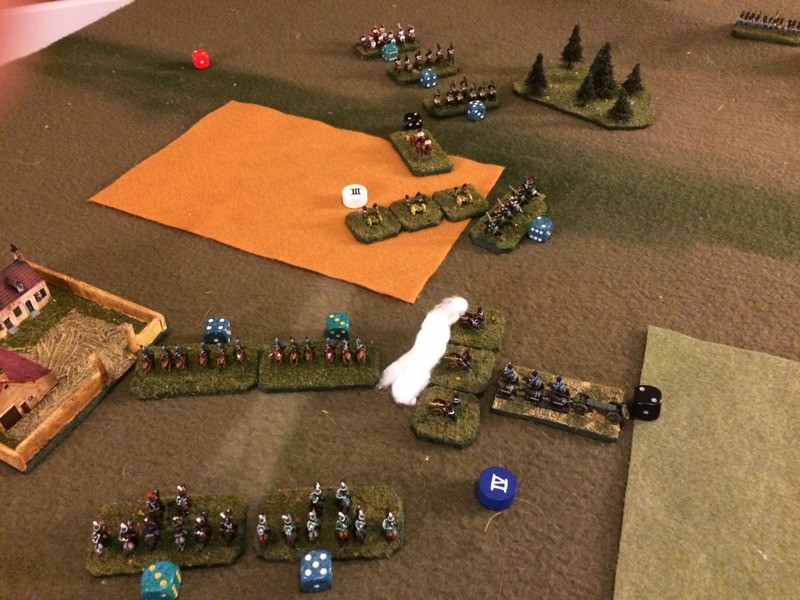
 

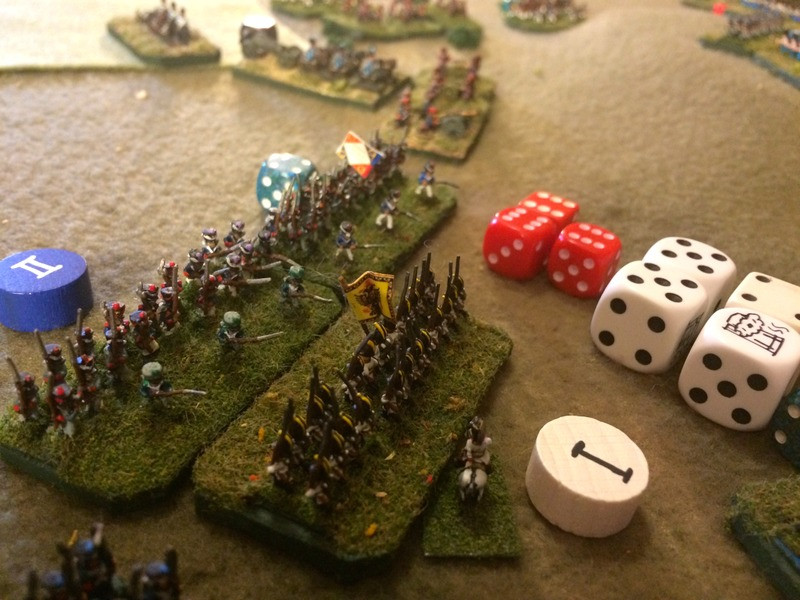
In the last few turns of the game night is falling and the Austrian cavalry have been swept from the table.   On the Austrian left, the proud grenadiers of 1 Korps still stand firm.  One of their four brigades has been broken, but they still protect one of the two objective markers that the French need for victory.   Here two French brigades charge into a full strength Austrian grenadier brigade.  The French get ten combat dice, while the Austrians get seven, plus one for the Steady trait of grenadiers plus one for the Steadfast quality of the 1 Korps sub commander, General Brodzky.   In the final combat of the game, the Austrians have rolled four scoring dice against the French three, forcing the two French units to retreat.   With night falling fast, the grenadiers have successfully blocked the road to Szhod.  Brodzky is wounded in the battle, but he will survive and be handsomely decorated.
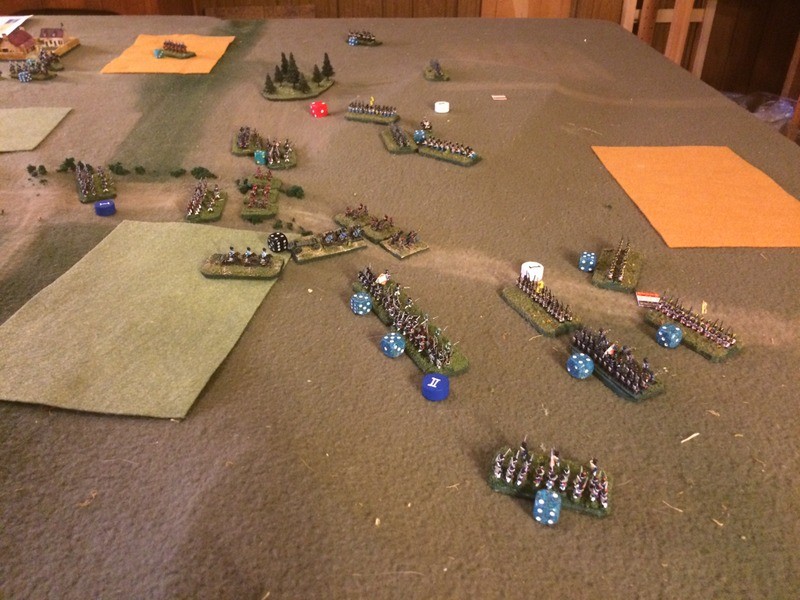
A view of the final positions at the end of the game.    The Austrians have three broken units, one short of the four required to demoralize them, while the French have only one broken unit.  However, the Austrians hold both the French objective markers, so it looks like an Austrian victory.   While the cavalry duel was won by the French, it cost them valuable MOs that could have better been spent assailing the Austrian centre, where the Austrian infantry was weakest, so the sacrifice of the Kaiserlich horse was not in vain.  General Turandotte will have to explain to the Emperor why he has not broken the Austrians and opened the road to Szhod.
In conclusion, I have to say that I am a fan of Blucher.   Some might prefer a more detailed, granular game.  For example, there are no morale tests for receiving fire or for being charged, and the command and control rules are almost entirely abstracted into the system of MO dice.  Other than having useful qualities which might bring sub commanders and commanders into combats (the French cavalry sub commander brought an extra dice to each melee he was in, and miraculously he was never killed or wounded), there is no point in having leader figures on the table.  However, as with Longstreet, the other Sam Mustafa rules system I’ve discussed on my blog, some might say that this abstraction gains a high level of playability.   Once I got the hang of the basic systems the game moved quickly.  I think with another game of this size, i could get through it in 3-5 hours, which is doable for evening with friends or at a club.

Also, as you can see from the last photo, there are some bookkeeping issues I need to resolve.  I’m not happy about the micro dice cluttering the table to indicate élan and ammo levels.   This bookkeeping could be moved to paper, but then I would need labels or tags to identify individual units, which I suppose could be developed and printed and then just tucked underneath the units, or glued to the back base edge, but I am loath to permanently assign unit identities to my stands - I would rather keep them generic for different battles and OOBs.  I would welcome your ideas.

There are some advanced rules with Blucher I haven’t tried yet, and as I said above, the dynamic of the MO dice in a two player game would be a whole different level of suspense and challenge.   However, I’m quite favourably impressed with my first look at Blucher and I’m sure I’ll have more adventures with these rules to describe here in future.   I think the next set of rules I try for this period will the Polemos General de Division rules from Baccus, once I clear the table and try something else for a palate cleanser.

In the meantime, mes brave soldats, blessings to your die rolls!

MP+
 

Tuesday, April 21, 2015

The Indispensable Napoleonics Playing Aid: The Foy Mug

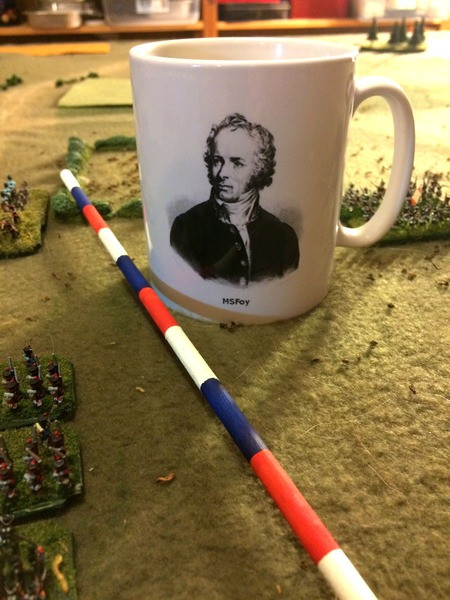
I was quite saddened to learn that while I had strayed from the Interwebs this winter I had missed the deadline for a contest to win the highly prestigious MS Foy mug.  I wasn’t above emailing Max Foy including his agent Tony, and whining and snivelling until he relented and sent me one.  Here his stern and martial visage watches critically as I send La Grand Armee into battle.

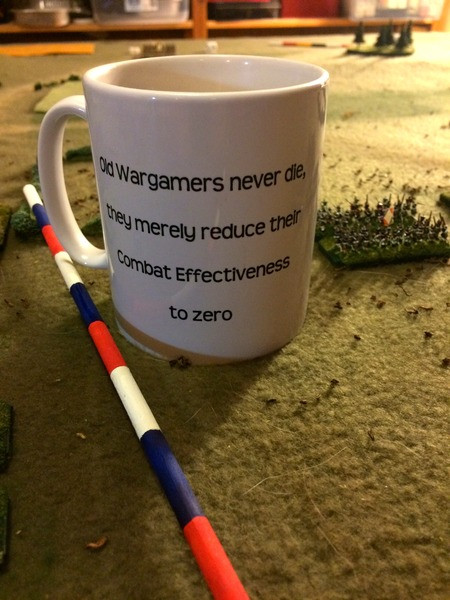
And an inspirational message to keep in mind.

Bless you, Tony, I am quite delighted to have this prestigious and highly necessary piece of kit, from which I shall sip tea (hot, strong, sweet) while I contemplate brilliant moves and ask myself, What Would Foy Do?

First Game of Blucher: Setting Up

In the lull before the storm as we begin packing for my next posting, I’ve finished preparing for my first solo game of Sam Mustafa’s Blucher.  I’m using my 6mm French and Austrian armies, and it’s the first time they’ve been on the gaming table.  I used the army builder lists in Blucher to generate two small forces, 200 points each, for simplicity’s sake.   The forces are fairly symmetrical, at 200 points each; the French have more artillery, while one Austrian Corps is made up of grenadiers, the other is of mixed quality.

French: 

CinC, Marshall Turandotte

SubCommander, Cavalry Hero (General LaFlamme)

1st Corps, Infantry 3 Ligne, 1 Elite, 1 Heavy Artillery Regiment

2nd Corps, Infantry, 3 Ligne, 1 Elite, 1 Heavy Artillery Regiment

3rd Corps, Cavalry, 2 Cuirassier, 2 Hussar, 1 Horse Artillery Regiment

Army: 1 Heavy Artillery Regiment


Austrian:

CinC, General Kurvi-Tasch

SubCommander, Steadfast (General Brodzky)

1st Corps, Infantry, 4 Grenadier, 1 Hvy Art Regt

2nd Corps, Infantry, 2 Regular, 2 Conscript, 1 Hvy Art Reg

3rd Corps, Cavalry, 2 Cuirassier, 1 Horse Art Regt 

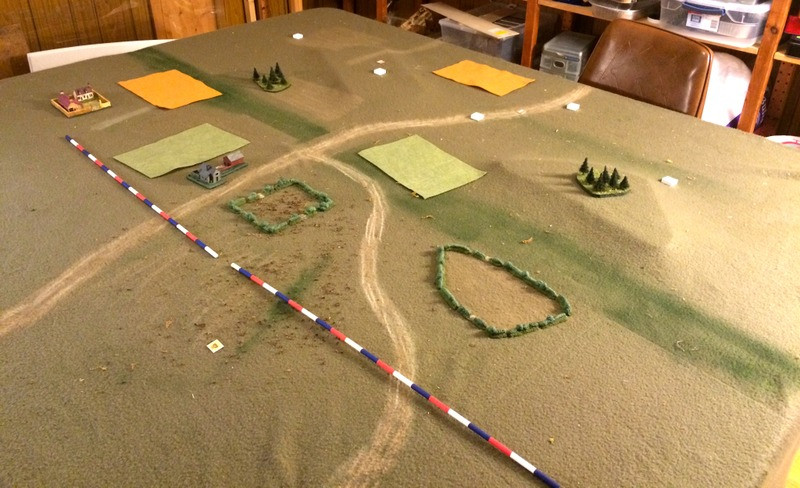
The field of battle.  It was randomly determined that the French are attacking, so their setup is behind the two measuring sticks (ils sont tres beaux, nest-ce pas?), eight BW in from the table edge.  To make it more interesting I randomized the Austrian setup.  There are five white blocks on the Austrian side of the table, two are dummies, and their identity is not revealed until the French are setup.

I used the Blucher system for terrain setup in the Basic Rules, with a random roll generating 4 choices of terrain features per side, somewhat constrained by the amount of 6mm I currently have available.  For my next game I may double the number of terrain features for 6mm and see if the table is more interesting.  The French chose two objectives.  One is the road on the Austrian side leading to the important provincial capital of Szohd.  The other is the left of the two hills, part of the important Plotzen Heights.

French initial setup.  Infantry Corps in the centre and on the right, III Corps (cavalry) on the left, artillery massed in the centre.  The goal is to push the infantry directly at the centre and hold the cavalry to exploit a breakthrough and guard against Austrian cavalry,

Austrian deployment is randomized but doesn’t work out too badly.  General Humperdinck rushes from a nearby beer-tasting session at the Monastery of St. Vitaliis to find his I Korps (Grenadiers) in the centre, his II Korps on the right side of the Plotzen Heights and the cavalry just arriving on his right flank.  

The tabletop, both armies in position, waiting for the French to make their first move, hopefully today.

Sunday, April 19, 2015

Saturday Samurai Shenanigans

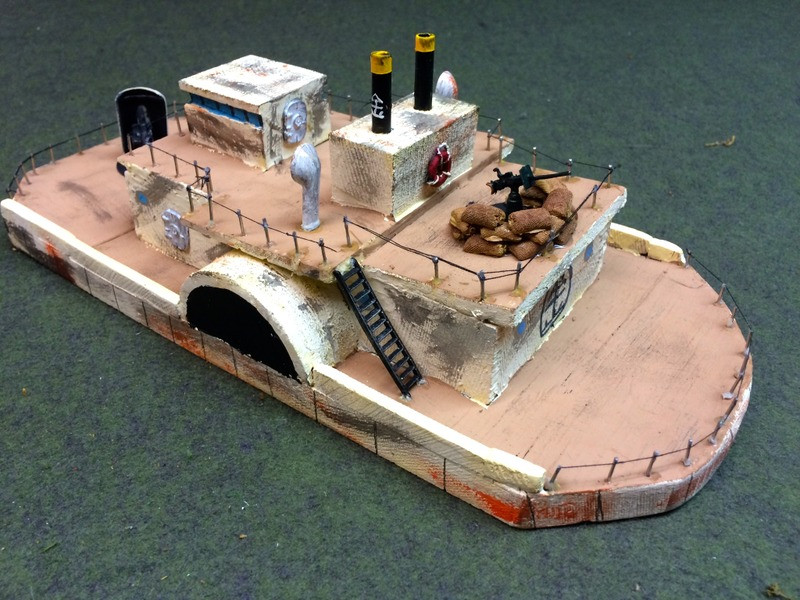
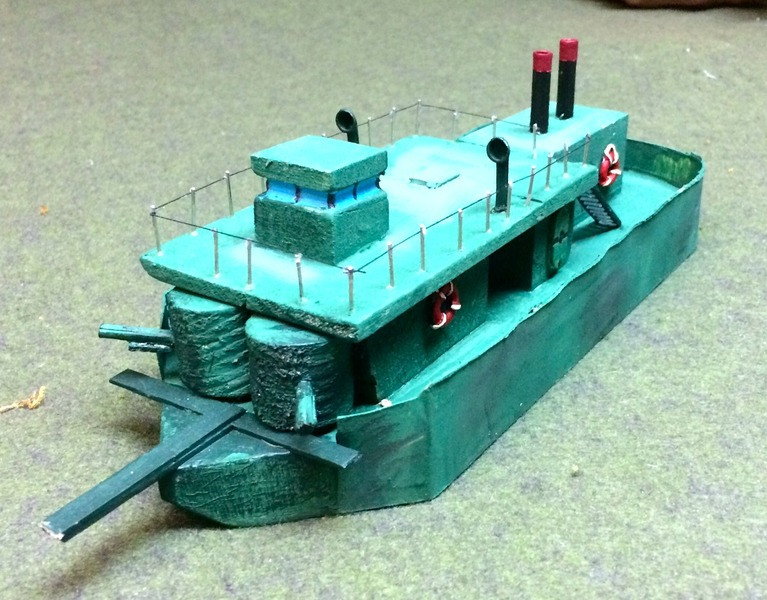
A very pleasant night Saturday evening at Rabbit HQ as the gang, which is the closest thing I have to a club at present and all stalwart chaps, gathered to blood some freshly painted samurai figures.  But first the usual show and tell.   Our chum Patrick, whose hosted several very original Interwar Chinese battles, unveiled this scratch built  Yangtze gunship in 1/72 scale, a crveryy nice piece of kit, looking appropriately dirty and rusty.  Talented fellow is young Patrick and a very kind one, as he gave me several packs of adhesive magnetic sheets found in his local dollar store - just the thing for storing my larger bases in thrift store biscuit tins for the coming move.

And another scratch-built vessel, this 1914-era Austrian gunboat, also built by Patrick, is modelled on the ships which opened fire on Belgrade at the start of the Great War.  It would look very suitable for a steampunk game too, methinks.  I quite like the big turrets at the bow.


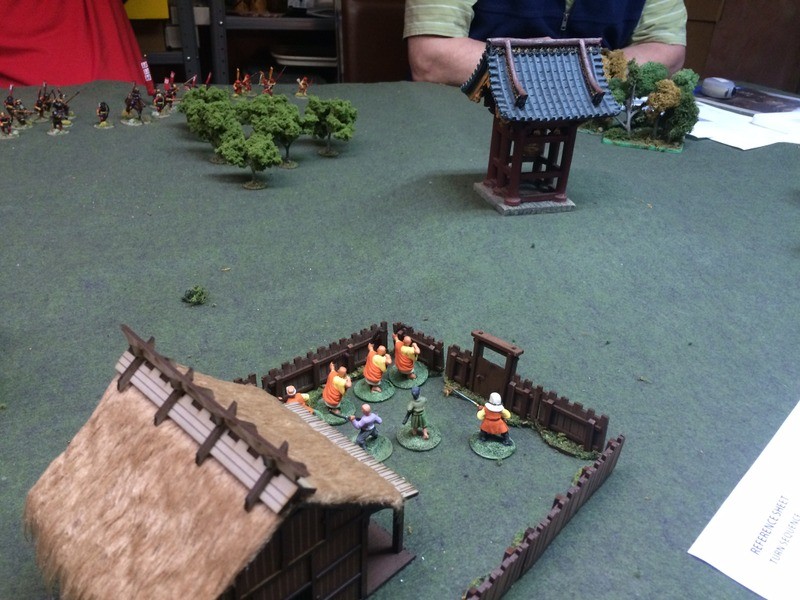
Both James and Other Mike have been collecting samurai figures of late, and had a sufficient number that we felt we could put them on the table and have a bash, along with James’ wonderful and carefully assembled  4Ground Japanese village models and a terrific temple bell that Mike had found in a pet store - it looked far better ornamenting our table than it would at the bottom of a fish tank.

James has a samurai retinue painted up, while Mike has a force of monks.  We put about 20 figures a side on the table, with the objective being the bell tower in the centre of a table.  Never being one to pass up the chance to play fighting monks, I sided with Patrick against James and Mike.  Here my three bowmen and some Sohei warrior monks wait in the walled garden of an inn, while the rest of my force sneaks around to the left of the table to deal with James’ sneaky snooty fellows.   I am facing James’ samurai while Patrick, to my left, squared off against Mike.

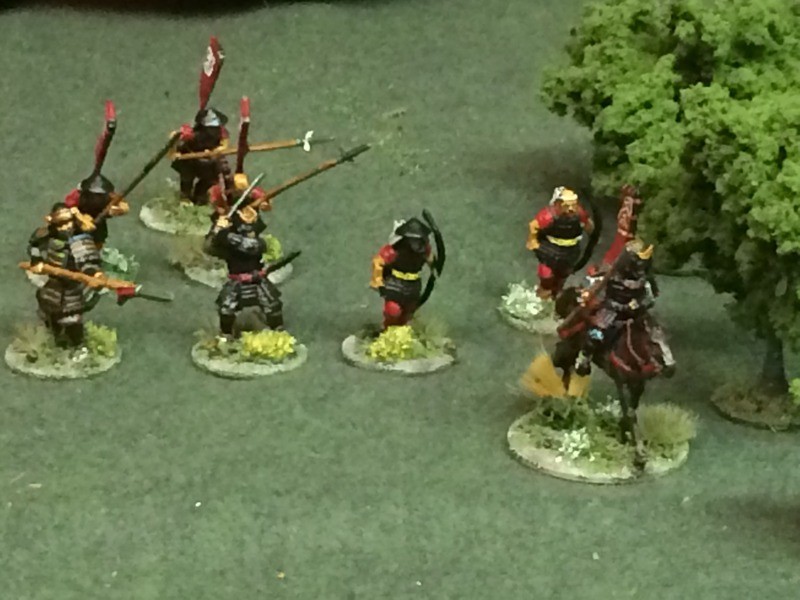
For rules we used the Osprey-published set, Ronin.  James was driving the bus, as he had read the rules, maybe an hour before play started.   Here’s a closeup of some of his samurai advancing.   The picture doesn’t quite capture how nice they are.  James does nice work.

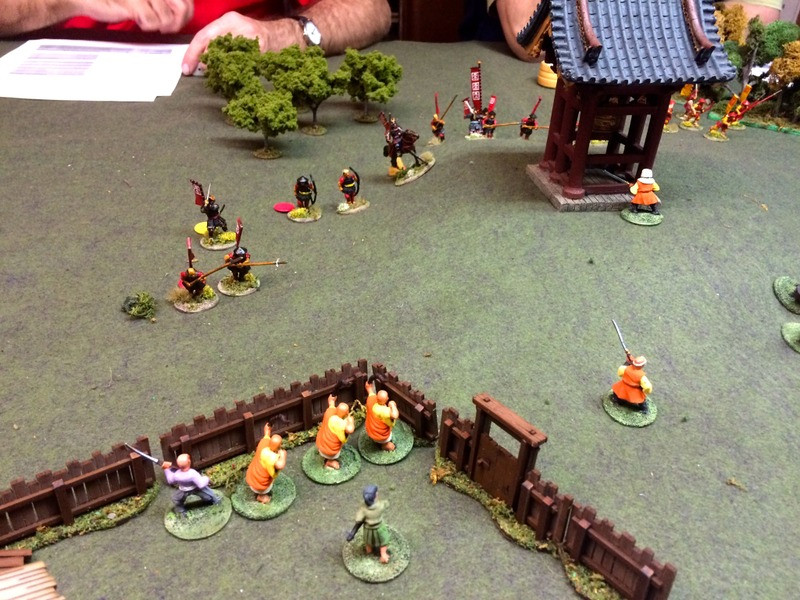
My monk archers start shooting and do some damage, inflicting stuns and light wounds on several of James’ fellows, and wounding his samurai boss’ horse.  One of my sohei monks rushes forward to have the honour of being the first to defend the bell tower,  He did quite well, cutting the samurai boss out of his saddle.

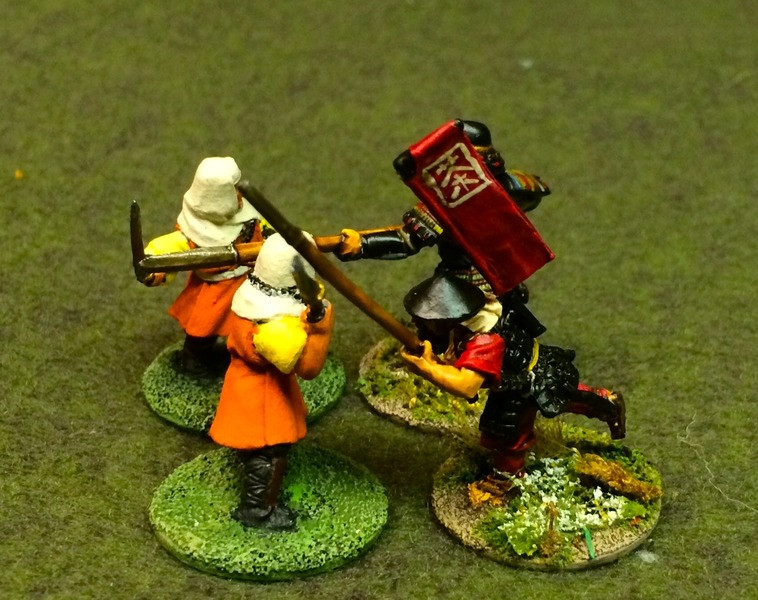
Two of my monks run into battle from my left flank to engage a samurai and an ashigaru.  Here’s where we found that the Ronin rules began to bog down for the number of figures we had brought to the table.  There was a lot I admired about the rules.  Fighters are rated for their personal initiative, modified by the kind of weapon they have and a base die roll.   Once initiative is determined, players get to secretly decide how many of their actions (the number depends on the class of fighter) will be dedicated to attack and to defence.   It’s a clever system, but it takes a while to go through a fight, even two on two, and the results are not always fatal - many of our fights ended with figures wounded but still capable of fighting on and doing damage.  It was quite rare for a figure to be cut down, especially when we started taking armour into account, which was too late, alas, for the red chaps in this photo, who got slaughtered right away.

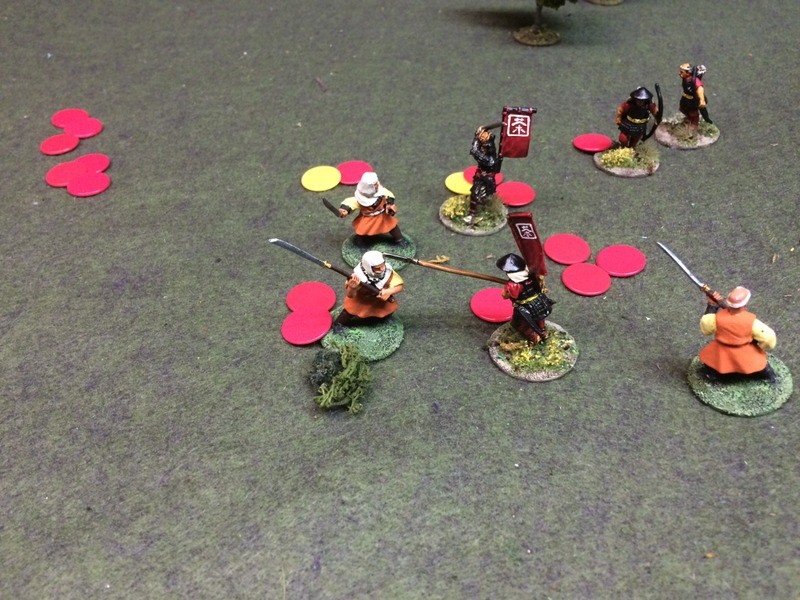
 Within two hours things had gotten pretty bloody.  The red chits indicate where James’ samurai and ashigaru had been sliced and diced.   While almost all of my ten monks had taken one or more wounds, they were almost all standing, and we came to realize that monks in ronin are rated quite highly - they seem to be the Old Guard of feudal Japan.  James had pretty much thrown in the towel after two hours, whereas Patrick and Mike were still delicately probing, writing haiku, painting flower blossoms, or whatever else high born lords do.   James and I just got stuck in.

Conclusion - Ronin would probably work best as a club game with a dozen figures aside tops.  You can read James’ initial thoughts on Ronin here, but as for me,  I like the mechanics, as far as I understood them, and the choice of attack/defence options adds an interesting degree of tactics and suspense to the game.  However, as I’ve noticed from another Osprey rules set I’ve played, In Her Majesty’s Name, the rules seem quite granular and best-suited to small level actions.  For a battle involving retinues of twenty or more figures a side, I think one would need something that handled groups of warriors moving and fighting together.   I believe there is a variant of Too Fat Lardies’ Sharpe Practice for Shogunate Japan out there somewhere, and I’ll leave that to James and Mike to track down.   

While it’s not a period I’m overly interesting in, I would be interested in playing this again, especially when James gets his Ikko-Ikki bandits painted - that would make an interesting alternative to battles involving celestial elite monks.

Cheers and blessings to your die rolls!

MP+

Blog Archive

Followers