I never got to deploy to Afghanistan, despite my best efforts, but at least I get to go there now, sort of. I’m just coming to grips with A Distant Plain (ADP), part of GMT’s COIN (Counter Insurgency) series of simulations. I say simulation deliberately, because it appears to me that the designers, Brian Train and Volko Ruhnkehave thought long and hard about making this a model of the political as well as military issues of the Afghan conflict.
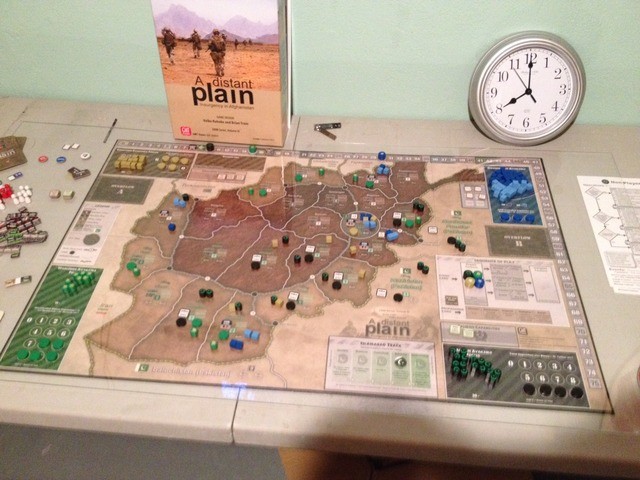
So first impressions. ADP doesn’t seem to be an easy game to play at first glance. There are no playing pieces with comforting NATO symbology, combat values, etc. There are a LOT of tracks on the board and information markers. There are a lot of cryptic wooden playing pieces in various colours. Fortunately, there is an excellent step by step player’s guide which has an extended tutorial that I’ve been working through very carefully and deliberately, and the more that I see and learn about it, the more that I am liking it.
ADP is a game for 1-4 players and has four sides: the Coalition (Western/NATO powers), the Afghan government, the Warlords, and the Taliban. It would be a total blast with four players, but is very suitable for solitaire play as either the Coalition or the Taliban, with decision tree charts guiding the actions of the non-player factions.
The sequence of play appears to be quite elegant. There is the inevitable deck of cards (do any wargames published these days NOT come with a deck of cards?) but instead of holding cards in their hands, the cards are turned two at a time, so all players can see the card for the current turn as well as the card for the NEXT turn. Besides special events which can be chosen by either the Coalition/Afghan (the COIN) players or by the Taliban/Warlords, the cards determine sequence of play.
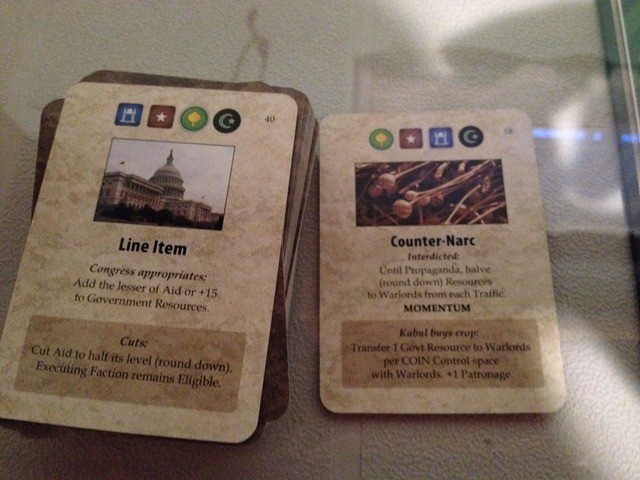
As you can see from these two cards, at the top of each is a row of four symbols, each corresponding to one of the four factions, so on the right hand card, the Counter-Narc card, the Warlord player’s symbol is first on the left, so he can go first, then the Coalition player, then the Afghan gov. player, then the Taliban. The order is slightly different on the left hand, “Line Item” card, which governs the next turn. The catch is that if the Warlord player acts on the first card, there is little he can do on the second card, so basically you get to move every other turn, near as I can tell so far, which means that you have to be fairly careful in deciding when you want to play and what events you want to capitalize on.
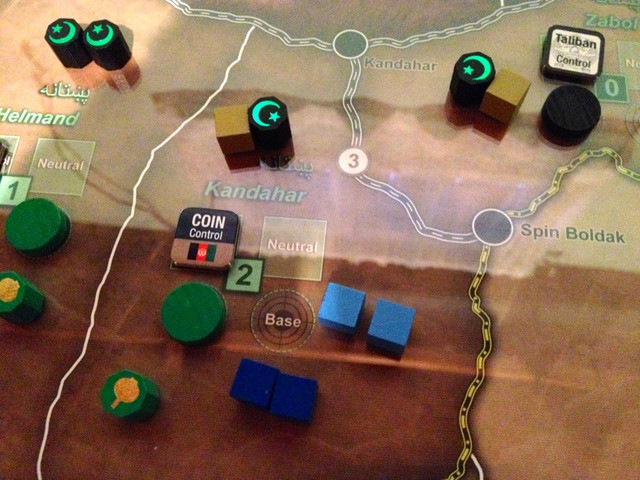
Here’s one of the areas on the map, Kandahar Province. The tan block is a Coalition force, the Green disc is a Warlord base, the smaller green circle is a Warlord guerrilla unit, the black disc with the star and crescent is a Taliban guerrilla unit, the two light blue blocks are Afghan gov police and the two dark blue blocks are Afghan gov military. Control of a province goes to the Taliban if they have the majority of units in a province, or to the COIN forces (coalition and Afghan gov if they have a majority of units. In this photo, currently, there are 5 COIN units to 2 Warlord units to 1 Taliban unit, so the COIN side has control and can count Kandahar towards its political and resource totals. Here is a cool thing. While the Taliban wants to control provinces, so do the Warlords, but for different reasons. If the Warlord player has the majority of units in a province, neither the Taliban nor the COIN side controls it, so the Warlords have their own discrete victory conditions, and in a multiplayer game, would be the player that both sides would court, because even though the Warlord has the fewest units, he has the the potential to wreak a lot of havoc. If you think of the current crisis with the Afghan elections stalemated between two leaders, one from the Pashtun south and one from the Tajik north, you can see that the game designers have thought a lot about how the Warlords represent the non-Pashtun tribes in Afghanistan, and what a complicated business it all is.
Guerilla units can either be operating openly, in which case the symbol is shown, or they can go into hiding, in which case the cylinder is inverted to show a blank side. The COIN player has a harder time finding and eradicating hidden guerrilla units.
Hopefully next week I will have more game time in, and can report on how the game plays, but for now I wanted to give you a sense of the mechanics of what promises to be a terrific game and model of a complex war. In other board game news, I finally got my copy of the new startup magazine, Ares, which true to its old SPI namesake, ships with an SF game, in this case, one based on HG Wells War of the Worlds. It looks cute and at some point, once I get out of Afghanistan, I’ll show it to you.
More to come. Blessings to your die rolls!
MP