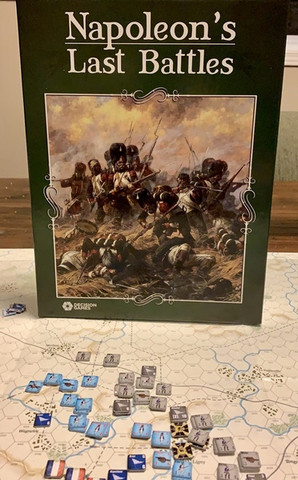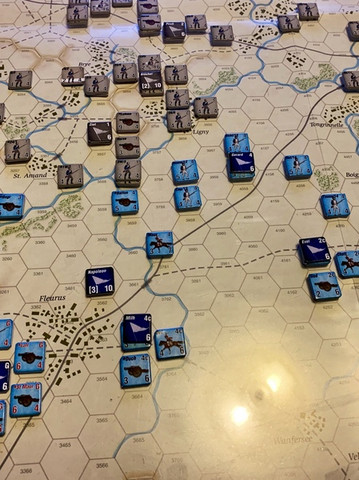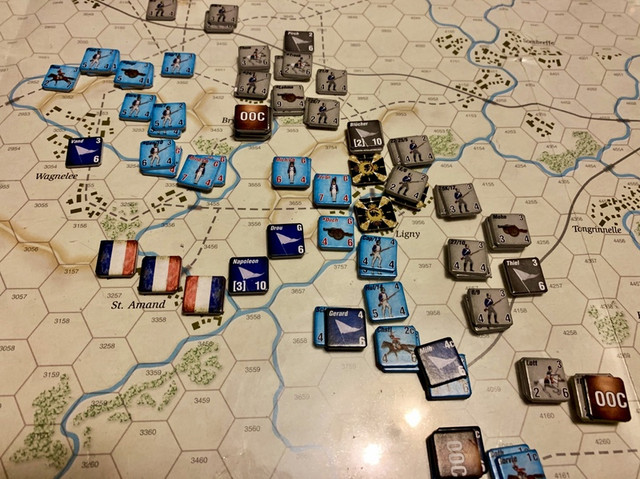
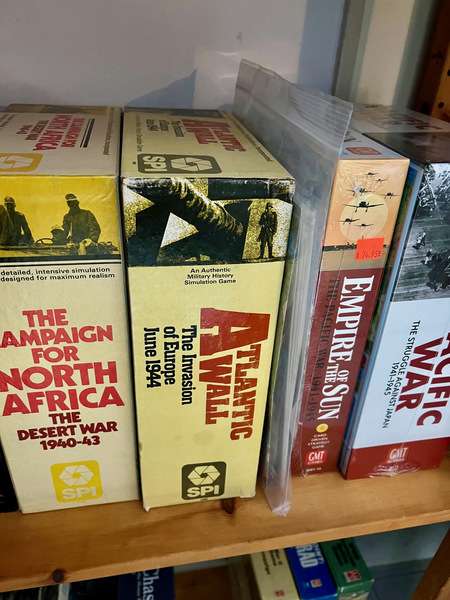
I think anyone who remembers the heyday of paper, hex and counter wargames from the 1970s and 80s has a fondness for the monster games, multi-map, thousand plus piece mammoths that took up all available space, chewed up thousands of hours, and often never got finished. The most well-known were published by SPI in so-called "soap box" format because they resembled those old laundry detergent boxes.
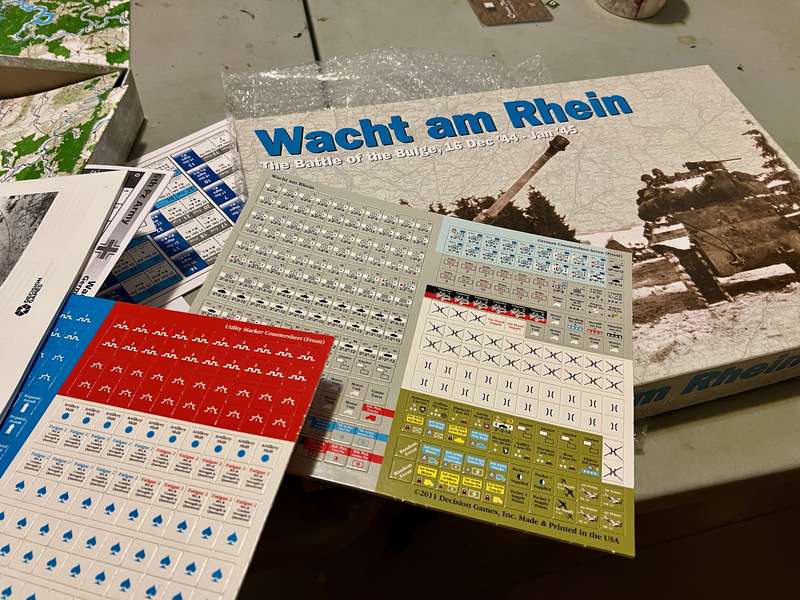
Last December I remembered that I had a Bulge monster game in my stash and I thought it was a good time of year to give it a try. Wacht Am Rhein is a Joe Youst design, published by Decision Games in 2005, and traces its lineage back to an SPI game of the same title designed by Joe Balkoski and Jim Dunnigan and published in 1977. There's a lot in the box.
It comes with a big rule book. The Grand Operational Simulation Series (GOSS) is highly detailed, and is grand-operational in scale, which is one of my gaming sweet spots. Units are mostly battalion sized, and have three steps; most BNs can break down into company level which is useful when attaching armour to an infantry attack, or distributing AT units among a defensive line. The system reminded me of SPI's Atlantic Wall which I played a lot of long ago.
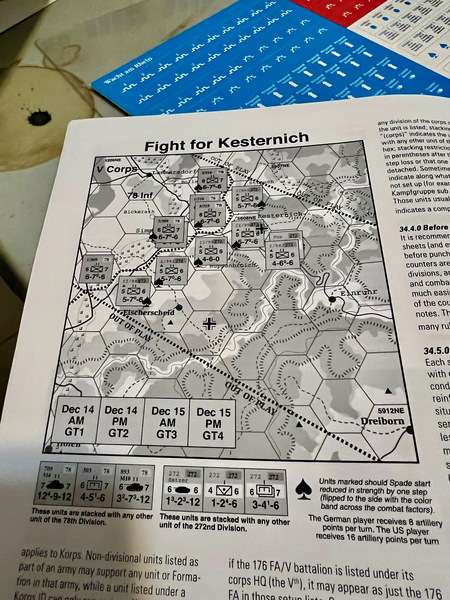
I chose a very simple learning scenario, a four turn (two day) battle called Fight For Kesternich, in which the US 78th Infantry Division tries to capture a ridge on the German/Belgian border guarding the Roer Dam. Defending the ridge was most of the 272nd Volksgrenadier Regiment. Historically this American offensive kicked off just days before the Ardennes offensive and forced the Germans to change the northern pivot point of their operation.
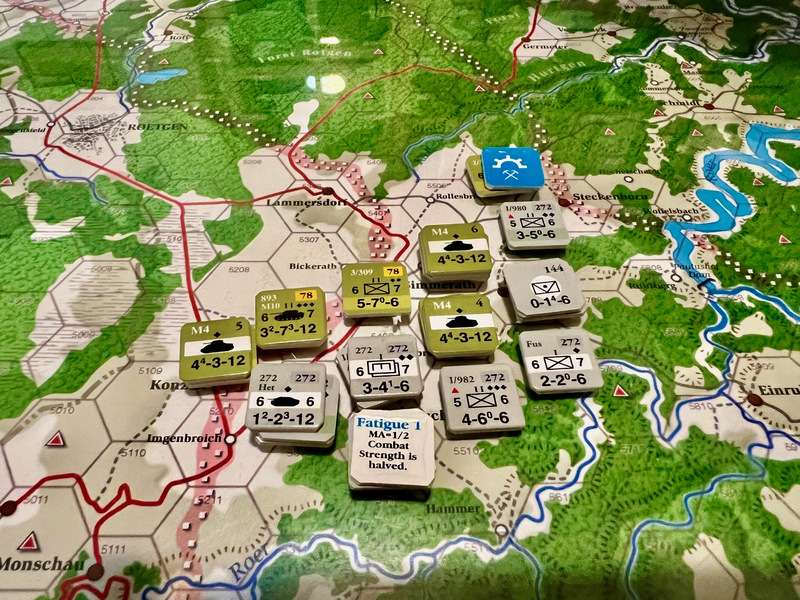
In the scenario, the Americans have two days/four turns to capture two hexes, one being the village of Kesternich (shown below towards the left of the photo, occupied by a stack topped by the German (grey) AT company0, as well as hex 5510 towards the bottom of the photo. I've broken the US tank battalion down into three companies to support the infantry. The Germans begin the game entrenched, so are hard to dig out, and there are some hexes occupied by the Germans at start which are rough and restrict the number of units that can attack each turn. The shot below is taken just after the first US turn, with a little progress made on the attack but the Germans pretty much holding fast.
This learning scenario abstracts artillery, has no weather or night rules, and imposes strict boundaries on the hexes in play.
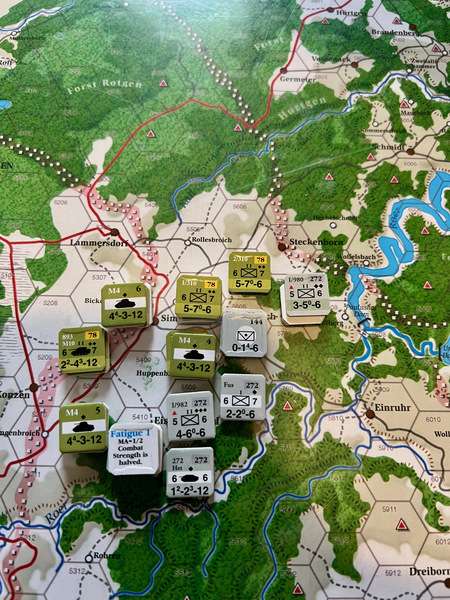
And the state of play at the final turn, No American progress to report, and at the bottom of the photo, the US attackers have actually been pushed back. Both sides have suffered casualties, and it would be unlikely that the 78th could manage another day on the offensive and still be effective, while the Germans have clung on by their fingernails.
One of the things I like about GOSS is the combat system is quite complex at first, but as you get the hang of it, you see its wisdom. Terrain determines the starting odds, which are then adjusted for or against the attacker depending on whether the attack is prepared, whether engineers are in support, whether the artillery barrage has been effective, and for the defender depending on entrenchments and, crucially, adjacent enemy units that are not themselves being attacked. Such shifts simulate supporting and enfilading fire that can be brought to bear on an attack from supporting, adjacent defending units, and they can break an attack.
Once the odds are calculated, there are a variety of bonuses that can be added to the D100 die roll depending on armour superiority, regimental integrity if more than one BN of the same Regt is attacking, and so forth. Both defender and attacker roll separately, meaning that an attack can have a NE fail while the defenders' fire is murderous, or vice versa. Combat results are a tradeoff between step losses, fatigue, or retreats, depending on how badly you want to hold a hex. A few days sustained combat can easily wreck a division.
So my first attempt at WAR was successful and I learned a lot about the basic system. The bigger systems have rules for strategic movement, transport, logistics, weather, air support, leaders, etc that I have yet to crack.
It was great fun to make it a little ways up the mountain of this monster game, and I hope to return soon. The next scenario features the 101st AB defending Bastogne and looks like great fun.
Blessings to your counter clipping!
MP+