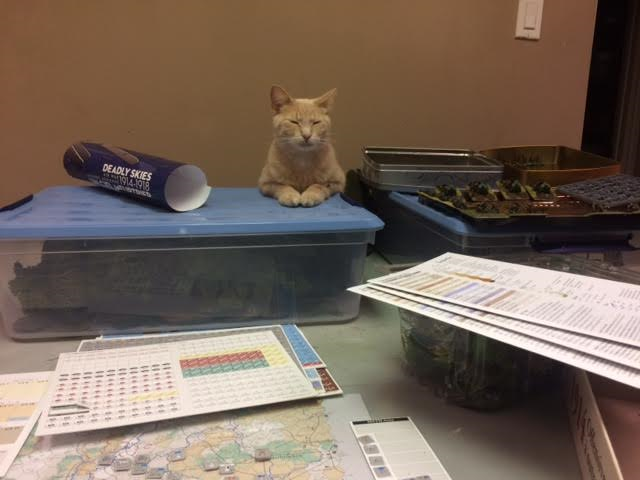
Returning to an old and occasional custom here at Mad Padre Wargames, it's our Tuesday night boardgame feature, in which I spare some love for my first love, hex and counter wargames.
Tonight's subject is the GMT Games Title, 1914: Offensive a Outrance, a modest monster game working on the operational level that recreates the first weeks of World War One on the western front. a 2013 title designed by Michael Resch.
1914 features a fairly rigorous model of army organization and attachment, and forces the player to think carefully about each army's designated areas of operation and objectives. It uses historical war plans that guide each army's movement and objectives, which is useful for solitaire play. Plans can be suspended and armies can be relocated, but initially the game works according to the designs of the 1914 war planners.
Logistics is a big deal in this game, and there are detailed rules for fortresses, siege artillery, and rail movement that I haven't yet dived into.
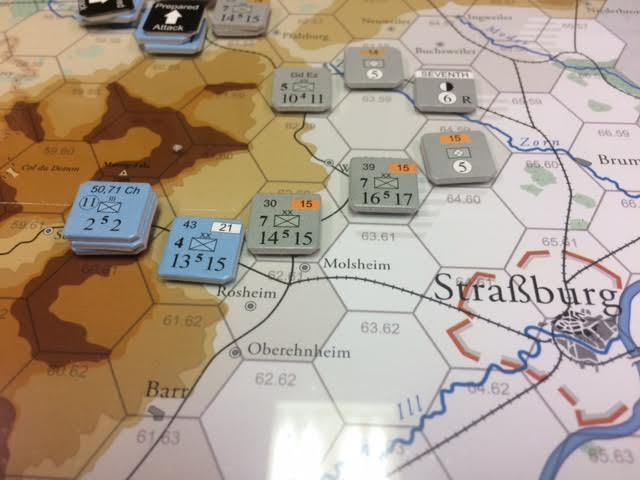
Because it's quite the big beast, I am only playing the tutorial scenario, which features the Lorraine offensive of France's First and Second armies in the first days of the war as part of the Republic's Plan XVII. Here Second Army throws itself at the German lines in the true spirit of the bayonet, while the Germans do their best to improve their positions. The black counters indicate Prepared Attacks, which cost movement points to execute, thus forcing the offensive to move fairly slowly, but which yield better odds of success. Attacks can be moderated by the Attacker and then the Defender declaring if the battle is to be Intensive, which increases the chances of casualties.
Combat units are rated by attack and defence strength, the two large numbers at the bottom of each counter. The smaller number between them indicates combat proficiency, and the small number to the side of the unit symbol indicates organic artillery. Besides the usual retreat/advance/step loss results, the CRT gives a modifier that each side must use in what is basically a morale check after each fight, which may result in a unit's combat effectiveness being degraded.

Turns allow the defender a limited move after the attacker or phasing player completes his/her movement. Here below the French 21st XXX was trying to sneak through the Vosges to pressure Strasbourg. In the German reaction face, elements of 15 XXX have moved far enough south to check the advance, showing that the game has some potential for solitaire play, as one can think through all options for both sides each turn.
Here the 30th XX has moved into a fortress hex (as in the red lines around Strasbourg. I did some checking and concluded that this hex must represent the Fort de Mutzig, which I was delighted to find has a website and looks well worth visiting. in fact, the whole Alsace region looks like a beautiful destination, perhaps a cycling holiday.
I am only half way through a four-turn game, but the tutorial is doing its job and teaching me the basic mechanics. I am working up the nerve to try the big game this summer, but am liking it so far. Following the spirit of the French generals, I shall throw myself on the German lines like a tiger and reap the certain victory. Faith in the bayonet and the spirit of the attack shall prevail!
Marshall Luigi watched the fighting for a while, but could not bear to witness the casualties.